We remain fully operational. Our teams are working around the clock to ensure your deliveries continue safely.

قم بتنزيل التطبيق


معلومات عنا
حقوق الطبع والنشر © 2024 Desertcart Holdings Limited
قم بتنزيل التطبيق
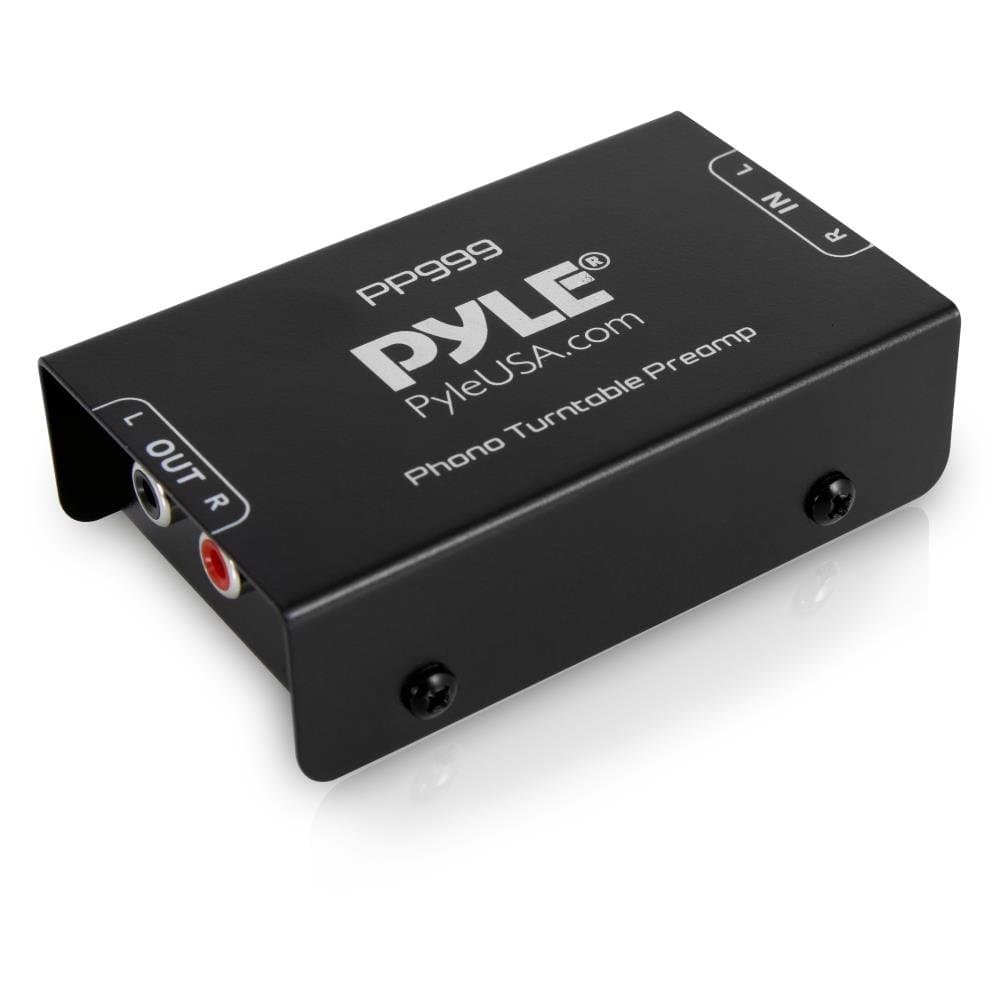
🎵 Elevate your vinyl vibes—because your classics deserve clarity!
The Pyle PP999 Phono Turntable Preamp converts low-level phono signals from magnetic pickups into line-level signals compatible with modern audio equipment. Featuring ultra-low noise operational amplifiers, a 3mV input sensitivity, and a 12V DC power adapter, it ensures clear, interference-free sound. Compact and easy to install with RCA inputs and outputs, it’s the perfect upgrade for audiophiles and professionals looking to seamlessly integrate vintage turntables with contemporary receivers or speakers.

| Best Sellers Rank | #3,156 in Electronics ( See Top 100 in Electronics ) #1 in Audio Component Preamplifiers |
| Customer Reviews | 4.2 out of 5 stars 6,389 Reviews |
A**Y
Great low cost preamp
I will start off by saying I am not an audiophile or a music expert in any way. But this thing works and solves my problem I need to get an old Technics turntable to my newish Denon AVR without a phono input. And it does just that. I have been using it for at least 6 months now and it still works good. All you have to is plug the left and right into it and screw in the ground wire from the turntable to it and then plug the power cord in the wall. Then connect the other left and right into an avr or a powered speaker. Everything that plays through it sounds fine and clear. No static or weird sounds. Is it a vacuum tube fancy pants thing? No. Do I care? Also No.
J**F
Quick Solution to an Old Turntable
This gizmo works exactly as advertised. I have a 1971 Sansui SR-2050-C turntable that has been sitting in storage for 37 years. (Yes, it needed some lubrication maintenance.) My old amplifier with a "phono" input is long gone and my current Yamaha RX-V385 amp has only HDMI and audio visual RCA inputs. I tried plugging the turntable into the red and white AV RCA plugs and was only able to get a very faint sound at max volume. Research showed this Pyle PP999 pre amp unit as a solution. The price was right so the next day Amazon had it on my door step. It was simple to connect and the power cord was long enough (about 30 inches). Everything was clearly marked and the instructions weren't even needed. Truly a plug 'n play setup and it works like a champ. Plenty of volume now. I would definitely recommend this unit to anyone in a similar situation.
A**K
Solid, cost-effective solution for using phonographs with newer equipment
This phonograph preamp really does the job it sets to do well. It does not alter the sound in any way, just amplifies to a line-level input; I use it with a line input on a stereo from 2005 and find that I need to have its volume on the stereo set twice as high as any other input (tape, CD, radio) but makes it usable. The lack of volume isn't a big deal though as that provides wiggle room if I were to add a tube preamp to adjust the sound as well, which often those can increase volume to bring it up to the other line levels. The ground works well and there is no hum from the turntable at all. The construction seems very solid, but you can tell cost-effective measures were taken to keep it affordable while keeping the build quality great. For example I initially had the left and right channels reversed when I hooked it up because the colors on the phono input were incorrect; the same RCA plugs were used on each side and that made the colors backwards on the input side... they are labelled correctly on the case of the unit so follow the label on the case instead of the color! Also the ground screw is not a thumb screw as pictured but a very stiff hex screw; I needed to use a pliers to actually move it to get the ground wire secured in place, but once it's done it's done. I do like that the unit itself is silent, does not get warm in the least, and has no lights to distract you. An on-off switch would be a nice addition but I solved this concern by having it on a switched surge protector (from Trickle Star) that automatically turns on when the stereo turns on. All in all a good product at a very good price point.
E**O
Worth the money
I didn't realize I needed a turntable pre-amp to connect my vintage turntable to my modern tuner. I couldn't figure out why I got no sound even at full volume. I did some quick research and ordered this item. It took less than a minute to hook up and the issue was solved. It works great. Make sure you have an additional outlet as it must be plugged in. I certainly recommend this product.
J**W
Clean audio
Item works as described. Clean audio.
D**D
This preamp WILL handicap your setup
I don’t typically bother writing negative reviews but I felt it was important to let people who may not know any better know what they’re getting into with this preamp. I kind of knew it wouldn’t be that great given the price. But I saw plenty of positive reviews so I figured I’d give it a shot. Well, I tried it with two different turntables and two different sets of speakers. The sound quality is frankly abysmal. It adds tons of unwanted distortion, and is particularly noticeable in vocals. If you are just getting into vinyl or getting your first setup you might not know any better. And it could sound passable enough. But if you know what your records/setup are actually supposed to sound like you’ll be immediately disappointed. Yes it is dirt cheap and I know it’s tempting. But believe me, this thing will make your listening experience so much worse than it needs to be. I ended up getting the Fluance preamp, which admittedly is like 7x the price. But the difference is absolute night and day. I’m sure there are plenty cheaper than the Fluance that work just great. But this Pyle preamp just isn’t it. If you’re splashing out on a nice turntable and/or speakers (or even “okay” ones), don’t let a junky preamp handicap the whole thing.
H**N
Much better than expected
I recently upgraded to a new turntable and wanted to give my old turntable (which doesn’t have a built-in preamp) to my son. The plan is to use the Pyle preamp to connect the turntable to a pair of powered budget speakers. The turntable and cartridge are in the $500 range, and this preamp (nor the budget speakers) will probably not be the best match for it. He can upgrade to a proper amplifier and speakers later if he wishes. The turntable was previously connected to a modern Marantz stereo amplifier, but I’m not expecting the Pyle to compare with that. I have a vintage Pioneer receiver and used that to compare the performance of the Pyle against the phono stage on the receiver. This review is based on that comparison. The turntable and the Pyle preamp are both connected to the grounding terminal on the receiver so that they share a common ground. The output from the Pyle is fed into the receiver through the tape input. The turntable is either connected directly to the phono input on the receiver or the Pyle depending on which one I am evaluating. There is a hum when using the Pyle. Because it is sharing the same ground as the receiver, I don’t think it is a grounding issue. The hum is not loud and is not noticeable when music is playing but is noticeable in the blank spaces between tracks or when the stylus is lifted off the record. As for the audio quality, the Pyle was almost as good as the receiver, which is pretty darn good for the price point. The bass was a bit muddy, but that might be due to the aforementioned hum. There was not much to complain about mids and highs which I felt was a tad better on the receiver’s phono input. The phono preamp has two things to do: amplify the weak signal from the turntable cartridge by about 1000-tmes to the standard line input level, and apply RIAA equalization. These two steps can introduce noise and distortion to the signal, and I think the Pyle did a very decent job in controlling that. If your amplifier or powered speakers are far from the turntable requiring extra long RCA cables first connect the preamp directly to the phono cable from the turntable and run the long RCA cable between the preamp and the amplifier/powered speakers. The phono cables are shielded to isolate from outside interferences and regular RCA cables typically are not. If the long RCA cable is used between the turntable and the preamp it will happily amplify (by about 1000 times) any interference picked up by the RCA cable and you will hear it. This is in no way an audiophile quality preamp. It is almost as good as the phono stage on a 50+ year old receiver with old worn transistors and capacitors. A good phono preamp would cost well over a hundred dollars, and this only cost me seventeen dollars! I think the Pyle is doing a stellar job at this price point.
A**R
Worked like a charm
I hooked up my Technics turntable that I purchased in 1977, connected it to the preamp and connected the preamp to the SA-CD/CD RCA jacks on my Sony surround sound receiver. My old vinyl records sound great. Even better than they did on my original HH Scott receiver and speakers.
ترست بايلوت
منذ أسبوعين
منذ 5 أيام