We remain fully operational. Our teams are working around the clock to ensure your deliveries continue safely.

قم بتنزيل التطبيق


معلومات عنا
حقوق الطبع والنشر © 2024 Desertcart Holdings Limited
قم بتنزيل التطبيق
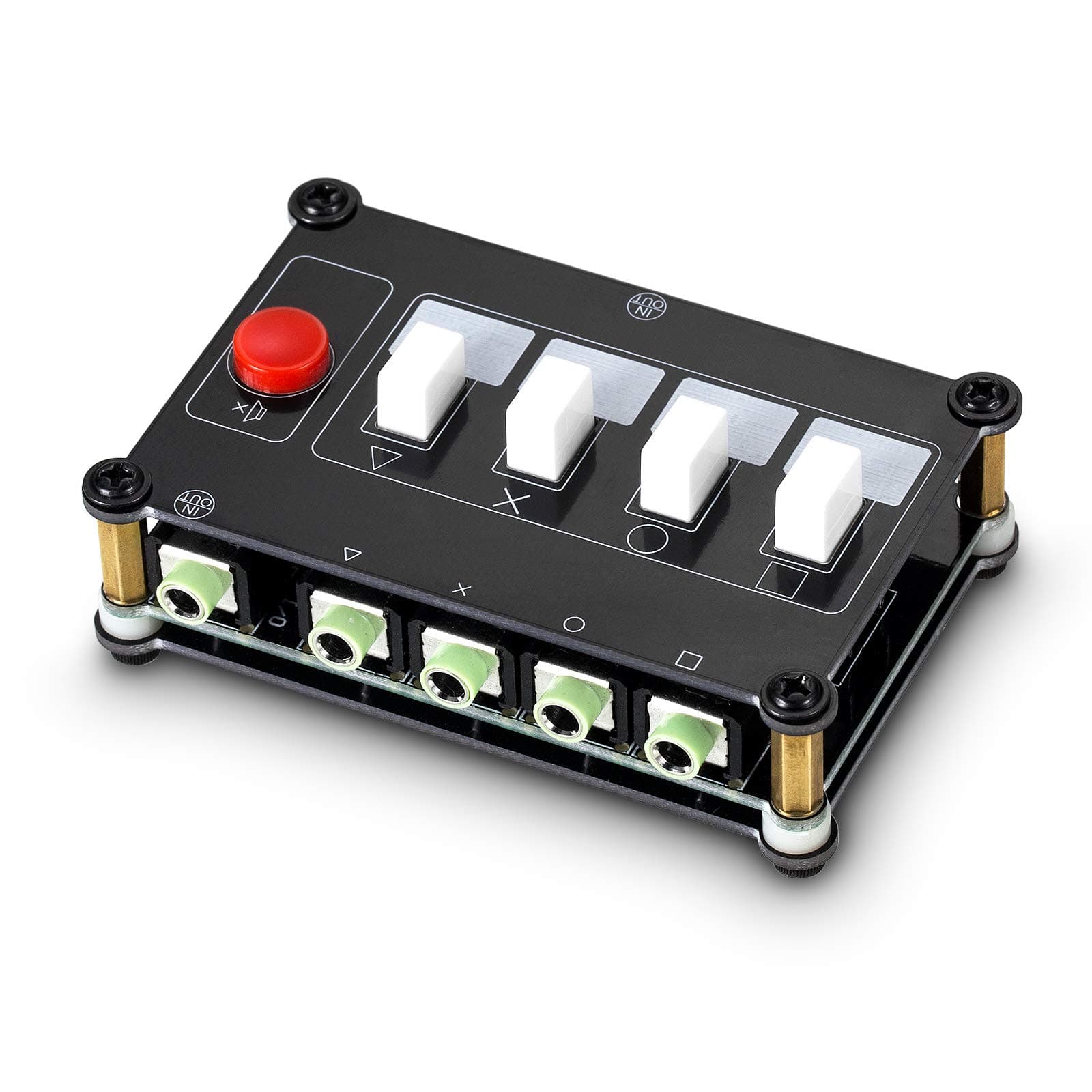
🎵 Elevate your audio game—switch smarter, sound sharper!
The Little Bear MC104 Pro Mini Audio Switcher is a compact, passive 4-way 3.5mm AUX stereo selector designed for professionals and audiophiles. It allows seamless switching between multiple audio sources without power, preserving pure sound quality. Featuring user-friendly independent switches, a mute button, and a durable build with noise-isolating components, it fits perfectly on any desk or travel setup, making it the ultimate audio control hub for multitasking millennials.


| ASIN | B07Q1W4484 |
| Best Sellers Rank | #497 in Audio & Video Selector Boxes |
| Brand | Douk Audio |
| Cable Type | Auxiliary |
| Color | black |
| Compatible Devices | PC |
| Connector Type | 3.5mm Jack |
| Connector Type Used on Cable | 3.5mm Jack |
| Customer Reviews | 4.3 out of 5 stars 284 Reviews |
| Item Dimensions D x W x H | 2.17"D x 3.31"W x 0.98"H |
| Manufacturer | Nobsound |
| Number of Ports | 4 |
M**E
Worth the money
I use this to switch sound between two computers to a set of desktop speakers. Works great and no sound lost or any kind of distortion. There are a total of four in ports so I could add more if I needed to. One cool design of this little control is you have all inputs in the back and one output in the back and one output in the front so all my wirers are out of the way falling behind the desk. It looks really nice sitting on the desktop secure with it's no slide rubber feet. Good product.
D**N
Interesting design and works well. Beware one design feature!
The device has no case and is constructed as a stack of circuit boards separated by standoffs, spacers and screws. The components are exposed, which is part of the appeal of the unit for my use and taste. The button assembly allows only a single button to be depressed at one time, connecting the common jack to one of four output/input jacks. If you plug a device into the single front-facing jack, it becomes the common jack, bypassing whatever is connected to the common jack at the rear. This very convenient, as it allows hiding cords at the rear, while allowing a headset or other device to be plugged in without moving the unit. The red button disconnects both the front and rear common jacks from the selected output jack. It can act as a mute switch and is very handy. My application was to switch DC low voltage levels (a Morse code ham radio “paddle” using a 3.5mm stereo plug) through the box to one of four ham radio transceivers. I discovered a feature of the unit that caused the unselected radio to continuously transmit. The designer include two hidden 220 ohm surface mount resistors for each of the 5 input/outputs. The box connects the tip and ring connections of any unselected jack to ground through these resistors. This was probably done to place a load on any unselected audio device to avoid damaging it if unselected, a good precaution. For my application, the resistors were activating the unselected device by grounding the connections through them. My solution was to disassemble the unit and remove the hidden chip resistors with a small soldering iron. After doing so, the device functioned as I expected. Note, for normal audio applications, this probably does NOT need to be done. The unit was very easy to take apart and reassemble due to its design. I noticed a great deal of soldering flux residue on the board that had not been cleaned off. This was hidden from view and probably did not affect operation, but I cleaned it off the board with a cotton cloth and naphtha solvent, being careful not to get the dissolved flux into the switches or jacks. This should have been done during factory assembly, but likely omitted because of the danger of contaminating the switch assembly and jacks.
M**R
Does what I wanted.
As other have said, this is made with a couple circuit boards separated by standoffs and no case. The only issue with not having a case, is that I think after a while it will get dusty and dirty inside. It is small, but that is what I wanted. I did not need something to take up much desktop space. My application is simply connecting the output from my PC to several different audio sources. I run various applications that benefit from different audio amplification systems from headphones to Tanoy speakers. This device makes it easier to switch between them. I only need it to go to one source at a time so not being able to select more than one for output is not an issue. For what it cost, it was probably cheaper than having to go out and get the parts and make one myself. While they seem to work fine, I am a little concerned about the quality of the switches. They seem to be sturdy enough, but I am not sure how well they will hold up from repeated use. Time will tell. Until then I rate it upon current functionality.
B**N
neat little gadget
This is a neat little product. it’s simple and smaller than u think. but works fine. please note the buttons are mechanical. it’s not super easy to tell which one is clicked down, there’s no light to indicate anything. so it’s best to use it by feel. i velcroed mine underneath my piano, so i could hook up various pieces of recording equipment to it. i just have the order memorized. so i know the first one is my bass amp, the second is my piano, the third is my computer and the fourth is my audio interface. i just use my fingers to find the one i need. works like a charm so far.
B**T
You get what you pay for…just don’t touch your output cable ever…
Functionality is good and works as expected. My output jack is extremely sensitive though and I can’t as much as breathe on it without getting a ton of loud feedback. Wish this could be resolved.
J**L
Fun stuff
For the current price of about $25, this is a fun piece of gear. It's comprised of 3 circuit boards (the bottom being for structural integrity only). Very simple build with an open frame, no chassis, very fun vibe similar to DIY MIDI project kits, but it's ready to go! The 4 rectangular pushbuttons are labelled with geometric shapes reminiscent of a video game controller, while the 4 buttons themselves are mutually exclusive, only 1 selection at a time, no combining of signals. Musicians may be reminded of the BOSS DC-2 Dimension C (vintage version) pedal, with a similar button arrangement. As on that classic pedal, these buttons CAN be latched down at the same time to combine them together if you've got just the right touch, but that's not officially supported of course! Mute button is handy but I don't use it much myself. I love that them went with a fun, round, red button for this. I love the looks of this unit. I have a coily red AUX cable plugged into it and it's a vibe. It's really small as well, smaller than it seems in the photos. Comes with 4 rubber feet to stick on the bottom. Fully passive. I use it to select between synthesizers going into my audio interface in my mostly 3.5mm stereo TRS based home studio. I assume this could also be used to switch between TRS MIDI signals as well, or 4 mono balanced signals, being a fully passive box. Even just to choose between your boring phone and boring tablet on the way into your boring desktop speakers, this little switch has the funnest appearance of any on Amazon. If you like big knobs they have another model with a rotary switch and volume control that're just asking for googly eyes to be glued to them If you're a clumsy drink spiller or operating your equipment in a sand and/or dust storm, you may want to choose a more enclosed model of switcher. I haven't tested yet to see if the rear output is disconnected when the front output is used (like if you plug your headphones into the front, does it cut off the signal going to your speaker out the rear output, or are they both always connected?). I only use one output port at a time. If this was $50 I would feel a bit robbed, but at $25 it's a charming little gizmo.
G**.
Quality is lacking with this product.
I purchased this to be able to connect 3 devices to my computers audio output. It has 4 outputs and one input connection. When it arrived and I opened it up my first impression was that this is not good.... I connected the input to this device to my computer and connected into the outputs Headphones, External computer speakers and an audio line to my Home Stereo Amplifier. After I connected everything up I still had one extra connection point not being used. I had problems with one of the connection areas two days later as the Audio would cut in and out without even touching it. So I move that plug into the extra connection area and it worked. I figured I didn't need the 4th connecting point so I will keep this thing. Well now that it is 2 months almost and another one quit working properly. Now this is useless because I need the 3 connecting points to work. This is very flimsy and I am now sorry I purchased it. DO NOT BUY THIS! My first impression was correct.
R**.
Awesome for setups with multiple sound sources
I have a lot of stuff clustered together for a combination of convenience and laziness. There are two PCs, and several consoles through an HDMI switch with aux out on the monitor. In total, three sound sources. I also have two sound outputs. Primary one is the soundbar but I also have a headset. In my particular case I often want a different output to be active on both, which means I needed two of these devices. At any rate, the device does seem effective. It allows me to connect multiple input sources to an output without having to swap cabling around like what was necessary before, so it does fill its purpose nicely. My only complaints about it are minor, firstly being that it looks like an unfinished Arduino project. I think an actual plastic shell would have been a better idea. Beyond that, one of the two devices I ordered has one broken button and the rest are squishy. I only have three inputs so the loss of the fourth isn't a big deal at this moment, but a 50% chance of getting the item in great condition isn't ideal. Finally, the possibility of introducing a ground loop is high. When you have several powered devices connected together then it's pretty much inevitable that you're going to hear a buzzing sound when the shielding of the aux cables gets energized. It's a good idea to buy an isolation transformer (aka ground loop isolator) and connect it on your output, because you'll probably need it.
ترست بايلوت
منذ شهر
منذ أسبوع