We remain fully operational. Our teams are working around the clock to ensure your deliveries continue safely.

قم بتنزيل التطبيق


معلومات عنا
حقوق الطبع والنشر © 2024 Desertcart Holdings Limited
قم بتنزيل التطبيق
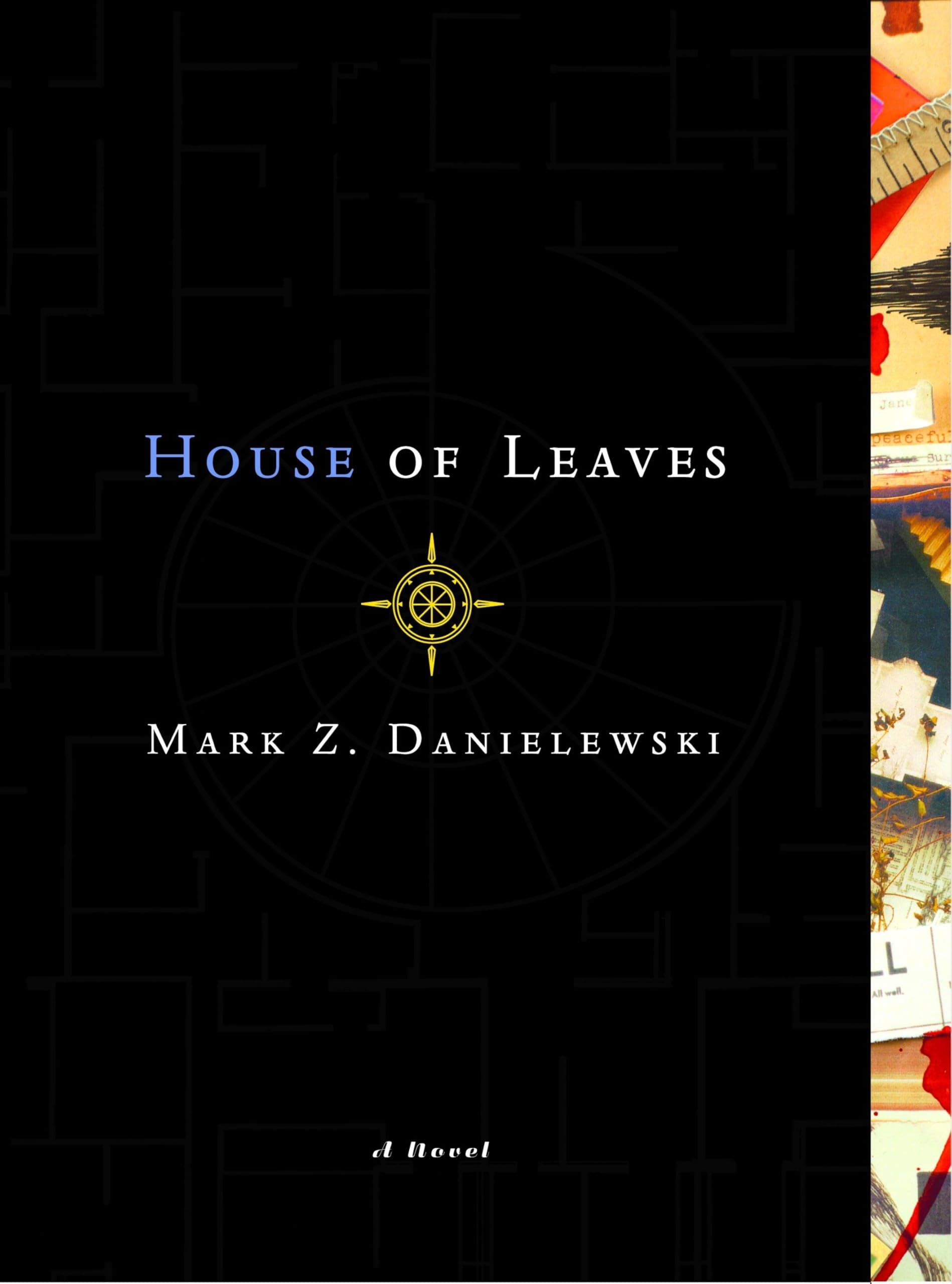
🌀 Unlock the book that bends reality and rewires your mind.
House of Leaves: The Remastered Full-Color Edition is a 528-page postmodern novel by Mark Z. Danielewski that blends experimental narrative, multi-layered storytelling, and visual design. Featuring three narrators and coded footnotes, it challenges traditional reading with a complex, puzzle-like structure. This edition enhances the experience with full-color visuals, making it a must-have for literary adventurers seeking a unique, mind-bending journey.


| Best Sellers Rank | #395 in Books ( See Top 100 in Books ) #8 in Contemporary Literature & Fiction #97 in Literary Fiction (Books) #128 in Suspense Thrillers |
| Customer Reviews | 4.6 4.6 out of 5 stars (14,188) |
| Dimensions | 6.93 x 1.36 x 9.15 inches |
| Edition | 2nd |
| ISBN-10 | 0375703764 |
| ISBN-13 | 978-0375703768 |
| Item Weight | 2.31 pounds |
| Language | English |
| Print length | 709 pages |
| Publication date | March 7, 2000 |
| Publisher | Pantheon |
D**D
Do the words meta, post-modern, or experimental make you cringe when used to describe books? Then turn back now.
Do the words meta, post-modern, or experimental make you cringe when used to describe books? Then turn back now. I feel the need to say that up front because many people seem to go into this book expecting a horror novel and wind up wasting their money. Just take a look at the genres that goodreads lists this as. Horror, fiction, fantasy, and mystery. With inapt labels like that, it's easy to see how people could get the wrong idea. This is not a horror novel, nor is it a mystery novel or a fantasy novel. This book is, among many other things, a personal story about the author's parents presented as experimental literary fiction that's thinly veiled as a horror novel. Confused? Good, stay that way for now, and don't think too hard about what I just said. I'm not that into horror novels, and I generally like post-modern and experimental stuff, and I knew what I was getting into when I bought this. Know what you're getting into, that's all I'm trying to say. Here's the basic concept as clear and concise as I can tell it. There are essentially three narrators that will be addressing you, the reader. 1) Zampano, an old blind man 2) Johnny Truant, a thirty-something druggie 3) The "editors" Johnny's friend, Lude, knows Zampano because he lives in the same apartment building. The old man, ominously, tells Lude he's going to die soon, and does. After the body is gone, Lude and Johnny sneak into the apartment to take a look around at Zampano's things. They find a crazy manuscript, which Johnny takes home with him. The manuscript is a non-fiction book/dissertation about a documentary called "The Navidson Record." The Navidson Record is about a famous photojournalist named Will Navidson and his family moving into a new house that is bigger on the inside. When I say non-fiction, I mean it. It reads like a textbook. On every page there are footnotes about other articles and other books that reference this documentary that, by all accounts, doesn't exist (I'll get to this in a second). It starts out simple at first. After the family returns home from vacation they notice a hallway on the second floor connecting two bedrooms that wasn't there before. They track down a blueprint of the building and see that there is a space between the walls, although it's not supposed to be a finished hallway with doors. Okay, no big deal, maybe they didn't notice the doors before, it's a new house after all and they had just moved in before going on vacation. Then comes the realization that measuring the house through that hallway results in an extra inch that shouldn't exist, and that can't be explained. Then a new door appears, on the first floor this time, that should lead to an empty back yard but instead leads to a long, dark hallway that extends into an endless labyrinth of cavernous, thousand-foot rooms that leads to god knows where and contains god knows what, and the exploration of this door is the main focus of the documentary. So Johnny finds this manuscript, reads it, edits it, adds his own footnotes relating to research he's done on Zampano's life and the manuscript contents (translations of foreign phrases, for instance), but also personal tangents about his own life and stream of consciousness ramblings. In the prologue where he explains how he found the manuscript, he also says that The Navidson Record doesn't actually exist. Johnny's editors also appear in footnotes and in the first say they have never met Johnny Truant in person, only communicating via letters and rare phone calls. Weird, right? What follows is 528 pages of an interwoven, multi-layered story. On the one hand, you have Zampano's non-fiction book about this fictitious documentary, which simmers as a slow-paced "found-footage" horror novel that can be unsettling, thought-provoking, but is likely to disappoint hardcore horror fans looking for adrenaline-pumping scares. Then you have Johnny's story, told through long footnotes, which is more vague and slow to reveal itself, but the basic idea is that although he knows the manuscript is fiction, the act of reading it causes him to lose his marbles. Whether the manuscript or Johnny's brain chemistry is to blame is up to the reader. Whether Johnny is even telling the truth is up to the reader. And, to be honest, Johnny's parts can sometimes be hard to read because he's just pitiable and depressing and the stream of consciousness prose can wear down your focus. It gets Joyce-esque at times, though only for short stretches, because Danielewski is a nice man who wants you to have a good time, unlike Joyce, who hates you and hates fun. Then the "story" part ends, and you have 130 pages of appendices (which you should read) which include things like: Zampano's writings which are not a part of The Navidson Record The obituary of Johnny's dad Childhood letters from Johnny's crazy, institutionalized, long dead mother Poems So what does it all mean? Well, it means a clever and perhaps over-educated man named Mark Danielewski decided to write a novel that experiments with the format of the novel, that pushes the boundaries of what a novel can be and what it can do. While much of it could quite fairly be called a gimmick, and it won't be redefining how all novels are written going forward, it's a gimmick that works, that is unique, that is stimulating, that is discussion-worthy, that makes the world more interesting by existing, and isn't that what good art is supposed to do? It is an unmitigated success at being singular, and because it is singular it will inspire intense love and intense hatred from different people. It means that while there are answers, you will have to work for them. I mean this both figuratively and literally. On the literal side, there is a letter in the appendices that is written in a simple code, which you will have to translate into a coherent message with pen and paper. And that's a code that is plainly said to be a code. There are other codes that are truly hidden. Many sections have weird, cluttered layouts that make the act of reading them hard, and make tracking down the right footnote a scavenger hunt. You'll be presented with footnotes that make no sense until you realize the text is broken up over several pages and presented backwards. There are a lot of elements to the story, little throwaway lines and facts that you need to remember, or write down. How did Johnny's dad die. How did Navidson's dad die. Stuff like that. While it's not absolutely necessary, I'd recommend having a notebook handy starting on page one. I have an amazing memory, took notes here and there, and still wish I'd taken more. Like I said, this book is work. It's fun work though, depending on your tastes and personality. I'm an INTP and I loved it. Your mileage may vary. On the figurative side, the book still won't hold your hand and spell out what it all means in flashing neon. That's up to you to figure out by gathering all the evidence together and deconstructing the book on several different levels by asking yourself what's true and what isn't, what matters and what doesn't, what's literal and what's figurative, what's the metanarrative, what's the subtext. Ultimately it's up to you to decide when you're satisfied with your answer. While this is nowhere near as open to interpretation as most books you'd label as post-modern or modernist, it is still open to interpretation compared to a typical novel, which isn't open to interpretation at all. There are no easy answers, no definitive answers, but there are satisfying answers that I firmly believe are more or less what the author intended, if you're willing to put in the effort to discover them and have a flexible mind that delights in abstract concepts. Alternatively there are, of course, existing breakdowns of it on the internet that you can turn to for some help, although none I've read have gone far enough into speculation. They present facts and evidence, point out what's true or not, but none of them have drawn the kind of final conclusion that I've drawn. That's how it should be. You should decide for yourself. If none of this sounds like fun to you, I recommend giving this one a pass
J**N
Worth it if you put in the effort, like any good novel.
What makes a good book is how much you put into it. Most good books don't tell you their meaning up front. You have to invest in the book to get something out of it. Mark Danielewski takes a radical approach in challenging the conventions of writing with this postmodern read. The very structure of the book creates visual experiences that convey meaning (even if it's small) in addition to the content of the book. This book explores structure and the style of writing, not just the content. The perfect blend of the two makes it a novel experience in enjoying both the challenging story, narration styles, and structure/form of the story to create a unique experience unlike most other novels you will read. This is not by any means even a moderate read - it is a hard read. But any good book is worth it if you stick with it and really try to understand it. Most people rate it poorly, even if they are avid readers, because it is not an easy read. It takes effort, but so does all good reading. Reading is not always so light and easy. There are books to enjoy that are more towards that end of the spectrum, but this is a highly rewarding text for its complexity. It is highly worth it if you understand that books don't always have immediate sense to it. That is what makes it a postmodern book, a book that challenges everything we know to be true and sensible in a "novel." I have read the entirety once and will do it two times again this next quarter in university and I look forward to it so much. Allow yourself to fall down the rabbit hole and discover a radical challenge to every convention of writing you know. An amazing book if you understand that you have to give yourself to a book in order to be impacted and changed by it. An amazing text if you approach it with an open mind. That is the only thing that is constant in this novel - open to the chaos, madness, and sheer beauty we find in Danielewski's vision of what is possible in a piece of written art. Art does not always make sense. Just as Oscar Wilde writes in his prologue to The Picture of Dorian Gray, "All art is rather useless." If you seek to understand the wicked truth in this novel, you will look into the abyss and the abyss will look back into you. There is beauty in the ugliness, there is peace in the chaos, and logic in the nonsensical rollercoaster of a ride this text is. It is a postmodern text that uses the conventions of the English language/syntax/grammar to break the conventions of English, showing its absurdity. It is truly amazing. So worth it if you allow yourself to be humbled and open to learning from a text as an intellectually honest person. A lot of people who read a lot of books become arrogant and lose their ability to have a growth mindset that can adapt and learn the value (or create value where you can't seem to find it readily) of a text that challenges what they expect or want out of a text. In school, college, university, and throughout life we learn to be skeptical, cynical, and rebellious to all things we encounter. While this can be useful and healthy, most everybody never learns to balance it out with an inquisitive, open, and empathetic side to it which helps you to not just tear down everything you don't understand but helps you to see the value in something novel. I feel bad for the other people who did not have a good experience reading this text and rated it poorly. A lot of them sound like they either gave up because it is a difficult text to read (not a very healthy way to read, which is to challenge and grow yourself while also enjoying the pleasure of prose and verse) or they were unable to see the value of something that seems immediately harmful because it challenges your worldview and assumptions as to what "good" (or what is safe) to read. Not all of them, but some of them are close-minded and do not allow themselves to adapt and change, to learn and grow from this text, even if it challenges everything you know to be true and good. Identify yourself with our amazing ability to change and adapt and to be smart, and you can't go wrong. Even "bad" texts can teach us something. Take the leap if you dare. With the right mindset, there is so much in this text to experience and to learn from. A truly challenging and amazing text to read. TLDR: it is so worth it. Open your mind to it, and let it break down everything you know to be true and good in our Western mindset, and in our limited English sense of grammar. Have the growth mindset and an inquisitive attitude and you will be fundamentally changed by the power of this book to restructure the way you think, freeing you from the captivity of our modern conventions of thinking. Radically changing book.
F**I
Its a bit complex to read at first, but It was worth the hassle, it was a pleasant read.
F**A
En iyi versiyonu amazon ile en iyi fiyata
W**N
Uno de los mejores libros que he leído. No solo la edición y el diseño están cuidados hasta el mínimo detalle; la historia en si me cautivó desde el primer momento. Es un libro que merece la pena ser leído varias veces. Recomiendo adquirir la edición en inglés porque, aunque no he leido la versión en español, imagino que habrá muchas cosas que se pierdan en la traducción; la historia está repleta de juegos de palabras, referencias y sobre todo (y más importante) hay algunos mensajes escondidos entre las palabras. Esta edición en tapa blanda con solapas está a todo color (eso es, con la palabra "house" en azul, los pasajes del minotauro en rojo, las palabras correspondientes en morado y las imágenes del final en cuatricromía). El peso del libro y su volumen hacen que sea un poco incómodo de leer, y la letra es un poco pequeña, pero merece mucho la pena. Un buen acompañamiento para este libro es el álbum "Haunted" de Poe (el nombre artístico de la hermana del escritor), ya que ambas obras fueron hechas (según el propio Danielewski) para complementarse mutuamente.
Y**O
Melhor livro que já li. A história extremamente interessante do início ao fim, porém, o livro é bem fácil de amassar devido ao tipo de papel em que ele é impresso, fazendo com que os danos já esperados (pontas amassadas, etc.) de uma entrega, sejam ainda mais evidentes.
L**A
„This is not for you“ So begrüßt einen dieses Buch, und je tiefer man vordringt, desto mehr hat man das Gefühl, dass dies wahr sein könnte. House of Leaves ist sicher kein gewöhnliches Buch. Schon den Inhalt sinnvoll zusammen zu fassen fällt mir fast schwer, denn hier gibt es verschiedene Ebenen die parallel erzählt werden. Die oberste Ebene bildet wohl Johnny Truant, dessen Geschichte und Anmerkungen im Vorwort und in Fußnoten zu finden ist. Er findet, dank einem Freund, die Aufzeichnungen von einem blinden alten Mann, die ihn fortan fesseln sollen. Daher kommt dann auch die nächste Ebene, die aus den Aufzeichnungen von dem alten Mann Namens Zampanò bestehen. Über ihn selber erfährt man nicht all zu viel, stattdessen kommentiert er einen Film. Dieser Film bildet auch die letzte Ebene dieser Erzählung, das eigentliche Herz des ganzen. In diesem Film, dem „Navidson Record“ geht es um die Familie Navidson, die in ihr neues Zuhause zieht. Was eigentlich ein harmloses kleines Projekt werden sollte, nimmt eine düstere Wendung, als sich herausstellt, dass das Haus in keiner Weise gewöhnlich ist. Es verändert sich von jetzt auf gleich und birgt ungeahnte, gar unmögliche Tiefen. Der Preisgekrönte Fotograf und Familienvater Will Navidson kann gar nicht anders, als mitsamt seiner Kamera in die tiefen dieses Hauses vordringen zu wollen und herauszufinden, was es damit auf sich hat. Mehr will ich auch wirklich nicht verraten. Nur noch so viel vielleicht: Es stellt sich sehr schnell heraus, dass der Film den Zampanò so ausführlich behandelt überhaupt nicht existiert – nicht einmal in Johnnys Welt gibt es eine Spur von diesem Film. Und doch scheint etwas düsteres aus diesen Seiten zu kommen, etwas das Johnny nicht mehr los lassen will. Die Geschichte ist geheimnisvoll, trotz aller Analyse im Buch bleibt vieles im dunkeln, im wörtlichen wie im übertragenden Sinne. Viele Fragen werden aufgeworfen und nur wenige auch beantwortet. Am Ende lässt die ganze Erfahrung einen etwas ratlos zurück, aber grade das ist doch der Reiz an diesem Werk. Wenn man die letzten Worte gelesen hat, ist man eben noch nicht unbedingt fertig damit. Es lädt dazu ein es noch einmal in die Hand zu nehmen und durchzusehen, Dinge nachzuschlagen und darüber zu philosophieren. So bleibt auch immer die Frage, was am Ende eigentlich wie glaubwürdig ist. Wie viel von dem, was da auf Papier gebannt wurde kann auch wahr sein, und wie viel ist nur der unzuverlässigen Erzählung Johnnys zu verdanken? Neben der wirklich wunderschön aufgebauten Geschichte ist aber auch die Darstellungsweise erwähnenswert. In der von mir gelesenen englischen ‚Remastered Full-Color Edition‘ wurden verschiedene Schriftarten für verschiedene Autoren der Passagen verwendet und verschiedene Worte und Abschnitte in verschiedenen Farben gedrückt. Viele Fußnoten weisen auf Quellenangaben zu Zitaten (teilweise nicht-reale Werke zu dem Film) hin oder dienen als Anmerkungen von Johnny oder Zampanò. Am interessantesten jedoch ist das Spiel mit dem Layout des Textes, welchem sich hier bedient wird. So ist der Text teilweise auf den Kopf oder die Seite gedreht, es werden nur halbe Seiten beschrieben oder gar nur einzelne Sätze und Worte die in faszinierenden Anordnungen über die Seite verteilt werden. Je tiefer man vordringt, um so verwirrender wird es auch, allerdings nie so, dass es frustrierend würde. Ein Nachteil dieses Buches ist allerdings, dass es grade am Anfang doch etwas abschreckend wirkt. Es dauert eine Weile, bis man zum Herz der ganzen Sache gelangt und bis dahin wurde zumindest mir ein kleines bisschen Geduld abverlangt. Ganz sicher kein Buch, welches man nur mal nebenbei liest, sondern tatsächlich eines, welches etwas Zeit und Aufmerksamkeit fordert. Aber das hat es auf jeden Fall auch verdient, jeder der dieses Art von Buch mögen könnte, sollte ihm zumindest eine Chance geben. Sicher nicht etwas für jeden, aber für mich auf jeden Fall 5 Sterne wert! Ich werde wahrscheinlich noch eine Weile etwas davon haben.
ترست بايلوت
منذ شهر
منذ 3 أسابيع