
قم بتنزيل التطبيق


معلومات عنا
حقوق الطبع والنشر © 2024 Desertcart Holdings Limited
قم بتنزيل التطبيق
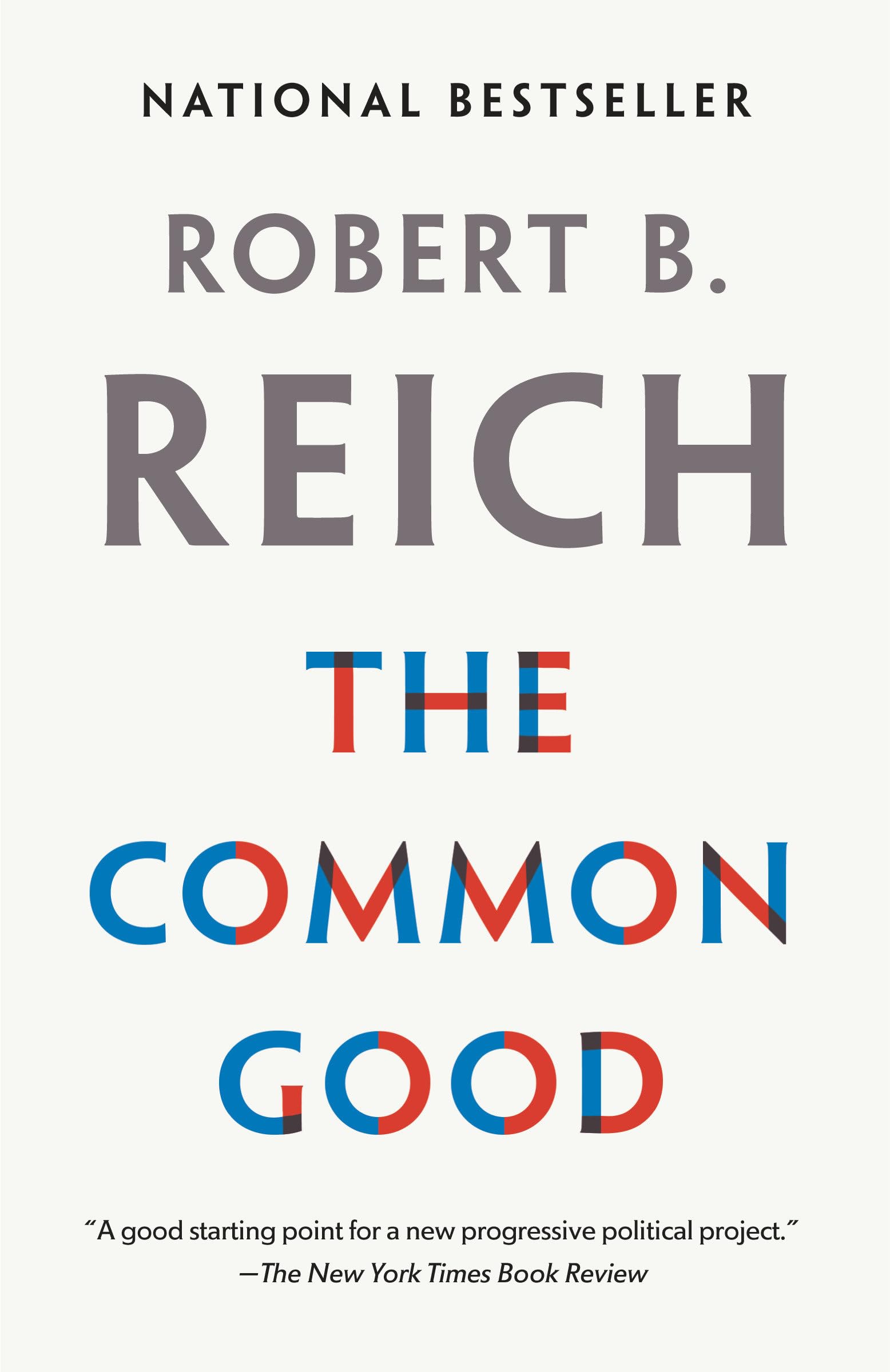
The Common Good [Reich, Robert B.] on desertcart.com. *FREE* shipping on qualifying offers. The Common Good Review: Democracy vs authoritarianism is not a binary choice - If Robert Reich has not written the best book of political economy in a long while, he has certainly written the most timely and necessary book of our time. And it’s written on one fundamental truth: The reality of American history is the pursuit of an ideal of individuality defined by the common good, not the achievement of individual Americans jockeying for personal advantage at any cost to the common good. Without the collective good, there is no society. Without regulatory restrictions insuring intellectual property and competitive fair play, there is no American economy. To suggest that our economy is “free” in any literal sense is to ignore the very principles of competition on which Adam Smith built his economic model. It is a model built on the ideal of truth and equitable competition, not the ideal of individualism without rules or constraints. If we are a nation of law and order, it is because we, in our collective sense of right and wrong, have voluntarily committed to the ideal. It’s a commitment not to our individuality, but to our individual peace and prosperity through collective cooperation and self-restraint. Without the self-restraint that can only come from recognition of the common good the police would have virtually no chance to keep the peace. It is the ideal, as much as the police (who clearly deserve our respect and support), which keep the streets safe. If modern science has taught us anything it is the degree to which our world is integrated. The quality of our environment is determined not by the local ecology of a prairie here and a rain forest there, but by the balance achieved within a complex and integrated global ecosystem. The most impactful economic theory flows not from presumed theoretical behaviors but from the recognition of how much our actual economic behavior is driven by human psychology. Human biology and medicine, by the same token, cannot be understood outside of the influence of evolution and the body’s integrated systems. If there is a common theme to the malaise currently paralyzing our politics it is the historically inaccurate digital perspective that there is only democracy and authoritarianism. Any attempt to promote the common good on any front, including gender and racial equality, immigration, prison reform, income inequality, etc., is quickly and effectively dismissed by the people holding the microphone with a simple allusion to the slippery slope of tyranny, fascism, and, of course, communism. As Reich points out, however, when Ayn Rand was establishing the ideological foundation of the conservatism now embraced by the ruling political class in Washington, the Allied powers did not defeat fascism, nor did the US defeat the USSR in the Cold War, by employing the opposite ideology. We defeated the repulsive authoritarianism of the mid-20th Century by doubling down on our commitment to the common good and the guiding ideal which redefined it in a uniquely American and effective way. Technology has integrated our lives more than ever before. And whether you think that’s good or bad, we aren’t going to turn back the clock of technology. (Nor do I think we should want to.) Attempting to make the common good irrelevant or undesirable by abandoning our collective ideals of a commitment to truth, inclusion, and compassion, we aren’t going to resurrect America’s golden years. Those years were built on a commitment to the common good, not its rejection. As any honest accountant will tell you, no accounting is without fault because no accounting can, by definition, be complete. The context of reality is just too complex and multi-faceted. Reich’s account is no different and many critics, I’m sure, will be quick to point to all of the offenses he chose not to include in his book. I could, too. But that kind of reciprocal finger pointing is one of the forces that undermine the common good today. It is the ultimate “broken window”, as Reich refers to it. The simple fact is that the problem is bigger than the individual injustices that collectively define it. In the same way, every solution Reich provides (e.g., commitment to truth, education, leadership as trusteeship, etc.) is part of a duality that he doesn’t always fully explore. If we have a responsibility in the name of the common good to universities, for example, they have a responsibility to our common good as well. Again, however, a duality is just that. Or to put it in more colloquial terms, two wrongs don’t make a right. All told, Robert Reich has a perspective. We all do. In the end, however, I don’t believe his is just a personal perspective. It is the reality: “If we are losing our national identity, it is not because we come in more colors speak more languages than before. If is because we are losing our sense of common good…We have never been a perfect union. Our finest moments have been when we sought to become more perfect than we had been.” A superb and quick read that should be on everyone’s reading list. Review: A masterful analysis of the roots of America's malaise with wise suggestions for how to recover - Just finished reading Robert Reich's 2018 book entitled "The Common Good." It is outstanding. As you may know, Reich was Secretary of Labor during the Clinton Administration and might have had a great career in politics if he was not 4'10" (due to a genetic anomaly). He just retired from UC Berkeley, where he was much loved. He starts by defining the common good as the fabric of public morality that is the foundation of any society or nation. More specifically, this means, among other things a shared sense of what is honorable and what is shameful, what is true and what is not, what patriotism really entails, and what constitutes admirable leadership. He observes that America's store of the common good has diminished since the '70s, attributing it mostly to a watershed change in the goals of corporate governance, to modern shareholder capitalism from classic stakeholder capitalism, where CEOs considered the needs not only of shareholders and the executive suite, but also of employees, customers, and local government. He further attributes it to a "do-whatever-it-takes to win" attitude to accrue more political power, make more money, and better rig the economic system in favor of the rich at the expense of the poor. He finishes by providing wise suggestions for reversing the loss of the common good, including a public movement to demand a change of goals for corporate leadership, a renewed effort by religious and other thought leaders to identify actions and persons worthy of honor, as well as persons whose actions, while perhaps successful in a political or financial sense, are nevertheless shameful. Finally, he suggests that schools need to re-institute classes in civics (cancelled for budgetary reasons) such that all citizens have a mastery of the basic features of the American government, at least to the level demanded of naturalized citizens.
| Best Sellers Rank | #789,971 in Books ( See Top 100 in Books ) #241 in Civics & Citizenship (Books) #705 in Civil Rights & Liberties (Books) #1,119 in Philosophy of Ethics & Morality |
| Customer Reviews | 4.6 out of 5 stars 970 Reviews |
G**R
Democracy vs authoritarianism is not a binary choice
If Robert Reich has not written the best book of political economy in a long while, he has certainly written the most timely and necessary book of our time. And it’s written on one fundamental truth: The reality of American history is the pursuit of an ideal of individuality defined by the common good, not the achievement of individual Americans jockeying for personal advantage at any cost to the common good. Without the collective good, there is no society. Without regulatory restrictions insuring intellectual property and competitive fair play, there is no American economy. To suggest that our economy is “free” in any literal sense is to ignore the very principles of competition on which Adam Smith built his economic model. It is a model built on the ideal of truth and equitable competition, not the ideal of individualism without rules or constraints. If we are a nation of law and order, it is because we, in our collective sense of right and wrong, have voluntarily committed to the ideal. It’s a commitment not to our individuality, but to our individual peace and prosperity through collective cooperation and self-restraint. Without the self-restraint that can only come from recognition of the common good the police would have virtually no chance to keep the peace. It is the ideal, as much as the police (who clearly deserve our respect and support), which keep the streets safe. If modern science has taught us anything it is the degree to which our world is integrated. The quality of our environment is determined not by the local ecology of a prairie here and a rain forest there, but by the balance achieved within a complex and integrated global ecosystem. The most impactful economic theory flows not from presumed theoretical behaviors but from the recognition of how much our actual economic behavior is driven by human psychology. Human biology and medicine, by the same token, cannot be understood outside of the influence of evolution and the body’s integrated systems. If there is a common theme to the malaise currently paralyzing our politics it is the historically inaccurate digital perspective that there is only democracy and authoritarianism. Any attempt to promote the common good on any front, including gender and racial equality, immigration, prison reform, income inequality, etc., is quickly and effectively dismissed by the people holding the microphone with a simple allusion to the slippery slope of tyranny, fascism, and, of course, communism. As Reich points out, however, when Ayn Rand was establishing the ideological foundation of the conservatism now embraced by the ruling political class in Washington, the Allied powers did not defeat fascism, nor did the US defeat the USSR in the Cold War, by employing the opposite ideology. We defeated the repulsive authoritarianism of the mid-20th Century by doubling down on our commitment to the common good and the guiding ideal which redefined it in a uniquely American and effective way. Technology has integrated our lives more than ever before. And whether you think that’s good or bad, we aren’t going to turn back the clock of technology. (Nor do I think we should want to.) Attempting to make the common good irrelevant or undesirable by abandoning our collective ideals of a commitment to truth, inclusion, and compassion, we aren’t going to resurrect America’s golden years. Those years were built on a commitment to the common good, not its rejection. As any honest accountant will tell you, no accounting is without fault because no accounting can, by definition, be complete. The context of reality is just too complex and multi-faceted. Reich’s account is no different and many critics, I’m sure, will be quick to point to all of the offenses he chose not to include in his book. I could, too. But that kind of reciprocal finger pointing is one of the forces that undermine the common good today. It is the ultimate “broken window”, as Reich refers to it. The simple fact is that the problem is bigger than the individual injustices that collectively define it. In the same way, every solution Reich provides (e.g., commitment to truth, education, leadership as trusteeship, etc.) is part of a duality that he doesn’t always fully explore. If we have a responsibility in the name of the common good to universities, for example, they have a responsibility to our common good as well. Again, however, a duality is just that. Or to put it in more colloquial terms, two wrongs don’t make a right. All told, Robert Reich has a perspective. We all do. In the end, however, I don’t believe his is just a personal perspective. It is the reality: “If we are losing our national identity, it is not because we come in more colors speak more languages than before. If is because we are losing our sense of common good…We have never been a perfect union. Our finest moments have been when we sought to become more perfect than we had been.” A superb and quick read that should be on everyone’s reading list.
J**N
A masterful analysis of the roots of America's malaise with wise suggestions for how to recover
Just finished reading Robert Reich's 2018 book entitled "The Common Good." It is outstanding. As you may know, Reich was Secretary of Labor during the Clinton Administration and might have had a great career in politics if he was not 4'10" (due to a genetic anomaly). He just retired from UC Berkeley, where he was much loved. He starts by defining the common good as the fabric of public morality that is the foundation of any society or nation. More specifically, this means, among other things a shared sense of what is honorable and what is shameful, what is true and what is not, what patriotism really entails, and what constitutes admirable leadership. He observes that America's store of the common good has diminished since the '70s, attributing it mostly to a watershed change in the goals of corporate governance, to modern shareholder capitalism from classic stakeholder capitalism, where CEOs considered the needs not only of shareholders and the executive suite, but also of employees, customers, and local government. He further attributes it to a "do-whatever-it-takes to win" attitude to accrue more political power, make more money, and better rig the economic system in favor of the rich at the expense of the poor. He finishes by providing wise suggestions for reversing the loss of the common good, including a public movement to demand a change of goals for corporate leadership, a renewed effort by religious and other thought leaders to identify actions and persons worthy of honor, as well as persons whose actions, while perhaps successful in a political or financial sense, are nevertheless shameful. Finally, he suggests that schools need to re-institute classes in civics (cancelled for budgetary reasons) such that all citizens have a mastery of the basic features of the American government, at least to the level demanded of naturalized citizens.
B**K
Succinct and Solid Book
The Common Good by Robert B. Reich “The Common Good” is a solid book of the good we have had in common, what has happened to it, and what we might do to restore it. Best-selling author and current Professor of Public Policy, Robert B. Reich explains what we owe one another as members of the same society. This succinct 209-page book includes ten chapters broken out by the following three parts: I. What is the Common Good?, II. What Happened to the Common Good?, and III. Can the Common Good Be Restored? Positives: 1. Engaging, well-written, well-researched and fair-minded book that is accessible to the masses. 2. An interesting topic in the expert hands of Professor Reich, what we need to do restore the common good and what happened to it. 3. Succinct, easy book to follow. 4. Focused on the topic of the common good. “I believe we’re bound together by the ideals and principles we share, and the mutual obligations those principles entail.” 5. An interesting look at critics of the common good and their followers. “Rand saw government actions that require people to give their money and resources to other people under the pretext of a “common good” as steps toward tyranny.” “Atlas Shrugged was said to be the favorite book of Rex Tillerson, Trump’s secretary of state. Rand also had a major influence on Mike Pompeo, Trump’s CIA chief. Trump’s first nominee for secretary of labor, Andrew Puzder, said he spent much of his free time reading Rand. The Republican leader of the House of Representatives, Paul Ryan, required his staff to read Rand.” 6. The role of government. “Government doesn’t “intrude” on the “free market.” It creates the market. Government officials—legislators, administrators, regulators, judges, and heads of state—must decide on and enforce such laws and rules in order for a market to exist.” 7. The importance of safeguarding the truth. “Truth itself is a common good. Through history, one of the first things tyrants have done is attack independent truth-tellers—philosophers (Plato), scientists (Galileo), and the free and independent press—thereby confusing the public and substituting their own “facts.” Without a shared truth, democratic deliberation is hobbled.” 8. The concept of common identity. “Our core identity—the most precious legacy we have been given by the generations who came before us—is the ideals we share, the good we hold in common. If we are losing our national identity, it is not because we are becoming browner or speak in more languages than we once did. It is because we are losing our sense of the common good.” 9. Explains what has happened to the common good. “Modern societies are filled with tacit rules that can be exploited by people who view them as opportunities for selfish gain rather than as social constraints.” 10. Provides a timeline of the common good breakdown with many highlights. “1999 Repeal of the Glass-Steagall Act. Clinton joins with congressional Republicans in repealing the act, which since the 1930s had separated commercial banking from investment banking.” 11. Fair-minded. Not afraid to criticize the left as well as the right. “Whatever-it-takes partisanship continued to escalate on both sides. Before the presidential election of 2008, both John McCain, the Republican candidate, and Barack Obama accepted limits on campaign contributions in exchange for public financing. When Obama’s powerful fund-raising ability became apparent, however, he abandoned his commitment.” 12. Many examples of how President Trump has damaged the common good. “Trump escalated conflict to another level. He used white resentment against the nation’s growing population of blacks, Latinos, and immigrants to solidify his largely white, working-class base—urging travel bans on Muslims, immigration enforcement raids on Latino communities, photo IDs to vote, a wall along the Mexican border, the purging of voter registration lists, and bans on transgender personnel in the military. These measures had nothing whatever to do with the central problems facing the nation nor with the deep unease at economic exclusion and vulnerability much of his core base experienced. They served only to advance a narrow political agenda at the expense of the common good.” 13. Provides many examples including three chain reactions that undermined the common good. “A second chain reaction that undermined the common good was set off in the 1980s as “corporate raiders” mounted hostile takeovers of corporations, financed by risky bonds. The raiders made fortunes, Wall Street became the most powerful force in the economy, and CEOs began to devote themselves entirely and obsessively to maximizing the short-term value of shares of stock. The new rule was: Do whatever it takes to make huge profits.” 14. Many examples of rigging the system to benefit the rich. “Corporations have used their profits to give shareholders dividends and buy back their shares of stock—thereby reducing the number of shares outstanding and giving stock prices short-term boosts. All of this has meant more money for the top executives of big companies, whose pay began to be linked to share prices. CEO pay soared from an average of 20 times that of the typical worker in the 1960s to almost 300 times by 2017.” 15. The influence of lobbying. “Business executives haven’t cared which party they contribute to as long as the money gets results.” “After Trump’s charitable foundation made a $25,000 contribution to a campaign organization linked to Florida’s attorney general, she decided not to open a fraud investigation of Trump University that her office had been considering.” 16. Can we restore the common good? “Leaders must see that part of their responsibility is to rebuild public trust in the institutions they oversee.” “A president’s most fundamental responsibility is to uphold and protect our system of government. Trump has weakened that system.” “This is the essence of Trump’s failure of trusteeship—not that he has chosen one set of policies over another, or has divided rather than united Americans, or even that he has behaved in childish and vindictive ways unbecoming a president. It is that he has sacrificed the processes and institutions of American democracy to achieve his goals.” 17. Interesting stories of whistleblowers. “I’m thinking of people like Cheryl Eckard, who, in 2002, as a quality assurance manager at pharmaceutical giant GlaxoSmithKline, discovered serious problems at its largest plant—drugs produced in nonsterile environments, a water system contaminated with microorganisms, and medicines made in the wrong doses. After Eckard alerted management, she was fired. She then shared her findings with the Food and Drug Administration, and sued the company. After an eight-year trial, GlaxoSmithKline agreed to pay the government $750 million for manufacturing and selling adulterated drug products.” 18. Solutions to restoring the common good. “If we’re serious about restoring the common good, congressional shaming must be followed by legislation and criminal prosecutions that confirm the standard of behavior we expect.” 19. The need to resurrect the truth. “We cannot be effective citizens in a democracy if truths unfavorable to those with power are suppressed, while lies favorable to them are offered as truth.” 20. Includes a discussion guide. Negatives: 1. It feels more like a long essay than an in-depth book. 2. Very few charts and visual material to complement the narrative. 3. Like a good professor, repetition is in order. In summary, this is a very good, succinct book on the common good. Reich is a gifted author who takes complex topics and reduces it to clarity. This book is more an essay of the common good versus say an in depth analysis of it. It’s not Saving Capitalism but it’s yet another solid effort by Reich. I recommend it. Further suggestions: “Saving Capitalism” and “Beyond Outrage” by the same author, “How Democracies Die” by Steven Levitsky, “Inequality” by Anthony B. Atkinson, “The Economics of Inequality” by Thomas Piketty, “The Great Divide” by Joseph Stiglitz, “Winner-Take All Politics” by Jacob S. Hacker, “The Great Escape” by Angus Deaton, “Screwed the Undeclared War Against the Middle Class” by Thom Hartmann, “The Monster: How a Gang of Predatory Lenders and Wall Street Bankers Fleeced America…” by Michael W. Hudson, “It’s Even Worse Than You Think” and “Perfectly Legal…” by David Cay Johnston, “The Looting of America” by Les Leopold and “The Great American Stickup” by Robert Scheer.
J**E
Compelling
From the very first page, with the details of pharmaceutical CEO Shkreli's story and the banking CEO Stumpf's appearance, this book grabbed me by my emotional center as almost no book ever has. Honestly, I feel angry. Actually angry. The reason this book is so compelling, I think, is that it rings of a truth that I've known for a while but haven't actually heard anyone say. Consider how it starts. It begins with Shkreli, the American hedge fund guy who bought out a pharmaceutical company, then raised the price of a cheap life-saving drug just to make money. In a completely selfish way, he stated that he didn't care if people couldn't afford it, because he "was only interested in making money and we live in a capitalist society." He said it wasn't illegal and he would do everything he could to make more money. He said he regretted not raising the price higher. He antagonized everyone around him. The good news is that he also did illegal things, so they were able to jail him, but what if he hadn't? What if he only raised the price? It made me think of Epipens, for example, and other drugs, whose price has only recently been raised here in American, whose pharmaceutical owners are making huge profits. It's not hard to do the math. So, Shkreli's story was both fascinating and repulsive, but then Stumpf appears, a criminal parading as good man. It's hard to know why he bothered, but there Stumpf was, saying politely that he was a man interest in being helpful. It broke soon after that he was making hundreds of millions of dollars destroying millions of American's lives. Could he really have wanted to be helpful? As I read, I thought about it. But no. Stumpf's behavior was clearly predatory. He was making money. And he didn't go to jail. He was too rich. Robert Reich is talking about these two men first because that's what is bleeding our society dry now. Our businesses, our politicians, our Congress, and even our president, they are straightforward about making money to the detriment of the good of most of the people. And I think we are brainwashed into thinking this is how it has to be. This book discusses how it was in 1975 and earlier, before Reagonomics took hold, before we allowed the people who are so desperate to make and stockpile an infinite amount of money to the detriment of others in this country. One last thing. Is there even such a thing as, "A Common Good"? You know, that's something that Reich talks about a lot throughout this book. As I was reading, a certain realization formed in my own mind. It's my own opinion. Reich paints a good picture of what the common good is. Here's what I personally came up with myself but if you read this book, and I think you'll really enjoy it if you do - "A Common Good" refers to several things, but most importantly, it refers to these things: 1. Recognizing other people as human beings and not hurting each other for any reason, not even to make money (so, not breaking laws and not worrying about laws because you have no desire to break them because you don't want to hurt anyone); 2. Doing everything you can to help others as long as it doesn't hurt yourself (so, paying taxes and supporting schools and things like that). In conclusion, I haven't ruined the book for you because it's a lot more than what I've just said. It's really worth reading.
G**R
A bracing and welcome reminder of Democracy's need for constant maintenance.
Reich writes with certainty and humility about our need to stay aware of the continuing deterioration of civility and responsibility, and our need to re-acquaint ourselves with basic ideas of humanity and decency, ideals which of recent seem to have become quaint anachronisms.
D**H
Eye-opening
Dr. Reich provides a rich vocabulary and historical framework for understanding many or the social and economic troubles we currently face in this country. Helps to explain our extreme income inequality and political polarization. Somewhat frustrating that “Common good” has not become part of the conversation in modern politics.
P**R
Another masterpiece by Robert Reich
The book describes how our society has been hijacked by money. This is my second book written by hm. I am now looking for another.
K**S
Impactful and relevant
The common good is a topic I have pondered deeply over the years. Robert Reich presents clear insight and perspective that is understandable and accessible. I have profoundly considered many of the ideas he presents, and will even be making a graduation speech citing some of them. In today’s world, his book is all the more relevant. While he focuses primarily on the lessening of support for the common good, society’s support for those values which bind us together, his book does not just apply to the US but has urgency in many other counties too. He does offer some suggestions about what society can do to increase the relevance in today’s society so that individualism doesn’t not become the major force driving our society apart. My critique for the book is that Reich pontificates a lot about what is the problem but some of his suggestions to improve the situation are so broadly painted that it seems unlikely that society would adopt them. It’s easy to say “society should ...” without offering a clearer blueprint about how that can be done — arm-chair quarterbacking almost, but action is far harder to achieve. His book can inspire conversation though, and I am doing my part in presenting these ideas through my work. The views in this book are valuable and very relevant, but those looking for the “how to implement” will be somewhat disappointed. Still the book is well worth the time to read.
ترست بايلوت
منذ شهر
منذ 3 أيام