Some deliveries may take a little longer than usual due to regional shipping conditions.

قم بتنزيل التطبيق


معلومات عنا
حقوق الطبع والنشر © 2024 Desertcart Holdings Limited
قم بتنزيل التطبيق

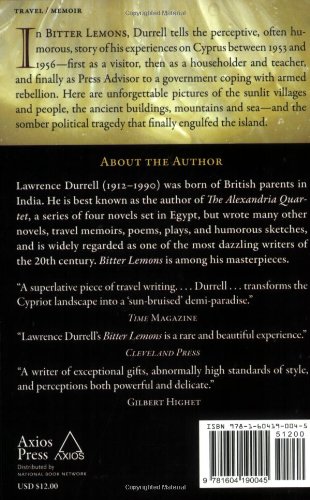
Full description not available
J**A
Amazing writing!
This book is written in such dense English prose that I found it difficult to read and remember what I had just read at the same time! Durrells descriptions of the island landscape, its people, and the rhythms of life are poetic and rich. I was sad to leave Cyprus with him.
K**.
Gifted writer, but a bit tedious
I came across this writer while reading books by Robert KaplanIt is an interesting time capsule of Cyprus, but also an indictment of Britain and their meddling around the world as they tried to grasp their crumbling empire
J**S
Cyprus Beauty, Calm and Revolution
Yes, Durrell's writing as this book begins is overblown, flowery, as some others have said. It starts off as a paean to village life in Cyprus. ( Durrell is caught up in the life of the "noble savage", the Cypriot villagers who live much as they did eons ago. He even buys ,and settles into, a home in an obscure village.) But, then this memoir morphs into a sad look at the push for Cypriot self-determination in the 1950s.The author changes from an optimistic lover of all things Cyprus to a man who is just not sure where his allegiances lie between the English, Greeks and Turks. To give Durrell credit, he is open-minded on the issues---wants to avoid the problems or postpone them. But, this is not to be. Conflict comes. War comes. He's been hired by the British government. He ultimately is a colonial power.Durrell's voice is gentle and seems to be of the past--which it is. As a side note, he gives an interesting take on how ordinary villagers become partisans--revolutionaries. This is still applicable today, I think.
T**M
Very Good
I love books like this that explore an area of ideas or the world where it would never have occurred to me to go. Well, this guy was there and had the knowledge (like the Greek language) to understand the situation. I read about the trouble in Cyprus at the time, but understood nothing.Some may say 'how could a political situation that happened 50 years ago matter now?' Just read the book. It is just great. The subject may not matter to many (I consider it tragic, but no more than an hundred other areas of the world with similar problems), but the fact that this guy was on the ground there is brilliant.The book is so well written that I think most anyone will be absorbed by the narrative, and lack of knowledge or interest in this remote area will not affect the reading.I know this is all a little vague, but I'm not the writer Durrell is.
M**M
WHERE THE MOON'S COOL FEVERS BURN
During WWII Durrell served as a press attache to the British Embassy. After a life spent in various locales, he moved to Cypress as a private individual, settling in the Greek village of Bellapaix. He wrote this memoir as a tribute to the Cypriot peasantry and the island landscape.Durrell got to know the people of the island by working in many different jobs, eventually serving as an official of the Cyprus government the last two years he was there. The home he chose to make livable was a portion of the ruined monastery of Bellapaix, a Gothic remnant "with huge carved doors made for some forgotten race of giants and their oxen."This is the third in a trilogy of island books, earlier ones about Corfu and Rhodes. In this last one, Durrell set out to describe the moods and atmospheres on Cyprus during the unfolding of the tragedy (1953-6) when English and Greek governments brought military forces to Cypress to fight for the domination of the island. In a poem to Cypress Durrell wrote, "In an island of bitter lemons, where moon's cool fevers burn ... Beauty, darkness, vehemence ... and the Greek sea's curly head keep its calms like tears unshed."
M**E
Fans of Durrell will delight in his adept use of the English language in ...
Fans of Durrell will delight in his adept use of the English language in Bitter Lemons. His easy facility with words is matched by only a few others of similar repute.But one does not have to be a Durrell-phile to revel in this book. If you cleave to travel writing, if you are fascinated by Cyprus or simply yearn to learn about it, if you fancy yourself a historian (or actually are one), then this book is for you. Fortunately for us, Durrell lived in Cyprus during a pivotal point in its calamitous history. Not only is he a sharp and clever observer of all things Cypriot, but he details events so clearly that the reader feels she is standing right next to him. We marinate in the rich culture and crescendo of conflict--understanding their essence in a visceral way.
K**R
Cyprus in the 1950's
I read this book about three years ago before moving to Cyprus. I bought it for my husband's birthday this June, and he enjoyed his first read of Bitter Lemons. I have just finished rereading it and found it much more interesting reading the descriptions of places I know well, especially Bellapais. I wonder who owns the house now?An excellent story setting the scene for the troubles of the 1950s that is even more poignant right now since the new memorial stones in the British Cemetery in Kyrenia list all the military personnel killed in those troubles. Many of their relatives attended the unveiling service last November 2009. Most of the soldiers, air personnel, sailors and police were under 25 when they died. Lawrence Durrell's book just shows how (in my humble opinion) unnecessary it all was.Cyprus remains a beautiful place. We have lemons in our garden. The Tree of Idleness still stands. All we need now is a sequel.
K**S
Two books in one
This beautifully written book gradually evolves from a delightful description of life on timeless Cyprus to a tense story dealing with growing tensions as Cypriots fight for their self-determination and Durrell was right in the middle of it, working in PR for the government, but with very mixed feelings. He appreciates both sides of the question and has friends in both camps. I originally got this book because I had spent some time on Crete and wanted to recapture the feeling of being on such an island -- I got that beautifully in the first half of the book. Then the historical background of Cyprus in the 50's was fascinating. It's almost like 2 books in one.
D**R
nature at its calming and uplifting best, are a joy and a delight to read ...
A word on the title -- I chose this edition, which is an American reprint which I couldn't help noticing strongly suggests the style of the Faber paperbacks of the 1950s and 60s, because it uses Lawrence Durrell's original title. (For some reason a lot of reprints are now entitled "Bitter Lemons of Cyprus" -- why?) I have tried to read Durrell's Alexandria Quartet, and also a paperback I found lying around, "The Dark Labyrinth", but sadly could not persevere with them and could not relate to any of the characters or the atmosphere ... but this book is a different kettle of fish: not a piece of fiction, but a report, albeit by a novelist. This book gives a lovely picture of life in north Cyprus in the 1950s when Durrell had some kind of loosely-defined diplomatic job there. He describes how he took up residence in Bellapais and the people he encountered there, both Cypriot and British. He mixed with pleasure in Cypriot society and revelled in entering into the local people's passions, large and small, unjudgementally. Everything would seem to have been so relaxed then ... except that the threatening troubles between Greeks and Turks were approaching ever closer. Durrell's descriptions of the beguiling beauty of the landscape and sea, birds and flowers, nature at its calming and uplifting best, are a joy and a delight to read -- this is what I most took to in the book. The latter part interested me less as that foul phenomenon of human life, politics, and its inevitable consequence, strife between sections of people (my judgement, not Durrell's) took hold and overthrew the calm and enduring quality of life that he loved and described. Of course, I realise that other people might find Durrell's view of these events a useful individual viewpoint.
J**E
Bitter Lemons
Very interesting re the social history of Cyprus mid 20th century. Especially the north of the island. But saying that, I could picture the journey it describes to Pathos. The way the lovely cypriot people were negatively viewed then is sad and an eye opener. Made me feel nostalgic for a simpler way of life.
A**S
Bitter Lemon
a great book. However, I wish the publishers would use a better quality binding - I took it on holiday (to Cyprus) and the heat melted the glue .....!
F**S
Gives an insight to the political divisions in Cyprus
Great book, excellent read
D**Y
A Classic!
One of Lawrence Durrell's best books. A slice of Cyprus 50s history. Everybody who has not yet read it will be enchanted.
ترست بايلوت
منذ شهر
منذ شهر