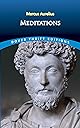

Desertcart purchases this item on your behalf and handles shipping, customs, and support to EGYPT.
📖 Elevate Your Mind, Transform Your Life!
Meditations by Marcus Aurelius is a collection of personal writings that offer timeless insights into Stoic philosophy, encouraging readers to cultivate resilience, mindfulness, and self-improvement. This Dover Thrift Edition makes this classic accessible and affordable for anyone seeking to enhance their mental well-being.


| Best Sellers Rank | #58,982 in Books ( See Top 100 in Books ) #20 in Classic Roman Literature #30 in Ancient Greek & Roman Philosophy #45 in Individual Philosophers (Books) |
| Customer Reviews | 4.5 out of 5 stars 10,628 Reviews |
M**N
Great Read !!!
I was researching an historical author online and Marcus Aurelius's name came up as one of his inspirations and I decided to take a closer look at him also. "A king that shares my own first name, I have to see what this is about" I thought to myself. So I found "Meditations" and marked it to be read. Now I have to make this clear immediately, I hated this book! Let me clarify before you jump to conclusions, die hard fans of "Meditations". What I mean is that I hate that I love this book so much! Now there are things in life that people love to hate. There are things in life that are so outrageously obnoxious that you have to tune in just to see what happens next. This is a book that I hate to love and that's a first for me. This book will forever harbor a special place in my heart, and even if I'm out and I'm not in possession of a physical copy literally, it's divine principles and virtuous insight will reside in my heart figuratively. Now here is where I elaborate on what I mean by I hate (to love) this book. The fact that it took me three days to read this book when it would've taken three hours had it been any other book, on account of the fact that I found myself constantly pausing to meditate while pondering what I was in reading in a book that just happens to be entitled "Meditations" was just downright eerie to me! When I begin to delve into these very deep issues and encounter his profound insight in regards to them, it became impossible to simply breeze through them as anticipated. Now if it wasn't already eerie enough that my name is Marcus and I'm reading the diary of a man; a king whose name just happens to be Marcus also, and not only are these his inner most personal thoughts, that may have quite possibly been intended to be a private note to himself, but there were also certain parts that totally felt like fate as I came across them. It literally felt like certain things were specifically laid out for me...a very eerie feeling to say the least. This book is outrageously good! There are absolutely NO DULL MOMENTS in this book! It really felt like Marcus was pressed for time and didn't have a moment to spare, and he was absolutely determined to diligently contain these wonderful conceptions and document them before they were lost forever. He did an excellent job, and I found every bit of what I read to be excellent and extremely helpful. I must admit that certain parts were so good that it angered me a little. "How could this guy be so great"! I thought to myself. It was like someone vehemently addressing the issues that we all face at some point in life, and extracting them individually one by one and presenting them to me to be examined. It was literally like he took life's pain: love, the loss thereof, jealousy, envy, betrayal and death, and intentionally put pressure on all those wounds, but only for the purposes of assessment though. Then afterwards going to work on them, going in serious depth and detail about them all with such a gentle, pleasant, and appropriate empathy that it became impossible to remain upset about it. It was refreshing to know that someone cared enough to actually give an analysis about these things. The issues he explored, the conclusions drawn, really hit me as hard as a punch directly to the heart. It didn't feel like an attack though, more like CPR. Even though CPR hurts it's vital and for the better in the end. Now mind you "Meditations" is this man's note to himself, so he unintentionally affected me. I can't be mad at him for that. It was like having a heart to heart with someone who has the courage and is considerate enough to offer you an alternative in regards to any character flaws you may have, and ultimately challenges you to be better. As irritating as that can be, it hurts so good because you know it's coming from a place of love and that that person genuinely wishes the best for you, and is not patronizing you or being condescending in any way. If a woman were to have expressed this kind of genuine concern for me in regards to the interactions we shared with each other, I would fall madly in love with her instantly afterwards. If any couple were to express this kind of openness and genuine concern for one another I bet they would never part. The fact that is fashioned as if it were a diary only adds to the purity and importance of it, making it a sacred experience for me. I truly don't believe that a man who was this knowledgeable and articulate, and diligent in his outlook on life would lie to himself. There is nothing watered down, fake, or half true at all here! Marcus actually proceeded to address not only life but death also in the same body of work. The nerve of this dude! Death is usually an issue a person would either prefer to hurt about with no interference, or to just be left alone about it and be enabled to move on and forget about it. Marcus Aurelius, having loss both his parents at a young age, and then his wife also, that must have instilled a sense of entitlement in him by then I suppose. His analysis was excellent though, very brilliant! Reading such an excellent body of work compelled me to pose a couple of questions to myself. Will a person like myself ever be able to live up to these excellent standards? will I ever be able to attain this type of greatness? Marcus's ability to examine human nature is absolutely astounding! When everyone around you is angry, no matter where you reside, or what the circumstances maybe; you so desperately want to be angry also, naturally, but Marcus Aurelius is a man, a king, who stresses the importance of patience and temperance. Not only does he stress it, he also insist that patience and temperance are both collectively the ultimate symbol of strength, and only the strong survive where I come from. The concept of individuality has pretty much vanished in these modern times. The insistence of taking moral inventory of one's self, being self-reliant, self-sufficient, and exercising self-control was highly emphasized throughout the entire book. Nobody is asking anybody to be perfect, we all have our flaws, and many of the things in this world are what they are and the reasonable response is to adapt and behave accordingly but "See how the life of a good man suits you, the life of him who is satisfied with his portion of the whole, and is satisfied with his own just acts and benevolent disposition". "Does another do me wrong? Let him look to it. He has his own disposition and his own activity. I now have what universal nature wills me to have, and I now do what universal nature wills me to do", this is sheer brilliance. Here you have an emperor, a real ruler of a culturally enriched nation with a refined legacy, yet this man never mentions his own wealth, not once! His only concern is his very essence and his genuine empathy for mankind. I find that to be very distinctive and honorable to say the least. This man really poured his heart and soul into this work and I greatly appreciate it. I recommend this book honestly to every man. I think every man should read this book at least once. I also recommend this book to anybody who has suffered some kind of loss, such as the death of a close family member or friend. I think this book would be very helpful to anyone who has experienced such a thing. I also recommend this book to anyone who is seeking a deeper level of understanding in regards to human nature, whether it be for the purposes of excelling in business or it be of a personal nature. Whatever the case may be, this man's insight will definitely assist you in filling any void you may have in your soul.
P**M
Great read on Stoicism in like new condition from Goodwill if Heartland
Arrived on time and in like new condition as advertised by seller. Glad to support Goodwill with this purchase. Enjoying this hardcover edition of Meditation because it includes also writings by Seneca and Epictetus in addition to those by Marcus Aurelius. Good collection for someone who wishes to learn more about stoicism.
A**S
Meditations - 5stars
Meditations by Marcus Aurelius “The happiness of your life depends upon the quality of your thoughts: therefore, guard, accordingly, and take care that you entertain no notions unsuitable to virtue and reasonable nature.” Before I get into details, I must say that reading Meditations was one of the hardest, but most rewarding experiences in my own personal growth. The book has done so much to ferment my prior beliefs and has helped a lot to broaden my mind and encourage me to be all that I can be. It is very difficult in today’s world to believe in anything, whether it be divine beings, other people, or even ourselves. It is an epidemic that buries potential and love deep down and leaves anger and frustration to dictate life. There is no reason to feel unhappy, unfulfilled, or unappreciated , and Meditations by Marcus Aurelius offers advice to anyone who is looking for self help, self love, and a rational way of directing life. Before reading this book it is interesting to know the man that wrote it. Marcus Aurelius was the last of The Five Good Emperors of Ancient Rome. He took the title of Augustus after the death of his adopted father, Antoninus Pius, the adopted son of the late Emperor Hadrian. However Marcus Aurelius had tried to pass on the emperorship, for he prefered a much more simple philosophic lifestyle. He accepted the honor with the sole demand that Lucius Verus, his adopted brother, would share the seat with him. Sharing his seat of power is the one move that summarizes Marcus Aurelius’s entire life; the fear of power and the duty embedded in him through his interest in Stoicism, a philosophy that grounds itself on self-restraint, reason, and fate. His work is a reflection of his life, and the words inscribed in Meditations are the product of his own thoughts and his own experiences. While reading this book good feelings will begin to surface through introspection, and in turn bad feelings will be expelled. In my everyday life quotes from his book swim in my mind when I am met with difficult situations, and they enable me to make smarter more thought out and rational decisions. It is fascinating and rewarding each time I don’t simply act on impulse. This book is not for entertainment, not for adventure, and it is definitely not a “light read.” It is a book that will help those who seek help, irritate those who don’t, and fascinate those who wish to learn and grow.
P**O
Review: The Book, Meditations, by Marcus Aurelius…
Here’s a question for you: What’s the difference between a diary and a journal? A diary functions as a chronological record that highlights daily events and factual information (what happened), while a journal serves as a profound space for personal development, self-examination, and emotional processing—helping to understand what things signify. Traditionally, the latter is meant to be shared, while the former is not. Here’s another question for you: Which one would be easier to review? Since I’m a fiction guy and perceive the world in terms of plot and resolution, of character arcs and foibles, of rising and falling action—and being able to find any of these elements in daily life—a diary would be easier for me to review. Much easier. But I don’t have that luxury. Not this time. Meditations by Marcus Aurelius falls squarely in the journal category, minus the personal development and emotional processing. It is a collection of ideas, proclamations, and—heh—meditations from an ancient Roman emperor. It is organized into twelve books, with Book One expressing the emperor’s unyielding gratitude to family members, teachers, and the gods for imparting to him lessons on virtues and ethics. Books two through twelve serve as the essential collection of aphorisms, reflections, and reminders, which are, annoyingly, non-chronological, untitled, and unsorted by specific topic. Needless to say, beyond the fact that this is a journal, it isn’t an easy book to review. So I’ll go about it thematically. Since Aurelius returns to several—and I mean, several—concepts and ideas, with subtle and not-so-subtle messages concerning them, I can just imagine the amount of college essay topics that this tome can generate. One theme is The Control of Perception. You cannot dictate what occurs around you, but you can choose how to interpret those situations. Events are, by many estimations, neutral; they occur, but they are not by design good or bad. Your mind serves as an "inner fortress" that remains protected if you choose not to allow yourself to be affected by external events or feel pain because of them. Acceptance of change and Nature is another theme—it's important to highlight that Nature is capitalized here, referring to the personified idea of Nature as a female figure, rather than the physical environment and all its non-man-made elements. The message here conveys that the universe functions as a unified entity—what benefits the whole also benefits the individual parts. You should also stop fighting what you cannot change—the Serenity Prayer comes to mind. Nature is about change, and she loves to change things. It is all cyclical: things live, die, nothing is inherently evil, and death itself is also merely a change. Memento Mori, or the reality of death, is also a major theme in this work. Death is a completely natural occurrence, just like when fruits ripen and then drop from trees. It arrives for everyone in the same way: both kings and beggars find themselves in the very same place. Within the concept and constraints of time, your life is just a minuscule blink when compared to the scope and breadth of time. Since your existence on Earth is so short, you should strive to be a kind and fair person. Aurelius also offers peace of mind in his musings about death—according to him, accepting that you could leave this world at any time frees you from worrying about what others think of you. He also expounds upon one’s duty to humanity. Humans are made to work together like limbs, digits, or rows of teeth—working against one another is unnatural. All people share a piece of the Logos, or universal reason, which makes every person a natural relative. Bad behavior comes from ignorance. When someone causes you pain, react with compassion and guidance instead of rage. Aurelius criticizes withdrawing from society as a neglect of responsibility; he believes true peace is achieved through active service to the community. To focus on the present is the only true way to live. The past has slipped away, and the future remains unknown. The present moment is yours alone, and it is the only time when you can truly act with virtue. You can't lose the past or the future since you don't possess them. The present is all you truly have, and it's the only thing you can actually lose. The anxiety about the future and the remorse from the past generate ghostly aches. However, when you focus on this very moment, many of those fears dissipate. Action takes place only in the present, as you can't change the past or control the future. There are a few quotes from Meditations that stick with me—most are self-explanatory. “The best revenge is not to copy him that wronged you,” “Consider what men are; whom they seek to please; what they expect to gain, and how they go about to compass their ends,” and “Be upright either by nature or by correction,” are just a few. Others state, “What profits not the swarm profits not the bee,” “Discourse no more of what a good man should be; but be one,” and, “In writing and reading you must be led before you can lead. Much more is this so in life.” I could go on, but you get the idea. A book like this warrants a second, or even a third, read. I’ve added it to my TBR again—I’ll most likely read it sometime next year. All in all, I recommend reading this book; there are gems of wisdom not to be ignored.
J**R
Direct Life Wisdom
I find it difficult to consider a work more complete. Marcus Aurelius from on high saw all that was within, without, below, and around, regarding that which is important in life. He knew where to place his attentions and though these writings likely weren’t meant for any eyes but his own, they function well for an audience all the same. There is nothing I’ve yet encountered in life which has offered a more direct wisdom. It can be applied immediately and will draw you closer to your own spirit, to your own purpose. Be mindful that the English in this version is likely from the 1700s. It’s *very* old, with many archaic terms and strange sentence structure. I did adapt to it over time but you can probably see that it has affected the English of this current review. That said, I’m now going to read a direct Modern English translation to see how much more readily the information therein can and will be absorbed. All that stated, I’m a better human being for having read this and will thus always hold it close.
S**7
Worthy of a read...but please, just once.
The 4,000-plus reviews here speak to the regard which people hold for his writings. Many reviewers here are better able to illuminate the high points of this volume than I am, but having labored through the entire text, I will put forth my thoughts on this (Dover Thrift edition). Firstly, these are the private thoughts and writings of a man to me who seems to have been very just and thoughtful, as well as an effective, fair and good-natured statesman. His lines were never intended for mass distribution or even small scale comprehension. Having established that, I'm not sure he was as great a writer as he was a man. Not having read other translations of Meditations, I also can't compare those to this. Suffice it to say then, these 99 pages were at times a tedious read for me, and it's not just because these are ancient writings. Some of these paragraphs are almost incomprehensibly long and wordy and I had to read them several times to capture the gist of his thoughts in mine. (The 99 pages took me about as long as I take to complete most 350 pagers). That's not to say there aren't some beautiful true thoughts here, there are quite a few gems, but they are far between. Meditations is also very repetitive and little of it seems to emanate from Marcus Aurelius. Instead it appears that most of these writings stemmed from those he admired and studied, Epictetus, Socrates etc. There is nothing particularly wrong in this, but in comparison to the writings of Seneca for example, there are stark contrasts and these differences make reading Seneca much more rewarding for me. Whereas brilliance, truth, wonderful humor and wit, clarity and easily digestible wisdom seems to pour freely and from the soul in Seneca's writings, Aurelius seems to be coaching himself to become what Seneca simply IS. Having only read this book and some selected Seneca (I have more Stoicism books ordered) I'm open to coming back to this review at a later date and revising it in Aurelius' favor if I so feel the need. But it is my opinion that the writings of Aurelius and of Seneca may very well represent polar opposites in the field of stoic studies. There is much to learned from them both, but only in one is there timeless wisdom and even exceptional humor and wit, to be found and enjoyed.
B**M
Awesome and simple yet not
I heard of this book from many people that I respect but it was Jerry Seinfeld mentioning it to a podcaster that tilted my opinion to the point that I went on Amazon and down loaded it. Now I Will need to read it over again and again until I understand it better! I think every one needs to do the same!
J**S
Different translations, but some version should be given to every rational, social creature
Amazon really should separate the translations on this incredible work. Just like the Bible, the translations are NOT equivalent, and if you start out with the wrong one, you’ll probably never appreciate it. I have tried three of them so far (and I am not a scholar, just someone who wants to appreciate stoicism.) I started with the cheap/free download on the Kindle store, the one whose cover is slightly green with a stone bust and yellow lettering, published by Prabhat. The translator isn’t clearly credited, but I think I confirmed in the back pages that it is by Causaubon, translated in 1634. This is similar to the King James Version of the Bible and Shakespeare. Since I was raised on KJV and Shakespeare, I have no problem with the “thee” and “thou” and “whatsoe’er”. I understand most of it, and it has a pleasing poetical authority, like reading the Psalms. Marcus rambles a little, too, so you really feel his stream of consciousness. There are places where the syntax, however, makes me say, “huh?” and reach for the next version. The Hays translation is the one I would give to just about everyone. The ideas closely follow the Causaubon version, condensing them, losing the heft and stateliness, but pretty accurate and easy to read. Good for non-geeks. Teens could understand it, and any adult enjoy it. I also tried the Gregory Long version (1862) but tossed it away. Too colloquial, and when compared to the others I would exclaim, “that’s not at all what Aurelius was trying to say!” Dumbed-down words with confusing syntax. Why bother? The book itself is full of Stoic philosophy. Even if you aren’t religious, you can be philosophical, and Aurelius argues that is the highest state humans can achieve. If we are going to chuck religion as a nation, not many could object to the principles here as a replacement for current social law (as inoffensive as Buddhism). With Aurelius you learn people have been the very same for millennia, but the only constant for an individual is change. All we can do is run our own race with dignity and kindness. We control our minds and reactions. No one can take your spirit away but you. No wonder this text has been cited by so many leaders, POWs, and weary sufferers. Highly recommended.
Y**O
⭐️⭐️⭐️⭐️⭐️ – philosophisch grundlegend, kulturell prägend und persönlich inspirierend.
⭐️⭐️⭐️⭐️⭐️ (5/5) „Meditations“ – zeitlose Lebensweisheit eines Philosophenkaisers 📌 Kurzfazit Die Meditationen sind keine systematische Philosophie, sondern persönliche Notizen eines Kaisers, der im 2. Jahrhundert n. Chr. über Sinn, Moral und Selbstbeherrschung nachdachte. Das Werk ist schlicht, eindringlich und universell – ein Text, der seit fast 2000 Jahren Menschen inspiriert, mit Klarheit und Gelassenheit zu leben. 📚 Inhalt in Kürze Grundgedanken des Stoizismus: Kontrolle über das, was in unserer Macht liegt – und Akzeptanz dessen, was wir nicht ändern können Konzentration auf Pflicht, Tugend und Vernunft Vergänglichkeit von Macht, Ruhm und Besitz Gelassenheit gegenüber Leid und Tod Kein Lehrbuch, sondern eine Sammlung persönlicher Reflexionen Entstanden während Feldzügen, in Momenten der Einsamkeit und Belastung 🔬 Wissenschaftliche Relevanz Stärken: Historisches Dokument: einzigartige Quelle für die stoische Philosophie und die Gedankenwelt eines römischen Kaisers. Philosophisch anschlussfähig an moderne Ethik, Psychologie (Resilienz, kognitive Verhaltenstherapie) und Achtsamkeit. Schwächen: Fragmentarisch, nicht systematisch aufgebaut. Stil kann durch Wiederholungen und Sprunghaftigkeit herausfordernd sein. 👉 Fazit Wissenschaft: Ein Grundtext der Philosophie, methodisch nicht als Theorie, sondern als Reflexionssammlung. 🌍 Kulturelle Relevanz Tiefgreifender Einfluss auf Philosophie, Literatur und Selbsthilfekultur. Zentrale Inspirationsquelle für moderne Bücher über Resilienz, Minimalismus, Stoizismus. Hat das Bild des „philosophischen Herrschers“ in der westlichen Kultur geprägt. Heute populärer denn je, besonders in Management-, Leadership- und Selbsthilfe-Kontexten. 💭 Meine persönliche Meinung Positiv: Klar, direkt, ohne Schnörkel – viele Passagen wirken erstaunlich modern. Kritisch: Manche Teile wiederholen sich stark; nicht jede Passage wirkt gleich tief. Für mich: ein Lebensbegleiter, den man immer wieder aufschlagen kann, statt ihn nur einmal durchzulesen. 🎯 Fazit Meditations ist ein zeitloses Meisterwerk der Lebensphilosophie, das weit über seine Epoche hinaus Bedeutung hat. Es bietet keine fertigen Rezepte, sondern Einsichten in das Ringen eines Menschen um Haltung, Pflicht und Gelassenheit. ⭐️⭐️⭐️⭐️⭐️ – 5 von 5 Sternen Weil: philosophisch grundlegend, kulturell prägend und persönlich inspirierend.
N**S
Original material
Original material, so worth reading
C**I
Best translation of this book
One of the best translations of this book. A very good read, food for thought and a good introduction to the Stoics.
B**M
Estoicos, este es vuestro libro.
Me pregunto cómo puede un libro tan antiguo mantener de manera sencilla y fácil su contenido. Elegi esta traducción recomendada por otro autor, expresando que este manual habia traducido muy bien el libro original. Y ha dado en el clavo, incluso para un hispanohablante. Un libro muy recomendado de la mano de unos de los mayores referentes de la filosofia estoica.
A**M
Life changer
Awesome
Trustpilot
2 months ago
1 week ago