Some deliveries may take a little longer than usual due to regional shipping conditions.

قم بتنزيل التطبيق


معلومات عنا
حقوق الطبع والنشر © 2024 Desertcart Holdings Limited
قم بتنزيل التطبيق

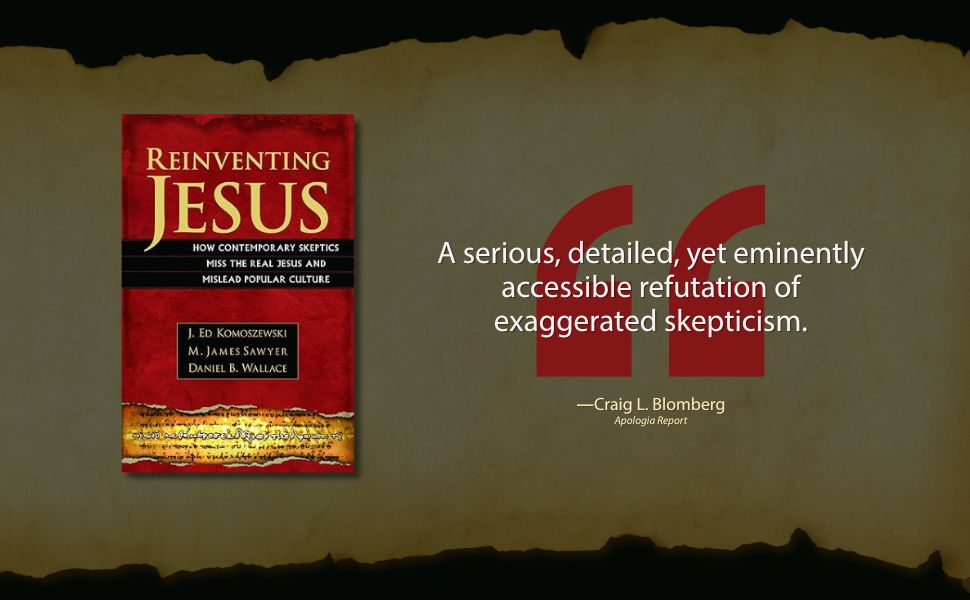
Reinventing Jesus [Komoszewski, J. Ed, Sawyer, M. James, Wallace, Daniel B.] on desertcart.com. *FREE* shipping on qualifying offers. Reinventing Jesus Review: A New Kind of Apologetics -- Welcome and Needed - In some ways the title is unfortunate, because Reinventing Jesus is so much more than another response to The Da Vinci Code (as good as some of those are). What this book provides is excellent scholarship on a number of issues that have been inadequately addressed, if addressed at all, by traditional apologists. The authors have actually lowered themselves to address arguments and theories that academics rarely encounter in scholarly circles. As noted in Reinventing Jesus, much of said sludge has flowed forth as a result of -- in the author's words -- "ready access to unfiltered information via the Internet and the influential power of this medium. The result is junk food for the mind--a pseudointellectual meal that is as easy to swallow as it is devoid of substance." Id. at 221-22. In response, Reinventing Jesus provides rebuttals to arguments propounded by the likes of Internet Infidels, Robert M. Price, and even, yes, Earl Doherty (though not yet his Jesus Myth stuff). In my opinion, the best part of the book is a superb discussion of the textual transmission of the New Testament. There is the usual stuff we see from apologists like Josh McDowell about the wealth of manuscript evidence comparative to other ancient writings, but there is a lot more. Reinventing Jesus breaks down the information into greater detail, explaining the manuscript evidence more deeply, the nature of the disagreements in the traditions, the types of traditions and their origins. The result is a powerful case for accuracy of our modern translations. All this is written for the layperson, but the authors apparently believe that the layperson can handle a lot more (intellectually and spiritually) than is typically assumed. This targeting of the well-informed layperson is a hallmark of the entire book, resulting in more information and deeper analysis than the typical apologetic provides. The discussion of the origins of the NT Canon is also excellent, once again giving layreaders more information than they may be expecting. Reinventing Jesus goes through the criteria by which the books of the NT were chosen and is candid about which books were quickly accepted as well as those which where not. The authors also discuss those who made the decisions and when the decisions were made. Special attention is given to the last books to be accepted. In this section, as well as throughout the book, the authors attempt to come up with examples and metaphors from sports, work, pop culture, or everyday life. Most of these examples are well made and a feature employed throughout the book. Another very effective set of chapters addresses what the authors call "Parallelomania." Here the authors take on an argument that even many of the online-skeptics have abandoned; namely that Christianity was merely a myth based on pre-existing pagan myths. It is good that they do such an excellent job of debunking all of the supposed "parallels" because too many of the underinformed on the internet are still being taken in. Reinventing Jesus is successful in showing that the core doctrines of Christianity originated out of Judaism and the events in the life of Jesus and his apostles. The supposed "parallels" between Christianity and the pagan religions are either based on word games (describing very different beliefs as if they were the same), misunderstandings of the evidence, are the result of pagan copying of the more successful Christian belief system, or are the result of some Christian copying of pagan beliefs in the third and fourth centuries (after the core NT beliefs were already well-established). There are several online responses to parallelomania, but this chapter exceeds most of them in its breadth, depth, and readability. The chapter on the Council of Nicea is quite good. There are also chapters about the accuracy of the NT, oral tradition, and authorship of NT documents that are solid discussions, though not the best available. Still, they add to the value of the book and fill out the complete picture that the authors are trying to impart. As for other features, there is a helpful list of Suggested Reading for each part of the book, as well as a scripture index and subject index. My only real complaint about the book is that it uses book endnotes, rather than footnotes or chapter endnotes. On a whole, Reinventing Jesus would be an excellent addition to any apologist's or pastor's library. In fact, it is so effective and readable, it would be a good buy for any Christian wanting to better understand the history of their faith (as all should). It is a big step above Josh McDowell's helpful though basic historical apologetic books. It effectively engages some of the most recent skeptical arguments that having been spreading with the help of the internet. Finally, it trusts laypersons to sort through the good and the bad in the historical evidence while maintaining a very readable presentation. Review: A fantastic book for the hungry beginner. - This was one of the best, most satisfying books I've read in quite some time. It wasn't a spiritual book by any means but it fed my mind and interested me like few other informative "apologetic" books. I really appreciated the tone and how they went at each topic. I read this in just two days because it was so enjoyable, easy to grasp and take on. It wasn't even close to exhaustive at any point, so it was never tedious, but they challenged my thinking and added meat to the bones of every topic covered. I felt like I have a firm handle on the concept of biblical textual variants, a great grasp of the critical basics involved in textual criticism, and have a much more informed view on the church fathers, the canonization of the New Testament and the early biblical and theological history of the church after Christ. Definitely a fantastic book for people who want to go in-depth on the basics regarding biblical authority, who want to know the basics regarding textual criticism and how they've been applied to modern translations, the details regarding the canonization of the New Testament and want a few tools to strike back at typical barbs thrown out by internet soaked skeptics. I should say, not that these are negatives but, I wouldn't read this book if you're wanting a firm defense of the deity of Christ. That is a topic I've spent a great deal of time with on my own and enjoy the exhaustive proofs in scripture. They cover it here in a basic sense with a couple of solid treatments of scripture but their aim was more to prove that the early church had accepted His deity from the start rather than prove it from the text. On that latter end, they did a great job. Also, I wasn't very satisfied with their treatment of mystery religions and their purported similarities to Christ. Those chapters seemed rushed and a tad garbled. It made for a weaker ending to an outstanding read. Again, a great book for a beginner who wants some serious meat to add to their defense and understanding of the Bible and the origins of the New Testament.


| Best Sellers Rank | #185,182 in Books ( See Top 100 in Books ) #382 in Christology (Books) #547 in Christian Apologetics (Books) #5,509 in Christian Spiritual Growth (Books) |
| Customer Reviews | 4.8 4.8 out of 5 stars (209) |
| Dimensions | 5.5 x 0.75 x 8.5 inches |
| ISBN-10 | 082542982X |
| ISBN-13 | 978-0825429828 |
| Item Weight | 15.2 ounces |
| Language | English |
| Print length | 350 pages |
| Publication date | May 9, 2006 |
| Publisher | Kregel Publications |
C**E
A New Kind of Apologetics -- Welcome and Needed
In some ways the title is unfortunate, because Reinventing Jesus is so much more than another response to The Da Vinci Code (as good as some of those are). What this book provides is excellent scholarship on a number of issues that have been inadequately addressed, if addressed at all, by traditional apologists. The authors have actually lowered themselves to address arguments and theories that academics rarely encounter in scholarly circles. As noted in Reinventing Jesus, much of said sludge has flowed forth as a result of -- in the author's words -- "ready access to unfiltered information via the Internet and the influential power of this medium. The result is junk food for the mind--a pseudointellectual meal that is as easy to swallow as it is devoid of substance." Id. at 221-22. In response, Reinventing Jesus provides rebuttals to arguments propounded by the likes of Internet Infidels, Robert M. Price, and even, yes, Earl Doherty (though not yet his Jesus Myth stuff). In my opinion, the best part of the book is a superb discussion of the textual transmission of the New Testament. There is the usual stuff we see from apologists like Josh McDowell about the wealth of manuscript evidence comparative to other ancient writings, but there is a lot more. Reinventing Jesus breaks down the information into greater detail, explaining the manuscript evidence more deeply, the nature of the disagreements in the traditions, the types of traditions and their origins. The result is a powerful case for accuracy of our modern translations. All this is written for the layperson, but the authors apparently believe that the layperson can handle a lot more (intellectually and spiritually) than is typically assumed. This targeting of the well-informed layperson is a hallmark of the entire book, resulting in more information and deeper analysis than the typical apologetic provides. The discussion of the origins of the NT Canon is also excellent, once again giving layreaders more information than they may be expecting. Reinventing Jesus goes through the criteria by which the books of the NT were chosen and is candid about which books were quickly accepted as well as those which where not. The authors also discuss those who made the decisions and when the decisions were made. Special attention is given to the last books to be accepted. In this section, as well as throughout the book, the authors attempt to come up with examples and metaphors from sports, work, pop culture, or everyday life. Most of these examples are well made and a feature employed throughout the book. Another very effective set of chapters addresses what the authors call "Parallelomania." Here the authors take on an argument that even many of the online-skeptics have abandoned; namely that Christianity was merely a myth based on pre-existing pagan myths. It is good that they do such an excellent job of debunking all of the supposed "parallels" because too many of the underinformed on the internet are still being taken in. Reinventing Jesus is successful in showing that the core doctrines of Christianity originated out of Judaism and the events in the life of Jesus and his apostles. The supposed "parallels" between Christianity and the pagan religions are either based on word games (describing very different beliefs as if they were the same), misunderstandings of the evidence, are the result of pagan copying of the more successful Christian belief system, or are the result of some Christian copying of pagan beliefs in the third and fourth centuries (after the core NT beliefs were already well-established). There are several online responses to parallelomania, but this chapter exceeds most of them in its breadth, depth, and readability. The chapter on the Council of Nicea is quite good. There are also chapters about the accuracy of the NT, oral tradition, and authorship of NT documents that are solid discussions, though not the best available. Still, they add to the value of the book and fill out the complete picture that the authors are trying to impart. As for other features, there is a helpful list of Suggested Reading for each part of the book, as well as a scripture index and subject index. My only real complaint about the book is that it uses book endnotes, rather than footnotes or chapter endnotes. On a whole, Reinventing Jesus would be an excellent addition to any apologist's or pastor's library. In fact, it is so effective and readable, it would be a good buy for any Christian wanting to better understand the history of their faith (as all should). It is a big step above Josh McDowell's helpful though basic historical apologetic books. It effectively engages some of the most recent skeptical arguments that having been spreading with the help of the internet. Finally, it trusts laypersons to sort through the good and the bad in the historical evidence while maintaining a very readable presentation.
M**L
A fantastic book for the hungry beginner.
This was one of the best, most satisfying books I've read in quite some time. It wasn't a spiritual book by any means but it fed my mind and interested me like few other informative "apologetic" books. I really appreciated the tone and how they went at each topic. I read this in just two days because it was so enjoyable, easy to grasp and take on. It wasn't even close to exhaustive at any point, so it was never tedious, but they challenged my thinking and added meat to the bones of every topic covered. I felt like I have a firm handle on the concept of biblical textual variants, a great grasp of the critical basics involved in textual criticism, and have a much more informed view on the church fathers, the canonization of the New Testament and the early biblical and theological history of the church after Christ. Definitely a fantastic book for people who want to go in-depth on the basics regarding biblical authority, who want to know the basics regarding textual criticism and how they've been applied to modern translations, the details regarding the canonization of the New Testament and want a few tools to strike back at typical barbs thrown out by internet soaked skeptics. I should say, not that these are negatives but, I wouldn't read this book if you're wanting a firm defense of the deity of Christ. That is a topic I've spent a great deal of time with on my own and enjoy the exhaustive proofs in scripture. They cover it here in a basic sense with a couple of solid treatments of scripture but their aim was more to prove that the early church had accepted His deity from the start rather than prove it from the text. On that latter end, they did a great job. Also, I wasn't very satisfied with their treatment of mystery religions and their purported similarities to Christ. Those chapters seemed rushed and a tad garbled. It made for a weaker ending to an outstanding read. Again, a great book for a beginner who wants some serious meat to add to their defense and understanding of the Bible and the origins of the New Testament.
R**T
Nearly finished the book, and thoroughly enjoyed it. Although the subjects dealt with might be considered 'dry' by some, the way it is written makes it all very interesting, with some very interesting titbits here and there. I am more in awe now than before about the accuracy of Gods Word, and the way He preserved it throughout the ages.
H**.
Great! They do introduce you to the issues and in a non-technical and kind of concise way do dismiss some of the nonsence people make up against the New Testament and Jesus... what's very worthy is the sourced they quote for further studying.
M**E
I love how informative this book is! I've learned so much from it! Highly recommended!
D**N
I'm not one usually for long reviews but to be blunt this is simply one of the best if not the best Christian Apologetics book I've had the pleasure of reading. The authors have produced a work that is of both scholarly in its research yet understandable for those with no previous history in the subjects included. I won't give every chapter by name, as there are too many, but the book is split into five different parts which cover the following: Part 1: Believe in Yesterday. Goes into the sources used by the Gospel authors and some of the means by which information was gathered, such as Oral tradition although for a more extensive look at that subject see: The Jesus Legend by Paul Rhodes Eddy & Gregory Boyd. It also looks at the different criteria critical scholars use to determine the reliability of an ancient text. Part 2: Politically Corrupt? The Tainting of Ancient New Testament Texts. Looks at manuscript evidence, dates etc. Deals with many of the modern myths put forward by popular writers such as Dan Brown the author of the Da Vinci Code. Looks into textual criticism and some of the work of Bart Ehrrman, and examines many questions regarding the historicity of the NT documents. Part 3:Did the Early Church Muzzle the Canon? Looks at different suggested canons, dates and some of the debated books for inclusion. Part 4: The Divinity of Jesus: Early Tradition or Late Superstition? One of my favourite parts of the book, it examines both internal and external evidence that look at Jesus' divinity and looks specifically at the Council of Nicea as this has been thought to be an area of controversy by some. However for a more detailed examination of this subject see: Putting Jesus in His Place by Robert Bowman & Ed Komoszewski. Part 5: The authors look into the claims that have again been popularized by many misinformed internet nibblers that Jesus is some sort of copy-cat of Egyptian deities such as Osiris. These claims generally stem from the Christ-myth position, a very ignorant position if you were to ask me. So that's a brief summary, but all I can say is buy the book for yourself, recommend it to your friends, then your Pastor/Elders then anyone else who will listen. Awesome book!
M**S
For those of us who have spent time in the academic world but who have grown heartily sick of hearing the scriptures dismissed this book comes as a breath of fresh air. The top scholars of the true church unite to demolish liberal claims that we can no longer trust the scriptural picture of Jesus. Having read this book I am more confident than ever that much of the textual criticism and speculation of the last three centuries has been nothing better than hot air and that now more than ever before we can trust the text that we have when we read our bibles. My takeaway having read this: 1) The Gospels were early eyewitness testimony from a community with a strong oral tradition that rendered the accounts more rather than less credible. They have not been changed. 2) The enormous number of manuscripts we have, have allowed an exhaustive process of checking and reviewing the most likely original text. We can pretty sure that we have the original text and that the minor variances that are still being disputed do not affect any key Christian doctrines or insights. 3) Manuscript evidence from before Nicea indicates that the Divinity of Christ was accepted from the earliest moments of the church and indeed it is John and even in the Synoptics. To call the Divinity of Christ a Constantian fabrication can only be made by someone who is utterly blind to the evidence or determined to deny the truth. 4) The example of the early church is of careful and deliberate scrutiny of the texts and their affirmation of the bible books came in different geographical streams and is pretty unanimous over time for the gospels, Pauls's letters, Acts. There is a clear difference between these biblical affirmers and the fanciful and creative approach in many pagan circles. 5) Comparative religious arguments of biblical borrowing from pagans are often dishonest about the actual chronology and indeed about the important overall differences between pagan religions and Christianity. Also, the historical nature of the Christian revelation is far better attested to. This book makes me wonder why a great many people ever gained the title of professor of theology. At the same time, the authors of this book are to be affirmed as the genuine theologians of our age.
ترست بايلوت
منذ 5 أيام
منذ أسبوع