
Buy anything from 5,000+ international stores. One checkout price. No surprise fees. Join 2M+ shoppers on Desertcart.
Desertcart purchases this item on your behalf and handles shipping, customs, and support to EGYPT.
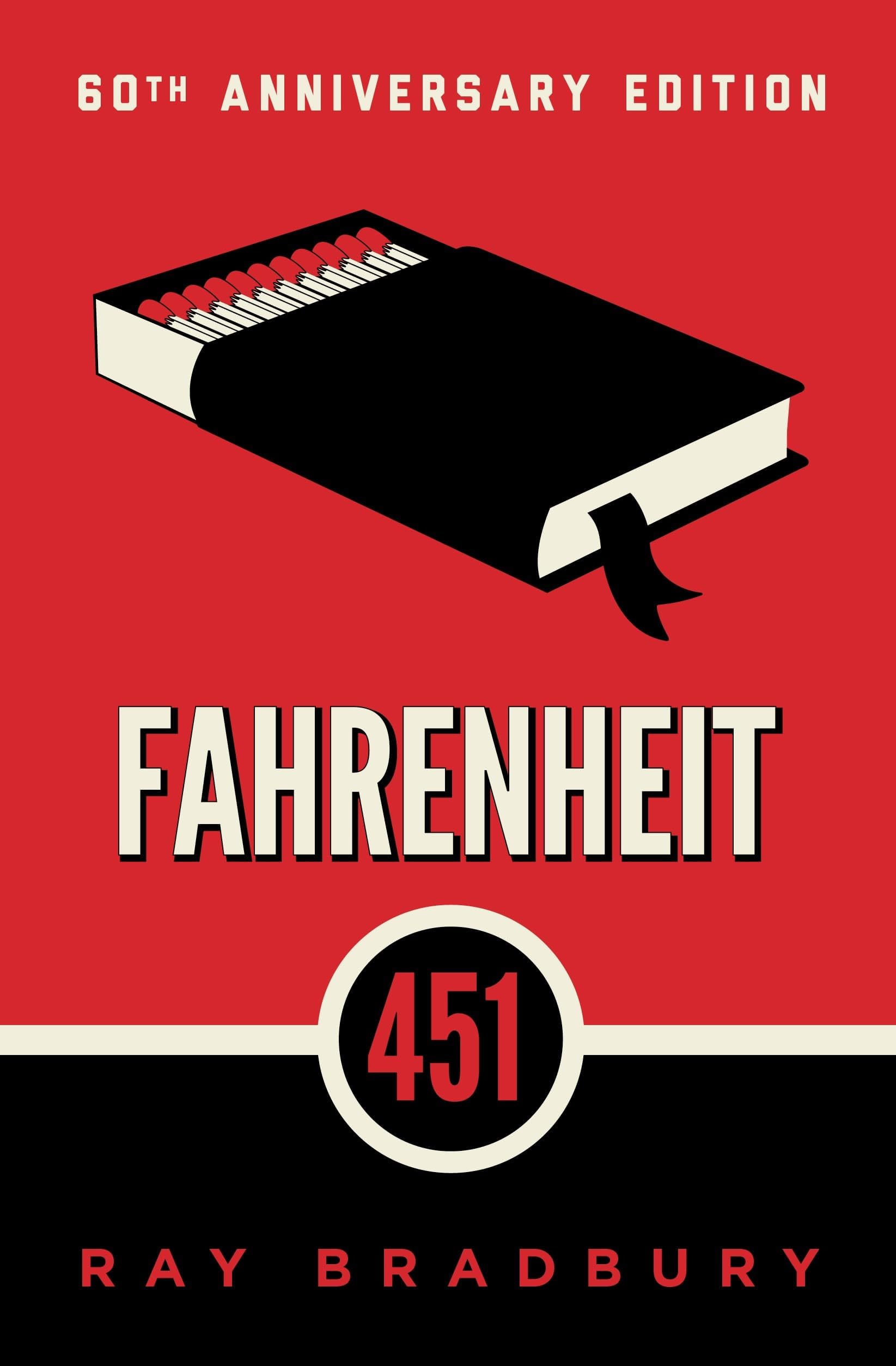
🔥 Ignite your mind with the book that still burns bright in every generation!
Fahrenheit 451 by Ray Bradbury is a critically acclaimed dystopian novel that explores a future society where books are outlawed and 'firemen' burn them to suppress independent thought. With a compelling protagonist and enduring themes of censorship, technology, and resistance, it remains a top-ranked classic with over 59,000 reviews and a 4.6-star rating, making it essential reading for millennials seeking intellectual and cultural relevance.


| Best Sellers Rank | #196 in Books ( See Top 100 in Books ) #1 in Classic American Literature #20 in Classic Literature & Fiction #56 in Literary Fiction (Books) |
| Customer Reviews | 4.6 out of 5 stars 59,970 Reviews |
K**H
Review from Contrary World blog (the premier source for all things dystopian)
Fahrenheit 451 is one of my all time favorites. It's written in the third person, placing you into the shoes of an objective narrator who has special access to the thoughts and world view of the characters within the book, especially that of the protagonist. The protagonist (Guy Montag) actually begins the story as a sort of villain really. His profession is that of a future based fireman, who don’t really put out fires like they used to. In fact, they professionally start fires. What a clever twist on Bradbury’s part. These firemen are sanctioned by what one can only conclude to be a dystopian government to burn books, as well as the houses they are contained within. In this future world, the government has deemed books as dangerous, containing ideas that run counter to the narrative they wish to form and broadcast via televisions that cover entire walls within people’s homes. And the people want this, as they feel more comfortable with their government fed information. How dystopian indeed. Reminds one of the behavior of the Roman Catholic Church during the Dark Ages. The two have book burning in common, as well as burning Bibles (in the case of the RCC, Bibles that didn’t subscribe to their criteria – even though they came from source material originating from the same authors). No offense to Catholics – some Protestant sects weren’t much better (like the early Anglicans who destroyed much of the Church’s property, including relics, as did Orthodox Christians during the Iconoclast Era). Montag takes quite apparent joy in his job, causing a smile to overcome his face every time he gets to burn those devilish books. That is, until he becomes intrigued by a young neighbor girl named Clarisse. Clarisse is a female character that many feminists sadly overlook as to her importance in the overall arc of the story. Good on Bradbury for taking this approach, as you know what they say – “behind every great man, there’s an even greater woman”. This doesn’t always have to imply a spouse, mind you, and Bradbury exploited this fact while using Montag’s lame wife as a great contrast. Clarisse is somehow able to tap into Montag’s emotional capacity to better understand what exactly his job is harming, and how his otherwise dull life (including dull wife who serves as a great example of the brainwashed zombie like people of his society) could become so much more enriched by. This confrontation with not only Clarisse – but himself – causes a sort of psychosis for our villainous protagonist. And thus begins his character development that makes the book really begin to take off and hook the reader into the protagonist’s story arc and growth. At first, Montag struggles with his newfound understanding of the profound beauty of books. He is intrigued by the sense of wonder, emotion, and timelessness that books have to offer compared to the mind numbing talking heads that rule the day (sounds similar to our times with all the political talking heads telling how people should think, unlike books that allow people to draw their own conclusions). Yet he is still skeptical, resisting this newfound understanding as he continues in his line of work. He challenges the notion of books being a net positive for society along the way, including challenging protectors of books along the way. All of this amidst some unknown war going on in the background of the story that is never really described in much detail. I assume that Bradbury himself had assumed (living in the days of the Cold War between the US and the USSR) that some kind of war of that magnitude coming to fruition was sadly somewhat inevitable. As his change of heart is occurring, he struggles with his chief named Beatty (the antagonist of the story). Beatty is a walking contradiction, as he is full of knowledge pertaining to the books they burn. He is so well versed in their content by heart, yet seeks to eliminate books from existence on behalf of the government. Unlike Montag who simply found pleasure in his destructive line of work, Beatty knows full well every reason and intention as to why they do and takes pleasure in doing so. This, all while being so well versed in the knowledge and insights contained within them. He overall sees them as dangerous, yet behaves as if the type of knowledge contained within books should be reserved for elites rather than the average citizen. This antagonist displays the kind of pretentious attitude that perfectly captures what it means to convey the notion of a dystopian society within a book of this genre. After trials and tribulations in his struggle, Montag reaches a point where he is so moved by the message of a particular book, that he even steals it so that he can preserve it himself. As a Christian myself, I personally loved that this book just so happened to be a Bible. Why does Montag take such a personal infatuation with the Bible? It may be that Montag’s society is so lost that when bombs begin to fall toward the end, whatever Montag had read might help him and others rebuild society for the better. After all, the Bible is full of advice, and provides direction for moral and ethical enrichment. Certainly a new society would need guidelines to rebuild and improve over mistakes made in the past. Montag refers to the book of Job at one point in the story, as well as references made about Caanan. At the end, Montag even tries to recall parts of the books of Ecclesiastes and Revelation. The book of Revelation itself (arguably my favorite book of the Bible – I’m a fan of the dystopian genre after all) deals with the end of times. Although, perhaps Montag failed to recall this as quickly as he might because they are preparing to start a new life when the world appears to be ending. The novel ends with Montag escaping the city in the midst of this new war. He escapes deep into the countryside, meeting a band of roving intellectuals who have elected to preserve significant works of literature in their memory. Reminds me of the Vaudois, the Waldenses and the Albigenses who preserved the original books of scripture in spite of the persecution they suffered from the RCC. Not long after these roving intellectuals welcome Montag into their community, an atomic bomb falls on the city and reduces it to rubble. The next morning Montag leads the men on foot back toward the city with rebuilding in mind. The novel’s conclusion functions to bring the prevalent violence to its logical conclusion, which is that violence infiltrates nearly every aspect of the world our protagonist finds himself in. The firemen violently destroy people’s property and lives. Television displays gruesome, desensitizing violence for viewers’ entertainment. Pedestrians regularly get trampled by speeding vehicles. Finally, war takes these forms of violence to a new extreme, destroying society and its infrastructure altogether. The novel’s ending depicts the inevitable self-destruction of such an oppressive society in such an effective, and rather melancholy fashion. As stated in the beginning of the Fahrenheit 451 book review, this book is one of my all time favorites. It’s no wonder as to why I give it a 5/5 rating. Bradbury’s use of language is lyrical, yet not overly forceful. He paints a picture of a world in which we as a society should wish to avoid – in a multifaceted way. When it comes to dystopian books, this is truly a classic – and for good reason. Not only was it tremendous back in its heyday; it has stood the test of time, proving to be of use to us nearly 70 years later. I absolutely love Fahrenheit 451, and I believe you would too if you love dystopian fiction and have happened to somehow not have read it yet (it happens – later is better than never though!).
A**R
Powerful and Thought-Provoking Read
Fahrenheit 451 is a meaningful and eye-opening book, especially for young readers. The story encourages critical thinking about technology, censorship, and the importance of knowledge and independent thought. It’s well written, engaging, and sparks great conversations between parents and kids. A great choice if you want your daughter to read something classic, educational, and still very relevant today. Highly recommend for teens and young readers.
M**S
Thought-Provoking and Memorable Classic
Fahrenheit 451 is a thought-provoking and engaging novel that explores censorship, technology, and the importance of critical thinking. The story remains relevant and sparks meaningful reflection even years after it was written. The pacing and themes make it memorable and impactful. Overall, it’s a strong classic novel that encourages deeper thinking and discussion.
A**L
I wish I could forget it just to read it again 😭🙏
An incredible dystopian novel that really makes you think about censorship, media, and the role of books in society. The writing is vivid and the story pulls you in quickly. Even though it was written decades ago, many of the ideas feel surprisingly modern. A must-read classic.
B**T
In Defense of Digital Books
An awareness of a film remake of Fahrenheit 451 got me digging into this story once again; it was written 65 years ago when I was in the 6th grade and books said it all! Bradbury said that this was the only science fiction book he had ever done and that it was based on reality, what he described as ‘the art of the possible’. I couldn’t remember from the first time I read it how he had dealt with the ideas of book burning and discontent so I went back and reread his original so that I might get to the heart of digital books today. This 1953 novel emerged from his concerns over the threats of the McCarthy era and the historical role that book burnings have played in suppressing dissenting ideas. It describes the dehumanizing of a society where books are outlawed because of the disagreement that they spread. The job of censoring these works and destroying such knowledge was that of the firemen who would burn them. It is considered one of his best works. At the time, he described it as a commentary on how mass media may reduce interest in the reading of literature. The 60th Anniversary Edition of ‘Fahrenheit 451’ was an exciting find for me because in it the original story is supplemented with an assortment of commentary from other admirers and from Bradbury himself. Books were only one type of receptacle where we stored a lot of things we were afraid we might forget. There is nothing magical in them, at all. The magic is only in what books say, how they stitched the patches of the universe together into one garment for us. — Ray Bradbury, Guy Montag is the main character, who has been a fireman for ten years. The story’s focus is on his questioning of his inner thoughts and the dialogue that he is having, or doesn’t have, with his boss Captain Beatty, his wife Mildred, his intriguing and now missing neighbor, Clarisse McClellan, his new-found friend Faber, a retired English professor, and ‘five old men’ that surfaced. Two other items bring their unique coloring to the story, the Salamander fire trucks, complete with fire throwers, and the Mechanical Hounds. I was delighted with Neil Geiman’s Introduction; his words reaffirm the timelessness that the story brought to me. I was born between Bradbury (1920) and Geiman (1960) and I went back to reread the book, already questioning how a story that was written in the past about the future could truly hold up for today’s generation in a world that’s already been dramatically shaped by time and technology in ways that they weren’t even aware of. In he 1950’s, Bradbury already saw computers possibilities in simple terms and saw that nothing but good would be coming from them. He believed that, in a sense, computers were simply books, were all over the place and that computers would be as well. A familiarity exists in the conversations and the silences of the story that is easily recognized as the firemen discuss their work, their lives and the complexities of their relationships; those surroundings seem timeless. The images of Mildred’s ‘family’ in the parlor are quite similar to the multiscreen environments that typically surround us today. Look around you; computers and smartphones count! The relationships that we still have with books goes without saying; they’ve been with us for centuries. The idea that all books could become criminal has always been an absurdity to the masses but the historical role that book burning has played as a means deleting or controlling differences and dissidents is real. ‘Fahrenheit 451’ is a novel first, a fiction, a story about a dedicated fireman, Montag, who believes that all books cause conflicting ideas and must be destroyed. He is part of a zealous effort to purge their existence from society. After meeting Clarisse, he begins to question how his beliefs have been shaped and his curiosity inspires his quest for meaning in words. By story’s end he has become the revolution and a hero for the future of books… just like Bradbury!! I was struck by Bradbury’s comments in Coda (1979) of how he waged a lifelong battle with well-intentioned readers or the actions of cubby-hole editors, fearful of contaminating the young, blatantly changing his words or suggesting that he do. In one instance, he discovered that, bit-by-bit, some seventy-five separate section had been censured from Fahrenheit, causing the entire book to be reset. His point should be obvious; there is more than one way to burn a book and the world is full of people running about with lit matches! This book contains an unprecedented collection of timely wisdom from noted experts from the world of words just in time to bolster my efforts to promote storytelling in today's younger generation, not the least of these are from Bradbury’s own perspectives. Bob Magnant created the Fingertips Series on iTunes to promote the reading, writing and reviewing of books in the digital age. He has written multiple Apple iBooks and is the author of 'Domestic Satellite: An FCC Giant Step' and ' The Last Transition... ', a fact-based novel about Iran. He writes about politics, globalization, the Internet and US policy and lives near the beach in Jupiter, FL.
L**T
Great quality, sobering read.
Great read for 2026. Classic for a reason. Buy this book, you will not be disappointed. Hardcover: pages and print and very nice.
C**N
Great dystopian novel!
This book is set in a future society (through the lens of the American 1950’s) where a fireman’s job is not to stop fires, but to start them. We follow our protagonist, Guy Montag, as he contentedly goes to work everyday and burns books. Sometimes, if there are many books, he and his fellow fireman burn the entire house down, and they do it without question. One day, that question is posed by an eccentric young girl named Clarisse, who challenges Guy’s notions of why he lives the way that he does. He begins to realize that everything in his life is censored to keep him from thinking. The reasoning is ostensibly that hard and difficult thoughts and ideas (like those held in books) make people unhappy, as it forces them to think. As an added example, his wife spends all day at home with her “family,” which is really just a wall of televisions that keep her entertained and thus unthinking. I found it poignant that even in the early 50’s, television had been identified as a tool for media barons to spread mass influence, especially when you consider the addiction that television and media has become in today’s age. So, Guy pushes back against the system in control (by reading a book) and he is subsequently pursued as an outsider. His life is turned upside down, he flees, and by the end of our story, he finds himself amongst the rebels. These “rebels” are former college professors and intellectual thinkers who have been cast out of the system and now live in the forest as homeless men. Their mission in life, and how they show their resistance, is by remembering. They remember the knowledge of old, things that used to be held in books, and their hope is to someday bring humanity’s collective intelligence back to the forefront of society. What I really liked about this book was the thought put into the characters. Sure, Guy is your average guy, as his name suggests, and his wife is cast as the sucker of the system, refusing to be enlightened and instead choosing to live in blissful ignorance (at one point in the book, Guy is raising his concerns about not being happy in their shallow lives, and his wife responds “I’m tired of listening to this junk” and promptly turns from Guy back to her television program.) But I found it impressively accurate that the initial crack in the facade came from youth. At a certain age, people seem to come to a form of societal acceptance, and I loved that it was essentially a child who came along and finally asked the all important question: “Why?” It made me wonder, what do we adults lose by forgoing our ability to continually ask this question, both of ourselves and the world around us? Another character I liked was the fire captain Beatty. Every dystopian novel needs an antagonist and this is Beatty’s role. However, while it makes sense that the haggard professors comprise the resistance, Beatty is also an educated man having read many pieces of literature and views the information in books in an opposing light. He has found them to be endlessly contradictory, and thusly tools of unhappiness, and has found comfort in his mission to destroy them. I found it fascinating that the author showed learned characters who, when presented with the same world-choices, made opposing decisions. I think it really goes to show the differing wisdoms of individual people. Two people can read the same book, and while one can love it and the other hate it, both can be correct, because it is (in most cases) a subjective medium. Now, framed as the antagonist, some might say that Beatty took the ‘easy’ way out. But would it also be appropriate to suggest that in a world overflowing with chaos, he accepted the path of least resistance? Would there be merit in a condemnation of his choice, or should we opt for mercy? Or neither, and should we, as both readers of fiction and also members of our current society, accept his decision and the reasons behind it? I don’t have answers to these questions, and I think it wise not to try and decide. Instead, I think we should all periodically ponder them, especially as we find ourselves making similar decisions in our own lives, and watch others close to us do the same. Society doesn’t move forward when we force our opinions onto other. True merit is born of the perpetual quest for understanding and always asking why?
E**E
So-so
Fahrenheit 451 by Ray Bradbury illustrates a dull society that has taken technology to a whole new level. But, even though technology may be luxurious and highly tempting, the overuse of technology may lead to the loss of humanity and a sense of isolation. While battling his sanity and the rest of the preoccupied society, the main character, Montag, must determine his future, while attempting to cling to his humanity. The book is placed sometime after the year 2022. The United States has won multiple nuclear wars, the citizens live in a deep technology induced stupor, and books are prohibited. If books are discovered, it is the firemen’s job to burn them however, not all firemen are against owning books. Ray Bradbury’s descriptions of the blazing fires and indifferent people convey a depressing, unimaginative feeling to readers. Guy Montag, a 30-year-old fireman, struggles to see how people can sit and watching actors, referred to as “relatives” talk about nothing and still be happy. Montag worries that the nothingness of the society has isolated people, forcing them to forget who they really are and what real happiness is. He wonders about books and why people would spend so much time writing them if they are not worth reading and offend people. He really begins to challenge society, after Clarisse McClellan, one of his neighbors, asks him if he is happy. Clarisse is a 17-year-old oddball that is confined by a society that she does not understand. She is somewhat of a wonder because her family talks to each other and she doesn’t relate to people her own age, however, this also means that the government is keeping tabs on her. Although Montag only knows Clarisse for a brief time, she has a significant impact on him. Fahrenheit 451 begins when Montag is walking home from work and runs into Clarisse. On the way home, she repeatedly asks him prying question that he either does not want to answer or does not know how to answer. Montag and Clarisse continually meet up until Clarisse goes mysteriously missing. During her absence, Montag begins to wonder why he is so unhappy and how his wife, Mildred, and the rest of the people can live with all of the technology but without each other. Montag’s unhappiness leads to some unexpected twists and does not go unnoticed by his boss, Captain Beatty of the firemen. Beatty holds an intervention with Guy telling him that there are certain individuals, Beatty being one of them, that are allowed to read books, but those people understand how dangerous books are and how books can corrupt thoughts. Other people must be given false information and a distraction in the form of technology, so that they can live in happiness. Montag is not satisfied by this and goes in search of someone he can talk to. He finds Faber, a retired English teacher, who gives him a different opinion of books. Torn between two different outlooks, Montag must discover his own beliefs. Once Montag makes up his mind, he sets forth onto the path less travelled to free himself from the grasps of technology, isolation, and the society that he was once satisfied to be a part of. Ray Bradbury successfully keeps a readers attention with sudden, unexpected transitions and surprises that could never be predicted. The deep descriptions, while nice for visualization and breaking the action, where very easy to get caught up in, which sometimes made it difficult to understand what was happening. Additionally, the excessive number of questions was confusing and difficult to follow. Readers searching for action packed quick reads should look elsewhere whereas readers that desire an intense novel with a little action but more internal conflict should definitely read Fahrenheit 451. It is better suited for older readers with longer attention spans. Although it is not action packed or particularly fast paced, Fahrenheit 451 is an interesting novel that warns us that rapid advances in technology may seem wonderful, however, it may actually lead to our destruction.
C**E
A classic!
Amazing read!
Ö**N
Distopya Şaheseri
Ray Bradbury'nin yakın gelecekteki korkulara ilişkin kaleme aldığı baş yapıtı.
A**K
良書
かなり昔に書かれた本であるが、内容は現代社会の問題にも非常に関連しており、作者の先見性には驚かされた。
G**D
Perfect product
Quick delivery, well packed, products as displayed, very pleased!😁
D**I
ok
książka klejona, dość szybko złamał mi się grzbiet; sama treść nie zachwyca, ale nie jest też tragiczna
Trustpilot
2 weeks ago
2 months ago