We remain fully operational. Our teams are working around the clock to ensure your deliveries continue safely.

قم بتنزيل التطبيق


معلومات عنا
حقوق الطبع والنشر © 2024 Desertcart Holdings Limited
قم بتنزيل التطبيق
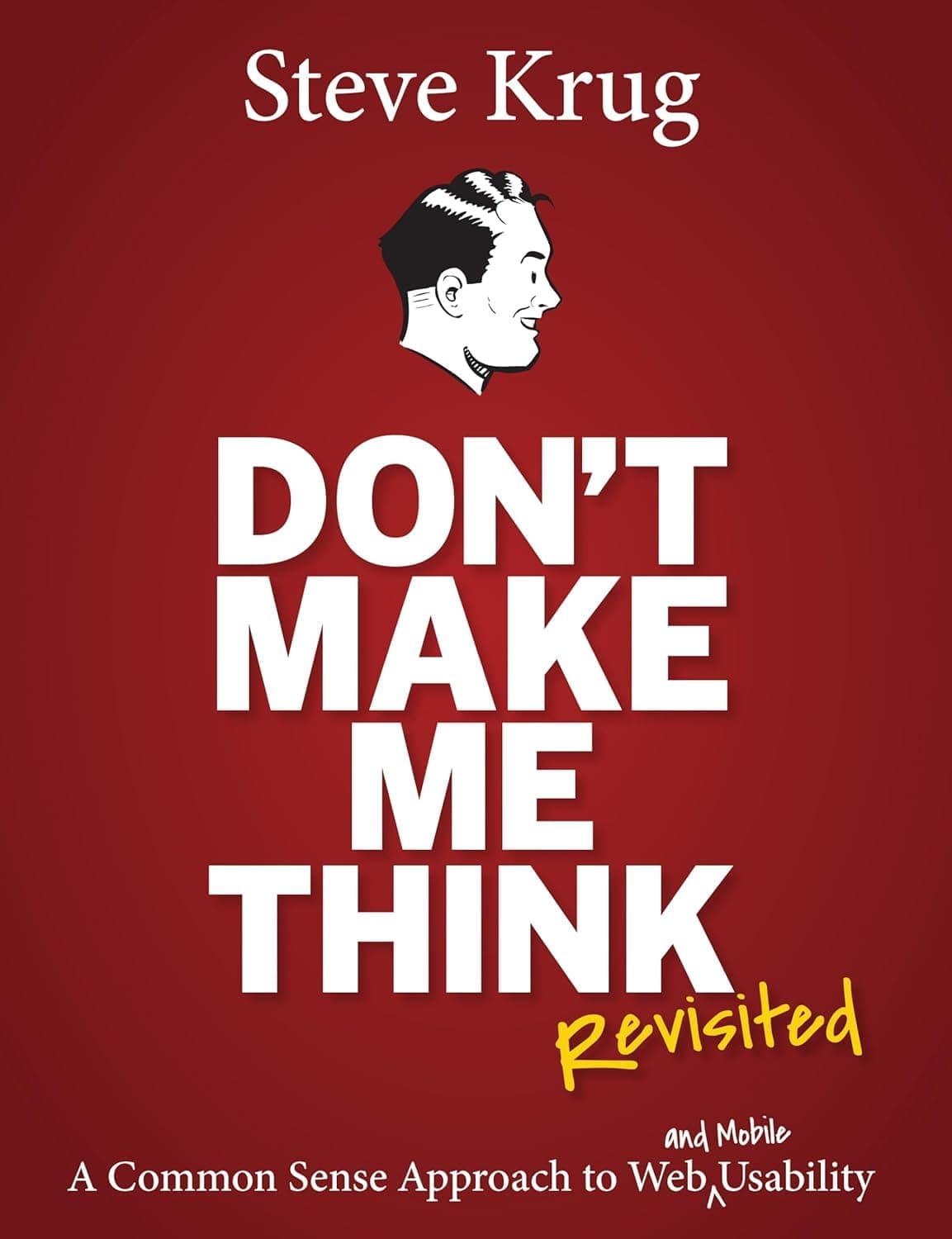
Don't Make Me Think, Revisited: A Common Sense Approach to Web Usability (3rd Edition) (Voices That Matter) [Krug, Steve] on desertcart.com. *FREE* shipping on qualifying offers. Don't Make Me Think, Revisited: A Common Sense Approach to Web Usability (3rd Edition) (Voices That Matter) Review: Bible of web usability common sense - I am a doctor, a surgeon, so you would say why are you reading “Don’t make me think”. Good question. Today we all live by the web, through smart phones and PCs, apps and websites, not to mention social networks that I personally have not yet discovered. The web and its usability is part of our common language, a new alphabet, grammar and syntax we have had to learn to live in our world and get along in our profession and free time. But if you met a person who was only able to speak and not read and write you would say he is an analphabet, the same is not true for a user of the web from whom no one expects she/he be able of composing or better designing a website or an app. Presently, many domain professionals are willing to designing web content necessary for their specific necessities, but not yet able to do it by themselves and look for “primers” or “how to..” books to help them start or go pro in this activity. “Don’t make met think” is I believe one of the basic books to learn from. Not only it is easy to read and very clear, but it is also funny, entertaining, full of useful information and at the same time systematic and complete. Steven Krug is evidently a guru of web usability and he has reached the 3rd edition of his book that has filled the minds and hearts of thousands of computer people. It has been and is so popular I believe because it gets to the point of how to think before starting to design. In some ways it is almost a psychology text or better it uses a practical psychological approach to give simple directives to follow in order to keep on the right tract while carrying out design. It sidetracks into information on attention, the use of time, expert remarks on design and interfaces and also on how people actually think. A whole chapter is focused on ethics of web design: a web site should be a “mensche” or as we would say in Italian “un uomo d’onore”, a man of honor, and another on mobile applications with all their space related problems. So, if you are a information technology specialist or if you are an amateur wanting to learn how to design an app or a website, this book is a good point to start from. Read it, love it and treasure its teachings. Review: Buy, don't rent, this usability text! - ***SPOILER ALERT*** I share Steve Krug’s definition of Usability (even though he doesn't share it until the last chapter) here because I feel it describes his own book so well: Usability: “A person of average (or even below average) ability and experience can figure out how to use the thing [i.e., it’s learnable] to accomplish something [effective] without it being more trouble than it’s worth [efficient].” This book is learnable in that its format is structured but delightful, with clearly laid out chapters with copious illustrations that enhance and amuse without distracting. It has a full index and easy-to-reread organization, which I know I will be turning to again and again as I perform regular usability testing on my company’s website. This book is effective in its recommendations for how (and why) to design sites to be usable and then later to regularly test the usability of what you have created, being ready to tweak based on the results. Many other reviewers have said it, and I mean it: I am going to make this book required reading for all stakeholders in our company website. Whether we digest individual chapters at weekly staff meetings or people read it on their own, there is too much good content in Don’t Make Me Think to keep to myself. And finally, this book is efficient. Weighing in at a scant 200 pages (yes, exactly 200), it still contains enough deep thought and meaty content to be truly useful. Krug just follows his own directives and writes the book as if writing for the Web, spare and concise, making good use of headings and bullet points to clearly get his message across. I salute his inclusion of the revised chapters addressing the “Wild West” of development for mobile platforms, even though trends are still in flux as developers work out what works and what doesn’t. He is understandably cautious to embrace any trend, and at this point, that is wise. I do look forward to the next revision, however, to see his take on the latest developments. Don’t Make Me Think was required reading for a course on Emerging Web Trends, and I cannot think of a better text. I have already ordered many of the other books Krug recommends for my holiday reading, and appreciate his inclusion of links to helpful supplementary materials on his own website. If you are a student considering whether to rent or buy this textbook, I would definitely vote “buy.” This one is a keeper.





| ASIN | 0321965515 |
| Best Sellers Rank | #44,732 in Books ( See Top 100 in Books ) #12 in Web Design (Books) #50 in Computer Science (Books) |
| Customer Reviews | 4.6 4.6 out of 5 stars (4,637) |
| Dimensions | 7 x 0.49 x 9 inches |
| Edition | 3rd |
| ISBN-10 | 9780321965516 |
| ISBN-13 | 978-0321965516 |
| Item Weight | 15.2 ounces |
| Language | English |
| Part of series | Voices That Matter |
| Print length | 216 pages |
| Publication date | December 24, 2013 |
| Publisher | New Riders |
M**A
Bible of web usability common sense
I am a doctor, a surgeon, so you would say why are you reading “Don’t make me think”. Good question. Today we all live by the web, through smart phones and PCs, apps and websites, not to mention social networks that I personally have not yet discovered. The web and its usability is part of our common language, a new alphabet, grammar and syntax we have had to learn to live in our world and get along in our profession and free time. But if you met a person who was only able to speak and not read and write you would say he is an analphabet, the same is not true for a user of the web from whom no one expects she/he be able of composing or better designing a website or an app. Presently, many domain professionals are willing to designing web content necessary for their specific necessities, but not yet able to do it by themselves and look for “primers” or “how to..” books to help them start or go pro in this activity. “Don’t make met think” is I believe one of the basic books to learn from. Not only it is easy to read and very clear, but it is also funny, entertaining, full of useful information and at the same time systematic and complete. Steven Krug is evidently a guru of web usability and he has reached the 3rd edition of his book that has filled the minds and hearts of thousands of computer people. It has been and is so popular I believe because it gets to the point of how to think before starting to design. In some ways it is almost a psychology text or better it uses a practical psychological approach to give simple directives to follow in order to keep on the right tract while carrying out design. It sidetracks into information on attention, the use of time, expert remarks on design and interfaces and also on how people actually think. A whole chapter is focused on ethics of web design: a web site should be a “mensche” or as we would say in Italian “un uomo d’onore”, a man of honor, and another on mobile applications with all their space related problems. So, if you are a information technology specialist or if you are an amateur wanting to learn how to design an app or a website, this book is a good point to start from. Read it, love it and treasure its teachings.
D**S
Buy, don't rent, this usability text!
***SPOILER ALERT*** I share Steve Krug’s definition of Usability (even though he doesn't share it until the last chapter) here because I feel it describes his own book so well: Usability: “A person of average (or even below average) ability and experience can figure out how to use the thing [i.e., it’s learnable] to accomplish something [effective] without it being more trouble than it’s worth [efficient].” This book is learnable in that its format is structured but delightful, with clearly laid out chapters with copious illustrations that enhance and amuse without distracting. It has a full index and easy-to-reread organization, which I know I will be turning to again and again as I perform regular usability testing on my company’s website. This book is effective in its recommendations for how (and why) to design sites to be usable and then later to regularly test the usability of what you have created, being ready to tweak based on the results. Many other reviewers have said it, and I mean it: I am going to make this book required reading for all stakeholders in our company website. Whether we digest individual chapters at weekly staff meetings or people read it on their own, there is too much good content in Don’t Make Me Think to keep to myself. And finally, this book is efficient. Weighing in at a scant 200 pages (yes, exactly 200), it still contains enough deep thought and meaty content to be truly useful. Krug just follows his own directives and writes the book as if writing for the Web, spare and concise, making good use of headings and bullet points to clearly get his message across. I salute his inclusion of the revised chapters addressing the “Wild West” of development for mobile platforms, even though trends are still in flux as developers work out what works and what doesn’t. He is understandably cautious to embrace any trend, and at this point, that is wise. I do look forward to the next revision, however, to see his take on the latest developments. Don’t Make Me Think was required reading for a course on Emerging Web Trends, and I cannot think of a better text. I have already ordered many of the other books Krug recommends for my holiday reading, and appreciate his inclusion of links to helpful supplementary materials on his own website. If you are a student considering whether to rent or buy this textbook, I would definitely vote “buy.” This one is a keeper.
A**R
Great book… weird printing paper
Love the book, but I do not like the paper that it is printed on. It’s kinda cheap paper and it feels strange on the skin. Otherwise the book contents are 100% golden information. It’s worth looking past the weird paper used.
T**P
Straightforward, witty, and informative
As a front-end developer, user experience design is something that I work with on a daily basis. After being recommended this book from multiple sources, I decided to give it a go. The first thing I truly appreciate about this book is that the author seems to understand that my time is valuable, and he was very concise with his writing and structure. Too many textbooks ramble on and on as if they are simply trying to fill the pages of their book. This book, as you can tell by the thickness (or lack thereof), is not written that way. This book is written in an informal but also informative manner. The humor keeps it interesting without reaching the point of distraction from subject matter. All information is presented in a way that puts an emphasis on practicality and real-life examples. I recommend this for anyone who is looking for an introduction and overview of user experience design practices. As a developer, it has proven very useful for me.
A**R
Don’t make me think book gives very nice explanation about web usablity for website designers and web product developers. The book mainly focuses on general guideline about how to make a web pages so that a user doesn’t have to think much and can understand fast from the design and placement of the sections. It also explain how to design different sections of the page so that user can easily identify what he/she is looking for and how to go back from here. How a home page should look a like. What a home page should contain. Book is really nice for a web developer as well web deigner.
A**.
A must-read for anyone in UX design.
G**O
I read this book when starting studying user experience for web design and i can say i strongly suggest to anyone.
A**A
You can learn a great deal of UX best practices from this book alone. I highly recommend reading it. .
T**E
All reccommendations!
ترست بايلوت
منذ شهر
منذ أسبوعين