We remain fully operational. Our teams are working around the clock to ensure your deliveries continue safely.

قم بتنزيل التطبيق


معلومات عنا
حقوق الطبع والنشر © 2024 Desertcart Holdings Limited
قم بتنزيل التطبيق
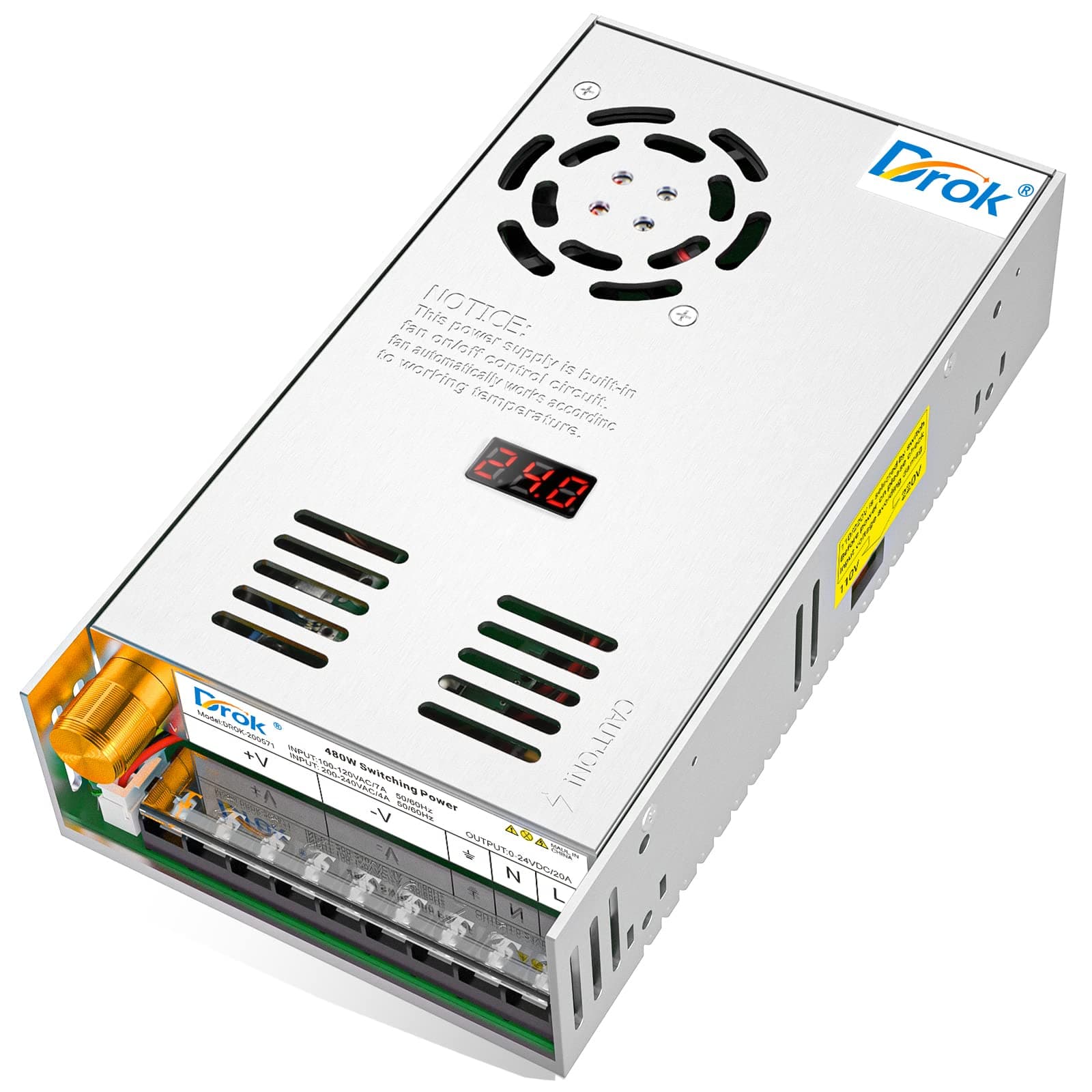
⚡ Power your projects with precision and confidence — never settle for less!
The DROK 24V Power Supply is a versatile, high-performance buck converter delivering up to 480W with a variable 0-24V output and 20A max current. Featuring an LED display, advanced cooling system, and multiple safety protections, it’s designed for professionals needing reliable, adjustable DC power for labs, computers, and electronics testing. Its plug-and-play design and wide input voltage compatibility (110V/220V) make it an essential tool for millennial managers demanding efficiency and control.


| ASIN | B08GFSVHLS |
| Best Sellers Rank | #33,095 in Tools & Home Improvement ( See Top 100 in Tools & Home Improvement ) #138 in Power Converters |
| Brand | DROK |
| Brand Name | DROK |
| Customer Reviews | 4.5 out of 5 stars 409 Reviews |
| Manufacturer | DROK |
| Model | 20050 |
| Part Number | 200571 |
| Specification Met | CE, FCC |
R**Y
Taig Micro lathe DC motor setup
I am using this Drok 115VAC to 24V 20A variable power supply, along with a YaeTek 24V DC 350W Permanent Magnet Electric Motor, to drive my Taig Micro II lathe. Considering this whole kit cost about $80 I'm very happy with the result. While not perfect, the value is so high I have to give it 5 stars. If you've been thinking about one of these motors for your micro lathe I say, go ahead! If you are running the 115VAC Marathon motor that Taig sells, then you know about that motor. It's OK, but the speed range with the 4 step pullies is 430 RPM to 1725 RPM, pretty high for larger parts. And it's big, heavy, and kind of brutish - there is no way you need that much power, nor can it even be transmitted with the stock belt. This DC motor setup runs well down to about 5 volts/570 RPM, which is a lathe speed of 140 RPM. It will go a lot slower, but it sounds a bit notchy. It's happier above 5 volts, and I usually have it set about 16 Volts, which makes a lathe speed of 450 RPM to 1800 RPM. The power supply goes to 28 volts and the motor is spinning at 3200 RPM. This PS has been flawless in this application. It is the voltage regulated only model. Using a "Kilowatt" meter I'm seeing up to about 120 watts in my application. So, about 5A at 24V. The PS seems perfectly happy, and the fan has never turned on. Judging from the motor whine while running the lathe there is a very minor variation in RPM with no load, just a few RPM or small fraction of a percent speed. Under cutting load I've not noticed any significant speed change - it does sound like the system is working harder but that's normal. The motor has plenty of torque for this application. At 7V I have no trouble machining 2" diameter aluminum at a no drama SFM. Once again, the belt is the limitation. The only negative for me is the motor is kind of loud. It makes an ever rising pitch and volume whine as RPM increases. I only use this lathe for occasional small parts, so the noise doesn't matter. If you are doing production, it might get tiresome. Who knows how long it will last. Considering it's intended use as a scooter motor I'm hoping with this very light lathe duty it will last forever.
A**G
Cheap alternative to a benchtop supply.
I got this to kind of use as a benchtop supply. I had a variety of DC motors I needed to test, at a variety of voltages and power ratings. They were intended for battery powered applications, but I didn't have the variety of batteries I would have needed to test them. I looked at actual benchtop power supplies, and they all seemed to top out at about 10 or 11 amps, and were much more expensive. Before ordering this, I hadn't seen anything like this before, although they look to be pretty common. I also bought some leads that I connected to it to make it easy to connect and disconnect what I am powering. It worked perfectly. Provided the voltage range and current I needed and one of the motors, was 24V DC and drew 17.5 Amps, which this provided with no complaints. While I do appreciate the Voltage indicator as a rough guestimate of the voltage, probably "good enough", I did hook up a more accurate meter to set the voltage during my testing. It was easy to get it to within a few 10ths of a volt, but getting it much finer than that took a very delicate touch, but with patience, I could even get it to the hundredths and once there, it would hold it. I see they have another model where it has both voltage and current limit adjustments, and I am thinking I might pick one of those up too.
J**E
Excellent Supply so far
This works really well, the adjustment range isn't super precise but you get the full range (mine goes up to something like 27.7V) and the accuracy seems good, when checked with my cheap multimeter it's always within about 0.2V... For the price this adjustable supply has so many possibilities; I'm currently using it to power a ~12V diesel heater with a lead-acid battery backup during the winter from the mower. I set it at 12.7 to 12.9V and it keeps the battery topped off and runs the heater no problem. Only complaint would be that there's no eyelets or anything to mount it, just a few threaded holes for machine screws, but I'm not removing any stars for it at this price!
R**.
Excellent product.
Appreciate reliability and precise voltage. Very nice forgiving current overdraw safety features. Does not however tolerate water below circuit board. Had severe rain which fried component in replaced power supply, but it lasted 2 years of constant use Very nice unit for the money
A**R
Great buy
I absolutely love this power supply. This is the second power supply that I've owned and I really enjoy that I can adjust the voltage with the knob it has held up for you multiple months now and I really appreciate the voltage adjustment switch on the input side too.! Bonus points use the multimeter and the voltage adjustment is accurate. The fan's not noisy. And bonus points it sustained no damage when I accidentally shorted wires due to a bad connection and the wires overheated but the power supply is still a chance
I**E
Impressive - doesn't drop voltage even exceeding its max power
I've been using this for a year on a 3D printer I designed and due to a miscalculation, I thought I only needed a 400w during experimental runs. I've pulled up to 450 watts or so at a time and never saw the voltage drop. I have it up at 25.1v. Meanwhile I have some LED power supplies from China I figured I'd give a go and the 300w model drops to 16v at 130w... Won't make that mistake again. DROK might sound generic but it's a real brand with a real name!
M**T
Cheap variable voltage (not amperage) power supply
I only briefly used this to to verify it is functional. It goes down to about .8 volts and up to 24 volts. It can be touchy to get the exact voltage you want. You can't control how much current it puts out, so for projects this may not be a good option. For powering existing devices this works fine.
A**S
Remember to set the input voltage switch!
When I first installed this power supply I forgot to set the input voltage switch to 115V. As a result the power supply delivered *almost* 22.8V when the dial was set to the maximum. This led me to erroneously believe it had poor regulation and I was about to return it and posted a negative review. After having a careful look, I set the input voltage switch to 115V and readjusted the dial. It now delivers the correct voltage and sustains it within the load range I am using it with. So my suggestion is to first have a look at the input voltage switch as it probably comes set to 230V by default in most or all units, which in the North American market is the wrong setting. I have been unable to hear the fan so far, despite elevated temperatures this time of the year, but my application uses less than half the available current. I will update the review if at any time I hear anything unusual.
ترست بايلوت
منذ يومين
منذ شهر