We remain fully operational. Our teams are working around the clock to ensure your deliveries continue safely.

قم بتنزيل التطبيق


معلومات عنا
حقوق الطبع والنشر © 2024 Desertcart Holdings Limited
قم بتنزيل التطبيق
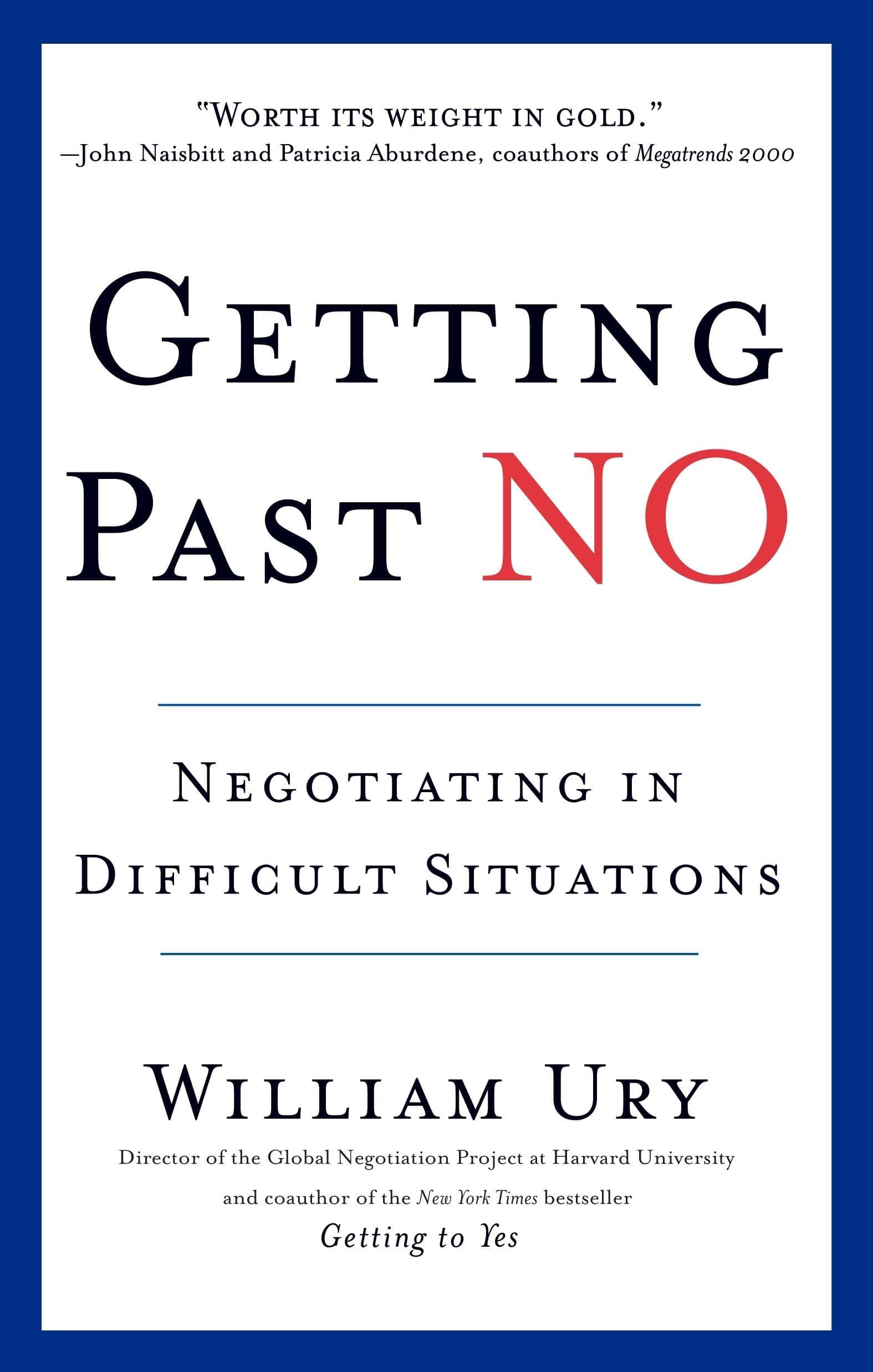
Getting Past No: Negotiating in Difficult Situations : Ury, William: desertcart.co.uk: Books Review: Five Stars - Very Nice Review: Five Stars - Excellent

| Best Sellers Rank | 519,155 in Books ( See Top 100 in Books ) 24,401 in Psychology & Psychiatry 31,347 in Business, Finance & Law |
| Customer reviews | 4.6 4.6 out of 5 stars (1,081) |
| Dimensions | 13.41 x 1.52 x 20.9 cm |
| Edition | Revised ed. |
| ISBN-10 | 0553371312 |
| ISBN-13 | 978-0553371314 |
| Item weight | 1.05 kg |
| Language | English |
| Print length | 208 pages |
| Publication date | 1 Jan. 1993 |
| Publisher | Bantam USA |
H**K
Five Stars
Very Nice
B**T
Five Stars
Excellent
M**@
Five Stars
Excellent
N**O
Five Stars
Good
C**C
Negotiating with difficult people.....5 straightforward steps
William Ury wrote here an excellent sequel on the bestseller "Getting to Yes" and expands hereby the negotiation tools set to be more equipped towards dealing with the difficult person in a negotiaton (or situation). The book follows 5 steps. It covers basic communication styles to diffuse the situation and elements to boost your BATNA (your best alternative) overall. The content list of his book gives already some ideas of this approach. The book covers these 5 steps in a schematic way, by being brief and very much to the point. Compact written and easy to assimilate. William Ury does also give the course "Dealing with Difficult People and Difficult Situations" at the Program on Negotiation (PON) at Harvard Law School. This course follows also these 5 steps as illustrated here in this book. He is certainly a highly experienced and empathic speaker. He is a great person to come across and therefore I am not surprised he wrote a excellent book like this. I certainly highly recommend his book, his negotiation course, as well as William Ury as public speaker/trainer. Content: Overview: Negotiating with difficult people Step 1: Go to the balcony (Don't react) - Keep your eyes on the prize o Identify your interests o Identify your BATNA o Decide if your should negotiate o Stay focused on your goal - Name the game - Buy time to think o Pause and say nothing o Rewind the tape o Take a time-out o Don't make important decisions on the spot Step 2: Step to their side (Disarm them) - Listen actively o Give your opponent a hearing o Paraphrase and ask for corrections - Acknowledge the point & the person o Acknowledge your opponent's feelings o Offer an apology - Agree wherever you can o Agree without conceding o Accumulate Yeses o Tune in to your opponent's wavelength - Acknowledge the person o Acknowledge his authority and competence - Express your views without provoking o Don't say BUT, say YES...AND o Make I statements, not you-statements o Step up for yourself o Acknowledge your differences with optimism Step 3: Don't reject....reframe (Change the game) Step 4: Build them a golden bridge (Make it easy to say YES) Step 5: Educate, don't escalate (Make it easy to say NO) Conclusion: Turning adversaries into partners Analytical table of contents
N**A
Five Stars
Really good book.
T**O
Cover did of the actual book did not correspond to ...
Cover did of the actual book did not correspond to the picture. I have received a different addition of the book
R**I
Concise, practical book on negotiating
Best-selling author William Ury has the topic of negotiation down cold. Reading this classic book (originally released in 1991) is a pleasure and the reasons it became a bestseller are obvious: It is clear, concise and eminently readable. This book has such wide appeal that getAbstract recommends it to all businesspeople and to anyone who ever needs to negotiate about anything - from cops bargaining with hostage takers to consumers pushing for the best car prices. Read this book and become a better negotiator.
P**M
Good high level negotiations strategies but just a couple of practical examples makes the book not so interesting.
B**.
Sehr lesenswert, viele praktische Beispiele und kurzweilig geschrieben - hilft dabei etwas "um die Ecke zu denken" wenn es um kleinere oder größere Verhandlungen geht
J**N
In his superb book, William Ury builds on the pricipals first put forth in his first book with Roger Fisher, "Getting To Yes." In "Getting Past No" Ury discusses the nuances and niceties of negotiating using a joint problem solving approach which is "interest based" rather than being "rights based" or "power based." Ury explains that the challenge is to convert a confrontational situation to a cooperative creative problem solving process, that integrates the parties in a negotiation into a cooperative mode, that results in the best long term agreements. The specific wonder of this book, is its focus on what to do, when you don't know how to get past a problem. Ury calls his method the "Breakthrough Strategy" and is virtually totally as applicable for mediators as it is for negotiators. In fact, several times, Ury mentions that a mediator may assist the process. Simply put, Ury contends that there are basically 5 things that one needs to do to preserve smooth negotiations and to break through an impasse if it occurs. He calls these 'steps' by the following designations: "Go To The Balcony", "Step To Their Side", "Reframe", "Build Them A Golden Bridge" and "Use Power To Educate." These simple concepts are extremely useful tools for negotiators and mediators alike. There is no disappointment in this book. The approach and the writing style are just superb. Once again, the Harvard Group, especially William Ury, have produced a book that anyone can gain from and is almost a must for those in dispute resolution and negotiation on a day to day basis.
T**O
Useful and succinct.
A**A
Le bouquin est un succès auprès de mes proches aussi. Il est très complet avec des vraies clés de négociation.
ترست بايلوت
منذ أسبوعين
منذ شهرين
منذ 3 أسابيع
منذ 5 أيام