
📈 Elevate your signal processing IQ — the ultimate guide you can’t afford to miss!
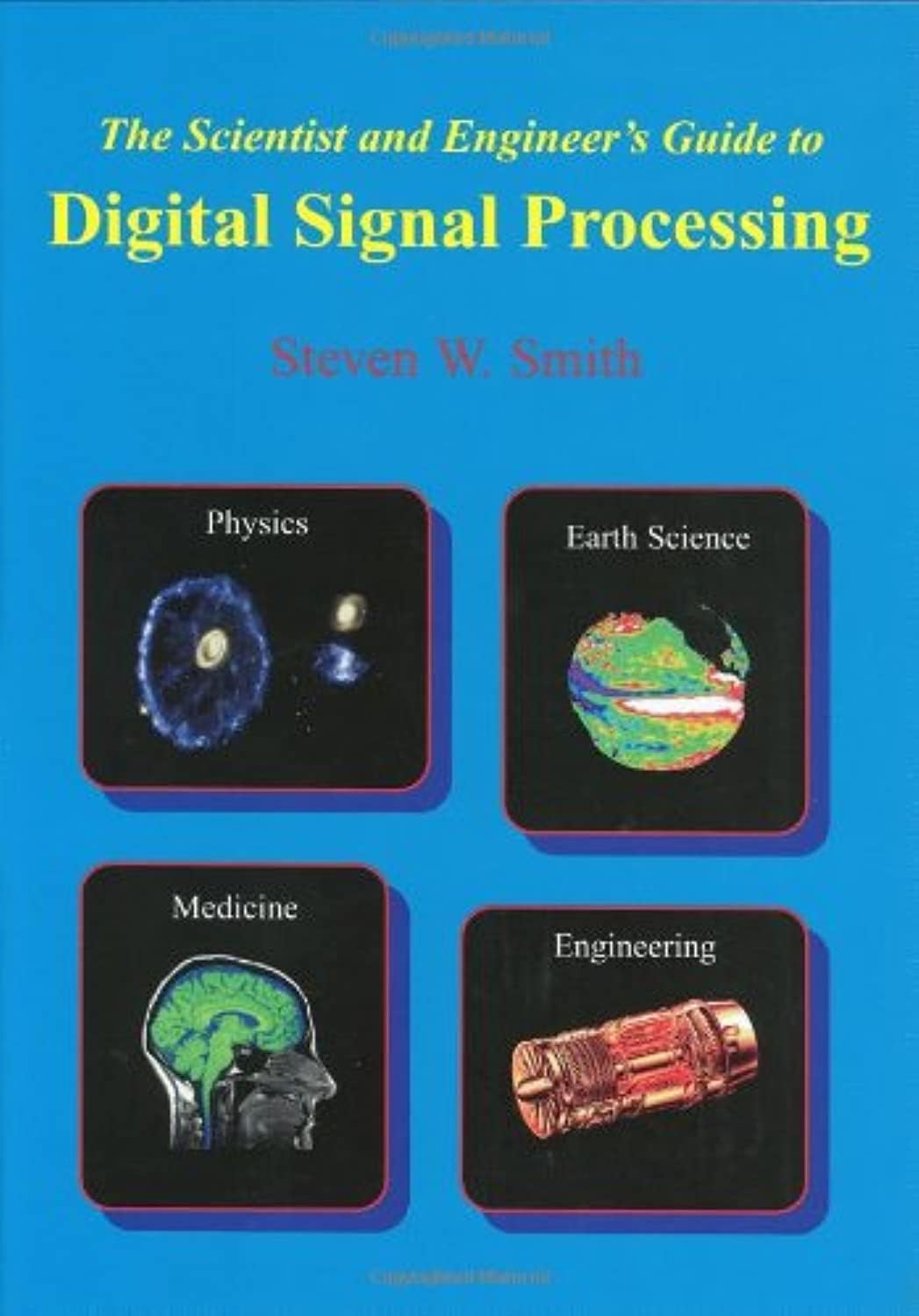
The Scientist & Engineer's Guide to Digital Signal Processing by Steven W. Smith is a highly rated, accessible textbook that expertly balances theory and practical application. With clear explanations, abundant visuals, and a conversational style, it’s a must-have resource for engineers, scientists, and managers seeking to master DSP fundamentals and mechanics. This used copy in good condition offers a valuable opportunity to own a timeless classic that enhances both academic and professional growth.
| Best Sellers Rank | #560,450 in Books ( See Top 100 in Books ) #22 in Computer Hardware DSPs #2,385 in Technology (Books) #10,918 in Engineering (Books) |
| Customer Reviews | 4.8 out of 5 stars 200 Reviews |
J**.
timeless and extremely well-written
This is without question the best academic book I've ever read. Mr. Smith is so articulate and clear. He starts at the very beginning and approaches each new concept carefully, building on the concepts you've already read about. Usually when I'm having difficult understanding something, I find he has already answered it in the previous page. His presentation is logical, intuitive, and on occasion entertaining. It's concise and well-formed but not off-putting like the majority of text books I've read. All the information is there and in plain English. A monkey (who understands English, of course) could read this book from start to finish and be an expert in DSP. I found the pdf online but ended up buying the book just because it was so good and I wanted a copy to make notes in and cherish.
K**T
An Excellent Theoretical Review of Digital Signal Processing
This is an excellent college-level introduction to digital signal processing, especially if you wish to learn more about the underlying theory and application; i.e., how signal processing actually works. Yes, there is some math, but it's not the primary focus, and the author is very upfront about this. The author's style is conversational and friendly, and he provides plenty of examples, graphs and pictures, with a focus on the actual mechanics of signal processing. This is in contrast to a number of DSP texts that emphasize the underlying mathematics over the mechanics, some to the point where one wonders how the actual mechanics of signal processing even work. This book fills in those gaps. It should probably be read before taking on a math-heavy course or used in conjunction with one. I would recommend it as a primer or tutorial before beginning a typical engineering course in DSP or to have on hand while working with the standard math-heavy text. It will really fill in the knowledge gaps.
W**K
This book fits the bill.
I've really needed to know about DSP for a while, so I decided to dive in. The inter-webs said that this was the right book, and it sure is. Cleanly written, it has nicely filled in the math fuzzy patches from classes 40 years ago, and then proceeded into the good stuff. I am getting it strictly under self-study, and it is helping with an app I am building. I bought the book, but couldn't wait to start, so downloaded all of the on-line chapters and started working through them. When the book arrived, I found it wasn't an exact match: the author's web page has a few extra chapters near the end. But it is the same great stuff. I will continue through all this on the beach over the next week. It has been a while since I have been this excited about math.
J**G
Very well-written
Even thought this book is available online, after reading a few sections me and my fiance liked it so much we wanted to support the author and buy a hardcover copy as well. It covers a range of DSP topics in a way that is very easy to understand but with enough details to be useful and applicable. I was not taking this for a class, just found the topic fascinating and the presentation in this book makes it an enjoyable read. For example, in the section on how visual images can be processed, there are also details on how our eyes process visual information and how the electronics have parallel functionality. Another example of the kind of presentation I like: the edge detection section has pictures to demonstrate transforms that can be done on images and instead of just spewing out the pure math, the author tries to give readers a little more intuition into which variables can be tuned to what effect. I wish all textbooks were written like this.
S**E
Great, but missing some important topics.
This book has proved very valuable for what I've been doing at work lately. The explanation of all of the underlying theories and math have made a lot of the mish-mash of information I've learned from 10 years of graphics programming really make sense together. That said, it does seem to be missing at least one really important, basic topic: Resampling. I don't see it mentioned anywhere in the book?! It's not even in the index.
A**E
The clearest introduction to the Fourier Transform I've ever seen.
This is unquestionably the clearest introduction to digital signal processing and Fourier analysis that I've ever encountered. I've been in the field for years now, mostly self-taught (academic background in stats and machine learning). I bought this text to "fill the gaps" in my learning, and pick up more about filter design. The author stitches together concepts extremely effectively, while providing both math and code examples. A neat idea for a second edition could be to replace the BASIC with Python, but it's ultimately not nessecary. Anyone who can do basic programming (in any language) should be able to understand the code examples.
J**Y
Clear, concise and complete - ideal for beginners
I had previously struggled to grasp the basic principles behind Digital Signal Processing, however after reading Stephen Smith's perfect walkthrough I am not so daunted by the subject. As far as I can see everything is included, and taken in completely logical order in small steps to give a thorough understanding of the topic. Not only are there many examples, these are often rooted in everyday life to aid even the most confused reader (myself!). I would recommend this to anyone who is bogged down by the maths being piled on far too early in a course, and wants to ask any of the questions, "Buy why?", "Where did that come from?", "How did we get to that?", "Where's the full working?" or "Where did this come from and how is it relevant?" without receiving the answer "Nevermind, just accept it".
J**N
This is a great book and it is not a stretch (much of ...
This is a great book and it is not a stretch (much of one anyway) to compare it with the classic Feynman text on Physics. I struggled thru Oppenheim’s text and his video lectures from 30 years ago. Oppenheim sometimes skirts over the subtle (in the video lectures anyway) and over emphasizes the more straightforwardly obvious. Oppenheim’s text is often less than clear and the excesses of explanatory verbiage actually muddy the concepts further. The end result in the Oppenheim book is that while specifics may be comprehensible, you never get a good intuitive grasp of the whole discipline of DSP. Smith’s book, on the other hand, starts gradually, building first on an intuitive and practical understanding of the subject before delving into the complex and confusing mathematics. This text is hugely successful in conveying a clear overview of the whole subject in the way Oppenheim’s is not. Smith’s book is perhaps less mathematically rigorous than a typical DSP textbook but you will have a good intuitive grasp of what DSP is really trying to achieve by the time the math comes in. I personally find the math less intimidating than trying to combine the mathematical with the practical. The math is subtle but not formidable. What is hard is understanding the math well enough and having a good enough intuitive grasp of the subject to apply the mathematical tools in unfamiliar situations. Smith achieves this I think as well as anyone could. I think this book combined with the Schaum DSP outline book will give you as good an introduction to this field as you are likely to get. Highly recommended.
H**M
Scienctis and engineer’s guide to digital signal processing
Eased of understand the contents
A**R
Five Stars
As expected
P**K
Je recommande absolument
Parfaitement adapté à mon cas : intéressé par l'électronique numérique, besoin d'acquérir rapidement des connaissances en traitement du signal, mais malheureusement avec un bagage mathématique un peu léger. Les chapitres suivent une progression logique, chacun revenant sur des notions expliquées dans les précédents. Il y a beaucoup de graphiques, et des exemples de code facile à suivre (en BASIC, donc certainement plus utilisables aujourd'hui, mais faciles à traduire dans un langage plus actuel). Le style est assez plaisant à lire, plus ingénieur - voire bidouilleur - qu'académique. La totalité du livre est disponible en ligne, et même téléchargeable - j'avais lu quelques chapitres en ligne avant de le commander - mais je ne regrette pas un instant d'avoir acheté la version papier.
L**K
Excellent compendium on DSP effects.
Detailed set of knowledge about producing audio effects and neighbouring areas of science. Especially S to Z transformation explains a lot. Pity I found this book 20 years too late.
T**X
Excellent book (and less challenging than the title suggests)
This is a great book in terms of breadth, depth and effort put into explaining DSP to those with limited maths skills (I learnt new stuff about moving average filters from this book). While I have the 'heavy' books on DSP, for a quick refresh I'd grab this book or "Understanding DSP" by Richard Lyons (this one has the edge for anything involving 2D DSP, i.e. image processing).
Trustpilot
5 days ago
1 week ago