
قم بتنزيل التطبيق


معلومات عنا
حقوق الطبع والنشر © 2024 Desertcart Holdings Limited
قم بتنزيل التطبيق

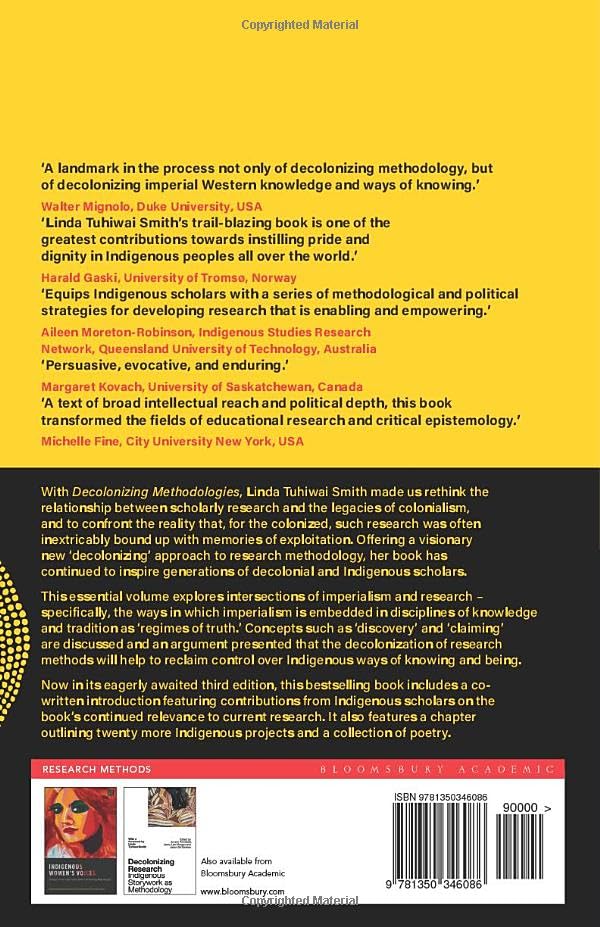
Decolonizing Methodologies: Research and Indigenous Peoples : Smith, Linda Tuhiwai: desertcart.co.uk: Books Review: Must read for researchers - Ordered 2 copies and both arrived super quickly and in great condition. Books can usually get bent in transit, but this one arrived perfectly! Review: good introduction - Good introduction into what is behind all the discussion about colonial studies
| Best Sellers Rank | 301,967 in Books ( See Top 100 in Books ) 69 in Indigenous Peoples Studies 265 in Under- & Postgraduate Student Guides 590 in Scientific History & Philosophy References |
| Customer reviews | 4.8 4.8 out of 5 stars (294) |
| Dimensions | 14 x 1.96 x 21.59 cm |
| Edition | 3rd |
| ISBN-10 | 135034608X |
| ISBN-13 | 978-1350346086 |
| Item weight | 408 g |
| Language | English |
| Print length | 340 pages |
| Publication date | 5 May 2022 |
| Publisher | Bloomsbury Academic |
P**2
Must read for researchers
Ordered 2 copies and both arrived super quickly and in great condition. Books can usually get bent in transit, but this one arrived perfectly!
S**N
good introduction
Good introduction into what is behind all the discussion about colonial studies
J**O
Very important text and tool to understand research from an Indigenous point of view, with a thorough and sharp explanation of the problems of the Western science. If you are white, read it with an open mind.
C**J
The most relevant book on research methods available . I’m using it to inform my PhD research and I’ve discovered that it is the book research ethics dept. are referring to.
A**R
Rapide et en bon état
R**L
The quality of the product is good. However, the book will change your present perception to gain knowledge.
T**Y
Decolonizing Methodologies: Research and Indigenous Peoples is a seminal text that is far more than just a "decent read"—it is a transformative work that has redefined the landscape of academic research. For anyone building a strong basis for educational history, Linda Tuhiwai Smith provides the essential critical lens needed to understand how research has historically been used as a tool of colonization. Why This Book is a Historical Cornerstone Challenging "Regimes of Truth": Smith powerfully argues that for Indigenous peoples, the word "research" is inextricably linked to European colonialism. She explores how Western scientific traditions have often been embedded with imperialistic biases that treat Indigenous knowledge as something to be "discovered" or "claimed." Reclaiming Knowledge: The book isn't just a critique; it’s a call to action. It provides a framework for Indigenous scholars to reclaim control over their own ways of knowing and being, establishing research methodologies that are respectful, ethical, and community-centered. Global Impact: Now in its third edition, this bestseller includes contributions from global Indigenous scholars and features a unique chapter outlining twenty-five Indigenous research projects. It serves as a practical and theoretical guide for decolonizing disciplines ranging from education and psychology to planning and sociology. Key Themes for Educators For those interested in the history of education, this book explains the politics of knowledge. It helps readers understand: Why certain histories are taught while others are erased. The importance of Indigenous storywork as a valid historical record and form of teaching. How "authentic caring" in education requires a deep respect for the student's cultural identity and sovereignty. Final Verdict If you are serious about understanding the deep-rooted structures of educational history, Decolonizing Methodologies is a non-negotiable addition to your library. It bridges the gap between historical analysis and modern social justice, making it an essential foundation for any student, researcher, or advocate.
ترست بايلوت
منذ شهر
منذ 3 أيام