We remain fully operational. Our teams are working around the clock to ensure your deliveries continue safely.

قم بتنزيل التطبيق


معلومات عنا
حقوق الطبع والنشر © 2024 Desertcart Holdings Limited
قم بتنزيل التطبيق
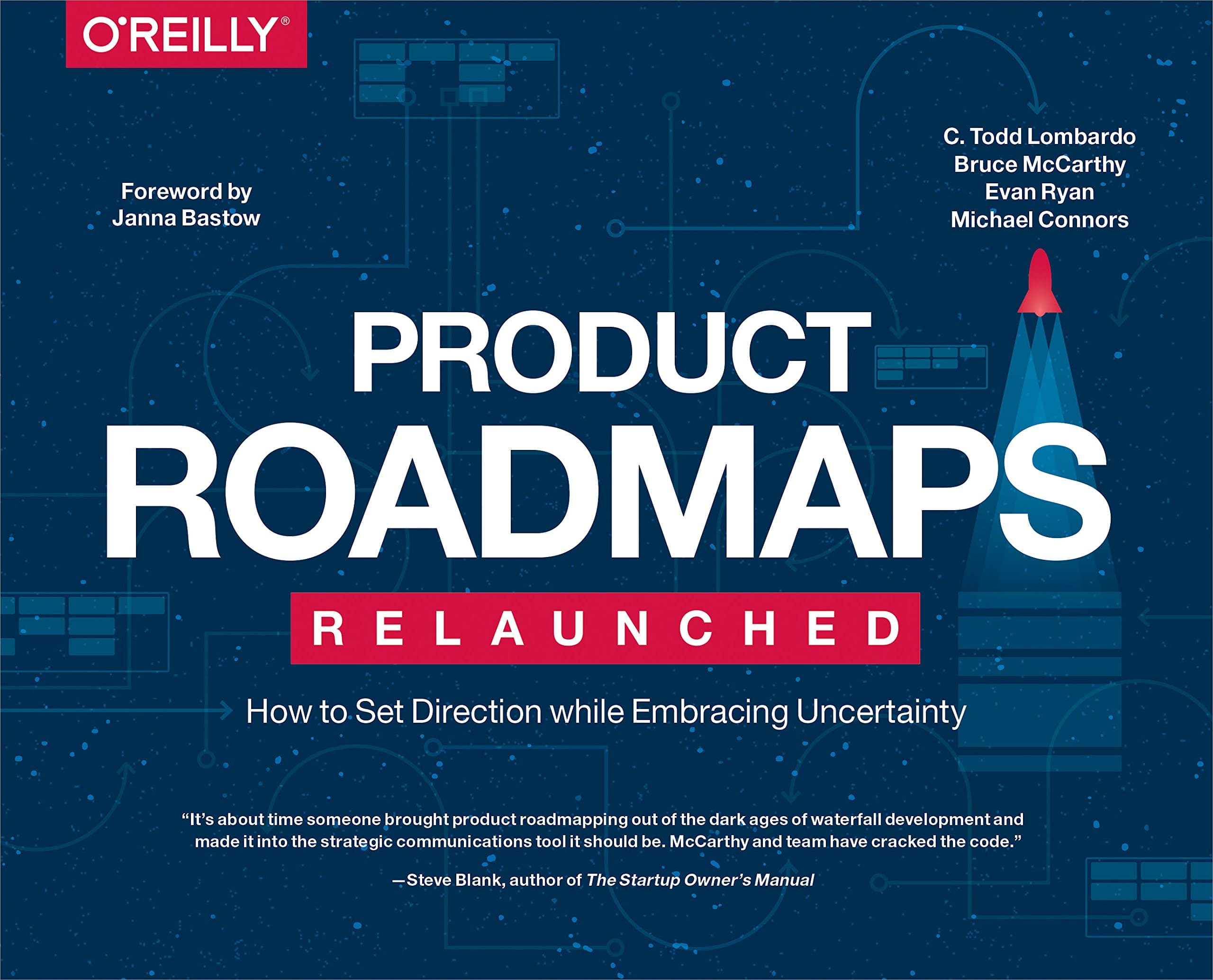
desertcart.com: Product Roadmaps Relaunched: How to Set Direction while Embracing Uncertainty: 9781491971727: Lombardo, C. Todd, McCarthy, Bruce, Ryan, Evan, Connors, Michael: Books Review: Focuses on value, not output or technology for the sake of technology - This is a very pragmatic guide through creating roadmaps that convey value. It pairs nicely with common Product Management practices as well as strategy (the Richard Rumelt kind). There are many fine examples in this book that you can draw from to immediately improve your own roadmaps or start from scratch. Review: Solidly Good. Not Necessarily Great - Decent book. Love the authors in general. Have used some of McCarthy's concepts as part of my own roadmaps; though I've modified them somewhat. And ironically, one of the products one of the authors talks about in the book is a product I worked on in a minor capacity for a little while. So it pains me a little to not give them all five stars. But even though the core value really is there for a newbie product person, there's just a couple of things I had some minor issues with. Here's the good: If you're a new product person or you've been doing it 'by accident' as a lot of PMs fall into it... and you really have no solid structure, then you really do need this book. The core concepts are reasonably solid and will give you a framework. (And frameworks are useful. Some these days are like... maaaan.... frameworks are like too stifling. They're wrong. And foolish.) So the book is useful there. The weak: I'm not sure if using themes and sub-themes to represent problem spaces vs. features really makes sense as a structure at all, but ok... Then we get into some hierarchy in terms of opportunity/solution trees and such, and ideas like critical path journey. Which is kind of funny in a way, because these are good, but feel a bit like waterfall project planning and work breakdown structures. Not exactly, but a bit. And maybe this is the age-old question, (and where agile/scrum fails a bit), just how far to do you take an idea before it gets into a backlog? And if you're doing all that before any kind of sprint planning, are you really involving enough of a team? But ok, this is more about product than project, (which are conflated a bit with agile), so maybe we give a break there. Still, it's not wholly clear how they might reconcile this level of planning with so-called agile/lean approaches. I'm sure there's ways to do that, but the book could have used some guidance in this area along the way. On a more practical level, as others have said, there's some physical problems with the book if you go old school instead of ebook. Now, this is just an opinion. But yes, I think the reading font is a bit small and unquestionably the graphics are too small to discern some things. Others have said the paper is too thin as well, and that could affect readability. Personally, partially based on reviews, I got the paper version as I thought it might be easier to use than electronic. Even though you can usually enlarge ebook graphics, because sometimes it's easier to see some things in context. I literally needed a magnifier for a lot of the graphics; and my eyesight is just fine. OK. Bottom Line: Yes, get the book if you're a newbie PM or an experienced PM feeling like you're lacking a solid process. Perhaps the most valuable aspect is prioritization calculations; which attempts to quantify even fuzzier guesstimates. It forces a rank. Because there's always going to be a rank; the only question is how you come to it. This at least tries to get you SOMEthing structured, (and arguably defensible), in terms of coming up with a priority list.








| Best Sellers Rank | #262,223 in Books ( See Top 100 in Books ) #48 in User Experience & Website Usability #64 in Business Project Management (Books) #1,107 in Leadership & Motivation |
| Customer Reviews | 4.5 out of 5 stars 776 Reviews |
P**Y
Focuses on value, not output or technology for the sake of technology
This is a very pragmatic guide through creating roadmaps that convey value. It pairs nicely with common Product Management practices as well as strategy (the Richard Rumelt kind). There are many fine examples in this book that you can draw from to immediately improve your own roadmaps or start from scratch.
S**T
Solidly Good. Not Necessarily Great
Decent book. Love the authors in general. Have used some of McCarthy's concepts as part of my own roadmaps; though I've modified them somewhat. And ironically, one of the products one of the authors talks about in the book is a product I worked on in a minor capacity for a little while. So it pains me a little to not give them all five stars. But even though the core value really is there for a newbie product person, there's just a couple of things I had some minor issues with. Here's the good: If you're a new product person or you've been doing it 'by accident' as a lot of PMs fall into it... and you really have no solid structure, then you really do need this book. The core concepts are reasonably solid and will give you a framework. (And frameworks are useful. Some these days are like... maaaan.... frameworks are like too stifling. They're wrong. And foolish.) So the book is useful there. The weak: I'm not sure if using themes and sub-themes to represent problem spaces vs. features really makes sense as a structure at all, but ok... Then we get into some hierarchy in terms of opportunity/solution trees and such, and ideas like critical path journey. Which is kind of funny in a way, because these are good, but feel a bit like waterfall project planning and work breakdown structures. Not exactly, but a bit. And maybe this is the age-old question, (and where agile/scrum fails a bit), just how far to do you take an idea before it gets into a backlog? And if you're doing all that before any kind of sprint planning, are you really involving enough of a team? But ok, this is more about product than project, (which are conflated a bit with agile), so maybe we give a break there. Still, it's not wholly clear how they might reconcile this level of planning with so-called agile/lean approaches. I'm sure there's ways to do that, but the book could have used some guidance in this area along the way. On a more practical level, as others have said, there's some physical problems with the book if you go old school instead of ebook. Now, this is just an opinion. But yes, I think the reading font is a bit small and unquestionably the graphics are too small to discern some things. Others have said the paper is too thin as well, and that could affect readability. Personally, partially based on reviews, I got the paper version as I thought it might be easier to use than electronic. Even though you can usually enlarge ebook graphics, because sometimes it's easier to see some things in context. I literally needed a magnifier for a lot of the graphics; and my eyesight is just fine. OK. Bottom Line: Yes, get the book if you're a newbie PM or an experienced PM feeling like you're lacking a solid process. Perhaps the most valuable aspect is prioritization calculations; which attempts to quantify even fuzzier guesstimates. It forces a rank. Because there's always going to be a rank; the only question is how you come to it. This at least tries to get you SOMEthing structured, (and arguably defensible), in terms of coming up with a priority list.
S**N
Product Roadmaps Relaunched shows how roadmaps are developed and used to align your teams.
The product roadmap is one of product management’s most commonly requested document and the most misunderstood. Executives reference the roadmap to monitor their pet projects. Sales people use the roadmap with customers to show features to be delivered in the future (“and if you buy today, I can guarantee these features next week!”) Marketing teams use the roadmap to align product releases with industry events. Sadly, most teams—both internal and external—see the roadmap as a commitment, not as a strategic plan. Product Roadmaps Relaunched explains what a roadmap is (and isn’t) and explores how to deal with unrealistic expectations. The authors write: “Properly done, a product roadmap can steer your entire organization toward delivering on the company strategy. A good roadmap, though, is not so much a project plan as a strategic communications tool, a statement of intent and direction.” Product Roadmaps Relaunched reveals best practices for managing product strategy using roadmaps with lots of examples, including how roadmaps change through the life cycle and how to incorporate feedback from customers, stakeholders, and your target markets. Of particular interest is the chapter on prioritization which includes what doesn’t work (voting, opinions, and popularity) and what does (Kano, ROI scorecard, and more). For product professionals, roadmaps are the artifact of choice for defining and sharing product strategy. Product Roadmaps Relaunched shows how they are developed and used to align your teams.
C**S
The best book for Product Managers
Every Product Manager and Product Owner should purchase the book "Product Roadmaps Relaunched: How to Set Direction while Embracing Uncertainty"! I read the book this week and find it incredibly comprehensive for roadmaps. I coach many teams on so many of the concepts and this is the first time I've found everything in one book. The clincher for me is Chapter 11 and the Roadmap Health Assessment Checklist. Love this book and everyone in Product should have this on their bookshelf.
J**I
Great Reference During Annual Planning
This is book was a great reference during our company's annual planning. I read through it, picked out what I needed, and shared it with my product managers. If you are looking for a planning guide or reference for building a product roadmap, this is the guide for you. Thanks.
S**N
Applies agile principles to product management
Agile practices of project management have transformed how software is developed. Planning an entire project from the start often leads to unmet objectives and cost overruns. Agile instead proposes to start small by developing a minimal viable product and growing one feature at a time. In an age of the Internet’s instantaneity, continual deployment makes agile an achievable possibility. These authors, whose careers have all been hewn in software to some degree, propose undertaking the same transformation with product management. Thus, instead of fixed plans, product roadmaps can become living documents responsive to feedback from various stakeholders. Before I get too far, let me address the unusual shape of the book. Yes, it’s a wide book instead of conforming to the traditional pattern of tall books. One of the authors has extensive experience in graphic design, so he seems to have aided in this book’s beautification. Both approaches embody a risk, but the final product pulls it off. While unusual and unorthodox, reading the book was a pleasureful experience. As someone who reads a lot of books, I found it nice to experience a change of approach. I’m currently writing roadmaps for a series of products in my job, and this book helped me polish nuances in those plans. I established a GitHub project to house Markdown versions of my documentation so that they will become living documents under version control. The authors expressed sentiments that I lacked words to convey better than I ever could. Software is a living industry no longer fixed by hard deadlines from a “waterfall” approach. Continual development, integration, and deployment will surely continue to serve as paradigms for the future. While this book did express thoughts I anticipated in my gut, its contents were not earth-shaking to someone already experienced in agile methods. The conceptual leap from software development to product management wasn’t all that great. They did bring out details that my work will benefit from, and I’m grateful to have spent time reading this work. However, potential readers should be aware while it’s really good, the book does not convey totally novel concept. The authors made some attempt to generalize its application to product managers in all technology fields that rely on research and development. It remains very focused on the field of software. IT plays a major role in almost every organization these days, so a software-centered approach seems honest. I still think that it doesn’t escape the field of software product management enough to generalize too broadly. Continual deployment isn’t possible in physical domains. Nonetheless, all product managers should read this book to improve their skillset. Staying agile with a living product plan is an idea whose time has come.
M**N
A great book that consolidates value-centric approaches into a one reference.
As time goes on, the more I find myself consulting different topics in this book for grounding and ideas. All of the information aligns with modern thoughts on product management and the authors add real-life examples and scenarios laid out neatly to guide people through the entire roadmap process.
T**3
Must have for junior to intermediate PMs
The senior PM-T on the team recommended this book and wanted to follow some of the principles for our internal roadmap. I haven’t had much training for being a PM, which I’ve find common, so this book was really nice to have to learn how to design and maintain product roadmaps. I enjoy the examples in the book and it was an easy read. I read through it once and review it monthly. I think if you’re a seasoned PM it’s probably not going to be as helpful but might give you some new ideas.
ترست بايلوت
منذ أسبوعين
منذ شهر