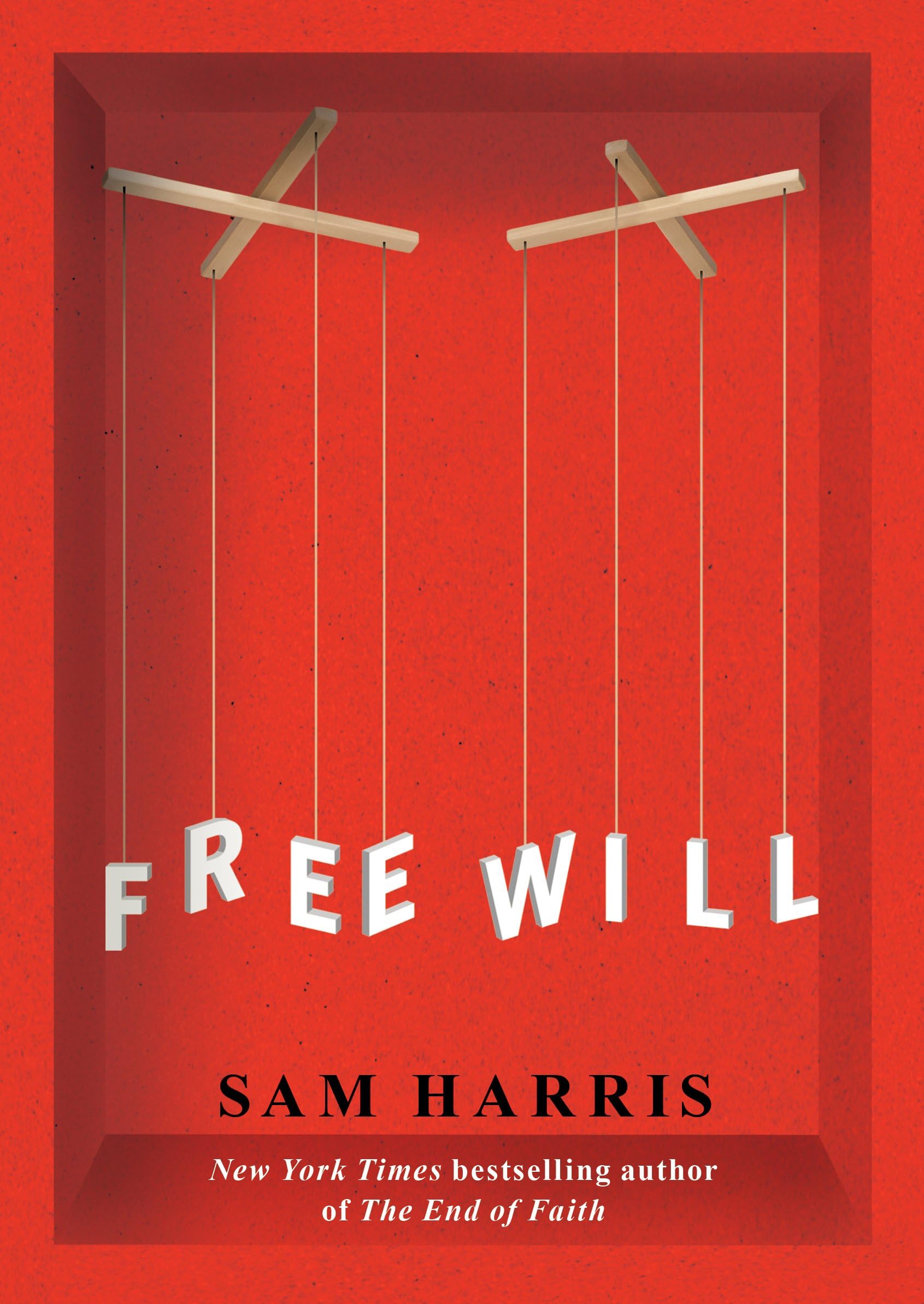


Free Will : Harris, Sam: desertcart.co.uk: Books Review: an accessible chew on the gristle of this fundamental and intriguing problem - This is a short book in which Harris pretty convincingly argues the case against the idea that we can do other than we do and also briefly considers the motivational, moral and political implications of accepting such a view. Central to Harris's argument is his view that not only is free will incompatible with objective descriptions of behaviour but also with our subjective experience: thus "the illusion of free will is in itself an illusion". In our subjective experience thoughts arise and take hold (or not) in ways that are subjectively if not theoretically mysterious (i.e. theoretically they arise from our brain states that are in themselves formed of chains of biologically coded influence). He writes vividly of his own 'choices' to show the determinism that is apparent if one carefully reflects on ordinary experience; "the choice you make will come out of the darkness of prior causes that you, the conscious witness of your experience, did not bring into being". He acknowledges, however, that our efforts matter and that we can alter the framework of our influences to make certain kinds of 'choices' more likely. He rejects that this entails free will but insofar as it acknowledges that we are causally relevant agents in the direction of our lives it seems to me that he comes close. If you find this review a bit heavy going, that is because I have needed to be succinct - the book itself is a much easier read. I recommend this book strongly to anyone who wants an accessible chew on the gristle of this fundamental and intriguing problem. Of course, whether or not you choose to follow this up is all a matter of determinism... Review: I couldn't help but like this book. - I've read all six of Sam Harris's books in the last few months, and picking a favourite would be like asking a mother to pick her favourite child, but if I had to rank them from "best" to just "excellent", Free Will would come near the top. Drawing on his expertise as both a neuroscientist and an experienced meditator, Harris explores the age-old philosophical question, "do we have free will? Are we truly the conscious authors of our actions, or are we just fixed-track automatons living under the delusion that we have control?" The question itself is nothing new, and numerous answers have been offered over the years, ranging ranging from the interesting and insightful to the confusing, meaningless, and masturbatory. Can Harris bring anything new to the table? To me: yes. Granted, I have no formal training in philosophy and am not familiar with the huge body of work that already exists on this subject, but Free Will isn't intended to be an all-encompassing philosophical treatise to be kept on dusty university library shelves and only ever pondered by PhDs. It's a succinct and incisive opinion piece that's open to all comers, and I found Harris's arguments to be eye-opening and authoritative - delivered with his trademark ability to steamroll any intellectual opponent in his path. Without meaning to spoil the ending, Harris's own answer to the question "do we have free will?" is a resounding "no". His arguments have been formulated in both the philosophy department and the research lab - and I found them convincing from all angles. We don't choose our thoughts - our thoughts simple arise in the brain uninvited, and anyone who's ever tried just 5 minutes of meditation can tell you first-hand how difficult it is to get even a hint of control over the contents of our own heads. Recent advances in brain imaging have also shown that we're able to predict with high accuracy the decisions a person is going to make *long before the person in question feels like they've actually made the decision.* If other people can predict our actions before we even know them ourselves, what space does this leave for free will as the genesis of those actions? I'm not sure there's any, and reading this book has made me acutely aware of just how little of the behaviour I consider to be "me" is the result of conscious choice - if that choice could ever be said to be "conscious" at all. My main criticism of this book is that it's very short - more of a pamphlet than a book - but at £2.99 for the Kindle version, it's not a major complaint. Also, if you've read "Waking Up" by the same author, there's a fair amount of overlap between the two books (including a few passages that seem be copied and pasted directly from one book to the other), so you may get the occasional sense of deja vu as you read Free Will, but its "exclusive" sections are more than enough to justify the low cost and the short amount of time it will take you to read it. Read this book. It's not like you have a choice.

| ASIN | 1451683405 |
| Best Sellers Rank | 27,294 in Books ( See Top 100 in Books ) 286 in Philosophy (Books) 385 in Scientific Psychology & Psychiatry 828 in Popular Science |
| Customer reviews | 4.3 4.3 out of 5 stars (5,021) |
| Dimensions | 14.29 x 0.76 x 20.32 cm |
| Edition | 1st |
| ISBN-10 | 9781451683400 |
| ISBN-13 | 978-1451683400 |
| Item weight | 127 g |
| Language | English |
| Print length | 96 pages |
| Publication date | 6 Mar. 2012 |
| Publisher | Free Press |
N**L
an accessible chew on the gristle of this fundamental and intriguing problem
This is a short book in which Harris pretty convincingly argues the case against the idea that we can do other than we do and also briefly considers the motivational, moral and political implications of accepting such a view. Central to Harris's argument is his view that not only is free will incompatible with objective descriptions of behaviour but also with our subjective experience: thus "the illusion of free will is in itself an illusion". In our subjective experience thoughts arise and take hold (or not) in ways that are subjectively if not theoretically mysterious (i.e. theoretically they arise from our brain states that are in themselves formed of chains of biologically coded influence). He writes vividly of his own 'choices' to show the determinism that is apparent if one carefully reflects on ordinary experience; "the choice you make will come out of the darkness of prior causes that you, the conscious witness of your experience, did not bring into being". He acknowledges, however, that our efforts matter and that we can alter the framework of our influences to make certain kinds of 'choices' more likely. He rejects that this entails free will but insofar as it acknowledges that we are causally relevant agents in the direction of our lives it seems to me that he comes close. If you find this review a bit heavy going, that is because I have needed to be succinct - the book itself is a much easier read. I recommend this book strongly to anyone who wants an accessible chew on the gristle of this fundamental and intriguing problem. Of course, whether or not you choose to follow this up is all a matter of determinism...
G**W
I couldn't help but like this book.
I've read all six of Sam Harris's books in the last few months, and picking a favourite would be like asking a mother to pick her favourite child, but if I had to rank them from "best" to just "excellent", Free Will would come near the top. Drawing on his expertise as both a neuroscientist and an experienced meditator, Harris explores the age-old philosophical question, "do we have free will? Are we truly the conscious authors of our actions, or are we just fixed-track automatons living under the delusion that we have control?" The question itself is nothing new, and numerous answers have been offered over the years, ranging ranging from the interesting and insightful to the confusing, meaningless, and masturbatory. Can Harris bring anything new to the table? To me: yes. Granted, I have no formal training in philosophy and am not familiar with the huge body of work that already exists on this subject, but Free Will isn't intended to be an all-encompassing philosophical treatise to be kept on dusty university library shelves and only ever pondered by PhDs. It's a succinct and incisive opinion piece that's open to all comers, and I found Harris's arguments to be eye-opening and authoritative - delivered with his trademark ability to steamroll any intellectual opponent in his path. Without meaning to spoil the ending, Harris's own answer to the question "do we have free will?" is a resounding "no". His arguments have been formulated in both the philosophy department and the research lab - and I found them convincing from all angles. We don't choose our thoughts - our thoughts simple arise in the brain uninvited, and anyone who's ever tried just 5 minutes of meditation can tell you first-hand how difficult it is to get even a hint of control over the contents of our own heads. Recent advances in brain imaging have also shown that we're able to predict with high accuracy the decisions a person is going to make *long before the person in question feels like they've actually made the decision.* If other people can predict our actions before we even know them ourselves, what space does this leave for free will as the genesis of those actions? I'm not sure there's any, and reading this book has made me acutely aware of just how little of the behaviour I consider to be "me" is the result of conscious choice - if that choice could ever be said to be "conscious" at all. My main criticism of this book is that it's very short - more of a pamphlet than a book - but at £2.99 for the Kindle version, it's not a major complaint. Also, if you've read "Waking Up" by the same author, there's a fair amount of overlap between the two books (including a few passages that seem be copied and pasted directly from one book to the other), so you may get the occasional sense of deja vu as you read Free Will, but its "exclusive" sections are more than enough to justify the low cost and the short amount of time it will take you to read it. Read this book. It's not like you have a choice.
R**E
Sam Harris doesn't disappoint, he will answer this question in the most ...
Sam Harris takes on one of the biggest questions about what we think defines humanity. Free Will. Surely that's a given, if we don't have free will, then what can we be, Without Free Will, then we are simply robots? As always, Sam Harris doesn't disappoint, he will answer this question in the most informative and truthful way that he can discover, no matter what the outcome ! As the brilliant scientist Richard Feynman once said ""Nature is there, and she's gonna come out the way she is" Free Will as it seems, is an illusion (which is not really that surprising if you consider the whole nature/nurture process), but to be absolutely critical of Sam's interpretation, he does not go far enough. Sam still eludes to the perception that although free will is eradicated, somehow, what we actually do in real life, is still important in an individual sense ? i.e. - this post would not have happened if I didn't actually write it, and post it ! Is that not the point ? This isn't written and posted due to "Free Will", but simply a pre-conceived response, which was actually determined before I was born. So that's determinism then ? As a post script, I have to yet again thank Sam Harris for producing the most thought compelling books. posts, webcasts et al . What a pleasure it is to read everything he produces (whether I completely agree or not, but 99% do agree) We don't have enough critical thinkers at the moment, or they simply just don't get the "airplay". If you haven't read this book, then please do, and take your time to understand the concepts, as they may be disturbing to what you accept as your own self. It may frighten you, and it may astound you, but whichever way, it will enlighten you !
P**O
Tardo un poco en llegar a Mexico pero llego en buenas condiciones.
B**R
Freilich, das Argument ist kein Geheimnis: Das Konzept des Freien Willens ist mit den aktuellen Erkenntnissen der Neurowissenschaften nicht vereinbar. Jedwede Entscheidung, deren Urheberschaft wir uns selbst zusprechen, ist das Ergebnis unbewusster neurophysiologischer Vorgänge, über die wir keinerlei Kontrolle haben. Folglich haben wir auch keine Kontrolle über das Ergebnis dieser unbewussten Vorgänge. Mit geeigneten Messgeräten lassen sich in (bisher einfachen) Experimenten die Entscheidungen von Testpersonen zuverlässig vorhersagen; lange bevor der Proband die Entscheidung getroffen hat. Eine vorurteilsfreie Selbstbeobachtung komme den Tatsachen deutlich näher: Gedanken, Stimmungen, Entscheidungen entstehen unabhängig von unserem Zutun. Wir sind lediglich die Zeugen ihres Auftauchens in unserem Bewusstsein. Neben seiner neurowissenschaftlichen Arbeit hat Harris einen Abschluss in Philosophie an der Stanford University und bringt auch dieses Feld der Expertise in die Argumentation ein. Kompatibilismus, die Überzeugung (zum Beispiel seines Kollegen Dan Dennetts), auch die unüberschaubare Neurophysiologie bei jeder Entscheidungsfindung gehöre integral zu einer Persönlichkeit, so dass man der Person durchaus eine genuine Urheberschaft an ihren Entscheidungen zusprechen könne, ist für Harris lediglich ein Ausweichmanöver. Er fasst die kompatibilistische Rechtfertigungsversuche in einer einprägsamen Pointe zusammen: "A puppet ist free as long as he loves his strings." Auch die Quantenmechanik, welche einem rein deterministischen Weltbild den Boden entzogen hat, bietet laut Harris keinen Unterschlupf für das Konzept des freien Willens. Quantenmechanische Zufälligkeit mag die Neurophysiologie des Gehirns in unvorhersehbarer Weise beeinflussen; mit freiem Willen und der bewussten, autonomen Urheberschaft von Entscheidungen hat ein solcher Zufallsgenerator aber nichts zu tun. In den abschließenden Kapiteln adressiert er die verbreitete Weigerung vieler Menschen, das Konzept des freien Willens trotz Unvereinbarkeit mit neurowissenschaftlichen Erkenntnissen aufzugeben; ihre Besorgnis, mit einem deterministischeren Weltbild würde menschliches Verhalten dehumanisiert werden, das Gefühl von ethischer Verantwortlichkeit für das eigene Handeln würde schwinden oder dem menschlichen Zusammenleben potentieller Schaden erwachsen. Er zeichnet eine Vision aufrichtiger Auseinandersetzung mit den Ursachen menschlichen Verhaltens, die vereinbar ist mit philosophischen und neurowissenschaftlichen Erkenntnissen. Ein Anerkennen der Tatsachen schule Empathie, Mitgefühl und Demut angesichts eigener Errungenschaften. Viele Faktoren, die zu einem erfolgreichen Leben verholfen haben, liegen und lagen außerhalb unserer Einflussmöglichkeiten. Ungekehrt: "It seems true enough to say that the men and women on death row had a combination of bad genes, bad parents, bad ideas, or bad luck. Which of these quantities are they responsible for?" In einer Reihe von Gedankenexperimenten gelingt Harris nichts weniger als eine Katharsis: Der Leser erlebt mit, wie die Anziehungskraft einer Vergeltungsjustiz als intellektueller Fehlschluss demaskiert wird. Das Buch enthält einige von Harris' Aufsätzen, die schon in seinem Blog zu lesen waren. Nichts desto weniger liegt hier eine gut lesbare und überzeugende Zusammenschau seines Diskussionsbeitrags vor, ergänzt durch einen Ausblick, in welcher Weise das Aufgeben des Konzepts eines Freien Willens den gesellschaftlichen Diskurs zu verändern imstande sein mag. Wem 80 Seiten zu kurz sind: The Moral Landscape gleich mitbestellen; Harris argumentiert hier für eine wissenschaftliche Behandlung ethischer Fragestellungen als Gegenentwurf zu dogmatischen Moraltheologien einerseits und postmodernistisch-selbsthadernder Urteilsenthaltung anderseits.
A**ー
You think you have the free will to choose whatever you want? Think again. Sam Harris gives a very good and brief account of how the concept of free will is really a myth. Well written and succinct.
F**E
J'ai acheté ce livre à la suite de la vision d'une vidéo sur youtube de Sam Harris. Certainement contre-intuitif et je me suis retrouvé comme une poule ayant trouvé un os: décontenancé. Plusieurs années après, je suis toujours à la recherche du contraire. C'est devenu un jeu puisque tout contribue à confirmer l'absence de libre arbitre.
C**N
Great condition, great (if somewhat short) read, no complaints.
ترست بايلوت
منذ يومين
منذ أسبوعين