🚗 Master Your Tires Like a Pro — Never Get Caught Off Guard Again!
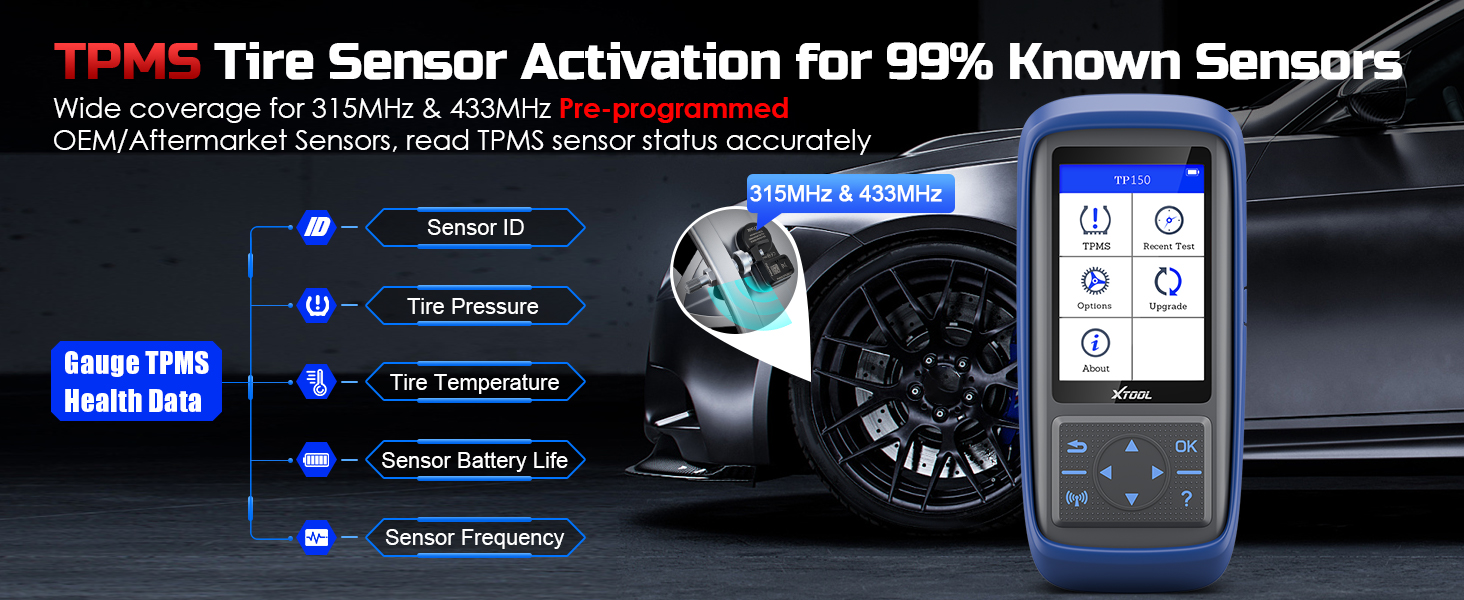
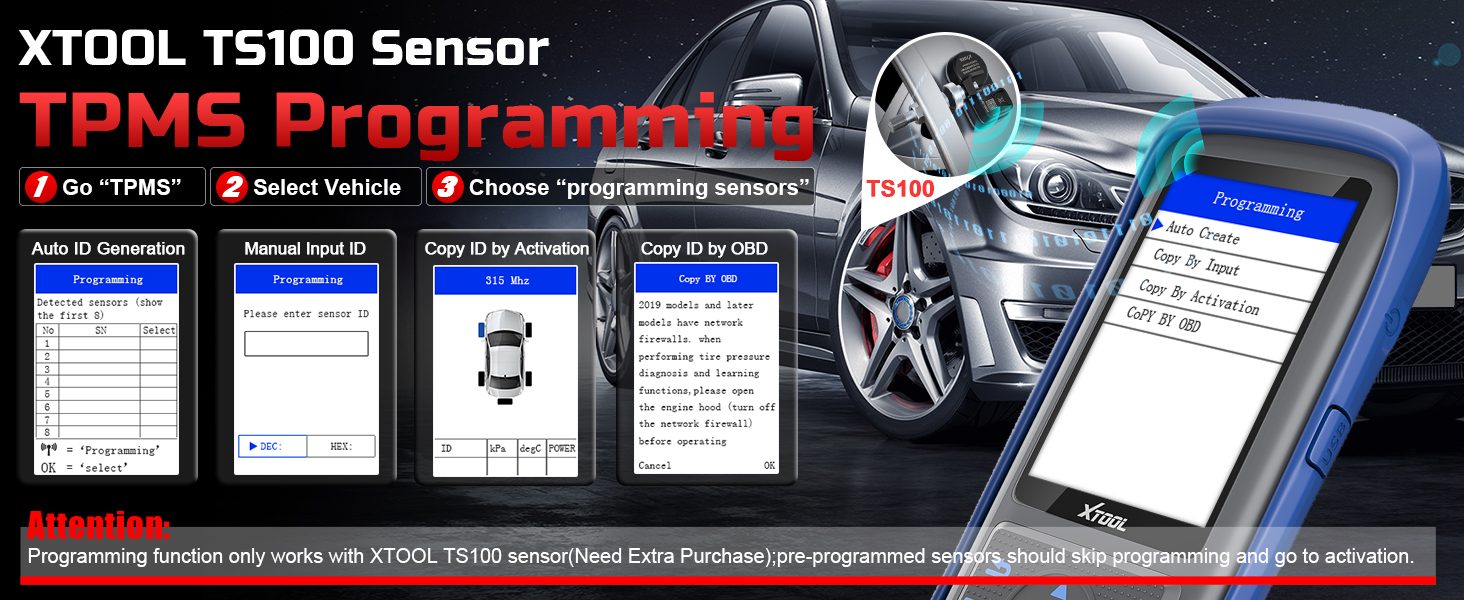
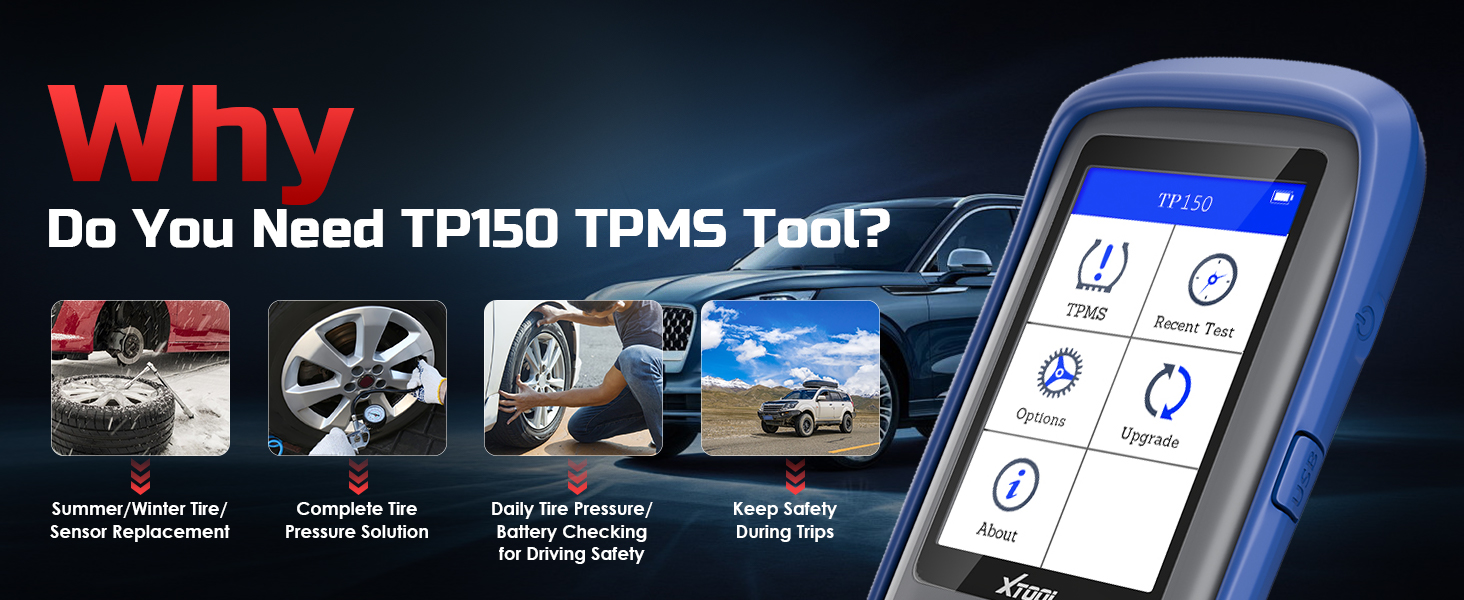
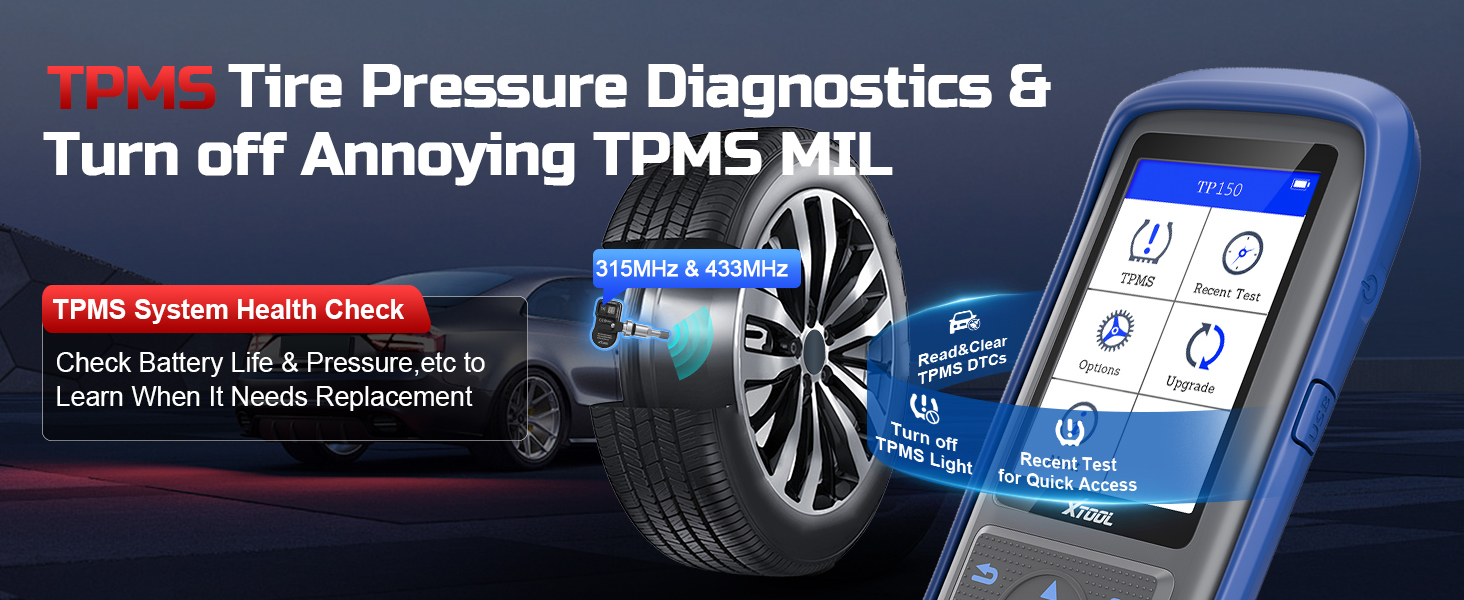
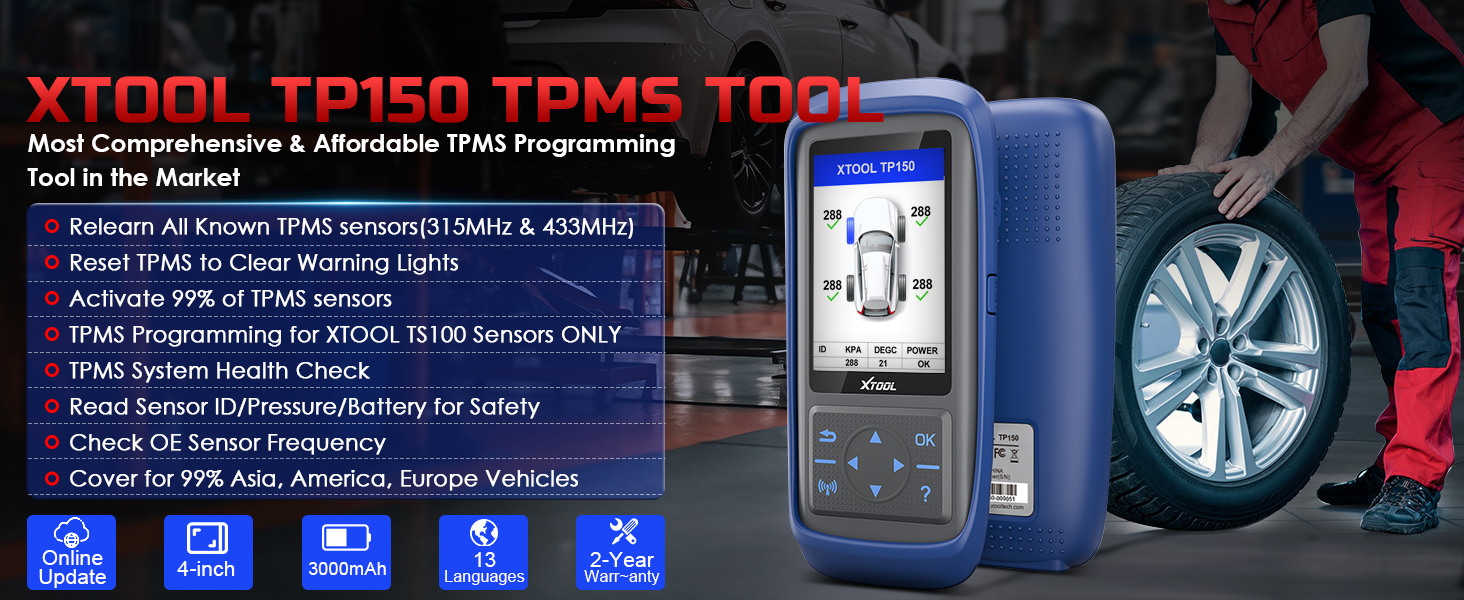
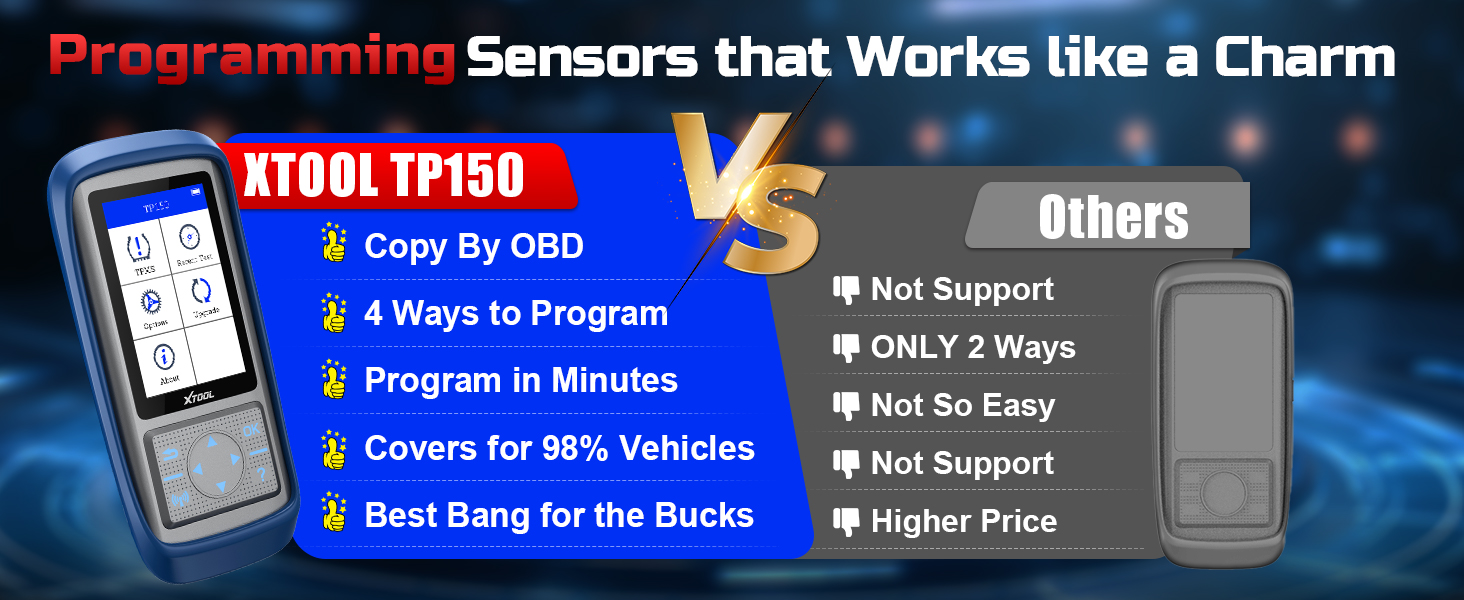
The XTOOL TP150 is a professional-grade TPMS programming and diagnostic tool designed exclusively for XTOOL TS100 sensors. Supporting dual-frequency 315/433MHz sensors, it offers universal coverage for 99% of 12V OBD2 vehicles worldwide. With advanced features including sensor activation, relearn, reset, and real-time diagnostics (pressure, temperature, battery status), it empowers DIYers and tire shops to save time and money by replacing and managing TPMS sensors independently. Its compact, durable design and lifetime free software updates make it an indispensable tool for maintaining tire safety and efficiency across multiple car brands and models.


| ASIN | B0BQ31D4J9 |
| Automotive Fit Type | Universal Fit |
| Best Sellers Rank | #3,846 in Automotive ( See Top 100 in Automotive ) #11 in Replacement Tire Pressure Monitoring System (TPMS) Sensors |
| Brand | XTOOL |
| Brand Name | XTOOL |
| Customer Reviews | 4.2 out of 5 stars 457 Reviews |
| Included Components | XTOOL TP150 |
| Item Height | 4.33 inches |
| Item Type Name | TPMS tool |
| Manufacturer | XTOOL |
| Manufacturer Warranty Description | 2 Year Warranty |
| Power Source | Battery Powered |
| Screen Size | 4 Inches |
| UPC | 758987845427 |
N**K
After a lot of research, I found this to be the best bang for the buck!
I currently have 4 cars in our family, all of which I provide maintenance and repair on, among many others that belong to friends and family. The one thing that I have not messed with up until now, were the TPMS sensors. The most I could do was to test the sensors with a scan tool and attempt to reset them. However, once they have failed, there is no resetting. More than likely, the battery is dead and all you can do is replace the sensors. I decided to eventually take on this job myself as I have access to tire changing equipment. But my primary concern at this time is to purchase a reasonably priced tool that would provide the ability to access TMPS data and provide additional functionality moving forward. When I purchase diagnostic equipment, I like to be somewhat future proof as much as possible. I also wanted a product that I could use in conjunction with my high-end scanner, which happens to be an Xtool (D9). Although I have had excellent experiences with Xtool products and customer service, I am completely open to purchasing from another company if it would best meet my needs, without a doubt. It just so happens that the Xtool product line continues to offer the best balance in value, customer service and capabilities, so I decided to try this product as well. I knew, based on experience, that if I had a problem, or any questions they would work with me to resolve them! So, as indicated, I as always, did a lot of research and found The Xtool TP-150 to be hands-down the most affordable and functional TPMS scanner/programmer in its class. I didn’t want to spend a lot of money on a TPMS scan tool, so I decided to purchase the Xtool product. The TP-150 comes in a compact cardboard storage box. It has a solid rubber case for protection that is also removable. This is a great feature that is robust enough to prevent damage if you were to accidentally drop the unit. The first step each time you use the device in my opinion, is to check for and complete any software updates. You can do this either by connecting the device to a computer through a USB port, or via wifi. It is much easier and more convenient to connect to wifi for any current and future updates that may be available. One of the features that attracted me to this Xtool device is that it offers lifetime (COST-FREE) updates! Some companies charge a fee. The TP-150 supports several regions and multiple car brands both domestic U.S. and other countries along with multiple languages. It has an audible beeper that is optional and can be deactivated. I chose to keep mine activated as it helps with testing to hear the noise prompts throughout the process. It also has an optional auto-power setting that can be deactivated or set at ranges from 3, 5, and 10 (minutes), or to not automatically shut off. I found the no shut off option to be more feasible for my usage. I’ll just need to remember to turn it off manually after I’m finished! Here is a rundown of the device’s features. Xtool TP-150 supports (5) different functions: Check: Allows you to check each tire by prompting you to walk around the vehicle and point the device at each valve stem, which is where the TMPS sensor is mounted. It provides a visual display of each tire location which makes the process fun and easy. The results display the sensor’s data, current tire pressure and the current battery life which is extremely helpful information to know. Diagnosis: This feature allows the device to connect to the vehicle through the OBD-2 port and scan the ECU (car’s computer) for any error codes. It provides the sensor ID, tire pressure reading, temperature and power to the sensors. You can also clear the TPMS error code that appears on your dashboard. Programming: Is a feature that allows you to clone your current sensors that need to be replaced and write the data to Xtool’s (TS-100) sensors. It will not allow you to program any other manufacturer’s sensor, however I found that the Xtool sensors are among the lowest priced dual frequency sensors available on the market. I was happy to find that this feature has (4) programming methods that cover every possible scenario. Relearning: Is only used for vehicles that require it and when you are needing to replace multiple sensors, or during tire rotation. Once the sensors are installed on the rims and mounted on the car, the Relearn function captures the data for all sensors as you walk around the vehicle, and stores this information based on the tire location. You can then connect to the vehicles OBD2 port and write the new sensor data to the vehicle’s ECU. Activating: This feature is very helpful if you choose to use universal aftermarket sensors, or OEM sensors that require a (relearning) process. It allows the TP-150 to capture the original sensor’s data and transfer it to the new sensor. This seems to work best if the tire locations have not changed. Sensor Information: Is a very useful feature that allows you to view the the sensor specification that are specific to your vehicle. This includes both OEM and Xtool (TP-100) sensor information. There is also a Recent Test feature that stores any vehicles that you have recently tested. This prevents you from having to conduct another vehicle search. In testing my various vehicles, I decided to compare the results with what I received with the Xtool D9 scanner, and the information was in alignment with the scanners diagnostic report as expected. In addition, the TP-150 provides the current tire pressure reading, and level of battery life available. I found that for my son’s Honda Accord, it showed that the right-side front TPMS sensor was at the end of its lifespan and will need to be replaced in the near future, although the other (3) were still good. With the late model Mercedes, I found that all sensors were functioning and that the battery life was optimal as well.. One of the features that I/you would likely use most often, would be having the ability to use this device to quicky check the tire pressure on each wheel. It is much easier than using a tire pressure gauge! I also found that you are not required to use the Xtool TP-100 sensors unless you are (programming) new sensors. You can still use universal and (OEM) sensors by using the device’s Activation feature. I would certainly recommend this product to do it yourself, as well as professional technicians. I have found it to be of high quality, and very useful.
T**N
Must Have!!!
The TP150, is a great tool to have, very accurate, easy to use and understand, small manageable design, excellent compatibility, and easy to update software when needed. I replace a TMPS Sensor and needed to do the relearn process, at this point I did not have the TP150, I call around to several tire shops, and they wanted 180 dollars, are these guys crazy? I Purchase the TP150 and perform the relearn process perfectly, Excellent Tool.
D**R
Professional Mechanic Approved – A Solid TPMS Tool That Delivers
As a professional mechanic, I’ve worked with many TPMS tools over the years, from basic handheld trigger tools to expensive OEM scanners. The XTOOL TP150 stands out as a compact, reliable, and cost-effective solution that still delivers professional-grade results. In the shop, I’ve used it to program XTOOL TS100 sensors, but it also works perfectly with OEM and other pre-programmed aftermarket sensors as long as the part number matches the vehicle’s original spec. It handles activation, programming, and relearns (OBD, stationary, manual, or copy) quickly and without fuss. The sensor readings ID, pressure, temperature, and battery life come up instantly, which makes it easy to confirm sensor health before installation. One of my favorite features is the built-in Wi-Fi paired with free lifetime updates. Keeping tools up to date is critical in this industry, and the TP150 makes it effortless just connect to Wi-Fi and update directly from the device. No cables, no extra software, and no subscription fees. Coverage is excellent, with support for a wide range of American, European, and Asian vehicles. The menu is simple to navigate, and the included relearn procedures are accurate and save time compared to searching manuals. It’s small enough to carry around the shop, yet powerful enough to handle daily professional use. For the price, you’re getting a TPMS tool that’s fast, versatile, and always up to date. Whether you’re in a professional shop or doing your own maintenance, the TP150 is a smart investment that will save you time, reduce headaches, and keep your tire pressure systems working exactly as they should.
A**R
Good inexpensive TPMS tool
I bought this tool to figure out why the TPMS light on my tacoma would not reset. I was able to activate and query 3 of the 4 TPMS sensors which told me which needed replacing. I ordered an OE sensor because I felt safer sticking with the original manufacturer. I built a tire lever rig to unseat the tire and replaced the sensor. So I cannot speak to the function of programming an XTool sensor. I'm sure it would work. My Tacoma would not relearn the new sensor with the TPMS button in the truck, but I knew it was working because I could query it with the tool. I'm guessing the Tacoma TPMS relearn button will just relearn sensor position after a tire rotation, but won't learn a new sensor (?). I just connected the the TP150 to the OBD connector and reprogrammed the TPMS on my truck with the tool - no problems. I hate paying a shop to do simple diagnostics, so I figure I've saved 1/2 the tool cost already. One gripe I have with the TP150 is that when you query the TPMS sensors, it does not indicate battery strength in volts. It just says "OK". Not very helpful to determine how much life is left on the sensor. The manual I downloaded from XTool website says it should display sensor voltage by pressing OK button after reading all sensors. Didn't work for me. I tried several times on multiple cars. I have updated the firmware twice, which is pretty easy to do. Still can't display sensor voltage. Since my truck is 8 yrs old, I'd really like to know what the sensor voltages are before I replace any tires. Much easier to replace TPMS sensor when the tires are off the wheel. Other than that, the TP150 works well.
C**D
Didn't work, Poor Instructions/Customer Support
All I wanted for this thing to do was to tell me which sensor was bad and causing my tpms light to come on. I found this impossible to understand or use. Very cheap interface felt like I was using a computer from 1984. The instructions were very vague so I emailed the company (3 times). The first two times it took 2 full days to get a response and nothing they said made sense to me. The third time they never even responded. One of my most frustrating purchases ever and a huge waste of time. Did not work at all for me and company gave up in responding so I returned it.
A**I
Xtool TS150 on the 2009 Ford Flex: A Hassle-Free Experience”
I tested the Xtool TS150 on a 2009 Ford Flex, and I loved it. It was very easy to activate the pre-programmed A-Premium sensors, and updating the tool was also very simple—just connected to my Wi-Fi, and it downloaded all the updates automatically. The tool is reliable, fast, and I highly recommend it 100%.
A**H
Look forward to trying it out. Nice directions, easy to update via wifi. Works great, quick results
I've been wanting this for a while, so I finally broke down and bought one. It upadated easily and the instructions seem easy to follow with good explinations. I haven't tried it yet, but I will tomorrow. I will follow up after actually using it ****ok I just tried it on my 2007 Tacoma. It showed "X" on all wheels. I thought maybe I didn't do it right, or maybe it doesn't work. I then tried it on my wife's 2016 Rav4 and it worked perfectly! The readings were quick and showed the tire pressure as well. I guess my little truck needs new sensors! At least I was able to clear the DTC's for now Love this tool!***
P**R
Worked 1st time, 2011 RAV4
Update: 10/25: I was not aware that the XTOOL A30M can also reset tpms in addition to being a full function ODBII diagnostic tool. This TP150 tool is only for tpms work and comes with a large number of vehicles preprogrammed in it. The A30M requires you to download vehicles you’re interested in but doesn’t come with all of them already in memory. Both units cost the same att and I may return the TP150 and purchase the A30M since it’s more useful to my general situation - i.e: I’m not a tire shop. Original 10/25: Easily relearned my sisters bare bones 2011 RAV4. I bought sensors and had them installed along with new tires and foolishly did not write down the ID numbers first. The installer didn’t either and did not offer tpms relearn, I expected to use the RAV4 relearn button but this RAV4 at least doesn’t have one. This tool saved me and likely cost less than paying someone else to do it. You air the tires up to proper pressure and then one at a time trigger them with the tool which displays and stores the ID, temp and pressure. Then you plug it in to the ODB port, turn on the ignition and press RELEARN. The operation completes without further user interaction. Drive the vehicle 5 miles or so and the tpms alarm should clear. When any tpms sensor fails a code is recorded for that sensor plus the C2026 code which is an umbrella code covering all tpms problems. The C2026 code will persist after relearning the new sensor ID’s until you’ve driven the car a while and it manages to successfully read all the sensors. There is surely a choice spot somewhere on each vehicle where the tpms reader antenna gets the best access to each sensor but it still takes time and rotations before all of them get read. The interesting part of this is that I had to remove the spare tire cover in order for the TP150 to read the spare tire sensor - it was not successful reading through the hard cover even when I repeatedly triggered it in many positions around the cover approximately where I thought the valve stem would be at. The spare’s tpms battery is reporting LOW so this might be due to that. Ironically none of my own vehicles have tpms. I like the feature a lot and would add it to my 94 Ranger and 05 Tacoma but there are few solutions that use internal sensors and none that use replaceable ones. Also their price is high but it’s probably because of low volume demand.
ترست بايلوت
منذ 3 أسابيع
منذ أسبوعين