We remain fully operational. Our teams are working around the clock to ensure your deliveries continue safely.

قم بتنزيل التطبيق


معلومات عنا
حقوق الطبع والنشر © 2024 Desertcart Holdings Limited
قم بتنزيل التطبيق
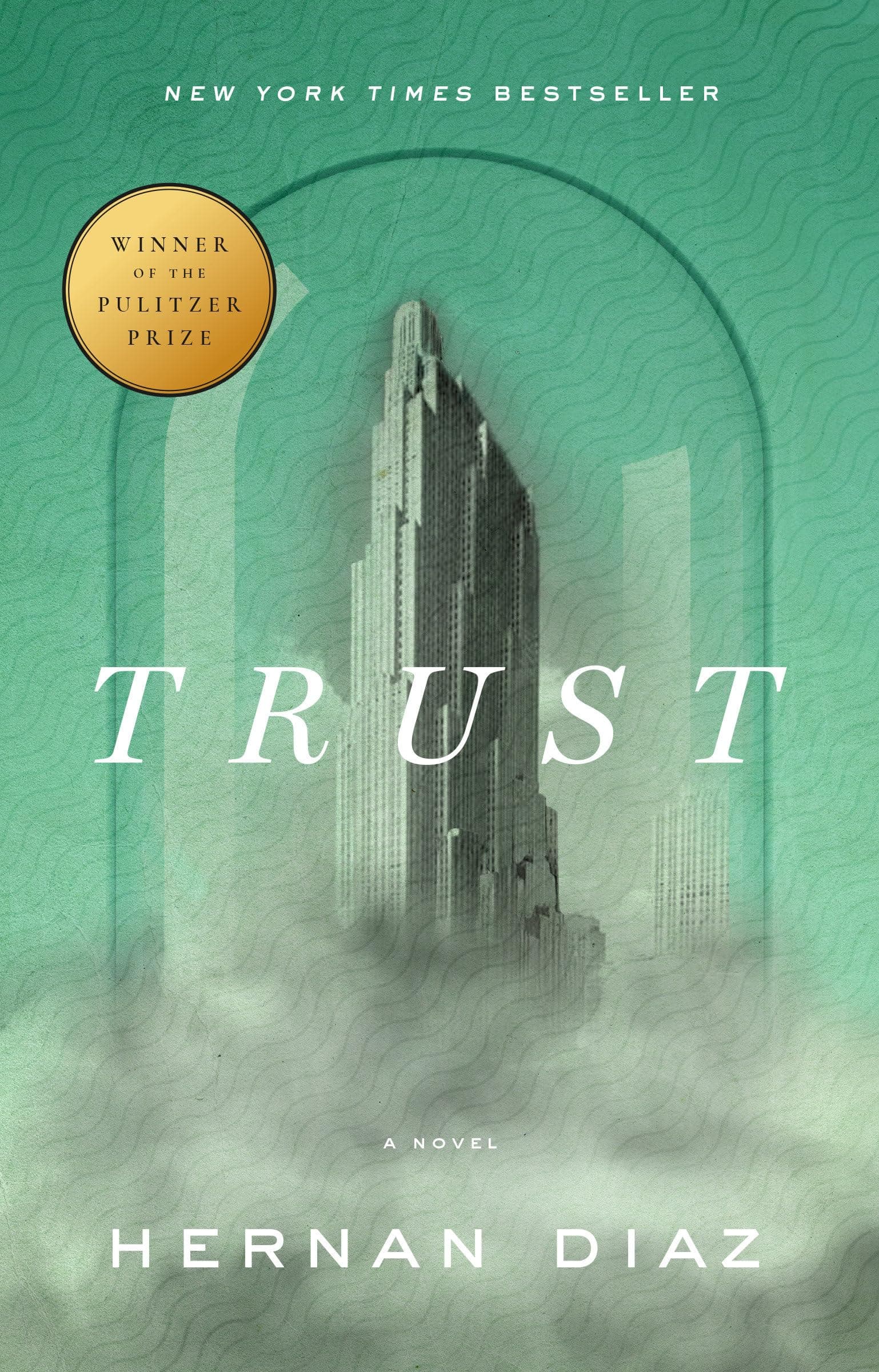
desertcart.com: Trust (Pulitzer Prize Winner): 9780593420324: Diaz, Hernan: Books Review: Storytelling On Wall Street - Herman Diaz's 2023 Pulitzer Prize winning novel "Trust" absorbed me from beginning to end. For several days, I was captivated -- couldn't wait to get to it. This is a rarity for me. "Trust" is largely set in the financial district of New York City in the years surrounding the Great Depression. Here is a bare-bones summary of the story. The main character is a financier and trader, Andrew Bevel, the latest, and last, of a line of traders in his family. The reclusive Bevel amasses a large fortune during the 1920s and also manages to make money during the early stages of the Depression. Bevel's wife, Mildred, is the daughter of another New York State family with wealth and with intellectual interests. While Bevel concentrates on making his fortune, Mildred promotes educational, artistic, and cultural endeavors, particularly the development of 20th Century classical music. When Mildred dies in a Swiss sanatorium, in the 1930s, Bevel carries on but is somewhat less successful than in the days with his wife. After Bevel's death and lengthy wrangling over his estate, his palatial New York City home is turned into a museum. As is pointed out through "Trust", American literature has many works about New York City, the wealthy classes, the financial markets, and the nature of capitalism. This novel brings to it subject a strong sense of perspectivism. Bevel's story is told in four voices by four individuals, each with their own distinct voice and background. Each story has commonalities, but each is also different in terms of what happened and in terms of human relationships. The reader is left to think through the stories to come to an understanding of events and people. Showing and considering different points of view is integral to the humanities, whether history, literature, or philosophy, and to this novel. "Trust" considers city life, capitalism and greed, the arts, marriage, the relationship between imagination and realism, and more within its complex structure. It is challenging and mostly effective. Each of the four storytellers are fascinating both as writers and as themselves. The first, Harold Vanner, was a minor novelist of the day who wrote a heavily fictionalized novella about the Bevels titled "Bonds". It was fascinating to get hints about Vanner through the book and to read his account. The second part, "My Life" was written by Andrew Bevel himself, with help, and tells his story from his perspective and to rebut Vanner's book. The third and longest story is "A Memoir, Remembered" by Ida Partenza. She tells her tale from the standpoint of a 70 year old successful author. Partenza had been raised in poverty in Brooklyn by her father, an anarchist. At the age of 23, Bevel had hired her to help write his Autobiography. Partenza discusses her life with her father, how she came to be hired by Bevel, and how she became fascinated by the writing project and shaped it to her own as well as to Bevel's ends. The final section of the book, "Futures" consists of diary entries by Midred during her time in the Swiss sanatorium just before her death. Midred has a different perspective on the story and on her relationship with Bevel than do the other three storytellers. The reader will be encouraged to think about the world of financial trusts and about whom to trust among the four narrators, with their differing aims and perspectives. In his "Phaedrus", Plato has Socrates say that the written word can be revealing but also narrowing in its fixity. With the many earlier literary antecedents to Diaz's novel, I was reminded most of "Martin Dressler: The Tale of an American Dreamer" by Steven Millhauser which won the 1997 Pulitzer Prize for fiction. Martin Dressler is an American entrepreneur who, unlike Bevel was born to modest means. Dressler reaches the American dream of riches in New York City by founding a series of hotels before his businesses and his personal life come crashing down on his head. The story is a mix of realism and surrealism which captured something of the themes and locations of "Trust" in its own way. Unfortunately "Martin Dressler" has fallen into neglect. It deserves to be read both in it own right and as another voice on the themes of "Trust". "Trust" is a challenging, provocative novel about an aspect of the American dream and the American experience. Robin Friedman Review: A novel that rewards sticking with it - Warning -- there's a bit of a reveal here. This novel, written in 4 parts, requires patience to find out what it's about, and if one sticks with it to the end, the reader realizes that it has been worth it. Written in 4 parts that from the titles of each seemed to be unconnected, when I started, I had no idea just what was going on. Was this single novel in fact going to be a group of 4 different stories? The first part I found difficult going, the writing style stilted and dated, though the story was interesting in an odd way. And then I moved on to part 2 and began to see that there might be a connection, maybe, but it wasn't clear just what -- but the writing style changed dramatically. Part 3 again is different, now a far more accessible writing style, and this is where we learn the tie between parts 1 and 3. The novel finishes with part 4, which in a way is a sort of epilogue, with a major twist on the truth of parts 1-3. Ultimately, when all the parts are integrated by the reader, this is a powerful book about the worlds of wealth in NY in the early 20th century, but more about personal relationships, ego, and self-deception. Well worth reading.


| Best Sellers Rank | #1,054 in Books ( See Top 100 in Books ) #5 in Biographical Historical Fiction #7 in Biographical & Autofiction #62 in Literary Fiction (Books) |
| Customer Reviews | 4.1 4.1 out of 5 stars (38,877) |
| Dimensions | 5.11 x 1.09 x 7.95 inches |
| ISBN-10 | 0593420322 |
| ISBN-13 | 978-0593420324 |
| Item Weight | 2.31 pounds |
| Language | English |
| Print length | 416 pages |
| Publication date | May 2, 2023 |
| Publisher | Riverhead Books |
R**N
Storytelling On Wall Street
Herman Diaz's 2023 Pulitzer Prize winning novel "Trust" absorbed me from beginning to end. For several days, I was captivated -- couldn't wait to get to it. This is a rarity for me. "Trust" is largely set in the financial district of New York City in the years surrounding the Great Depression. Here is a bare-bones summary of the story. The main character is a financier and trader, Andrew Bevel, the latest, and last, of a line of traders in his family. The reclusive Bevel amasses a large fortune during the 1920s and also manages to make money during the early stages of the Depression. Bevel's wife, Mildred, is the daughter of another New York State family with wealth and with intellectual interests. While Bevel concentrates on making his fortune, Mildred promotes educational, artistic, and cultural endeavors, particularly the development of 20th Century classical music. When Mildred dies in a Swiss sanatorium, in the 1930s, Bevel carries on but is somewhat less successful than in the days with his wife. After Bevel's death and lengthy wrangling over his estate, his palatial New York City home is turned into a museum. As is pointed out through "Trust", American literature has many works about New York City, the wealthy classes, the financial markets, and the nature of capitalism. This novel brings to it subject a strong sense of perspectivism. Bevel's story is told in four voices by four individuals, each with their own distinct voice and background. Each story has commonalities, but each is also different in terms of what happened and in terms of human relationships. The reader is left to think through the stories to come to an understanding of events and people. Showing and considering different points of view is integral to the humanities, whether history, literature, or philosophy, and to this novel. "Trust" considers city life, capitalism and greed, the arts, marriage, the relationship between imagination and realism, and more within its complex structure. It is challenging and mostly effective. Each of the four storytellers are fascinating both as writers and as themselves. The first, Harold Vanner, was a minor novelist of the day who wrote a heavily fictionalized novella about the Bevels titled "Bonds". It was fascinating to get hints about Vanner through the book and to read his account. The second part, "My Life" was written by Andrew Bevel himself, with help, and tells his story from his perspective and to rebut Vanner's book. The third and longest story is "A Memoir, Remembered" by Ida Partenza. She tells her tale from the standpoint of a 70 year old successful author. Partenza had been raised in poverty in Brooklyn by her father, an anarchist. At the age of 23, Bevel had hired her to help write his Autobiography. Partenza discusses her life with her father, how she came to be hired by Bevel, and how she became fascinated by the writing project and shaped it to her own as well as to Bevel's ends. The final section of the book, "Futures" consists of diary entries by Midred during her time in the Swiss sanatorium just before her death. Midred has a different perspective on the story and on her relationship with Bevel than do the other three storytellers. The reader will be encouraged to think about the world of financial trusts and about whom to trust among the four narrators, with their differing aims and perspectives. In his "Phaedrus", Plato has Socrates say that the written word can be revealing but also narrowing in its fixity. With the many earlier literary antecedents to Diaz's novel, I was reminded most of "Martin Dressler: The Tale of an American Dreamer" by Steven Millhauser which won the 1997 Pulitzer Prize for fiction. Martin Dressler is an American entrepreneur who, unlike Bevel was born to modest means. Dressler reaches the American dream of riches in New York City by founding a series of hotels before his businesses and his personal life come crashing down on his head. The story is a mix of realism and surrealism which captured something of the themes and locations of "Trust" in its own way. Unfortunately "Martin Dressler" has fallen into neglect. It deserves to be read both in it own right and as another voice on the themes of "Trust". "Trust" is a challenging, provocative novel about an aspect of the American dream and the American experience. Robin Friedman
J**.
A novel that rewards sticking with it
Warning -- there's a bit of a reveal here. This novel, written in 4 parts, requires patience to find out what it's about, and if one sticks with it to the end, the reader realizes that it has been worth it. Written in 4 parts that from the titles of each seemed to be unconnected, when I started, I had no idea just what was going on. Was this single novel in fact going to be a group of 4 different stories? The first part I found difficult going, the writing style stilted and dated, though the story was interesting in an odd way. And then I moved on to part 2 and began to see that there might be a connection, maybe, but it wasn't clear just what -- but the writing style changed dramatically. Part 3 again is different, now a far more accessible writing style, and this is where we learn the tie between parts 1 and 3. The novel finishes with part 4, which in a way is a sort of epilogue, with a major twist on the truth of parts 1-3. Ultimately, when all the parts are integrated by the reader, this is a powerful book about the worlds of wealth in NY in the early 20th century, but more about personal relationships, ego, and self-deception. Well worth reading.
A**A
Too Many Cooks Spoil the Broth
'Trust' by Diaz was long listed for the Booker Prize in 2022. It is a serious fictional work about capitalism, money and one of the richest and greatest stock traders/manipulators of all time. The first third of the novel is written by a fictional writer (not the author) in pretty straightforward narrative form and the writing is impeccable and quite inventive. We learn a great deal about the investor- Benjamin Rask, his family, his trades, his peculiar and idiosyncratic detached lifestyle, and his marrying a woman who also shares some of his quirks, if not particular strong feelings for him. Then the 'novel within the novel' ends and a brief autobiography by Mr. Rask (named Brevel in the book) commences. The writing here is rather listless, and little is added to the first part of the work. As this section concludes, a longer- in fact the longest section of the entire novel takes place, written by the young female secretary of Mr. Brevel in his later years. Frankly, I found this long section to be tired and uninspired, and it appears Hernan Diaz created this long section as a counterpoint to the capitalist system as we know it in the U.S. The secretary's father is a staunch communist and so it is ironic that the secretary is working for the biggest 'capitalist pig' on the planet. The secretary becomes the moral force of the work, and her opinions take on greater urgency as the work progresses. Or at least that is the intended hope of the author, as I read it. "Trust" then concludes with some journal entries written by the wife of Mr. Brevel. Honestly, I could have done without the four section vehicle of the work. It did no favors in showing me the 'truth' of who Mr. Brevel/Rask really was. Perhaps Mr. Diaz, who is a fine writer, felt that he could not write this novel in a traditionally narrative form and utilized the technique of multiple forms to showcase his work. As I read the later sections I asked myself the following questions. Why not include the secretary (and bring her in earlier than after Mrs. Brevel's death) in the original chapters of the original work? Perhaps the diaries of Mrs. Brevel could also have been incorporated as well, without resorting to the four separate narratives. I believe the book is important and has much to contribute to the novels about early 20th century capitalism in this country, so it is still a compelling read. Yet, I wonder how much more enjoyable it would have been if it had stuck to one narrative, instead of running on four tracks at once.
A**L
I can’t see why this book was long listed for the Booker Prize in 2022 or how on earth it won the Pulitzer Prize in 2023. It seems a disjointed, rambling and confusing book about money, power and relationships. But that is a lie – a trick - a bit like Hernan Diaz in this book. On the contrary I think ‘Trust’ is a dazzling cut-diamond of a book. Unlike many novels with a beginning, middle and an end, Trust is constructed like a Russian Matryoshka doll where once the smallest doll – the ‘Futures’ section of the book – is revealed all our questions are answered and we can only sit back and wonder at Diaz’s deft sleight of hand. The author uses four different genres: first is the novel within the novel, then the manuscript, followed by the memoir and finally, the diary. From the first Diaz lulls the reader into a false sense of security. “Bonds” a novel within a novel, written by Harold Vanner in a traditional style, using the third person, lacking in dialogue, tells the story of successful investor Benjamin Rask and his wife in their New York Mansion. Helen Rask was an excellent mathematician with no acceptable outlet in a patriarchal society for her brilliance. Through her philanthropy and sponsorship of artists and musicians, this otherwise reserved woman creates a social bubble in which she feels comfortable and achieves great success. The loss of this richly cultural life hit her hard after the Depression when people blamed her husband for manipulating the markets and making money from other people’s misfortune. Her descent into mental illness was swift. An uppity wife would often find herself despatched to a clinic for experimental treatment and Helen’s fate was not a one-off. The reader learns later that the fictional author, Harold Vanner, had been entirely wrong about Helen aka Mildred. He may have changed the names of the two main protagonists but he was subsequently destroyed by the “real-life” Andrew Bevel because the story was clearly about the Bevels. How shocked Vanner would have been to learn that Mildred Bevel, the de facto victim was actually the brains behind Andrew Bevel’s success. He would have been horrified that he had lost his literary livelihood for such a monumental lie – no one would have suspected that the ‘angel in the Bevel house’, Mildred Bevel, had been capable of such Machiavellian scheming and, let’s face it, shocking brilliance! ‘My Life’, the manuscript of Andrew Bevel’s autobiography, is written in the first person but the writing is more stilted, less fluent than Vanner’s novel and is peppered with copious author’s notes for further research. It eventually stutters to an unresolved end, much as Bevel’s life ended, - suddenly. Bevel employed an inexperienced secretary, Ida Partenza, to not only type up the book but also invent incidents in the life of his late wife – a woman Ida had never met. Today we would say that Ida was a ghost writer, of sorts. The interviews between her and Bevel gave her a chance to develop her obvious talent for creative writing. She had already created a false biography for herself along with a new name. This was a game she would be able to play with inexperienced enthusiasm. With her boss as the only source, writing Mildred’s truth was nigh on impossible. For example on page 286 Bevel instructed Ida as follows: “We wouldn’t want anyone to believe she was arrogant or affected. Keep it simple. Make her love of the arts approachable for the common reader”. That Mildred had sponsored and enjoyed innovative modern classical music was only one of the truths that needed to be buried. Ida realised that the Mildred she was writing about was very different from the one who had decorated her bedroom with minimalist furniture. Ida had even inserted interests and events from her own life into Mildred’s to pad out the text, so she was well aware of the lies contained within its pages. This book is set in the past but Diaz is a contemporary writer. “Trust” may well be a metaphor for the modern world – awash with lies and deepfake news. If he were alive today Andrew Bevel would no doubt have used AI, Chat GPT to write his book and social media to circulate lies about Harold Venner. For example, look at the vitriol addressed to J K Rowling. The more I think about it, the more Bevel’s pride in being able to bend and align reality so that the adjustment looks like truth, the more I read commentary about the present Age. Ida acknowledges in later life (her memoir section written in italics) that she had also been manipulated by him, that money equals power and that power is not always wielded by the most ethical people. Her naivete began to fall away with the realisation that Jack had been spying on her and her father had stolen pages from her bin. She sensed a genuine mystery around the Bevels and her love of crime novels whetted her appetite for finding out the answer to the puzzle of who Mildred really was. However, she conversely admitted that working for Bevel had set her on a solid career path, paid her a good salary, and provided her with independence and a roof over her head as well as paying for her father’s accommodation. Ida Partenza had been regularly subjected to her father’s political rantings and preoccupations until she left home. He even told her that being a Secretary was a demeaning occupation, which promised independence but was actually “another knot in the millenary subjection of women to the rule of men”, failing to recognise the hypocrisy of his words. He would eventually live alone in unhygienic squalor rather than lift a hand to do anything about it. Despite grudgingly admitting that secretarial work was work - and he admired anyone who worked - he did not seem to understand that cooking, laundry, and cleaning was house ‘work’. Ida attempted to make sense of the Bevels by writing a memoir but it was only when she discovered the hidden diary that she discovered Mildred’s truth. Mildred describes her husband, Andrew, as ‘stoically sulky’, which is not surprising as he was constantly jealous of her superior skills in successfully predicting the stock market’s movements while taking all the credit for himself. This was a dark secret Andrew Bevel was determined to take to his grave. On the other hand, Mildred felt guilty that her financial dexterity had financially ruined people. In another extract she writes: “I don’t believe in magic, but the viciousness of cancer after the crash didn’t feel like a coincidence.” In this book financial trust, trust between husband and wife or parents and children is often misplaced. Women are silenced. The men in ‘Trust’ don’t come out of it looking very good. Clearly, this book is as much about the imposed restrictive experience of being a woman as it is about making money. Living in the twenty-first century, as we do, when some people struggle to find words to describe what a woman actually is, it is a salutary reminder that we are human beings first. Despite growing up speaking Spanish and Swedish, Diaz has made no secret of his love for the English language. He writes longhand in notebooks, in English, with a Mont Blanc pen, often in the Centre for Brooklyn History library, close to his home. He is widely read and his academic background contributes to the wealth of previous reading that enriches this novel. I really didn’t want this thoughtful, elegantly-written book to end and would recommend it to others.
M**Y
Literally liked everything about this book.
M**O
Hernan Diaz is one of the most interesting authors of our time. His contributions have not gone unnoticed. His work is captivating and inspiring. His book is a masterpiece. The stories touch my heart. Sincerely mo
S**P
Beautiful writing, compelling storyline, intriguing and satisfying! Would def consider rereading which I rarely do. Outstanding. Glad a friend recommended it to me
H**D
A very enchanting novel. Twists and turns, sharp or subtle, jarring or smooth, happy or sad, handled very well by a talented author. A wordsmith. The structure of the novel, intriguing throughout, weaves a memorable tale, one would wish to read over and over. Super charectization. Like the journal in the novel, would the narrative would be haunting long after reading the novel.
ترست بايلوت
منذ شهرين
منذ 4 أيام