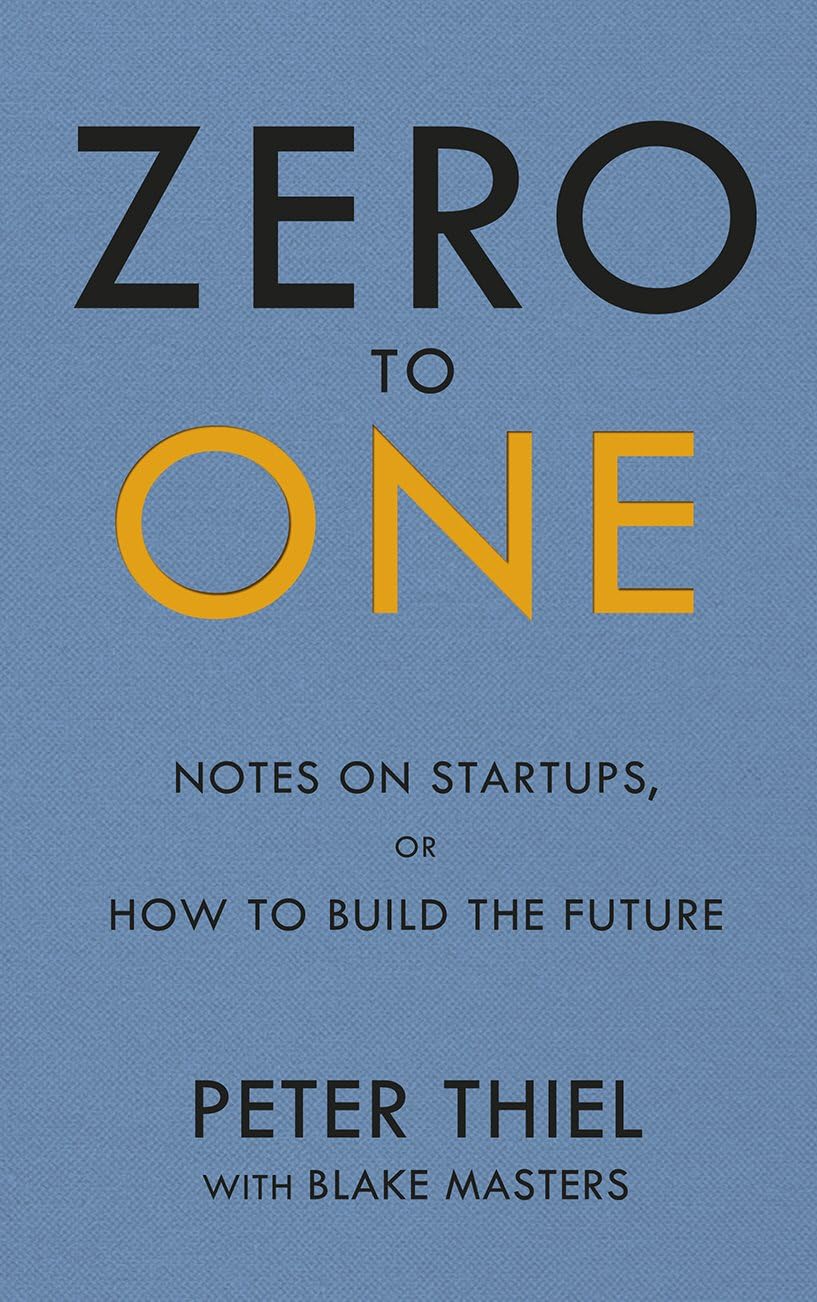
Zero to One: Notes on Start Ups, or How to Build the Future
Product ID: 58903398
Desertcart purchases this item on your behalf and handles shipping, customs, and support to EGYPT.
Libro usado en buenas condiciones, por su antiguedad podria contener señales normales de uso Review: A Propely Prescribed pair of Specacles that puts the world in focus - This book is like a pair of Prescription Spectacles that put the Innovation Startup Business world, into Sharp Focus. When I first saw the price I almost hit exit. However, I thought “If this guy has the balls to ask this price, this book had better be good”. Else I'm going to roast him in my desertcart review. I ain't roasting!! As usual I attacked reading this book in concept extraction mode for my normal initial scan read. Chapter 6, You are not a Lottery Ticket, hit me with a Baseball bat right between the eyes. and slowed my reading pace down to almost snails'. Despite this slow first read, this Chapter deserved a re-read, at almost letter by letter speed. Almost every word or phrase brings an idea from the past, often vague, to the fore and into sharp focus. When I finished my first highlighting trip, almost every word in this chapter was lit. I had to choose and eliminate some of them. In Zero to One, Thiel explores the world of New Business Creation. I would have loved using the word entrepreneurship but excessive and inappropriate use by “experts” have stripped this word of it's true meaning. We even invented a new version in South Africa under the ANC – Tenderpreneur. True entrepreneurship from basics is the creation of a New business that facilitates Economic Development by providing an Inventive New Product creating a New Market Sector that facilitates New Consumer Productivity enhancing opportunities. In Thiel's thesis, basic human attitudes can be split into a 2x2 matrix. I also tend to think in 2x2 matrixi. So this chapter fitted my mind. But Wow did he blow my mind with his various Definite vs Indefinite and Optimistic vs Pessimistic discussions. Despite many years in multinational business I could not fault the Author on any of his explanations. He clarified a lot for me. One of them “strategically humble” is certainly a new, yet valid descriptor for a company with a profitable monopoly. Yet in their Financial market press releases, they deliberately select a market description that yields for them a minority market share in a large market and not their true market share in the niche they dominate totally. (Are they hiding from Monopoly acuzations?) A few key quotes. ”In the 1950's, Americans thought big plans for the future were too important to be left to experts”. (San Francisco Dam) Ralph Waldo Emmerson is quoted as saying “Shallow men believe in luck, believe in circumstances …...... Strong men believe in cause and effect.” “you should do what you could, not focus on what you couldn't” Is to my mind the Quote of the Year. Another hand clapper was “No one pretended that misfortune didn't exist, but prior generations believed in making their own luck by working hard” I consider the following a nice funny; When Peter had to use either the words he or she in his text he seemed to consistently use she. I suppose this enables him to duck accusations of Sexism. Showing signs of being scared of Indefinite Pessimists? “We have to find our way back to a definite future, and the Western World needs nothing short of a cultural revolution to do it.” “ A startup is the largest endeavor over which you can have definite mastery. You can have agency not just over your own life, but over a small and important part of the world. It begins by rejecting the unjust tyranny of Chance” The rest of the book is devoted to discussing the practicalities of founding Innovative Startups successfully. These are focused at exploiting what is commonly considered a secret simply because nobody has really explored it before. Their uniqueness create innovative monopoly opportunities - the key source of profit. One of the issues discussed is; Power Law; We all know the Pareto principle is valid and 80-20 describes the unequal distribution of results in everything. Peter adds these considerations; “It defines our surroundings so completely that we usually don't see it”. He continues with; “but everyone needs to know exactly one thing that even venture capitalists struggle to understand: we don't live in a normal world; we live under power law.” In this way many other facets of Startup founding are discussed practically. In the end I came away with the following thought pattern; A potential successful startup founder is someone who is a Definite Optimist with a long term perspective, prepared to take risks. Who has a mind open enough to identify factual or human secrets that need illumination. Who is prepared to do the hard work necessary to acquire the factual knowledge needed to explore this secret and find a way to change this mystery into a solution. Who is capable of funding this idea or selling it to Venture Funders to acquire funding. Who is prepared to expend the effort to develop the idea into a useful practical end product that solves something significant for a new market sector. AND; Who then has the flexibility to turn around from dreaming, research and creativity. To then display the tenacity to knuckle down to make this idea work in practice, prepared to live through the low personal income initial loss making era, building the practical business. Thanks – A stimulating read, well worth the time and money – even for retired me! Review: Novel and Insightful - Overall this was an excellent book that made numerous interesting points. My favourite point being the arguments for monopoly over competition although I can’t bring myself to fully agree with his argument the mind-set that this type of thinking encourages should prove beneficial to me in the future. Perfect competition is abhorrent for anybody actually competing in such a market and his argument is sound when applied to companies like google , desertcart that are constantly innovating to maintain their competitive advantage. Monopoly’s only become truly dangerous when the barriers to entry become too high to encourage adequate competition and consumers are price gouged. There have been numerous examples of companies colluding to fix prices to screw over consumers and I don’t think this practice has been eradicated yet. I also liked the matrix on the role of optimism and a clear outline of the future, again it’s not something I would 100% agree with but it was certainly though provoking. I don’t believe that today’s society is as apathetic towards the future as described and I think there are a lot of people that have visons of the future and are working to create products that will prosper in this future environment although even as I write this it occurs to me that I would find I very difficult to predict anything in the future past the next ten years and even then you really are shooting in the dark. I also found the section on the Unabomber especially interesting as it wasn’t a viewpoint I had ever heard before. Overall I would give this a book four stars. The book was filled with some very interesting concepts from a person that has actually been there and done it. It is an excellent book and a must read for any aspiring entrepreneur.
| Best Sellers Rank | #212,823 in Books ( See Top 100 in Books ) #7 in Entrepreneurship (Books) #36 in Business & Organizational Learning |
| Customer Reviews | 4.5 out of 5 stars 39,735 Reviews |
P**W
A Propely Prescribed pair of Specacles that puts the world in focus
This book is like a pair of Prescription Spectacles that put the Innovation Startup Business world, into Sharp Focus. When I first saw the price I almost hit exit. However, I thought “If this guy has the balls to ask this price, this book had better be good”. Else I'm going to roast him in my Amazon review. I ain't roasting!! As usual I attacked reading this book in concept extraction mode for my normal initial scan read. Chapter 6, You are not a Lottery Ticket, hit me with a Baseball bat right between the eyes. and slowed my reading pace down to almost snails'. Despite this slow first read, this Chapter deserved a re-read, at almost letter by letter speed. Almost every word or phrase brings an idea from the past, often vague, to the fore and into sharp focus. When I finished my first highlighting trip, almost every word in this chapter was lit. I had to choose and eliminate some of them. In Zero to One, Thiel explores the world of New Business Creation. I would have loved using the word entrepreneurship but excessive and inappropriate use by “experts” have stripped this word of it's true meaning. We even invented a new version in South Africa under the ANC – Tenderpreneur. True entrepreneurship from basics is the creation of a New business that facilitates Economic Development by providing an Inventive New Product creating a New Market Sector that facilitates New Consumer Productivity enhancing opportunities. In Thiel's thesis, basic human attitudes can be split into a 2x2 matrix. I also tend to think in 2x2 matrixi. So this chapter fitted my mind. But Wow did he blow my mind with his various Definite vs Indefinite and Optimistic vs Pessimistic discussions. Despite many years in multinational business I could not fault the Author on any of his explanations. He clarified a lot for me. One of them “strategically humble” is certainly a new, yet valid descriptor for a company with a profitable monopoly. Yet in their Financial market press releases, they deliberately select a market description that yields for them a minority market share in a large market and not their true market share in the niche they dominate totally. (Are they hiding from Monopoly acuzations?) A few key quotes. ”In the 1950's, Americans thought big plans for the future were too important to be left to experts”. (San Francisco Dam) Ralph Waldo Emmerson is quoted as saying “Shallow men believe in luck, believe in circumstances …...... Strong men believe in cause and effect.” “you should do what you could, not focus on what you couldn't” Is to my mind the Quote of the Year. Another hand clapper was “No one pretended that misfortune didn't exist, but prior generations believed in making their own luck by working hard” I consider the following a nice funny; When Peter had to use either the words he or she in his text he seemed to consistently use she. I suppose this enables him to duck accusations of Sexism. Showing signs of being scared of Indefinite Pessimists? “We have to find our way back to a definite future, and the Western World needs nothing short of a cultural revolution to do it.” “ A startup is the largest endeavor over which you can have definite mastery. You can have agency not just over your own life, but over a small and important part of the world. It begins by rejecting the unjust tyranny of Chance” The rest of the book is devoted to discussing the practicalities of founding Innovative Startups successfully. These are focused at exploiting what is commonly considered a secret simply because nobody has really explored it before. Their uniqueness create innovative monopoly opportunities - the key source of profit. One of the issues discussed is; Power Law; We all know the Pareto principle is valid and 80-20 describes the unequal distribution of results in everything. Peter adds these considerations; “It defines our surroundings so completely that we usually don't see it”. He continues with; “but everyone needs to know exactly one thing that even venture capitalists struggle to understand: we don't live in a normal world; we live under power law.” In this way many other facets of Startup founding are discussed practically. In the end I came away with the following thought pattern; A potential successful startup founder is someone who is a Definite Optimist with a long term perspective, prepared to take risks. Who has a mind open enough to identify factual or human secrets that need illumination. Who is prepared to do the hard work necessary to acquire the factual knowledge needed to explore this secret and find a way to change this mystery into a solution. Who is capable of funding this idea or selling it to Venture Funders to acquire funding. Who is prepared to expend the effort to develop the idea into a useful practical end product that solves something significant for a new market sector. AND; Who then has the flexibility to turn around from dreaming, research and creativity. To then display the tenacity to knuckle down to make this idea work in practice, prepared to live through the low personal income initial loss making era, building the practical business. Thanks – A stimulating read, well worth the time and money – even for retired me!
S**Y
Novel and Insightful
Overall this was an excellent book that made numerous interesting points. My favourite point being the arguments for monopoly over competition although I can’t bring myself to fully agree with his argument the mind-set that this type of thinking encourages should prove beneficial to me in the future. Perfect competition is abhorrent for anybody actually competing in such a market and his argument is sound when applied to companies like google , Amazon that are constantly innovating to maintain their competitive advantage. Monopoly’s only become truly dangerous when the barriers to entry become too high to encourage adequate competition and consumers are price gouged. There have been numerous examples of companies colluding to fix prices to screw over consumers and I don’t think this practice has been eradicated yet. I also liked the matrix on the role of optimism and a clear outline of the future, again it’s not something I would 100% agree with but it was certainly though provoking. I don’t believe that today’s society is as apathetic towards the future as described and I think there are a lot of people that have visons of the future and are working to create products that will prosper in this future environment although even as I write this it occurs to me that I would find I very difficult to predict anything in the future past the next ten years and even then you really are shooting in the dark. I also found the section on the Unabomber especially interesting as it wasn’t a viewpoint I had ever heard before. Overall I would give this a book four stars. The book was filled with some very interesting concepts from a person that has actually been there and done it. It is an excellent book and a must read for any aspiring entrepreneur.
R**D
while it was highly recommended, my primary reason for reading the book was ...
http://focusinvestor.com/index.php/blog/item/28-zero-to-one.html Zero to One: Notes on Startups, or How to Build the Future by Peter Thiel with Blake Masters I had reservations about this book because, while it was highly recommended, my primary reason for reading the book was the hope that it might contain some useful perspective on common stock investing. The book is primarily focused on venture capital, not an area that holds a high level of interest to me so I was pleasantly surprised when the first paragraph of the book contained a question that hooked me. The question was one of the author’s favorite interview questions: “What important truth do very few people agree with you on?” The question was an easy one for me to answer as most people believe in diversification, but the truth is the opposite, i.e. portfolio concentration. Too many funds practice a high level of diversification that essentially makes them index funds with much higher fees. This will be an unconventional blog post as most of the items I quote from the book speak for themselves. p. 13: “The first step to thinking clearly is to question what we know about the past.” I'm always surprised that most investing books don't discuss investing history. If you don't take the time to understand historical markets movements you put yourself in a bad position because you will have a much harder time understanding market cycles. The low point of cycles when everyone else is afraid to invest is the ideal time to make outstanding investments. p. 21: What does the author say the lessons of the internet bubble were? 1. It is better to risk boldness than triviality. 2. A bad plan is better than no plan. 3. Competitive markets destroy profits. 4. Sales matters just as much as product. p.23: “The most contrarian thing of all is not to oppose the crowd but to think for yourself.” p.24: “Under perfect competition, in the long run no company makes an economic profit. The opposite of perfect competition is monopoly. p.25-35: He defines a monopoly as”…the kind of company that’s so good at what it does that no other firm can offer a close substitute.” “If you want to create and capture lasting value, don’t build an undifferentiated commodity business.” p.25: This in investing terms would change only slightly to don’t buy an undifferentiated commodity business. Decline of Monopolies p.33: "...old monopolies don't strangle innovation. With Apple's iOS at the forefront, the rise of mobile computing has dramatically reduced Microsoft's decades-long operating system dominance." He talks about IBM, AT&T also eventually declined. Even the best monopolies have finite lives. p.34: "All happy companies are different: each one earns a monopoly by solving a unique problem. All failed companies are the same: they failed to escape competition." p.47: "If you focus on near-term growth above all else, you miss the most important question you should be asking: will this business still be around a decade from now? Numbers alone won't tell you the answer; instead you must think critically about the qualitative characteristics of your business." p. 48: Monopoly Traits: 1. Proprietary technology: "...most substantive advantage a company can have because it makes your product difficult or impossible to replicate. Mentions Google's algorithms and that your product needs to be 10X better. Amazon had 10x inventory. 2. Network Effects Product is more useful as more people use it. He believes that to be successful with this strategy you must start in a small market. 3. Economies of Scale. Monopoly business gets stronger as they get bigger. Can spread costs out. 4. Branding Used Apple as an example - "paid advertising, branded stores, luxurious materials, playful keynote speeches. Reinforces other monopoly traits. Power Law p.87: "At Founders Fund, we focus on five to seven companies in a fund, each of which we think could become a multibillion-dollar business based on its unique framework Whenever you shift from the substance of a business to the financial question of whether or not it fits into a diversified hedging strategy, venture investing starts to look a lot like buying lottery tickets. And once you think that you're playing the lottery, you've already psychologically prepared yourself to lose." What an excellent quote and advice that I wish more people will follow. Investors should approach investing in a rational serious manner which in a perfect world would allow them to make the optimal investment decisions based on the companies available that they can understand and value. p. 90: "The most common answer to the question of future value is a diversified portfolio: "Don't put all your eggs in one basket... investors who understand the power law make as few investments as possible." The author is involved with venture capital an area where the accepted wisdom is to diversify your portfolio, much like what you hear as an accepted truth in the equity investing world. In his fun he tries to purchase companies that "..have the potential to be succeed at vast scale." The only thing I would add from an equity investing standpoint is that valuation must also play a role in your decision making process. To wrap this blog post up I have to say that I really enjoyed the book and would have no problem recommending it to followers of the blog.
H**T
Thiel has more wise things to teach you than just crazy though brilliant visions.
I have been reading Thiel‘s Zero to One in the last days. And after a compilation of his class notes last year, here are a few more comments. His book is as good as his notes but some readers may be puzzled. It’s not a book about how to build start-ups. (For this read Horowitz or Blank) “This book offers no formula for success. The paradox of teaching entrepreneurship is that such a formula necessarily cannot exist; because every innovation is new and unique, no authority can prescribe in concrete terms how to be innovative. Indeed, the single most powerful pattern I have noticed is that successful people find value in unexpected places, and they do this by thinking about business from first principles instead of formulas.” [Page 2] Thiel is a strong believer in exceptional achievements, in innovation just like in art or science. “The entrepreneurs who stuck with Silicon Valley learned four big lessons from the dot-com crash that still guide business thinking today: 1. Make incremental advances 2. Stay lean and flexible 3. Improve on the competition 4. Focus on products, not sales. These lessons have become dogma in the startup world. (…) And yet the opposite principles are probably more correct: 1. It is better to risk boldness than trivaility 2. A bad plan is better than no plan 3. Competitive markets destroy profits 4. Sales matters just as much as product.“ [Pages 20-21] There is one point where I disagree with Thiel. Though I tend to be convinced by his argument that monopoly is good and competition is bad – read Thiel with care for the subtlety of his arguments – I do not think he is right when he writes [page 33]: “Monopolies drive progress because the promise of years or even decades of monopoly profits provides a powerful incentive to innovate”. I prefer Levine and Boldrin. Now I do believe that established players are displaced by new players – not competitors – who innovate when the champions who have become dinosaurs stop being creative. Thiel does not believe in luck. “You are not a lottery ticket” and I agree that you can minimize uncertainty by carefully planning and probably by adapting too. He still quotes [page 59] Buffett who considers himself “a member of the lucky sperm club and a winner of the ovarian lottery”. He also quotes Bezos with his “incredible planetary alignment” (which has not much to do with luck either). According to Thiel. success is never accidental. I also like his piece about founders: “Bad decisions made early on – if you choose the wrong partners or hire the wrong people, for example – are very hard to correct after they are made. It may take a crisis on the order of bankruptcy before anybody will even try to correct them. As a founder your first job is to get the first things right, because you cannot build a great company on a flawed foundation. When you start something, the first and most crucial decision you make is whom to start it with. Choosing a co-founder is like getting married, and founder conflict is just as ugly as divorce. Optimism abounds at the start of every relationship. It’s unromantic to think soberly about what could go wrong, so people don’t. But if the founders develop irreconcilable differences, the company becomes the victim.” [page 108] Ands now about sales: “In engineering a solution either works or fails. [Sales is different]. This strikes engineers as trivial if not fundamentally dishonest. They know they own jobs are hard so when they look at salespeople laughing on the phone with a customer or going to two-hour lunches, they suspect that no real work is being done. If anything, people overestimate the relative difficulty of science and engineering, because the challenges of those fields are obvious. What nerds miss is that it takes hard work to makes sales look easy. Sales is hidden. All salesmen are actors: their priority is persuasion, not sincerity. That’s why the word “salesman” can be a slur and the used car dealer is our archetype of shadiness. But we react negatively to awkward, obvious salesmen – that is, the bad ones. There’s a wide range of sales ability: there are many gradations between novices, experts and masters. […] Like acting, sales works best when hidden. This explains why almost everyone whose job involves distribution – whether they’re in sales, marketing, or advertising – has a job title that has nothing to do with those things: account executive, bus. dev, but also investment banker, politician. There’s a reason for these re-descriptions: none of us wants to be reminded when we’re being sold. […] The engineer’s grail is a product great enough that “it sells itself”. But anyone who would actually say this about a real product must be lying: either he’s delusional (lying to himself) or he’s selling something (and thereby contradicting himself). […] It’s better to think of distribution as something essential to the design of your product. If you’ve invented something new but you haven’t invented an effective way to sell it, you have a bad business – no matter how good the product.” [Pages 128-130] And if you do not like it said this way, watch HBO’s Silicon Valley episode 15… I may come with more comments when I am finished with this great book. In fact I have... and here are a few more comments, less about entrepreneurship than about social issues. Whatever the reputation of Thiel in Silicon Valley as a possible Libertarian, there were a couple of topics he addresses very convincingly. He is not a pure Contrarian. He disagrees with mainstream fashion in a very serious manner. Here are a couple of examples: – The machine will not replace humankind Yes computers have made impressive progress in the recent decades, but not to the point of replacing mankind. He shows very convincingly through the cases of Paypal and Palantir [pages 144-148] that computers cannot solve automatically tough issues but are only (excellent and critical) complements to human beings. Even the Google experiment of recognizing cats “seems impressive – until you remember that an average four-year-old can do it flawlessly” [page 143]. He finishes his chapter about Man and Machine this way: “But even if strong AI is a real possibility rather than an imponderable mystery, it won’t happen anytime soon: replacement by computers is a worry for the 22nd century. Indefinite fears about the far future shouldn’t stop us from making definite plans today. Luddites claim that we shouldn’t build the computers that might replace people someday; crazed futurists argue that we should. These two positions are mutually exclusive but they are not exhaustive: there is room in between for sane people to build a vastly better world in the decades ahead. As we find new ways to use computers, they won’t just get better at the kinds of things people already do: they’ll help us to do what was previously unimaginable” [pages 150-151]. You will not be surprised I prefer this to Kurweil views. – Greentech was a bubble and it was obvious from day 1. I was always puzzled with greentech/cleantech. Why are people so excited about the promise to solve an important problem when we do not have any solution. Thiel is far tougher. First he shows the obvious: it was a bubble. Then he analyzes this industry through his “zero to one” arguments. “Most cleantech companies crashed because they neglected one or more of the seven questions that every business must answer: – Engineering: can you create a breakthrough technology instead of incremental improvements? – Timing: is now the right time to start your particular business? – Monopoly: are you starting with a big share of a small market? – People: do you have the right team? – Distribution: do you have a way to not just create but deliver your product? – Durability: will your market position be defensible 10 and 20 years into the future? – Secret: have you identified a unique opportunity that others don’t see? If you do not have answers to these questions, you’ll run into lots of “bad luck” and your business will fail. If you nail all seven, you’ll master fortune and succeed. Even getting five or six correct might work. But the striking thing about the cleantech bubble was that people were starting companies with zero good answers – and that meant hoping for a miracle” [page 154]. What’s next? Fintech?
B**.
Save your Money-Just go read the notes from the Stanford CS 183 Class
I really wanted to like this book. I've never read or heard anything previously from Thiel, so I had little bias going in. I heard a recent radio interview with Peter Thiel where I thought he handled questions really well and gave some great advice for entrepreneurs. From the amount of 5 star reviews on Amazon and an online list I found of best business books of all time with this book on it, I was expecting something very profound. I guess you could say no amount of Peter Thiel's novel insights and experiential knowledge could have met my high expectations. However, I was going to give the book 4 stars until I hit about half-way through book, where it just all seemed to go downhill thereafter. I suddenly started questioning many of Thiel's assertions from the earlier chapters, and ended up with a lopsided Pros vs. Cons list. I started researching into Thiel's accomplishment's and failures. The result was a three star review. My opinions are outlined below. I'll start with what I liked: 1.) The book has a core theme of empowering the individual. The technological future is not going to happen unless individuals or teams thereof make it happen. The future is not inevitable. Moore's law for transistors just doesn't happen like a natural phenomena; you need a dedicated team of innovators always solving the technical challenges. (Actually, Moore's law is expected to not hold over the next decade, due to technological barriers.) I liked the idea of "You are not a lottery ticket." Too much credit is given to founder blind luck in the creation of successful companies in popular culture. There were a whole lot of people busting their humps with late nights and weekends making these things happen. Startups are not 9-5 M-F jobs with lots of vacation and perks built in. 2.) Thiel reminds engineers that while their work is essential at a startup, its not sufficient for a successful business venture. You have to get your product to the customer (i.e. figure out the manufacturing/supply chains/logistics). You have to explain how this product is going to benefit the customer. You have to convince a customer to part from his/her money. This doesn't just magically happen, you're going to have to be a hustler if you ever want to see real profits. 3.) Although sometimes obvious, the book is full of useful advice and anecdotal lessons learned from tech startups' failures and successes. If you are planning a startup or interested in joining one you should read this book. You will learn something about entrepreneurship. Here's what I didn't like: 1.) Absence of Supporting Evidence. The writing style is very informal, which I actually enjoy (makes for a quick read), but many of his arguments are made poorly (sometimes unconvincingly). There are no citations in this book. No references are mentioned. Subjective opinions and personal anecdotes often substitute for any factual evidence. It's pretty clear Thiel has a disdain for statistics of any kind, both in a factual statistic sense and for any technology that relies on stochastic techniques. The book is also chock full of superlatives and (mostly false) dichotomies. A prime example: "Almost all successful entrepreneurs are simultaneously insiders and outsiders....When you plot them out, founders' traits appear to follow an inverse normal distribution." No citation or reference given....yeesh....I mean is this a personality study Peter Thiel personally did or does he just completely make this up? Another example is his central theme: "All happy companies are different: each one earns a monopoly by solving a unique problem. All failed companies are the same: they failed to escape competition." Not really true of either sentence as counter examples are given even by Thiel later in the book (e.g. some companies implode by poor distribution, infighting, unprofitable ideas, etc.) I'm glad Thiel didn't become a trial lawyer, he'd get embarrassed in any court room. Ironically, the book makes Thiel come across as sounding like the ivory tower university professor he so loathes, with all the 'take my word for it', 'I'm the expert'superficial arguments he makes in the book. 2.) Poor definitions and arbitrary/contradictory arguments. It's not real clear what's an incremental advance and what's not. A 10x improvement is not technically feasible or theoretically possible in many fields. For example, a power plant operating at 30% energy efficiency can't have a 10x advance in energy efficiency (more than 100 % efficiency breaks the conservation of energy law). Sometimes just a 2X (100%) advance is a big freaking deal. Doubling the fuel economy on a car (without negatively affecting its performance, safety, or cost) is a really hard problem that, if solved would be a huge breakthrough. It would line customers up at your door. Even Tesla, the company Thiel has a major hard-on for in the Seeing Green chapter, hasn't achieved that: a new Tesla roadster set you back at least $110,000 US, their lower end vehicles are still North of $60,000 US even with generous government subsidies and incentives. Not exactly a common man's car anyone can afford. Also, the claim of "undifferentiated products" is kind of a straw man argument. Do any two companies really produce identical products? Yes Pepsi and Coca-cola both make similar soft drinks, but they are not identical. Some people like the taste of Coke, others prefer the taste of Pepsi, but they don't taste the same. Big Macs vs. Whoppers. One make/model of vehicles vs. others. One Airline carrier over others. Most people will prefer one over the other, even if just by a little, and even if the prices are different (within a reasonable range). That's why businesses still exist in competitive markets. If this wasn't true, the lowest price, even by a penny, wins by default and monopolies would happen naturally in the long run, without need for any further competition. His last chapter on stagnation or singularity is very nebulous in which he plots "progress" on the vertical axis and time on the horizontal. It's not really clear why he chose just four scenarios? Why not linear progress? Why not linear with a mix of boom/bust cycles? The possibilities/combinations are endless. What does he mean by progress anyway? Computing power? World GDP? The DJI or NASDAQ Index? Your guess is as good as mine. 3.) Patently Obvious. Some statements that Thiel writes is blatantly obvious: see Elkin Wells "Ok, not amazing." review for great examples. The irony of this book is that it does not really represent a Zero to One contribution to thinking in technology, entrepreneurship, business, futurism, philosophy, etc. What Thiel states in this book has been said by many other people for quite some time. His central tenet of "creative" monopolies (i.e. a monopoly achieved through secured patents, copyrights, trade secrets, etc.) are a good thing that all startups should strive to achieve, wouldn't surprise anyone who has taken a basic economics or business class or has tried to start a business. I mean who starts a business (excluding franchises) and thinks I'm going to get rich producing exactly the same product this other guy did at the same cost. Everyone thinks their business is unique in some way. On the novelty factor, the US Patent & Trademark Office states it's mission is (it's also in the Constitution) "to promote the progress of science and useful arts, by securing for limited times to authors and inventors the exclusive right to their respective writing and discoveries." This is pretty obvious stuff, if you have nothing to gain personally by inventing something and sharing it with the world, you probably won't. And we all lose out in that scenario. Thus, a creative monopoly is something to be encouraged. The other key concept here is that these are temporary monopolies on specific products/works (e.g. a utility patent has a expiration of 20 years after filing). Creative monopolies don't last forever. A company has to keep innovating in order to obtain more creative monopolies for different products or refined products. To be fair, I think Thiel was trying to say this about Google and Apple, but he didn't finish the thought. 4.) Started Strong, ended very weakly. The first few chapters were pretty balanced and thought-provoking. The later chapters on green technology, characteristics of founders, and a brief comment on what the future may look like were a collection of half-baked and half-hearted ideas. The Founders Paradox chapter was an embarrassingly bad mix of pop culture nonsense that compares tech founders to rock stars and Gods (I'm not kidding or exaggerating). The book has "How to Build the Future" in its title and all we get from Thiel's final chapter is what he thinks the future may look like in a five page conjecture about what shape the progress over time graph may look like. Thoroughly disappointing. 5.) The organization of the book is pretty haphazard as well. It jumps from discussions of monopolies and competition and recommendations/pitfalls to avoid for a successful startup (which fit the title of the book) to a poorly argued discussion about founder traits and green technology. 6.) Silicon Valley is the center of the Universe? Thiel constantly references Silicon Valley companies and culture ad nauseam. Google this and Apple that. Hoodies, Crocs, and T-shirts are the coolest.....Yes I know it is the IT Mecca and it's where every programmer wants to land a job, but there is a whole startup world outside of the Valley. HBO's Silicon Valley show highlights some of the absurdities within the Valley's tech culture. Silicon Valley tends to suffer from a lot of superiority complexes, group think, and trend chasing as a result of both its real and perceived successes. 7.) Peter Thiel can do no wrong, or he can see the future and you can't. Thiel has made a name for himself by claiming to be a "contrarian thinker" and for his financial successes at PayPal, Google, and Facebook. He also likes to point out indefinitely optimistic the financial world is (page 70) as if he somehow knows how to beat the market. However, his hedge fund took a beating just like all the rest of the others during the 2008 crash. He doesn't discuss any of his failed VC endeavors at all in the book. Would be nice to hear what mistakes you've learned from personally. Or maybe every investment Thiel's made has gone gangbusters? Doubtful. Never mentions the highly publicized failure of his Thiel fellowship where he paid $100K to 20 college students to drop out of college and start a business. On page 75 he puts up a table of the differences between software and biotech companies (a real apples to oranges comparison, as evidenced by the table's stark contrast of biotech's study of expensive "poorly understood", "uncontrollable organisms" and software's artificially created, well understood, cheap environment.) He then makes the statement, "It's possible to wonder whether the genuine difficulty of biology has become an excuse for biotech startups' indefinite approach to research in general." Actually, Thiel I think the extreme contrast of lack of knowledge and understanding in a natural complex system like biology versus an artificial system like software (which he just highlighted) is the reason for the indefinite approach. Also Thiel seems to have a disdain for biotech (my guess is he has been burned by the slow pace of biological research on several investments in biotech) without a respect for its inherent complexity versus the highly linear and artificial world of computing. Yes, designing the software for PayPal's digital transactions is not trivial, but it pales in comparison to the difficulty of eradicating every ~100nm cancer cell in a human without killing the host. The number of variables (if they are even known in the biotech example) to account for are orders of magnitude larger than any problem a programmer would face. Re-iteration speed in computing is taken for granted as well. What's the worse that happens if your code has errors? It won't even break the machine it runs on unless that's your intent. We all know what the worse case is in biotech/medicine. He also acts like no innovation has come from biotech in the past 3 or 4 decades. What about the human genome mapping? What about artificial hearts and kidneys? Artificial hips and knees? Genetically modified plants that have 10x better yields? DNA matching of criminals from trace amounts of tissue samples that has revolutionized the justice system? He also didn't see the Green Tech bubble coming? In the seeing green chapter he rails against solar companies for seeking only incremental advances in technology as their major downfall. Yet he fails to see the real technological challenges of solar and wind: they are location specific and their energy density (the amount of energy you get from the same stored volume or weight of the fuel) is nowhere near that of nuclear and non-renewables. That is a huge pitfall to overcome in the energy and transportation sector and it's always been the well-known reason why wind and solar are niche power applications. At a coal or nuclear power plant, if the energy demand from a nearby city goes up, you just burn more fuel and possibly start up another turbine. The amount of fuel you have is only limited by logistics and your onsite storage. Not only are onsite storage needs larger for a solar or wind farm (a battery has much lower energy density than a lump of coal/ fuel rod/gallon of gasoline of the same weight) but your fuel (essentially electrons for storage) is generated onsite. Both wind and solar need enormously large areas of generation equipment (panels or turbines) to generate any appreciable energy for even a small city. And the ideal location for solar and wind power plants are often in deserts or on mountain sides, or miles off the coastline: exactly where most people don't live. So any efficiency gains you get from putting it in an ideal location is lost to power line transmission by having to put it far away from people using the power. The poor energy density is an even bigger problem with electric vehicles. These are multiple engineering feats that need major improvement, not simply a 10x reduction in a single technology. Nevertheless, modest efficiency gains of even a few percent in the energy sector are technically challenging or costly or both; thermal efficiency of conventional power plants have gone up only ~10-15% in the past century. There are fundamental limits to thermodynamics. In the end, Thiel is susceptible to the same dogmas ("peak oil", Malthusian resource shortages, the inevitability of "green" technology, reduce carbon emissions at all costs) that anyone else could end up believing without questioning any assumptions. Thiel shows a glaring ignorance of technology outside of IT. When technical progress doesn't meet the accelerated pace that he's seen in the computing world, he resorts to shooting the messenger and blaming the researchers within the field. 9.) If all the negatives above sounds like a class you've taken in college. That's because that's exactly how this book started. Thiel taught a class at Standford about startups with the same material. In fairness, Thiel's audience for the lectures that inspired the book, freshman and sophomores in Stanford's Computer Science department, probably know as much about business and economics as Thiel knows about being humble about his success at PayPal, hence the lack of any real depth on any particular subject matter. However, this is not forgivable when the notes from a class are almost pasted into a hardcover book verbatim. I mean there was a chance for some serious editing, more depth and refinement, and re-organization during this conversion process, but it doesn't appear much thought went into any of these. Honestly I thought the notes were better (which has more chapters as well), because they included many more pictures with better humor and more detail. My guess is that Thiel probably gave outstanding lectures with some cool Powerpoint slides, but any charisma and charm from the lectures were lost during the book transition. Qualifiers and Disclaimers: I'm a bioengineer doing both hardware and software for a small biotech startup. I was a patent examiner (in semiconductors) for the USPTO and still do part-time contract work for them (in mechanical and medical devices) so I see innovation all the time. I also consider myself a libertarian politically, as does Peter Thiel. Read some of the other 3 star reviews of this book, they are very much on point.
I**N
and they could easily mislead future entrepreneurs
Zero to One: Notes on Start Ups, or How to Build the Future by Blake Masters, Peter Thiel The author of this book, Peter Thiel, started the worldwide, online payment system, PayPal, together with Max Levchin, Luke Nosek, Ken Howery and later Elon Musk. Thiel, a formidable intelligence, has pulled together an insider’s insights into building a startup that will add significantly to the business environment. While his focus is technology and “building the future”, his thoughts are relevant to any start up, in any field. The Dot Com crash of 2000 led many to reconsider their thinking about creating new businesses. The euphoria of the Dot Com era was followed by huge losses, and a sobering of the irrational enthusiasm. However, the lessons many learned from this fall were the wrong ones, says Thiel, and they could easily mislead future entrepreneurs. These “lessons” included the warning that anyone who wants to change the world should be more humble; the future is unknowable so do not make plans; build on what others have already achieved; and so on. The opposite of this timidity is probably more correct, Thiel believes. It is better in every way to risk boldness than to make only slight, trivial, changes to what has already proven to be successful. While the future cannot be known with certainty, it isclearly better to plan than to have no plan. During the Dot Com bubble, there was an unbridled belief in the value of products with little or no significant thought given to the sales and distribution of these products. “Sales matters just as much as product”: we learned the hard way. When hiring new staff, Thiel explains, he asks candidates what contrarian idea they hold that no-one else seems to believe. That contrarian idea is also applicable to companies: “What valuable company is nobody building?” This is a powerful starting point for any start-up. To this value-adding benefit to people, the accompanying question should be added, “How much value can I keep from this company?” Thiel compares U.S. airline companies to Google to illustrate this point. Google’s revenues in 2012 were one third those of the airlines at $50b, but made 21% of those revenues as profits compared to the airlines’ 0.002%. Monopolies have a bad reputation. While they dominate, they draw excessive profits for shareholders, (very good,) but hurt consumers, which is why they are always under attack by regulators. Thiel favours monopolies, not of the kind that are protected by legislation, rather those that achieve this status because they are so good at what they do. However, those who accept Thiel’s view of “good” monopolies often delude themselves with the “We’re in a league of our own” deception. Too often start-ups are in a league of their own, but the league is so small that dominating it is not financially viable. If you are not significantly different to your competitors you will always struggle to survive. The only way to avoid this daily struggle, Thiel suggests, is to produce the profits that a monopoly commands. This is no easy matter because in a dynamic business environment, it is always possible for your competitors to invent new and better offerings. “Creative monopolists give customers more choices by adding entirely new categories of abundance to the world,” Thiel explains. Creative monopolies are not only good for society, it is they who make the future so much better than the past. There is a set of characteristics that is shared by all creative monopolies. The proprietary technologies these companies hold must be very difficult to replicate and provide a substantive advantage – they must be “at least 10 times better.” Google’s algorithms produce results 10 times more efficiently than any other search engine. Amazon has in excess of 10 times as many books as any other bookstore. A further characteristic of creative monopolies is their network effect. This effect makes the product more useful as more people use it. What is paradoxical is that these businesses must be valuable to the few first users in order for the business to survive. Recall that Facebook started with Harvard students to whom it offered value. A software startup has the additional advantage of dramatic economies of scale because the marginal cost of expansion is close to zero. Branding has always been, and remains an important characteristic of any creative monopoly. However, as we have seen clearly from the outrageously successful Apple products, the branding has to be substantive, not an add-on. Their products are fundamentally better. Thiel’s book on building successful startups holds far more valuable insights than I could possibly include in a column. Nissim Taleb, (author of The Black Swan,) put it succinctly: 'When a risk-taker writes a book, read it. In the case of Peter Thiel, read it twice. Or, to be safe, three times. This is a classic.' Readability Light ---+- Serious Insights High +---- Low Practical High --+-- Low
M**C
Short read that sticks with you
This is a pretty quick read but one of those books that changes how you look at a few things for a while after. Thiel's take on monopolies versus competition is the opposite of what you hear most places and the argument is actually pretty convincing. Made me rethink what it means to build something valuable versus just competing on price. Good book for anyone interested in startups or business even if you push back on some of the ideas.
P**9
Thiel's Advice To The Next Generation Of Visionaries
Thiel in "Zero To One" brings all his past experience, as entrepreneur, venture capitalist and visionary, together as he presents his thoughts and advice on how to build a better future and world. Overall Thiel delivers well on his purpose. He cites past experience, reasearch, thought experiments, future projections and more as he makes his case for what it will take to build a better future and what it would likely look like. He's extremely articulate (thanks in part to his philosophy and law background), funny, insightful and almost never boring. I picked up the book once and didn't set it down until I was done reading all of it (it's that good). With that being said though I'm not sure exactly who this book is for or even if it has a target audience. Theil himself says that the book is not meant to be a strict "do x and get y" (paraphrasing here). This is because often the best entrepreneurial ideas aren't achieved by sitting around and thinking I should start a company and then trying to find an idea. They come from people recognizing their is a real unmet need or opportunity in the world that is best achieved through entrepunurship. The best entrepreneurs are often "accidental" ones. I feel one purpose, of the book, is to put some thoughts in the back of your mind that may come to use at a later time. Or if you already have a business, or have been pondering one, and need some self help in acheiveing that vision. It's also good for those that are intellectually stimulated and or are dreamers visoniarys themselves. Ultimately though I feel, at least for Thiel himself, the book is like a letter to his younger self. If he could back to when he graduating high school or college and had his whole life ahead of him the advice he would give himself. So in some ways its more than just about entrepreneurship, there's a little self help advice mixed in with it all. Some advice in general... listen to people when they want to tell you what they wish they knew when they were your age. You can avoid alot of mistakes and mature faster that way. I recommend this book and I feel most people can take something from it. And hopefully it will be puzzle piece in helping you push for your vision in the world. 5/5 Stars!
H**F
Absolutely recommend it
if you're a startup guy like me you should buy it... you won't regret
J**E
The great difference
Great and different book about how to progress in business
B**L
A-Plus: instructive, definite, methodical.
This is a very good book and is likely to benefit many people wishing to learn about what constitutes great startups. I found myself agreeing with Peter on most topics. I liked his analysis of nations in terms of optimism and pessimism, definitiveness and the lack of it, and the parallels for startups; of competitions and monopolies; etc. He talks about some popular notions, notably the pursuit of the Minimum Viable Product (MVP) by tech startups and puts it in perspective: well put! I also appreciated his emphasis on marketing and sales, which is definitely understated by some other authors who have written about startups recently. His views on what constitutes great founders are informing, but his analysis covers a very small group of some very prominent names, and I could neither agree nor disagree with those views in the general sense.
C**N
Interessante, innovativo - anche se non molto “mainstream”
Libro molto interessante, da leggere. Analizza con diversi esempi la traiettoria e le strategie delle start-up, con concetti, a volte un po’ estremizzati, ma mai banali.
D**A
Good book
Awesome book.
Trustpilot
2 days ago
2 weeks ago