We remain fully operational. Our teams are working around the clock to ensure your deliveries continue safely.
قم بتنزيل التطبيق


معلومات عنا
حقوق الطبع والنشر © 2024 Desertcart Holdings Limited
قم بتنزيل التطبيق

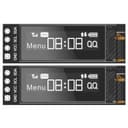
✨ Elevate your DIY game with crisp, low-power OLED brilliance!
The MakerFocus 2-pack 0.91-inch OLED display modules feature a 128x32 pixel resolution driven by the SSD1306 chip, delivering bright, self-luminous white visuals with a wide >160° viewing angle. Designed for seamless integration with Arduino, Raspberry Pi, ESP32, and other development boards, these I2C interface displays operate efficiently at 3.3V to 5V with ultra-low 0.06W power consumption. Ideal for compact, high-contrast graphical or textual output in professional and hobbyist projects alike.
| ASIN | B079BN2J8V |
| Best Sellers Rank | #326 in Single Board Computers (Computers & Accessories) |
| Brand | MakerFocus |
| Built-In Media | 2 * 0.91 Inch I2C OLED Display Module |
| CPU Model | None |
| CPU Speed | 3.4 |
| Compatible Devices | Arduino, ESP8266, ESP32, STM32 |
| Connectivity Technology | I2C |
| Customer Reviews | 4.6 out of 5 stars 592 Reviews |
| Included Components | 2 * 0.91 Inch I2C OLED Display Module |
| Item Weight | 9.07 g |
| Manufacturer | MakerFocus |
| Mfr Part Number | Y3L143419KVPKUK |
| Model Name | 0.91 Inch I2C OLED Display Module |
| Model Number | 8541549353 |
| Operating System | Linux |
| Processor Brand | AMD |
| Processor Count | 1 |
| Processor Speed | 3.4 |
| RAM Memory Technology | LPDDR3 |
| Smart Home Compatibility | Not Smart Home Compatible |
| Total Usb Ports | 1 |
| UPC | 702646045932 |
| Unit Count | 2.0 Count |
| Warranty Description | No Warranty |
| Wireless Compability | 802.11abg |
L**K
Great cheap little display.
I'm using this with a Sparkfun ESP8266 Thing. Works great! Nice small, crisp, and inexpensive little display. I'm using it with the u8g2 library and at this point I'm just interested in a a text display with no need for graphics so I am using the lightweight u8x8 text only version of the library/API and calling the display a U8X8_SSD1306_128X32_UNIVISION_HW_I2C. It is very easy to use with that simple library -- just remember to have pull-up resistors on SCL/SDA if you don't already have an I2C device on the bus that has them. Note that being OLED these displays probably shouldn't be used in cases where the display will be on continuously for a long time. I would expect that pixels will start to dim after being on for a few thousand hours as that is the nature of OLED. That said they are great for short term projects and for long term ones where pixels will not be on continuously. If you will be displaying continuously for a long time don't be surprised if it starts to dim.
H**S
Really Wonderful little displays!
These things are tiny! That worked out well for me since the projects I was making were suppose to essentially stay out of the way if all went well. I used the Adafruit SSD 1306 Libraries and they worked great. They are low power and bright. For the adafruit library examles, they really are over the top. There is no "hello world" essentially, so just do a google search for a hello world example for the libraries to get a basic starting point. Also, to rotate the display 180 Degrees, put in display.setRotation(2); in the setup. Basic usage for those libraries are.. display.display(); display.clearDisplay(); display.setTextSize(1-3); display.setCursor(0,0); // origin of text display.print("blah"); display.println("-appended to last word blah, then new line"); As for the hardware, the displays are nice and small. If you think of your breadboard, they are 4 rows high, then about 12 slots wide. (That's the entire board.) Voltage range is impressive and seems to operate at lower than 3.3, but I'm running it on 4.5v and there are no problems. (Basically, 5v from the wall but through a diode on the arduino). It takes around 5ma. With a watch dog timer and adjustment I bet you could get a whole pro mini project to run at under 3ma standby while keeping the display going. Refresh time on the display is very fast and cameras don't pick up any multiplexing/flicker. They did not come with headers, but the plated through holes are very well done and take solder well. The holes are pretty snug, which means it's strong. It will be hard to desolder these after, so google some tricks on removing header pins to make your life easier! If this was a useful review to you, please give it a thumbs up! :D I think a lot of people had these questions..
M**G
Cheap Board!
I'm always concerned buying displays, sensors, or other components from unknown suppliers or not directly from the manufacturer. It can be a gamble if the documentation is correct. I'm pleased to report that it took all of 5 minutes to get this setup with a PlatformIO project in VSCode! The display is nice and bright. In testing I'm running it from the 3.3v line on an Arduino Nano. As of Jan 2024 the board I received worked immediately with the Adafruit_SSD1306 and Adafruit_GFX libraries on I2C with address 0x3C (the default in the lib when using the 128x32 display example). I was able to use the example code from the Adafruit_SSD1306 library published to an Arduino Nano and successfully see the test sequences. Very happy with the out of box result and am really thinking it will be nice in my project!
S**E
Only if you know what you're doing
Update 1: I am in the middle of investigating why i'm still having problems with this device. Since posting, I have discovered that, at least with the NodeMCU8266, pull-up resistors may not be required, contrary to my initial review. (Indeed, the schematic diagram in the picture list seems to indicate that they are built in.) I have confirmed that the device can also work with Arduino Uno, so it appears to be both 3v3 and 5v compliant, as described. However, the Uno only works if a 4.7kOhm resistor pulls-up the SCL line. Odd. On the other hand, I cannot get it to work reliably, and it is not certain that this display module is at fault. Time to pull out the logic analyzer and see what is going on. I am provisionally changing my rating to 4 stars, because a) it may work as expected and b) the vendor has been extremely helpful trying to resolve the issue amicably. They are good, trustworthy people. (As an aside, they have indicated that they have requested their supplier to include headers, but no luck. Not a critical point in any case.) *** I'm going with 2.4 stars here. I received two units - they both work. 1) I understand the frustration of R.Arnold's review. However, the Adafruit library does work in sample code ( ssd1306_128x32_i2c ). Knowing I2C pretty well is required though. I learned the hard way. Had an 8266 (3.3v) as MCU plus an Adafruit temp/humidity sensor and this display on the I2C bus. I knew that I2C requires pull-up resistors on SDA/SCL, but the sensor has builtin pull-ups, and theoretically you only need one set. The sensor communicated fine and I was able to detect both devices using the I2C scanner code in the Adafruit library examples. No signs of life from the display, though, until I added 2 resistors from 3.3v across to SDA and SCL - one apiece of course. Yeah! (I used 4.7kOhm - YMMV.) Don't understand why the display's I2C address was detectable on the bus, but didn't actually display anything without the additional resistors. Still, including a rough schematic in the package would help speed debugging, especially for those new to I2C. (BTW, the reset pin referenced in the Adafruit library appears to be optional and can be changed in the source from "4" to "LED_BUILTIN", at least on an 8266.) 2) I don't find the text to be very legible without strong readers. It is crisp, but very very small. 3) There are reasonable economic (seller) and utility (buyer) reasons for not pre-soldering headers. But would it break the bank to toss in a couple 4-pinners? 4) There are no mounting holes!
J**T
No issue
No issue
S**S
MakerFocus OLED Display Modules - Tiny but Mighty
These little OLED displays are perfect for Arduino projects! The clear, bright white display is easy to read, and the I2C interface makes integration a breeze. Great value for the price, especially getting two in a pack. Highly recommend for any DIY enthusiast!
R**S
Love em, nice and bright.
Grabbed these for a bunch of rack mounted pis and they have been great. Easy to use, crisp display and has been doing great. Will be ordering another round for the next set of pis being placed in.
D**L
Affordable monochrome display
These displays are sold under a number of brand names. The model number is MC091GX if you want to look up physical dimensions or a datasheet for integration purposes. I'm using a relatively uncommon ESP32 devkit with these, but I was able to get them working reliably after figuring out the correct way to increase the I2C timeout in ESP-IDF for my particular ESP32 variant. The SSD1306 display driver is widely supported, so this should be very easy to integrate (general I2C issues aside). For people who want a similar display with a higher resolution, the MC096GX is 0.96" and has a 128x64 resolution, and the cost difference is negligible.
ترست بايلوت
منذ شهر
منذ شهرين