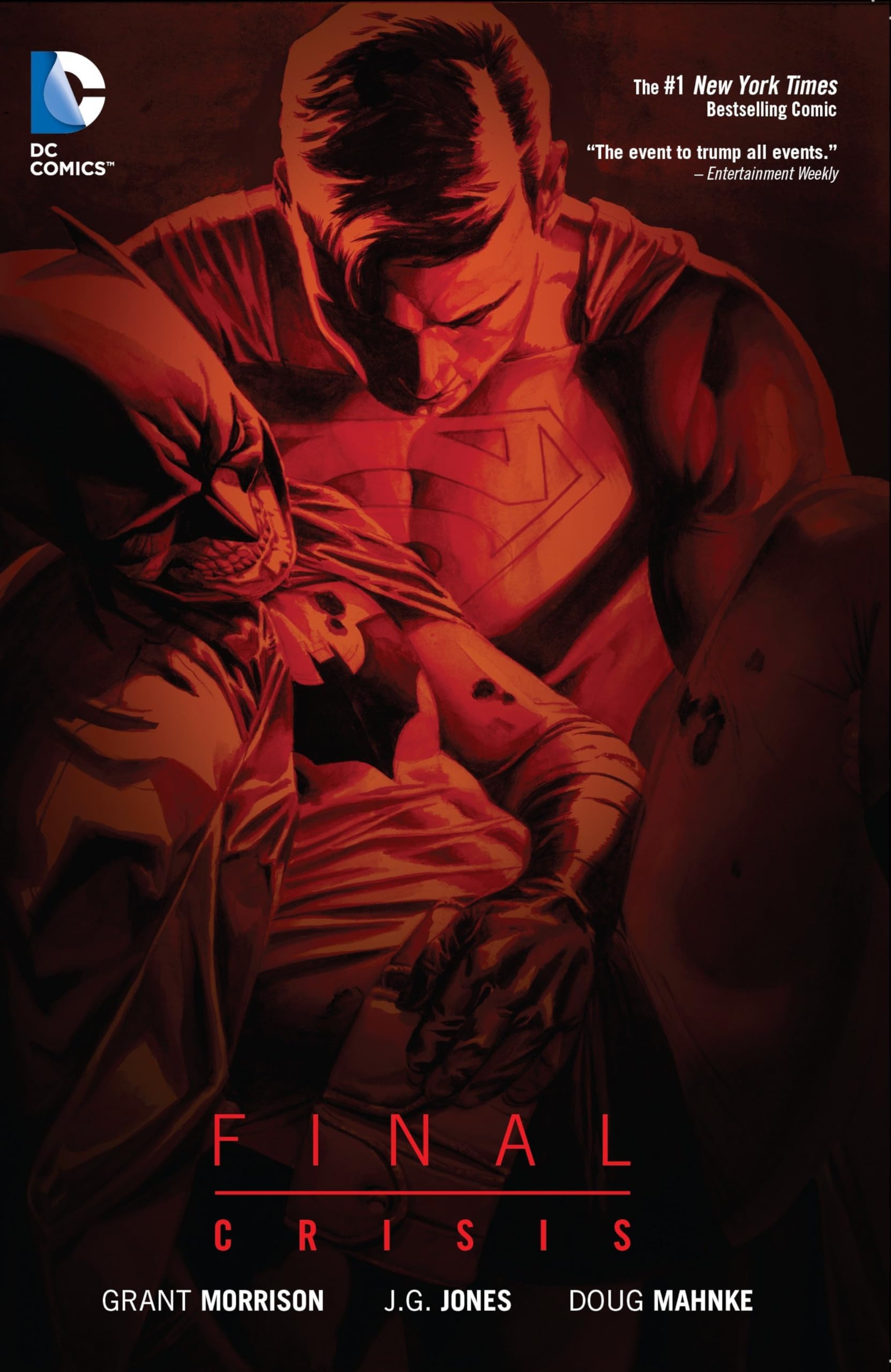
Final Crisis (New Edition)
Product ID: 6779634
Desertcart purchases this item on your behalf and handles shipping, customs, and support to EGYPT.
What happens when evil wins? That's the question Superman, Batman, the Justice League and every being in the DCU have to face when Darkseid and his otherworldly legion of narcissistic followers actually win the war between light and dark. Featuring the deaths and resurrections of major DC characters, Final Crisis is more than your average multi-part event-it's a deconstruction of Super Hero comics and a challenging, thought-provoking take on the modern, four-color icons. This new edition includes story pages from Batman #682-683 in addition to Final Crisis #1-7, Superman Beyond #1-2 and Submit #1. Review: Fever dream! A trippy trip! Gleefully insane! - Final Crisis is like a monumental fever dream. No, let me start again. Final Crisis was, to me, a trip; a trippy trip to trip-land. No, not good enough, let's try again. Final Crisis will be the craziest, most gleefully insane, epic comic book you've ever read. Mmmm... Well, let's go with all three! As Renee Monotoya voices it about 80% of the way in - "What? Enough of this %$@%$ sensory overload!". Amen. I'll be the first to admit I didn't get everything that happened in this first read-through. I will also say there is going to be a second, maybe a third, in time to come. Sit back and enjoy this crazy ride. Mr Morrison has a bountiful harvest of insane imagination to share, and is backed to the hilt by the art. As for the death at the end - no spoilers from me, but you'll know the one I mean - and its aftermath? Whew! Amazing, enigmatic read. Simply a must for DC fans - but I can see why it is so reviled and so loved, depending on your own POV. I think it helped me that I've been reading through all the crises (from 1986's Crisis on Infinite Earth to this one) recently. This will not be very accessible to casual readers - I know they say it was written as a standalone, but I didn't think it did stand alone. Review: Morrison ponders what makes a hero-and it's not superpowers - It's easy to say that DC Comics' "Final Crisis" crossover deals with supervillain Darkseid's plot to overthrow reality, and the subsequent deaths and corruption of various DC Universe characters. Sure, writer Grant Morrison includes plenty of the epic, property-destroying slugfests that are the hallmarks of events such as these. However, he's got much more on his mind than providing empty spectacle. He's interested in answering the question "What makes a hero?" His answer: Being a hero doesn't require superpowers. It requires not only sacrificing for others, but also doing things that make you uncomfortable-qualities all of us can aspire to. Batman, of course, makes the ultimate sacrifice with his life-though, this being big-time comics, the Dark Knight's death wasn't permanent. (Morrison himself brought Batman back to the land of the living in a subsequent storyline, "The Return of Bruce Wayne.") Superman also risks his life for the DC Multiverse's sake. Indeed, the DC heroes exhibit traits that the villains covet. Darkseid's minions want to steal Batman's "superior physical prowess, strategic acumen and courage"-because those are the qualities that make Batman what he is. (It's not gadgets like Batmobiles or Batarangs. Sorry, toy manufacturers.) How Morrison tells his tale is just as interesting as the questions he addresses in it. All of the concepts in Darkseid's Anti-Life Equation-including loneliness, alienation, fear and despair-equal chaos. Morrison expresses that chaos in the way he tells his story. It's a method that demands much more of the reader's attention and thought than the typical superhero saga, but the payoff is well worth the effort. In Morrison's view, every element of the Anti-Life Equation represents the antithesis of what makes a hero, and the qualities that make heroes what they are-not just self-sacrifice, but also self-confidence and relatability-promote the power of hope in the face of dire circumstances. As Batman's trusty right hand Alfred puts it, "No matter how dark the night...there will be no hiding place for evil." Not even an evil as great as Darkseid, who personifies the hate and the chaos that drive this story. Despite the presence of many different pencillers, the art holds together well throughout. J.G. Jones eventually needed help from Carlos Pacheco and Doug Mahnke to complete the series, and Lee Garbett pencilled two "Batman" issues pertinent to the story. All of the pencillers and inkers, as well as the letterers and colorists, maintain the story's epic scope from beginning to end, and keep everything uniform so the changes in artists aren't so jarring as to take the reader out of the story completely. This capstone to the trilogy that began with "Crisis on Infinite Earths" and continued in "Infinite Crisis" demands careful reading, but both the themes and the storytelling method will reward readers so inclined. Because Morrison expresses the power of both superheroes and storytelling, "Final Crisis" is a work that deserves to be studied and revisited.
| Best Sellers Rank | #197,932 in Books ( See Top 100 in Books ) #697 in DC Comics & Graphic Novels #2,948 in Superhero Comics & Graphic Novels |
| Customer Reviews | 4.2 out of 5 stars 981 Reviews |
H**N
Fever dream! A trippy trip! Gleefully insane!
Final Crisis is like a monumental fever dream. No, let me start again. Final Crisis was, to me, a trip; a trippy trip to trip-land. No, not good enough, let's try again. Final Crisis will be the craziest, most gleefully insane, epic comic book you've ever read. Mmmm... Well, let's go with all three! As Renee Monotoya voices it about 80% of the way in - "What? Enough of this %$@%$ sensory overload!". Amen. I'll be the first to admit I didn't get everything that happened in this first read-through. I will also say there is going to be a second, maybe a third, in time to come. Sit back and enjoy this crazy ride. Mr Morrison has a bountiful harvest of insane imagination to share, and is backed to the hilt by the art. As for the death at the end - no spoilers from me, but you'll know the one I mean - and its aftermath? Whew! Amazing, enigmatic read. Simply a must for DC fans - but I can see why it is so reviled and so loved, depending on your own POV. I think it helped me that I've been reading through all the crises (from 1986's Crisis on Infinite Earth to this one) recently. This will not be very accessible to casual readers - I know they say it was written as a standalone, but I didn't think it did stand alone.
L**Y
Morrison ponders what makes a hero-and it's not superpowers
It's easy to say that DC Comics' "Final Crisis" crossover deals with supervillain Darkseid's plot to overthrow reality, and the subsequent deaths and corruption of various DC Universe characters. Sure, writer Grant Morrison includes plenty of the epic, property-destroying slugfests that are the hallmarks of events such as these. However, he's got much more on his mind than providing empty spectacle. He's interested in answering the question "What makes a hero?" His answer: Being a hero doesn't require superpowers. It requires not only sacrificing for others, but also doing things that make you uncomfortable-qualities all of us can aspire to. Batman, of course, makes the ultimate sacrifice with his life-though, this being big-time comics, the Dark Knight's death wasn't permanent. (Morrison himself brought Batman back to the land of the living in a subsequent storyline, "The Return of Bruce Wayne.") Superman also risks his life for the DC Multiverse's sake. Indeed, the DC heroes exhibit traits that the villains covet. Darkseid's minions want to steal Batman's "superior physical prowess, strategic acumen and courage"-because those are the qualities that make Batman what he is. (It's not gadgets like Batmobiles or Batarangs. Sorry, toy manufacturers.) How Morrison tells his tale is just as interesting as the questions he addresses in it. All of the concepts in Darkseid's Anti-Life Equation-including loneliness, alienation, fear and despair-equal chaos. Morrison expresses that chaos in the way he tells his story. It's a method that demands much more of the reader's attention and thought than the typical superhero saga, but the payoff is well worth the effort. In Morrison's view, every element of the Anti-Life Equation represents the antithesis of what makes a hero, and the qualities that make heroes what they are-not just self-sacrifice, but also self-confidence and relatability-promote the power of hope in the face of dire circumstances. As Batman's trusty right hand Alfred puts it, "No matter how dark the night...there will be no hiding place for evil." Not even an evil as great as Darkseid, who personifies the hate and the chaos that drive this story. Despite the presence of many different pencillers, the art holds together well throughout. J.G. Jones eventually needed help from Carlos Pacheco and Doug Mahnke to complete the series, and Lee Garbett pencilled two "Batman" issues pertinent to the story. All of the pencillers and inkers, as well as the letterers and colorists, maintain the story's epic scope from beginning to end, and keep everything uniform so the changes in artists aren't so jarring as to take the reader out of the story completely. This capstone to the trilogy that began with "Crisis on Infinite Earths" and continued in "Infinite Crisis" demands careful reading, but both the themes and the storytelling method will reward readers so inclined. Because Morrison expresses the power of both superheroes and storytelling, "Final Crisis" is a work that deserves to be studied and revisited.
D**E
Anti-Life Justifies My Hate... However
Final Crisis is one of the more difficult event comics to get through and unless you read it correctly, you will be lost out in space, facing some sort of existential crisis of faith or something. Or not. Allow me to start of my review by stating that I hate Final Crisis. Or did. Or will. It's a DC Crisis event, time and space are bendable, so here's the deal. I was never a fan of DC Comics, being pretty strictly in the Marvel camp until the New 52. Thinking that the reboot was a great jumping on point (and boy was I wrong) I decided to not only pick up a few series for characters I knew I liked (Batman, because... Batman) but as a comic geek fanboy, I decided that this was the time to go full overload with DC and read about 25 years of history starting with Crisis on Infinite Earths. I worked my way up from there, reading various major storylines and events that all lead to Flashpoint. I was delighted with Infinite Crisis, which I found to be a worthy, albeit grittier successor to the original Crisis, returning many of the main characters and giving a sense of closure to the Golden Age with the ultimate fate of the original Superman. When I reached Final Crisis, I was ecstatic to finally reach the closing chapter of this nearly 25-year long story. So I read Final Crisis #1-7 and I couldn't understand where it all went wrong. I'd read some of Morrison's stuff before, namely some of his Batman stuff. (I grew up in the 90s watching the animated series; what boy wasn't a fan?) It was all so straight forward. Where did this go wrong? Jump ahead two years and I decided for Batman's 75th anniversary to reread Morrison's entire run on Batman from Batman & Son all the way through Batman Incorporated and given the intersection of Batman R.I.P. with Final Crisis, I decided to throw that into the mix and picked up this trade paperback. Suddenly everything in the story was so clear to me and I have several theories as to why. Firstly, since I last read Final Crisis, I've read a bit of Jack Kirby's Fourth World. Morrison is sort of a champion of the Silver Age of comics, drawing heavily from their often silly plots and warping them into dark, psychological nightmares. Much of Final Crisis contains many allusions to the Fourth World (aside from the New Gods of Apokolips being the main villains) which would be hard to notice unless you just happened to have randomly gone back and read them as I have. Secondly, I have read a lot more of Grant Morrison's library since my first read, including the brain-meltingly complex Seven Soldiers of Victory, a series so impossible for the mind to digest that to read with keeping your sanity mostly in tact probably puts you in the right frame of mind for understanding Final Crisis. Finally, this trade actually puts things much better into perspective. What do I mean by that? When I first read Final Crisis, I only read the core issues. This trade contains much more than that, namely Superman Beyond that introduces and explains the true main villain of Final Crisis and explains how Darkseid's fall is affecting the multiverse. The apocrypha chapters of Batman R.I.P. (#682-683 or Last Rites), which not only are a nice swan song to the Dark Knight, summarizing his entire career and containing a neat little Elseworlds tale, but also peer into the whereabouts of the Caped Crusader during the Final Crisis which lead up to his eventual climactic confrontation. I hate when an event requires you to read tie-ins to understand what is going on, though it has been said that one should always read the tie-ins written by the writer who is writing the event. I read no tie-ins to the other Crises and understood them fine. However, in judging the merits of this book, it contains exactly the right tie-ins (those penned by Grant). The story is actually fairly interesting when read correctly, but may require a few rereads to truly grasp the underlying elements. What good is a book that doesn't warrant rereading, though, I ask? There is a lot of plot going on here and often times scenes seem to jump around, especially in the final chapter which I still find a bit head-scratching at parts as we seem to jump between the present and the aftermath. However, the story also feels incomplete at times. One of my biggest complaints of this book is that there are plots that seem to come out of nowhere. From the beginning, the book keeps asking what happens when evil wins and I find myself wondering when this happened? You might say that this is when the New Gods unleash the anti-life equation, but they mention this fact long before. The answer, I believe (and don't quote me), is found in Jim Starlin's "Death of the New Gods" which is a lead-in to Final Crisis (part of the dreaded Countdown) that not only explains why only the evil counterparts of the New Gods are around but also why they have lost their bodies and are forced to incarnate themselves as humans. Countdown and its tie-ins are often considered one of the worst things DC ever produced and Morrison stated that one could read Final Crisis and ignore Countdown altogether. However, if you don't know what happened to the New Gods, you may be left utterly confused by why Mokkari and Simyan need to build a new body of Darkseid or why Desaad is inhabiting a really messed up Mary Marvel. None of this is explained beyond "the New Gods fell." Still, it is refreshing to see that Darkseid finally meets his endgame, attaining the one thing he has sought since his inception and how the Anti-Life Equation is actually unleashed. I say, if you managed to make it this far though my review, go ahead and read Final Crisis. Make up your own mind on the series. It couldn't hurt. If you can't be bothered to read something heavy, this will not be your cup of tea.
N**M
Brilliant
Another year, another comic mega-event. Or so it would seem that way anyway. Let it be known from this point forward that Final Crisis is definitely unlike any other comic mega-event you'll ever read, mainly thanks to the fact that none other than Grant Morrison (New X-Men, All Star Superman, Batman RIP, Animal Man, Doom Patrol; c'mon, you know the list) is at the helm. With Final Crisis, Morrison offers up a different sort of superhero story that begs the question of just what it really means to be a hero: what happens when evil wins? That's what we learn as Superman, Batman, Wonder Woman, Flash, Hal Jordan, the rest of the JLA, and every other person on the planet enter the darkest hour the world has ever known, as Darkseid brings his denziens of Apokolips to Earth, and everything just seems to go to hell from that point forward. While it certainly helps a little bit being brought up to speed by checking out the side stories, tie-in's, and lead-up's to this event, what makes Final Crisis so good is how different a path it sets itself out on compared to other, more linear mega-events like Infinite Crisis, Secret Invasion, Civil War, and the like. To be honest I wasn't too thrilled the first time I read through Final Crisis when released as single issues, but reading it over again in this collected format has certainly helped make me realize just how grand a canvas Morrison has been playing with here. The artwork from a variety of contributors, including J.G. Jones (whose contributions are sadly not as profound or present as one would hope), Doug Mahnke, Carlos Pacheco, and more besides is wonderful as well, and nicely complements the scale of Morrison's story, even though it should go without saying that Final Crisis is a superhero epic that is definitely not for all tastes. Heroes are resurrected and die, the world crumbles, and good doesn't always end up triumphing over evil; yet in the end, there's still a small glimmer of hope regardless. Something like this is something rarely seen in mainstream superhero comics, which helps make Final Crisis all the more brilliant a work indeed. Stop reading, pick this up.
S**Y
Good story, terribly explained
The story within Final Crisis is a bit disjointed and requires too much knowledge of whats going on in the DC universe. However, the plot and meaning of the book is still self contained. The problem is sifting through Morrison's cryptic, overly, and unnecessarily, complex and ambiguous story telling. The essence of this book is about story telling and not losing creativity and imagination. The problem is I had to read many posts and reviews to figure that out. There is an appealing notion in having to think and re-read the book to catch the layers of meaning. The problem is that Morrison's writing technique goes beyond cryptic and just seems like he doesn't want to bother with the connector pieces between pages and panels. Suddenly he goes from telling story from one POV to suddenly telling the story from a narrative and skips time frames at the same time without leaving any hint that anything changed. Just story structure that leaves the audience confused, but not from being clever. Its a great story worth a read but poorly structured and definitely lacking some of its bite if you haven't read all the follow ups and tie ins. Which is too much considering there's probably hundreds of comic tie ins for this event. A great story didn't make up for the bad structure and excessive tie ins to feel the full weight of the story.
P**N
A 5 Star 'Moz-terpiece'
Frantically written to match the rapid-fire consumer culture of this burgeoning 21st century, comic mastermind Grant Morrison's Final Crisis is a densely packed comic bonanza that will leave the reader dizzy from its otherworldly scope which constantly teeters on the sublime. While the work is unarguably tailored for readers well-versed in DC lore, the heart of Final Crisis examines the concept of story itself and why we tell them. From Superman's grave to his final wish, Morrison weaves a 21st century sigil to reveal just how powerful our imaginations can become. Of course, there's more here than a four-color study on the human spirit, and Morrison doesn't pull any punches when it comes to good old-fashioned comic fun. SEE the pitch-perfect showdown between Batman and Darkseid, arguably the Dark Knight's suavest moment; WONDER at the surreal world of Limbo; GASP at the triumphant return of Barry Allen; CHEER as Mr. Tawky Tawny squares off against Darkseid's son, and LAUGH at the newest comedy team of Lex Luthor and Doctor Sivana. But most importantly, BUY Final Crisis and enjoy this one of a kind comic experience. ***** -PRIME_FAN
D**S
Atrocious
There's an episode of the 1980s sit-com TAXI in which Ted Danson plays a trendy hair stylist who gives one of the show's regulars a hairdo from hell. When she expresses some misgivings, his throng of adoring fans rally to his defense. She's basically told that she's not sophisticated enough to appreciate his art. Grant Morrison and his fanboys remind me of that TAXI episode. Grant Morrison is the most over-rated witer in comics. Granted(no pun meant), his odd style was a perfect match for his dOOM pATROL run but everything I've seen of his since then has been a mixed bag - including his much lauded work on ANIMAL MAN which was ultimately just a padded version of a plot which had already been done in the 1960s FLASH comics (when the concept of "Earth Prime" was intoduced). The saving grace of Morrison's ARKHAM ASYLUM was Dave McKean's artwork. When that's stripped away what is left is a story where none of the participants behave in character. Unlike the new video game, Batman does not kick ass at Arkham, he just shambles from room to room, observing supervillains who stand there spouting dialogue like exhibits at some Boring Pretentious Comic Book Wax Mueum. The symbolism of the story is so heavy handed, it's difficult not to suspect that Morrison was putting the whole thing over as a joke. His recent incoherent BATMAN R.I.P. storyline should have been a red flag to the editors at DC not to put him in charge of one of their CRISIS events. Among the inexplicable nonsense that happens in BATMAN R.I.P. are scenes of billionaire Bruce Wayne wandering the streets of Gotham City as a homeless person and not being recognized by anyone. Huh? In another scene the Joker asks, "Don't you get it?" No, I don't. At this point I'd rather not even bother trying. FINAL CRISIS starts out as vague and as head-scratching as BATMAN R.I.P. and then moves into the realm of incomprehensible gibberish. In addition, as in ARKHAM ASYLUM, the author still tries to substitute titilation, sadism and cruelty for originality. For those of you who appreciate that sort of thing, there's a point in FINAL CRISIS where it's implied that the villains plan to gang rape Supergirl after their triumph. Ooh, that surely makes this a "mature" title. :) (What is up with some comic book writers and misogyny? Do they still harbor a grudge for not getting a date to the prom even after making their fortune in the medium that they preferred over girls in the first place?) FINAL CRISIS is practically devoid of any sincere human emotion. Scenes where Clark Kent shows devotion to Lois Lane are by-the-numbers and have all the subtlety of a train wreck (an apt anology for this book). One might think the story was written by an android. Is there no one at DC Comics whose job it is to toss a script back into a writer's face and say "What the hell is this @#$% ?" Why did they hand over control of their entire universe of characters to this writer? Does he have incriminating photos? Did Geoff Johns hold out for too much money? Were the editors afraid to approach the artiste and demand that he actually produce a quality product for the money he's being paid? In light of IDENTITY CRISIS and FINAL CRISIS, it seems that DC is more interested with making a buck than in providing quality stories about the pop icons they've been entrusted with. Who can enjoy a Ralph and Sue Dibny story now without thinking about the fates thay lay in store for them? Oh, and for those of you who bought 52 issues of COUNTDOWN TO FINAL CRISIS...that story has nothing to do with FINAL CRISIS! No kidding. I think there's as much a crisis in the DC offices than there is on the pages of their comic books. Enough with the CRISES. How about some SOLUTIONS? Maybe an INTERVENTION? :) The only reason I give this book one star is that I couldn't figure out how to give it zero stars. If you're curious about FINAL CRISIS, I agree with anther reviewer who recommends that you borrow a copy from your library. DC does not deserve to make one more dime off this crap.
R**E
Penultimate Crisis
They're not fooling anyone: this is not the final chapter in the saga begun with the great Crisis on Infinite Earths (1987). That honor goes to the current series Blackest Night, including the precursor to that one, The Sinestro Corps War. But it does at least wrap up (though it also extends) the Gnostic theogony/cosmogony of the Monitors that was introduced in the original Crisis. The reader needs to be prepared for the mind-bending approach of the great Grant Morrison with his tendency to make the story self-conscious AS a story. n this collection, Morrison is particularly quirky, and it will take some patience to crack the nut and appreciate the whole thing. I appreciate it more and more. The appearance of a thinly-veiled Dr. Manhattan, the dredging up of the old parody hero Merry Man from The Inferior Five, the inclusion of one-shot Morrison character Sunshine Superman, the echo of a tossed-off Superhero from Morrison's epic DC One Million, namely the Atomic Lantern, the resurrection of Barry Allen, the death of Batman and the return of the real Aquaman--all these are epic developments we would expect (yet perhaps fear) in an installment of the Crisis saga. You just have to read the books in the right order.
U**O
Morrison al meglio
Grande storia, non immediata e richiede una certa conoscenza dell'universo DC post crisi ma Morrison è al top..concordo con un altro recensore sul fatto che la storia è comprensibile se la si legge con attenzione, non è una narrazione semplice ma profonda e ricca di spunti di riflessione sull'evoluzione del medium fumettistico più mainstream..ottimo lavoro
K**E
APPRECIATE THE ARTISTIC IDEAS AND AMBITION...AND STORY...IT'S COOL.
Some people call this the most confusing piece of work they've ever read, seen, witnessed, layed eyes upon, or experienced. But with a tiny bit of background research, and I mean a quick look at a synopsis of a few graphic novels. I got the grasp of it pretty fast. In fact, I don't think that much 'research' was necessary. The art is fantastic, both by J G Jones and Doug Manhke. The story involves a lot of characters but they all serve the story well. The best thing about this book is the fact that the story as a whole feels extremely large and epic in scale. And that there really is a sense of universal stakes. But while it does all that, there are great personal victories for certain characters. Grant Morrison is known for his wacky and unusual style of writing. But for me, at least, it works wonders. There is so much wackiness to like. And it never feels....Weird? One thing I advise is to pay deep attention at all times. You notice things here and there that will make you go "OHHH". It's really worth it. Amazing plot lines, yes.. PlotlineS. There are a few subplots to keep things interesting but none are wasted. It all comes together perfectly in the end. And Superman's own story, Superman Beyond, is incorporated very well into the story. I'm glad they decided to include it as it wasn't in the planned 7 issues.
E**B
Un grand comics indispensable au Run de Grant Morrison
Fan de DC, on ne peux pas passer à côté de Final Crisis ! C'est LA pièce manquante de la grande collection "Grant Morrison présente Batman" chez Urban, cest un tome indispensable dans la continuité du Run du Grand Grant Morrison, à acheter les yeux fermés pour mieux comprendre le lien entre les tomes 3 et 4 du Run !! Magnifiquement écris, magnifiquement dessine ! Un grand Comics !
B**S
Item was second hand - Not noted on website
Purchased a product that was new but was delivered a second hand version. It wasn't in the shrink wrapping and had a distinct dirty/Dusty smell, that meant it couldn't join my collection. Reminds me that Amazon has a lot of negatives as I can't replace and must wait for my refund.
え**ド
クライシス最終章
00年代のクライシス三部作第二弾 第一弾はIdentity Crisis 第二弾はInfinite Crisis とはいえ、特に明確なつながりはありませんが。 正義は死に悪が勝利を収める?! 始まりは一発の銃弾だった。神をも貫く銃弾、果たして誰の手によって放たれたのか? 徐々に捜査を進めていくジャスティスリーグだが、あまりにも不審な点や妨害が多く……? バリーフラッシュが死神に追いかけられている!それを知ったバートはバリーを救出するため、バリーのもとへと走り出す! 徐々に悪に浸食されていた世界にとうとうアンチライフ方程式がばらまかれた! これによりヒーローを含むあまたの人物が悪に染まっていく! 果たして、ヒーローたちは再び立ち上がりダークザイドたちに打ち勝つことができるのか? とにかく壮大で圧巻の一言。 おまけでついているSuper Man Beyondも次元にまたがり展開する恐ろしいスケールの物語で、 まさに神をも超越しかねないスーパーマンにただただ脱帽です。 相変わらずモリソンなので何を言いたいかわかりづらいのですが、パーツパーツで見るよりは大雑把にとることを勧めます。
Trustpilot
1 week ago
2 weeks ago