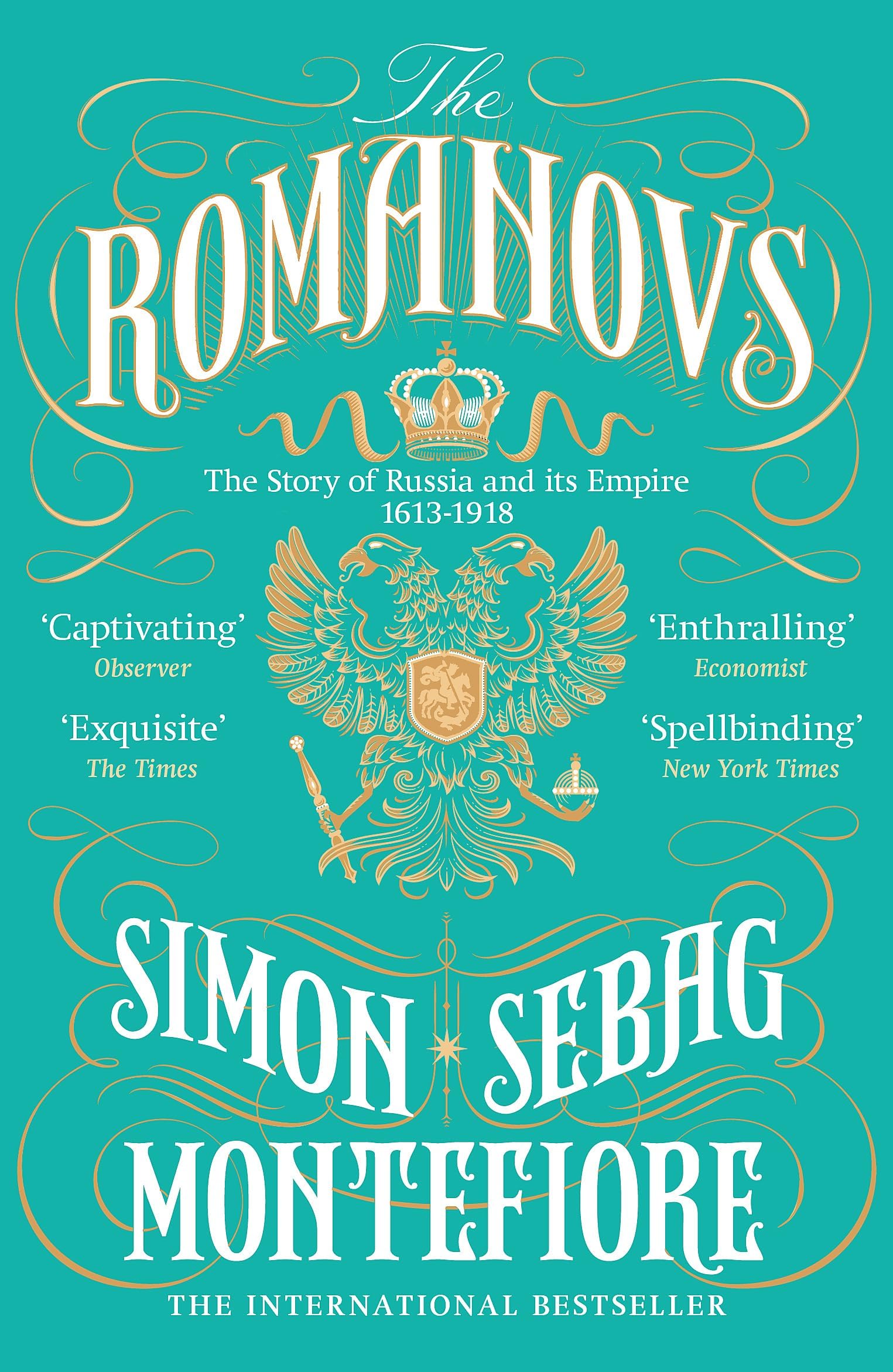
THE ROMANOVS
Product ID: 80719169
Desertcart purchases this item on your behalf and handles shipping, customs, and support to EGYPT.
Review: Fascinating History - The book is not an easy read but once you get over your initial phobia of complicated and repetitive names and characters, it is a pleasure to read. I read the book because i liked Jerusalem by Montefiore and wanted to know more of this period of Russian history. Montefiore impresses you with his command over facts, events and characterisation. The only complaint I have is the print edition i had wasnot well bound for its size and there was less of critical commentary by the author. Recommended to all keen on history. Review: Flavours of Russian autocracy - The author has very well captured the character of the royals of each age. It gives great insight into how these individuals were entrusted with the responsibility of this empire who sometimes they ill fitted and sometimes made for it. As always Simon's writing style is captivating as he has tried to do justice all the characters of the Romanov family.
| Best Sellers Rank | #113,929 in Books ( See Top 100 in Books ) #498 in European History (Books) #4,001 in Biographies & Autobiographies (Books) |
| Customer Reviews | 4.4 out of 5 stars 3,621 Reviews |
J**R
Fascinating History
The book is not an easy read but once you get over your initial phobia of complicated and repetitive names and characters, it is a pleasure to read. I read the book because i liked Jerusalem by Montefiore and wanted to know more of this period of Russian history. Montefiore impresses you with his command over facts, events and characterisation. The only complaint I have is the print edition i had wasnot well bound for its size and there was less of critical commentary by the author. Recommended to all keen on history.
T**S
Flavours of Russian autocracy
The author has very well captured the character of the royals of each age. It gives great insight into how these individuals were entrusted with the responsibility of this empire who sometimes they ill fitted and sometimes made for it. As always Simon's writing style is captivating as he has tried to do justice all the characters of the Romanov family.
A**N
AN INTERESTING BOOK ON A FASCINATING DYNASTY
A really good, engaging chronological account of the Romanov dynasty. The author understands his source material well enough to create a coherent concise series of chapters on the Czars and Czarinas that read like mini biographies of each. However, the reader should know that this is not a history of Russia but rather the story of a family that ruled with almost mythical autocracy for 300 years. I would suggest a companion book on the general history of Russia to place Montefiore's account in a larger context.
U**I
Majestic Splendour
A good and informative book about a well known family.A family that has risen to great heights to only end tragically with the Revolution.Highly recommended for lovers of history
D**A
Extensive and informative but lengthy
This is saga of survival, stability, lust, deception,power,murder and mayhem in a subterfuge, malicious and diabolic environment. This is the story of Romanov dynasty who ruled for three centuries. They were the second dynasty to rule Russia. Prior to that they were high ranking aristocrats. They had a shaky start, had some stability in between and at time struggled to find a suitable male heir to rule the kingdom. In such cases, women rulers pitched in and one of them also ruled with distinction. At different times, some parvenu character became ruler from nowhere. The trouble time of the dynasty during the early phase of their rule was however offset by a period, when development reached its zenith and Russia became an European power. However in the late 18th century and early 19th century, the geo political scenario had drastically changed which debased Romanov’s brand value, diminished their grandeur and ultimately triggered an ignominious end. The synopsis of the three centuries rule and the rulers are given below. The dynasty set up one of the most powerful empire of the modern world. Their reign coincided with trouble times where there were famines, plague, massacres and riots. The subjects were languishing in crisis. It’s then a compromise candidate Mikhail Romanov, who was just 16 year old was offered the crown. He baulked at the offer and ultimately accepted it reluctantly and with lot of fear and apprehension. He was surrounded by treacherous and ambitious boyars. Swedish and Polish Kings gathered army to crush him and Tatar Khan ravaged the south. Still Micheal Romanov survived long. His death threatened to derail and make the regime vulnerable. For death of any ruler, strategem were discussed and there were always collusion between interested parties. By and large, the law of succession leads to pandemonium and dangerous political crisis. It is a presage of bad times. However, there was a smooth transition and he was followed by his son Alexis Romanov, who was considered one of the best prepared heirs. He was intelligent and a reformer, who used foreign technology to boost his army. He steered the country away from numerous troubles and brought much needed stability. If Micheal Romanov started the dynasty then Alexis Romanov had established it. Establishment ensconed the dynasty but still Russia was underdeveloped compared to other European nations. Renaissance had swept Europe but Russia rejected westernization and modernization. Aristocracy in Russia was medivial. Orthodox Church and anarchic form of government were obstacles. These were inherited by Alexis son Peter, better known as Peter the Great in history. He is known for its extensive reform in pursuit of making Russia a great nation. He modernized Russian army and navy as per western standard. He exercised greater control on Church power. He annulled archaic form of government and introduced Senate which regulated different branches of administration and foreign policies too. The cultural revolution replaced traditional political and social system with much more modern and realistic approach. He expanded his territory and became the dominant power in both Baltic and Black Sea regions. Catherine the Great was the longest serving female monarch in Russian History. She was considered an astute , intelligent, skillful and the most unlikeliest of monarch, who became ruler due to circumstances. Her period is considered the golden age of Russian history. She was also known in equal measures for scandalous life. She was of Prussian origin and was married to Peter III, who was grandson of Peter the Great and an heir to Russia. When Catherine was married, Russia was being ruled by Peter’s aunt Elizabeth. Peter III and Catherine were a childless couple for years. Many alleged that their relationship was on a rocky ground and the marriage was never consummated. Due to unhappy marriage, both Peter III and Catherine were having extra marital affairs. When Catherine ultimately became a mother (three times again later), it was gossiped that the children were not fathered by Peter III. After Elizabeth death, the crown passed on to Peter III. Due to some of his unpopular decisions, he was overthrown in a bloodless coup. He abdicated the throne and Catherine the Great became an empress. She had the support of both people and the army. Her husband was assassinated after eight days. Whether she was not involved or not , is still debated. She went on to reign for thirty four years. She reduced the power of clergy. She maintained good relationship with her neighboring countries. She was more renowned for being patron of arts , education and culture. She wrote numerous books and educational materials for improving education system. She also had an impressive art collections. She has had multiple affairs. She was loyal to her lovers even after ending of relationship. She parted on good terms bestowing upon them titles, land and palaces. Catherine the Great had a frosty relationship with her son Paul, whom she kept far away from State affairs. She also believed Paul to be incompetent ruler. She took care of upbringing and education of Paul’s sons, possibly looking for an option for succession. After her death, Paul became Tsar. Catherine worst fear came true when Paul proved very erratic and unpopular. He was assassinated and was followed by his elder son Alexander I Unlike his father, Alexander I was very popular with his people. Like his predecessor, he too pushed for reforms. His reforms includes relaxation of censorship, providing constitution, setting up of Russian parliament and allowing peasants to buy their freedom from serfdom. Alexander I is also known as “Alexander the blessed” and is renowned for leading his country victorious against Napoleon. On his attempt so subdue Russia, Napoleon began his conquest . The war was known as “Patriotic War” in Russia. It resulted in colossal and unmeasurable damages to both sides. Napoleon forces were defeated and his soldiers had difficulty retreating due to punishing Russian winter. The war was also made famous by Leo Tolstoy in his epic “War and Peace”. He was hailed as hero across European continent. He wanted to continue with reforms but it was not backed up by nobles and polices. Alexander died leaving without a male heir. Next contender for the throne was Alexander I brother Constantine but he refused. Like Alexander I , he too had no son. The younger brother Nicholas I became Tsar even though he was never brought up to be an emperor. His reign coincided with corrupt bureaucracy and weak administrative policies. Economy was poor. There were frequent wars and Russia was defeated in the Crimean war. He died during the war. He was succeeded by his son Alexander II. He made efforts to develop Russia natural resources and reform all branches of the administration especially judicial system. He also curtailed some privileges of the nobility and promoted university education. He was killed in a bomb blast . Prior to his death, three assassination were made on him. His son Alexander III followed him next. Alexander III revoked some of his father’s reform. There were no major war during his times and there was peace. He died in 1894 due to a kidney disease. Enter the scene was Alexander III son Nicholas II, the last emperor of Russia Nicholas II came to rule at a dangerous time. Economy was struggling. People suffering were unbearable.Their endurance level had reached a saturation points. They fought for their rights. They craved for a better life. Their struggle was leading to militancy. Government machinery were breaking down. Treaties with other nation were made and broken. A war looked inevitable. It was an age of new ideas that lead to revolution. It was an age of nationalism which have doomed multinational empires. . It was an age of national awakening. The fact that the new Tsar accepted his role with relucatancy instead of enthusiasm , did not help matter much. He was considered politically weak and indecisive. What led to the dynasty downfall ? It’s people of Russia turning against their Tsar. The reasons are numerous. Let’s find out the major reason for this. After Nicholas became Tsar, his official coronation took place on 1896. More than two thousand people were killed or seriously injured in a human stampede. On the evening of the tragedy, the royal couple attended a ball at the French Embassy. This infuriated people and they lost any sympathy for him. In the year 1905, workers have gathered in large numbers to submit their petitions to the Tsar. However, things went out of control when soldiers opened fire on the crowed and many were killed and wounded. People started look down him as ruthless and uncaring for common people need. When Russian and Empire of Japan territorial ambition collided, war was imminent. The Tsar saw the war as an opportunity to raise morale and patriotism. He underestimated the military potention of Japan. This long distance war was baffling and was fought without taking into consideration logistics issues and financial repercussion. Russia lost many battles and was compelled to settled for peace. The myth of Russia as an European powerhouse was broken. The Russia was then involved in World War II. The government was inept in maintaining constant supplies to army that a prolonged war require. Economy was going from bad to worse and it led to mounting national hardship. The army failed to gain any military success and were routed in the battlefield. This led to renewed strikes and riots. With the Tsar leading in the front, St. Petersburg was at the mercy of strikers and mutinating soldiers. Nicholas II wife Alexandra was from German lineage and had a distaste for Russian culture, which made her unpopular with Russian people. Their only son and male heir to the family- Alexei suffered from severe hemophilia. No doctor was able to treat it and then the couple turned to mystic and holy men. One person who had some measure os success was Russian mystic- Grigori Rasputin. The couple were dependent on him. His influence first on Alexandra and then Tsar was increasing, so much so that he starting taking decisions on state affairs too. The influence infuriated nobles, church leader and peasants . Rasputin was murdered in 1916. The Tsar had already alienated non-Russian speaking population by linking his throne to Russian nation. Young people believed Marx’s ideology that old order of tsars, priests, landowners and factory masters would be destroyed. The idea of Marxism was romanticized. Workers vehemently went on strike, peasants attacked landowners and students rioted. People joined revolution with alarming alacrity. Many regions became independent revolutionary fiefdoms. The revolutionary parties assassaninated many officials. While the Tsar was away for World War, Russian capital fell into rebellion hand. The Duma(i.e Russian Parliament) wanted Tsar to step down. The Tsar had never reconciled with Duma. Along with politicians, military high command too want Tsar to go. The writing was on the wall. The Tsar had no option but to abdicate. He has already attracted odium of all concerned. In 1918, the royal couple along with children and attendants were executed thus putting an end to three century dynasty rule. Radical socialist Bolshevikis, led by Vladimir Lenin seized power and established the first Communist government. Post communism, the dynasty is getting some sympathy. Post disintegration of USSR, first head of Russia - Boris Yelstein had expressed guilt and said that one of the most glorious pages of the history has been associated with the family and some of the better lesson too. The current president of Russia- Vladimir Putin commented that The greatest criminals in our history were those weaklings who threw power on the floor – Nicholas II and Mikhail Gorbachev – who allowed power to be picked up by hysterics and madmen. The points covered so far is fraction of the actual content. The review is just touch and go. The book has an extensive coverage on the dynasty. The research done by the author is commendable. He had dig deeper to collect even minuets of detail. The reading gives you an impression that the author has been honest and scrupulous in his efforts. Obviously, the fact and events are mentioned in a chronological order. Also captured in the books are the emotions, drama, romance, lust , feelings and royal attire too with decent coverage, which however had stretch the book. If you are a kind of history buff who opts for hard historical facts, the book is not for you. Otherwise, if you are in a different category, try it. The book is painstakingly lengthy.
N**J
Outstanding book
This book gives a comprehensive understanding of Russia as it stands today ...... A great reading for anyone interested in the Romanov history.
M**B
Four Stars
Its like game of thrones but in reality
S**R
Awesome
This book was gifted to me by my nephew last month ! A compelling read of the Romanovs ! Anyone interested in the Russian monarchy and their impact all over Europe and Central Asia must definitely put this on their must reads
Trustpilot
1 day ago
3 weeks ago