

Desertcart purchases this item on your behalf and handles shipping, customs, and support to EGYPT.
🔎 Elevate your macro game—capture the unseen with Raynox DCR-250!
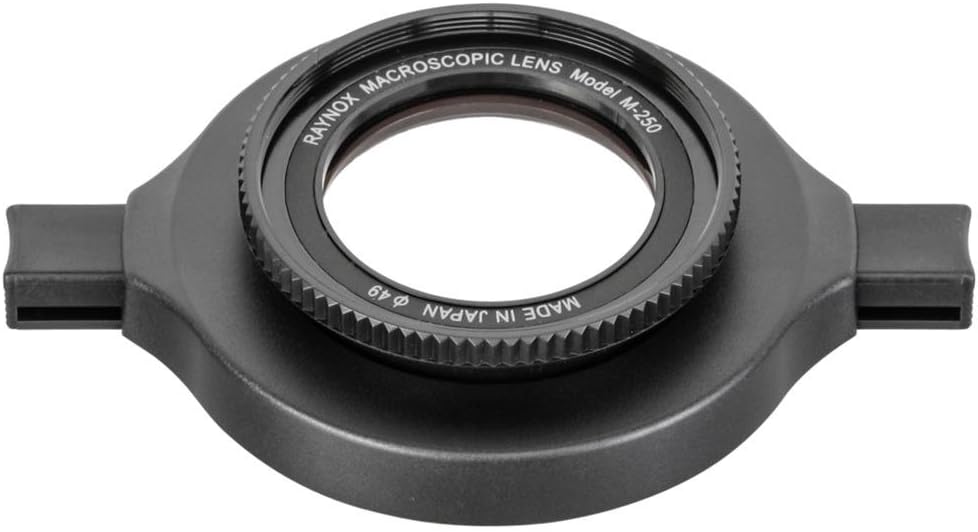
The Raynox DCR-250 Super Macro Snap-On Lens is a high-magnification (1.84x) macro attachment compatible with 52-67mm filter lenses. Designed for Canon, Nikon, and Sony mounts, it transforms standard zoom lenses into powerful macro tools with exceptional image clarity. Lightweight and easy to use, it offers a budget-friendly alternative to dedicated macro lenses, ideal for professionals seeking versatility and precision in close-up photography.
| ASIN | B000A1SZ2Y |
| Best Sellers Rank | #43 in SLR Camera Lenses |
| Brand | Raynox |
| Built-In Media | Macro-Scan 2.5x Lens - Universal Adapter 52 to |
| Camera Lens | DCR-250 is a zoom lens with a focal length of 0mm to 250mm, and is an autofocus lens that can be used for super macro photography |
| Camera Lens Description | DCR-250 is a zoom lens with a focal length of 0mm to 250mm, and is an autofocus lens that can be used for super macro photography Camera Lens Description DCR-250 is a zoom lens with a focal length of 0mm to 250mm, and is an autofocus lens that can be used for super macro photography See more |
| Color | Black |
| Compatible Camera Models | Canon EF-mount cameras, Nikon F-mount cameras |
| Compatible Camera Mount | Canon EF, Canon EF,Nikon F(DX),Sony Alpha |
| Compatible Devices | SLR |
| Compatible Mountings | Canon EF, Canon EF,Nikon F(DX),Sony Alpha |
| Customer Reviews | 4.6 out of 5 stars 1,016 Reviews |
| Exposure Control Type | Automatic |
| Focal Length Description | 250 millimeters |
| Focus Type | Auto Focus |
| Global Trade Identification Number | 00024616020191, 00796594749233, 04961787600172 |
| Image stabilization | yes |
| Item Type Name | Digital-slr-camera-lenses. |
| Item Weight | 2.1 ounces |
| Lens | Macro |
| Lens Coating Description | Coated |
| Lens Design | Zoom |
| Lens Fixed Focal Length | 49 millimeters |
| Lens Mount | Nikon F |
| Lens Type | Macro |
| Manufacturer | Raynox |
| Manufacturer Part Number | DCR-250 |
| Maximum Focal Length | 250 |
| Media Type | ProductImage, EnhancedContent |
| Minimum Aperture | 1 |
| Model Name | DCR-250 |
| Model Number | DCR-250 |
| Model Series | DCR-250 |
| Number of Items | 1 |
| Number of Packs | 1 |
| Photo Filter Size | 49 millimeters |
| Real Angle Of View | 46.8 degrees |
| Screen Size | 0.71 inches |
| UPC | 024616020191 782386464644 796594749233 |
| Unit Count | 1 Count |
| Video Capture Resolution | 4K |
| Viewfinder Type | Optical view |
| Warranty Description | 1 Year |
| Water Resistance Level | Not Water Resistant |
| Zoom Ratio | 250:1 |
B**2
Fantastic Value
This is one of the best bang-for-the-buck purchases I’ve made in photography. I shoot 1:1 macro on a Nikkor Z 105mm MC lens. Adding this Raynox to the end of the lens immediately gives me 1.84:1 magnification, which is a huge jump in magnification. The image looks wonderfully clear, and I have no complaints about the image quality. It’s also very easy to use. I also appreciate that I can turn my non-macro lenses into a macro lens for situations where I opt not to carry my dedicated macro lens. This works so well that it almost makes me feel like I don’t even need a dedicated macro lens… Anyways, this is an awesome product.
L**L
A Super Macro Snap-On Lens that does wonders
The Raynox DCR-250 Super Macro Snap-On Lens has been a pleasure to use with. This simple clamp on attachment clamps to any lens size of choice (52mm to 67mm filter size) and magnifies your subject accordingly. I wouldn't necessarily say that this lens is "super macro" as the product suggests, but you can get closer to your subject with a relative amount of closeness. I find this good if you plan to manually adjust the focal distance. The use of auto focus from your lens when you have the Raynox DCR-250 Super Macro Snap-On Lens attached can work but will mostly hunt for the subject sometimes. If you find that the clamp on mechanism a bit cumbersome to use, you can option out in buying a step down filter ring and have the macro lens screwed onto the lens instead. Best part about this little attachment is that it is really made in Japan. There are two different Raynox macro lens they provide, One DCR-250 and the other DCR-150. Most people end up choosing the DCR-250 because you are able to magnify your subject way more than the DCR-150. When taking pictures with the DCR-250, I would say patience is key to getting the shot you want. This isn't equivalent to a normal macro lens where its designed to do just that. However, if you add a piece of glass such as the DCR-250, What the lens was suppose to design to do is now thrown off with an extra piece glass, so chances are that the focus would be narrow and close to impossible to auto focus on the subject hand rather just Manual Focus instead. For the functionality and value for money, you cannot beat this as this is a budget option in getting into macro photography work than just buying another piece of glass lens that ranges from several hundreds, and if not perhaps thousands of dollars depending on the quality and rarity of it. It also lets you carry one less lens in your backpack, lightening your load. I've used the DCR-250 several times and I have to say that there is a big learning curve and some compensations needs to be made in order to make it work well, but once you get the hang of it, It'll probably be muscle memory.
C**S
Works great, no regrets
The DCR-250 snap-on works great. It really gets you close to the subject. The depth of field is really narrow but it allows you to get really good images even with kit lens, you just gotta work with it. For the price, I think it’s a really good value if you'd like to try some macro photography. It fits my 58mm lenses and I can use it on a 77mm (snap in hood.) I’m really enjoying the images I capture with it
P**A
I love this adapter
I love this adapter! It has been a wonderful way to step in to macro photography without the high price of a dedicated macro lens. It is also so much easier than dealing with extension tubes, because you don't have to unscrew anything from your camera. It just pops on and off. It is also much more compact, so easier to store and travel with. The other day I was taking pictures of dandelions, and my daughter told me she saw a zebra swallowtail, which I had been hoping to get a picture of. If I had extension tubes on my camera, I would have had to unscrew everything, screw a new lens on, and scramble to take the picture. With this, I just popped the adapter off and ran to find the butterfly, which I did, and was very happy. :) I am certain I would have missed out with tubes. Another benefit is that it works with pretty much any camera. I have a Nikon D3100 and was having a difficult time figuring out if the connections with many extention tubes would work with my camera. I don't have to worry about that with this. I still have full function with my camera. I can use it with any and all of my lenses for different macro magnifications. When using with my 55-200mm lens, I found that I can get up to 1.6:1 magnification ratio when fully zoomed at 200mm. Of course, the image looses some clarity at that point, which is the case without the adapter on as well. I have noticed that there is high chromatic aberration with high contrast pictures. This is probably the biggest downfall for me. Sometimes the aberration can be quite noticeable and distracting, and difficult to edit out. However, I do not have any experience with other types of macro equipment, so I cannot compare this to others. The DOF field is EXTREMELY thin, especially when pushing it to its limits. If you want to get a wider DOF you will need to learn focus stacking. But again, I think that is the case with macro in general when you get to this power. All in all, I LOVE it. I have been having so much fun taking pictures of flowers, bugs, coins, other random things. It has opened up a whole new world of stuff to take pictures of, right in my own home and yard. :) I have added some pictures to this review. None of these were cropped to appear larger.
N**P
Worth Every Penny for Anyone Getting Into Macro Photography
I’ve only had the Raynox DCR-250 for like 2 days, but I’m already blown away by what it can do. I paired it with my Nikon Z50II, and the amount of detail it captures is incredible. It’s amazing how something so small and affordable can completely change what your camera is capable of. The snap-on mount is quick to attach and remove, and the image quality is much better than I expected. The learning curve is definitely there—getting razor-thin depth of field means you need a steady hand and some patience—but once you start nailing focus, it’s incredibly rewarding. If you’ve been thinking about getting into macro photography but don’t want to spend hundreds on a dedicated macro lens, this is an easy recommendation. It has opened up a whole new world of photography for me, and now I’m constantly looking for tiny insects, flowers, and textures to photograph. For the price, I honestly don’t think you can beat it.
H**Z
versatility, portability, and performance-to-price ratio.
Why did you pick this product vs others?: When it comes to macro photography, achieving tight, detailed focus without investing in expensive dedicated macro lenses can be a challenge—unless you know where to look. The Raynox DCR-250 offers an elegant and surprisingly powerful solution that bridges affordability with performance, making it a favorite among both hobbyists and professionals looking to expand their creative toolkit. Optical Performance The DCR-250 delivers impressive image quality, transforming even standard telephoto lenses into capable macro setups. With its +8 diopter magnification, it brings subjects into striking focus at incredibly close distances, revealing intricate textures, tiny structures, and vibrant details often invisible to the naked eye. Despite its high magnification, the optical clarity holds strong across the frame, with minimal chromatic aberration and only slight edge softness—characteristics well within acceptable limits at this price point. Build & Compatibility Crafted from high-quality multi-coated optical glass, the Raynox DCR-250 is lightweight yet solid. Its unique snap-on universal adapter (suitable for filter sizes from 52mm to 67mm) allows quick attachment to a wide range of lenses without threading, offering unmatched versatility. It’s particularly useful for photographers who shoot with multiple lens systems or who work in fast-paced environments where gear needs to be modular. Why I Chose This Over Others I chose the Raynox DCR-250 over other macro solutions for three main reasons: versatility, portability, and performance-to-price ratio. Unlike expensive prime macro lenses or bulky extension tubes, the DCR-250 provides instant macro capability without adding significant weight or complexity to my gear bag. It allowed me to achieve near-professional macro results using lenses I already owned—no need for a separate dedicated lens. In real-world use, it performs well above its cost bracket, making it a no-brainer for photographers who value flexibility without compromising image quality. Final Verdict The Raynox DCR-250 is a deceptively powerful tool in a compact form. Whether you’re exploring insect photography, detailed product shots, or abstract close-ups, it delivers consistent, sharp, and strikingly intimate results. A must-have for any photographer looking to dip into macro without diving deep into their wallet.
S**E
Amazing
Fantastic! I have absolutely loved this. It has allowed me to do some macro photography and its great! Extremely easy to use and absolutely no regrets buying it. Should have bought one sooner.
T**U
very good macro lens
This is a really good macro lens. Using it on my 18-55 mm Canon lens, I got 1:2 magnification, which is good, but not amazing. Most of the times I am using it with my Sigma DG 70-300 mm zoom lens, and in this setting the DCR-250 achieves an amazing 3.5:1 magnification ratio! (in both cases I use maximal telephoto) With this amount of magnification come a few problems: most importantly, the depth-of-field is extremely small. Lowering the aperture as much as possible will help, but you still have trouble getting even both eyes of a bug in focus at the same time -- people often combine multiple exposures to obtain the incredible bug shots that you can find online. Of course, lowering the aperture also means *very* little light will get into the camera, so you most likely will need to use an external flash when taking macro shots (the internal flash will likely be hindered by the lens + macro lens combination, since the focusing distance is about 10 cm with the DCR-250). There are also ring flashes, specially designed for macro photography, though I'm not sure how easy it is to fit both a ring flash and this adapter on a lens. In a word, this is a very good alternative to buying a much more expensive dedicated macro lens. The adapter that comes with the DCR-250 allows it to attach to basically any lens, and you can actually successfully use it with many point-and-shoot cameras. It takes a while to get used to it before you can take great shots, but it's worth it.
Trustpilot
1 month ago
1 month ago