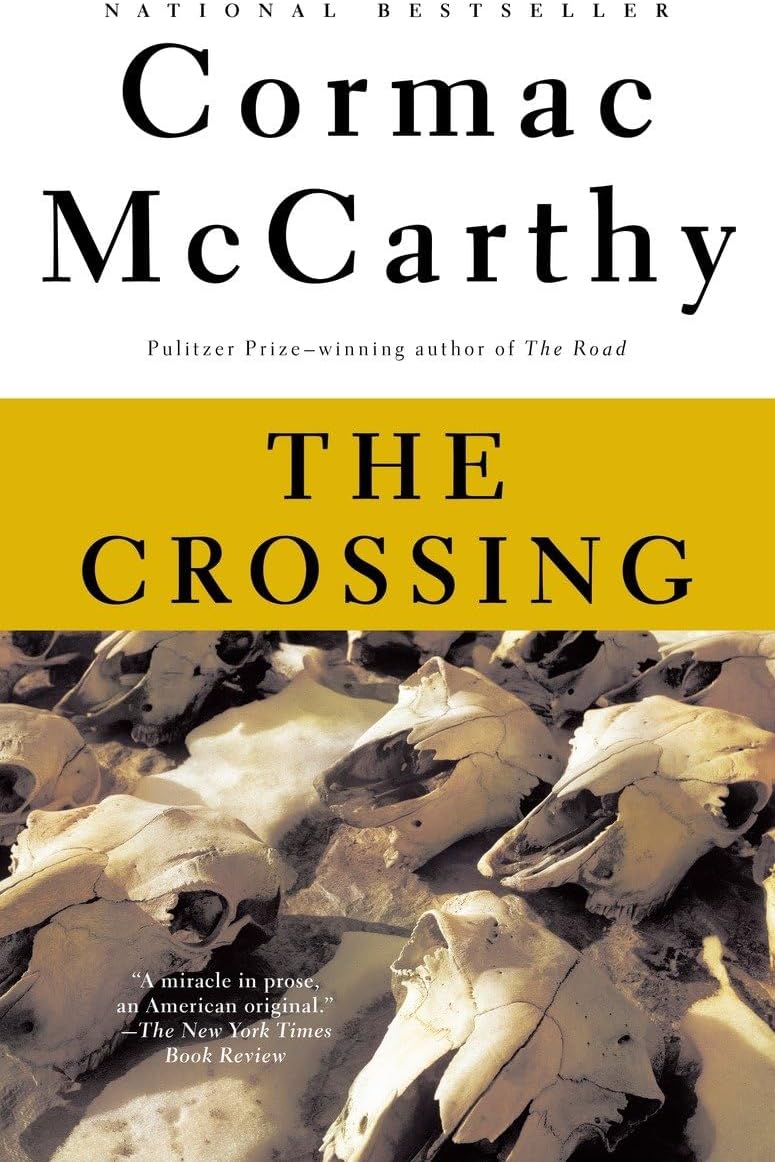
The Crossing: Border Trilogy (2)
Product ID: 8650463
Buy anything from 5,000+ international stores. One checkout price. No surprise fees. Join 2M+ shoppers on Desertcart.
Desertcart purchases this item on your behalf and handles shipping, customs, and support to EGYPT.
NATIONAL BESTSELLER • The second volume of the award-winning Border Trilogy— From the bestselling author of The Passenger and the Pulitzer Prize – winning novel The Road— fulfills the promise of All the Pretty Horses and at the same time give us a work that is darker and more visionary, a novel with the unstoppable momentum of a classic western and the elegaic power of a lost American myth. In the late 1930s, sixteen-year-old Billy Parham captures a she-wolf that has been marauding his family's ranch. But instead of killing it, he decides to take it back to the mountains of Mexico. With that crossing, he begins an arduous and often dreamlike journey into a country where men meet ghosts and violence strikes as suddenly as heat-lightning — a world where there is no order "save that which death has put there." An essential novel by any measure, The Crossing is luminous and appalling, a book that touches, stops, and starts the heart and mind at once. Review: The gloom master is darker than normal... - The gloom master is darker than normal in this second book of the Border Trilogy. Published in 1994, Cormac McCarthy once again takes the reader across the border into Mexico through the eyes of a young man. Has anybody ever seen Cormac smile? In a rare interview with 'The New York Times' , Cormac stated that he is not an aficionado of authors who don't "deal with issues of life and death." This novel deals with those issues. He is also the master of simple declarative sentences without quotation marks. He told Oprah Winfrey, on her show in 2007, that he believes there is no reason to "blot the page up with weird little marks." Yet, this rebel of proper grammar is consider one of the great writers of our times. Since I seem to be drawn to his novels, I can't argue that point, but many literary critics do. And what does William Strunk, Jr. and E.B. White, writers of 'The Elements of Style' , think about his prose? Not too much, I'm sure. The story starts innocently enough with sixteen year old Billy Parham trying to trap a wolf that traveled from Mexico on to Parham's ranch in New Mexico. The she-wolf has been destroying the livestock. Billy and his father are unsuccessful trapping the wolf until Billy gets the idea to bury the trap under a old campfire. Bingo! The wolf gets caught, but since Billy can't pull the trigger, he decides to take the wolf back to Mexico. Billy almost completes the mission up till the time a group of Mexicans take the wolf away from Billy. The Mexicans put the wolf in a pit at a town fair. While chained to a post, the wolf is forced to fight one dog after another. Billy tries fruitlessly to save the wolf that he has bonded with. With no options available to him, Billy shoots the wolf dead. After burying the wolf, Billy heads back to New Mexico. Cheery story so far, right? During his trek home, he runs into a man at a run-down church that tells Billy the first of three stories told by strangers in this novel. This part of the novel is unique, just as is the alternate Spanish and English lines throughout the tale. Although I don't know Spanish, it was written so brilliantly that I knew what they were saying. When Billy arrives at his parents ranch in New Mexico, he finds that his home is deserted. He rides into town to see the Sheriff. He is told that his parents were shot to death by two men and the six horses stolen. His brother, Boyd, got away and is staying a neighbor's house. Billy finds Boyd, steals money, a shotgun, ammo, and food from the family. The game plan is to head back to Mexico and find the horses. All this happens early in this 426 page novel, so I'm not giving away the story. The novel explodes once the boys cross into Mexico. They will encounter many difficulties, meet a mysterious young girl, meet a strange character named Quijada on two occasions. Oh, the troubles are many. You will read the second and third story told by strangers. The second story is about a rebel who gets his eyes sucked out after being captured by the federals, and the third story is about a gypsy and two airplanes. This novel is quite a trip. An example of Cormac's prose are the following lines pertaining to Billy Parham: "It had ceased raining in the night and he walked out on the road and called for the dog. He called and called. Standing in that inexplicable darkness. Where there was no sound anywhere save only the wind. After a while he sat in the road. He took off his hat and placed it on the tarmac before him and he bowed his head and held his face in his hands and wept. He sat there for a long time and after a while the east did gray and after a while the right and god made sun did rise, once again, for all and without distinction." Notice all the "ands"? This man of `no rules' prose can get his point across to the reader in his own remarkable way. I highly recommend this novel. Review: Dreamlike, ponderous, mythical quality - I always find McCarthy books very difficult to review for some reason, even though each one has been powerful in their own way and a thoughtful experience. I’ve enjoyed every Cormac McCarthy book I’ve read (The Crossing being my fourth read) and feel like there are some signature McCarthy staples that a reader experiences when venturing forth into one of his novels. The novel here is aptly named because in The Crossing we have a focus on various journeys of sorts, both literal and figurative, that are experienced namely by our protagonist, Billy Parham. Within the novel, there are a total of three literal crossings, one of which is Billy’s journey into Mexico after capturing a she-wolf that was terrorizing the father’s livestock. Along this path, Billy encounters allies, foes, dangers, and insights into the land. One of the most notable qualities of McCarthy (alongside the lack of quotations for dialogue) is his stream of conscious dreamlike prose that seems to go in line with the mythical effect of the plot. I felt like I could literally get lost in the prose (I mean, in an effective way). And this adds to the literary experience, as in The Crossing themes such as coming of age, loss of innocence, facing the harsh realities of life. There is a constant prevailing commentary on the human existence that is focus. This novel has less a linear styled plot but works instead more so as a series of connected episodes or parts that take us to one larger conclusion. Another notable aspect is McCarthy’s distinct ability to use the oral tradition of storytelling as part of both the literal and symbolic journey. In this way, we are given a story within a story, and I think this adds to the mythical, ponderous quality that The Crossing establishes. This was yet another powerful reading experience from McCarthy, and I look forward to finishing with the last in the Border trilogy, Cities of the Plain.

| Best Sellers Rank | #11,792 in Books ( See Top 100 in Books ) #114 in Contemporary Literature & Fiction #119 in Westerns (Books) #746 in Literary Fiction (Books) |
| Customer Reviews | 4.3 out of 5 stars 3,046 Reviews |
R**O
The gloom master is darker than normal...
The gloom master is darker than normal in this second book of the Border Trilogy. Published in 1994, Cormac McCarthy once again takes the reader across the border into Mexico through the eyes of a young man. Has anybody ever seen Cormac smile? In a rare interview with 'The New York Times' , Cormac stated that he is not an aficionado of authors who don't "deal with issues of life and death." This novel deals with those issues. He is also the master of simple declarative sentences without quotation marks. He told Oprah Winfrey, on her show in 2007, that he believes there is no reason to "blot the page up with weird little marks." Yet, this rebel of proper grammar is consider one of the great writers of our times. Since I seem to be drawn to his novels, I can't argue that point, but many literary critics do. And what does William Strunk, Jr. and E.B. White, writers of 'The Elements of Style' , think about his prose? Not too much, I'm sure. The story starts innocently enough with sixteen year old Billy Parham trying to trap a wolf that traveled from Mexico on to Parham's ranch in New Mexico. The she-wolf has been destroying the livestock. Billy and his father are unsuccessful trapping the wolf until Billy gets the idea to bury the trap under a old campfire. Bingo! The wolf gets caught, but since Billy can't pull the trigger, he decides to take the wolf back to Mexico. Billy almost completes the mission up till the time a group of Mexicans take the wolf away from Billy. The Mexicans put the wolf in a pit at a town fair. While chained to a post, the wolf is forced to fight one dog after another. Billy tries fruitlessly to save the wolf that he has bonded with. With no options available to him, Billy shoots the wolf dead. After burying the wolf, Billy heads back to New Mexico. Cheery story so far, right? During his trek home, he runs into a man at a run-down church that tells Billy the first of three stories told by strangers in this novel. This part of the novel is unique, just as is the alternate Spanish and English lines throughout the tale. Although I don't know Spanish, it was written so brilliantly that I knew what they were saying. When Billy arrives at his parents ranch in New Mexico, he finds that his home is deserted. He rides into town to see the Sheriff. He is told that his parents were shot to death by two men and the six horses stolen. His brother, Boyd, got away and is staying a neighbor's house. Billy finds Boyd, steals money, a shotgun, ammo, and food from the family. The game plan is to head back to Mexico and find the horses. All this happens early in this 426 page novel, so I'm not giving away the story. The novel explodes once the boys cross into Mexico. They will encounter many difficulties, meet a mysterious young girl, meet a strange character named Quijada on two occasions. Oh, the troubles are many. You will read the second and third story told by strangers. The second story is about a rebel who gets his eyes sucked out after being captured by the federals, and the third story is about a gypsy and two airplanes. This novel is quite a trip. An example of Cormac's prose are the following lines pertaining to Billy Parham: "It had ceased raining in the night and he walked out on the road and called for the dog. He called and called. Standing in that inexplicable darkness. Where there was no sound anywhere save only the wind. After a while he sat in the road. He took off his hat and placed it on the tarmac before him and he bowed his head and held his face in his hands and wept. He sat there for a long time and after a while the east did gray and after a while the right and god made sun did rise, once again, for all and without distinction." Notice all the "ands"? This man of `no rules' prose can get his point across to the reader in his own remarkable way. I highly recommend this novel.
F**9
Dreamlike, ponderous, mythical quality
I always find McCarthy books very difficult to review for some reason, even though each one has been powerful in their own way and a thoughtful experience. I’ve enjoyed every Cormac McCarthy book I’ve read (The Crossing being my fourth read) and feel like there are some signature McCarthy staples that a reader experiences when venturing forth into one of his novels. The novel here is aptly named because in The Crossing we have a focus on various journeys of sorts, both literal and figurative, that are experienced namely by our protagonist, Billy Parham. Within the novel, there are a total of three literal crossings, one of which is Billy’s journey into Mexico after capturing a she-wolf that was terrorizing the father’s livestock. Along this path, Billy encounters allies, foes, dangers, and insights into the land. One of the most notable qualities of McCarthy (alongside the lack of quotations for dialogue) is his stream of conscious dreamlike prose that seems to go in line with the mythical effect of the plot. I felt like I could literally get lost in the prose (I mean, in an effective way). And this adds to the literary experience, as in The Crossing themes such as coming of age, loss of innocence, facing the harsh realities of life. There is a constant prevailing commentary on the human existence that is focus. This novel has less a linear styled plot but works instead more so as a series of connected episodes or parts that take us to one larger conclusion. Another notable aspect is McCarthy’s distinct ability to use the oral tradition of storytelling as part of both the literal and symbolic journey. In this way, we are given a story within a story, and I think this adds to the mythical, ponderous quality that The Crossing establishes. This was yet another powerful reading experience from McCarthy, and I look forward to finishing with the last in the Border trilogy, Cities of the Plain.
J**I
...of which there are several...
This is the second volume of Cormac McCarthy's aptly named "Border Trilogy." After a reading of the first, All the Pretty Horses (The Border Trilogy, Book 1) , I knew I would complete the trilogy. Among other reasons, the novels are "set in my backyard," if one takes an expansive view of same: the border being the one between the United States and Mexico. In the first volume, American adolescents from Texas crossed into Mexico to "find their way in the world." In this volume, "the crossing" of the adolescent (a different one, different time period) is from New Mexico into Mexico, and the purpose is a bit different. It is the late `30's, what would be the waning days of the Great Depression, and Billy Parham, 16, and his brother Boyd, 14, are growing up on a "hard-scrabble" ranch in Hidalgo County, NM, in the area normally referred to as "the boot heel" of New Mexico. It is an area still so remote that probably less than one New Mexican in a 1,000 has visited it; I've been there only once, driving to Columbus, yet still missing the portion McCarthy so lyrically describes: the Animas Mountains and valley. This book encouraged me to make amends for this oversight. The two boys meet a hungry Indian, and obtain food for him, an event which foreshadows developments in an unlikely way. Over the past decade there have been efforts to re-introduce wolfs into the wild of NM (with considerable opposition), so it was ironic to read of the time that they had been hunted to extinction in NM, since they are no friend to the cattle ranchers. Nonetheless, in McCarthy's account, there is a wolf that has come up from the mountains of Mexico, and is killing cattle. The two boys, and their dad set out to trap it, and McCarthy demonstrates considerable narrative skills depicting the process whereby even a "clever" wolf is trapped. The author never veers to a "New Age" outlook on the interactions between man and wild animals, but he does describe the action with considerable empathy for the wolf, as well as the understandable reaction of Billy when the wolf is trapped: he will not kill the wolf, rather he will take it back to the mountains of Mexico, and release it. There was no border fence in the `30's, so Billy simply takes his horse, and now "his" wolf across. For anyone, but particularly for a 16 year old American boy, it is an adventure, requiring an essential ability to "think on your feet" in a new environment. McCarthy "style" involves long descriptive passages on the landscape, with numerous technical terms, particularly those involving the skills of horse-handling. And his narrative also involves interspersing passages of Spanish in the dialogue, a language Billy speaks, thanks to his maternal grandmother. Other reviewers who only speak English have complained of this. Although passages in French are more common in narratives of English, and I can read French, the Spanish was a bit more of a challenge, and did require a Spanish dictionary in the lap while reading: hopefully I'm a bit wiser for the process. Billy Parham's initial purpose, taking the wolf back to Mexico ends on page 125. There are more than 300 pages to go. Billy is joined by his brother Boyd, in both purposeful, and then seemingly random wanders in northern Mexico. The "kindness of strangers" is very much in evidence, as they both are often penniless. And the occasional terrifying violence that mars the peace of both countries is also in evidence. Through flashbacks, the revolution(s) in Mexico, which manage to kill off so much of the "best and brightest" usually of the male population, is also depicted. Billy stumbles into a church and finds an old woman praying. McCarthy brilliantly captures one slice of Mexican history and society with the following: "He knew her well enough, this old woman of Mexico, her sons long dead in that blood and violence which her prayers and her prostrations seemed powerless to appease. Her frail form was a constant in that land, her silent anguishing. Beyond the church walls the night harbored a millennial dread panoplied in feathers and the scales of royal fish and if it yet fed upon the children still who could say what worse wastes of war and torment and despair the old woman's constancy might not have stayed, what direr histories yet against which could be counted at least nothing more than her small figure bent and mumbling, her crone's hands clutching her beads of fruitseed. Unmoving, austere, implacable. Before just such a God." The Crossing? Billy crosses the American-Mexican border at least five times, yet the title is in the singular. I suspect it refers to that much tougher crossing he made, from adolescence into manhood. I welcome comments. 5-stars for an essential American novel.
G**Y
Open the book. Put on your waders.
Yes, McCormac has a mastery with words: the images, the sentiments, the senses they evoke. But all too often I found myself in awe -- if not swamped by -- the words, the lines, whole paragraphs that drew attention more so to themselves (and the author) than to the characters or the story. I didn't read The Crossing. I waded through it.
H**D
An American original.
Exceptional. The dialogue is unmatched. My favorite of ALL his books. The characterization and unique plot is captivating from the first scenes till the last.
A**C
Death Isn't the Worst. The Worst Is Being Untrue
Like John Grady Cole and Lacey Rawlins in All the Pretty Horses, Billy Parham and his younger brother Boyd cross into Mexico in this second novel of the so-called "border trilogy," this time from New Mexico instead of Texas. None of the characters from All the Pretty Horses appear in this book, but McCarthy's fascination with the road continues. These might be called coming-of-age stories but not in the usual sense. The boys in Pretty Horses and The Crossing haven't really had a childhood and are not really boys at all. They've been born into a world of hardship and hard work, so the disillusionment piece common to most coming-of-age stories doesn't apply; they don't have many illusions. The death of John Cole's grandfather and selling of the family ranch are what send John into Mexico with his friend Rawlins in Horses. Billy Parham crosses the border the first time to return a wolf to the wild mountains of Mexico. His father has already warned him that when a man crosses certain lines, the life he once knew may vanish forever. And so it happens. When he returns, his father and mother are dead. This is the tragedy that causes Billy and Boyd to head for Old Mexico on horseback. In both novels, great loss sends the protagonist on a harrowing journey, into an inferno that will test physical and moral fortitude. Somehow McCarthy manages to mix a nostalgia for cowboys and horses with a liberal dose of reality. Mexico is portrayed as a lawless land where the peasants abide and suffer the depredations of wealthy landowners, bandidos, hunger, their own weaknesses, and a landscape that yields life only grudgingly. Still, McCarthy seems to treasure this remnant of a medieval world. There is no corporation, no FBI, no phone call that will bring rescue. Acts of cruelty and criminality occur, but so do acts of courage and compassion, and these are the acts of Billy and Boyd Parham, characters I like and admire. They are true, true to themselves, true to others, true to an ancient code. In their matter-of-fact, inadvertently humorous dialogue, they sometimes remind me of Huck Finn, but they are distinct and fascinating characters in their own right even though they also remind me of the high plains drifter, the iconic cowboy of the frontier West. McCarthy calls them caballeros, and I don't think it's a coincidence that caballero not only means horseman, but gentleman. I enjoyed The Crossing. For me, it wasn't quite as skillfully plotted as Horses. I was riveted by the incidents involving the wolf, Boyd's bandida, the boy's discovery of their horses, and the shooting, but not as tuned in when Billy met the priest of the ruined church or when he was "drifting" toward the end of the novel. All in all, however, it's another wonderful book by a writer whose storytelling language is magical.
M**H
A dream, a vision, the West incarnate
Reading this book is like having a holy vision: I feel as if I should tell the world about it, but at the same time it seems so sacred and personal that maybe I should just keep it to myself and try to figure out why it came to me, into my life, into my head. The book is the story of Billy Parham, a son in a late-1930s New Mexican ranching family. Billy traps a wolf that has been killing his father's cattle but realizes he can't kill it and has to return it to its home in the mountains of old Mexico. Billy crosses the border into Mexico, and as he does he crosses from real life into a world of dreams, where everyone moves as if the air was liquid, where every ruin has an irretrievable story, where soot and heat and danger hang in the air, and where nothing ever goes as planned. The story is not as streamlined or as focused as its thematic predecessor, "All the Pretty Horses," but that's not necessarily a shortcoming. The book sprawls out like a wide hot desert--curling north and south, east and west, across the present and into the past. The writing is as good as any writing I've ever read ever, and certain metaphors and feelings will stay with you for years. For example: the coals of a campfire seeming like an exposed piece of the core of the earth. This is a book that needs to be read. Pick it up, and let it seep into your skin, let it open you to other worlds and peoples and ideas, and let it change you. Let it open your eyes to the world, and to the West, and the goodness and the hope and the sadness that haunts the lives of all of us. This is a book made of all those ineffable things that most of us just can't put into words. But here, somehow, Cormac McCarthy has managed to do just that. Here is the intangible, but tangible. Here is the unnameable, but named. Here are the thoughts you could never express, expressed.
C**S
Three crossings into a world of darkness
This is one of Cormac McCarthy's longest and complex novels and is a masterpiece of American fiction. The complexity comes in that the novel is about three journeys into Mexico, each taken by young Billy Parham, and each taken for a different compelling and archetypal reason. I say archetypal in that the novel rises above other works of contemporary fiction to become almost mythic. For three times our young hero takes a task upon himself and enters another land, sometimes a very dark and lawless land, and must depend upon his wits and the fates to direct his destiny. The title, `The Crossing' elicits a feeling of entering into the underworld, Hades, a crossing over that few survive in mythology. McCarthy is more than a great storyteller, for he evokes the stories of antiquity, that have been time tested by centuries, and upon this armature, he builds a straight forward narrative that often is carried by the darkest of free-verse poetry, disguised as description. I plan to re-read `The Crossing' one day and mark those foreboding and deterministic passages that read more like Homer in "The Iliad' than any other comparable contemporary writer. You the reader enter a world of uncertainty and fear and groundlessness with this book. Only Paul Bowles' "The Sheltering Sky" and Bowles' "Let it come Down" compare. Billy Parham, aged 16, and his 14 year old brother Boyd live in New Mexico and the story starts with two foreboding events. Billy goes out at night and watches the wolves that have come up from Mexico to hunt game and kill cattle. But in this short event we are given a hint of the tragedy that permeates this novel and many novels by McCarthy. The sense of the tragic that permeates McCarthy's work has three components. The first of these is that consciousness and reflection has lifted man above nature so that we can observe and reflect upon nature's cruel indifference. The second of these is that despite the perception that we have risen above the animals, we in fact are a vicious species. We are cruel, terrible, and vicious to our fellowman and the beasts around us. We are homicidal and destructive in a manner not unlike hurricanes, tornadoes, and earthquakes. Our cruelty and homicidal nature is truly our nature as the destruction of a tidal wave also follows its nature. The third tragic component is that consciousness and the creations of consciousness, such as God, are powerless to change that nature. McCarthy builds upon this triple tragedy that man is under the illusion that we are separate from nature, when in fact we are a terrible dark force upon the world, and finally, as proof of our powerlessness, our consciousness and its creations can not lift us above the darkness. Thus McCarthy; more so than Bowles, Faulkner, Freud, Melville, Waugh, and Conrad; paints the darkest vision of our nature and our fate. There is no romance or sentimentality here. McCarthy is not for everyone since the reader enters the underworld along with the characters and is changed also when our illusions are removed from our eyes. `The Crossing' is one of his best and most ambitious efforts.
M**O
Book is falling apart. Not what I expect of Amazon
The author is a fantastic writer and one of my favorites! Unfortunately, the book I received is falling apart.
N**R
Coarse...Philosophical...Painful...Evocative
Neatly defined plots are the mainstay of fiction, not real life. Life, as we know it, doesn't follow the expected course; it can go round in circles, take unexpected turns and head off in a direction we hadn't foreseen. Cormac McCarthy's novel 'The Crossing' is more true to life than a slave of the fiction format. The writing is as coarse as the landscape it evokes. Characters enter and leave the narrative never to return as the boy hero Billy traverses the length and breadth of Mexico, first (mild spoilers ahead) with a wolf, then with his brother, and then a third time all by himself. The tale turns deeply philosophical at times, putting forth questions regarding the injustices of life and whether God permits them willingly. Yes, the story does drag a few times as the author gets a little too indulgent, but all in all, there is something valuable to be had from this book. If you know McCarthy's style and language and are not put off by it, 'The Crossing' is strongly recommended. But do remember, it is the second book in the 'Border Trilogy'. I suggest you read 'All The Pretty Horses' (first in the trilogy) first even though the story of 'The Crossing' has nothing to do with it. The heroes of the two books come together in the third book 'Cities Of The Plain'.
A**R
A McCarthy masterpiece.
Great book, bought it again for a friend; it was in good condition when he picked it up.
S**R
BLEAK, BEAUTIFUL AND BIBLICAL
I am a confirmed fan, so I knew what to expect - even so, this is an unbelievably sad story that offers few, if any, consolations. But it is written in McCarthy's peerless prose, and that in itself is enough to commend it. The story is actually quite slight, focusing on Billy Parham, a very young cowboy in the 1930's who embarks on a mad journey to repatriate a wolf in Mexico and ends up having his whole life turned upside down. All McCarthy's trademarks are here: beautiful, lyrical descriptions of the countryside and wider environment; a wonderful expression of the relationship between man and horse; an unblinking story of poverty, mistrust, hatred and death; and a compelling central character, flawed, headstrong, loyal and tragic. Do not read this if you like happy endings!
J**Y
Arrived on time
Great book. Arrived quickly
Trustpilot
1 month ago
2 days ago