Desert Online General Trading LLC
Dubai, United Arab Emirates
Desert Online General Trading LLC
Dubai, United Arab Emirates

🌱 Cultivate Success with Every Reading!
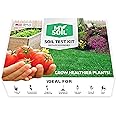
The Kelway PHD Soil pH Meter is a compact, handheld device designed for effortless soil testing. It requires no chemicals, power source, or distilled water, making it an eco-friendly choice for gardeners. With easy operation and full instructions included, this meter ensures your lawns and gardens thrive with optimal pH levels.
J**Y
Solid products
A pH soil meter that is quick & easy to use, is accurate and is highly durable - what more could one want? The only "negative" is that only tests for a relatively narrow pH range, albiet this is the range most typical gardeners are concerned about. Very few plants like alkaline conditions, so testing for anything above a 7.0 isn't very useful anyway. For what it does, it's hard to beat the Kelway - I've tried a number of cheapo (some not so cheap) soil testers and I'm rarely confident in their accuracy. But with the Kelyway, after I've watered the plants, I take a couple of quick readings that I can be confident about. With blueberries, the pH range is critical - so when I'm watering and if my soil tests a bit above 5.5, I know I need to add more acidified water immediately. If your goal is to quantify how alkaline your soil is so that it can be lowered to 8.0 or less, the Kelway is not your instrument - but for the rest of us, most of whom are dealing with slightly acidic to neutral soils, the Kelway is ideal.
A**R
Works as advertised.
Works well but have to keep the tip cleaned to work properly.
R**G
Works, perhaps not the best for alkaline soils though.
I recently purchased this and if you follow the directions it definitely works but I'm unsure if it's accurate, especially in my area which is quite alkaline. It says in the instructions that it may not take accurate readings in salty alkaline soils but that that won't be a problem because most areas have acid soils.... well not here we are quite alkaline. All my readings came back acidic 6.5 was my highest reading. I think I'll have the soil tested professionally and see how it compares. Even if it isn't calibrated properly it may still come in handy once I learn how far off it's reading I can adjust accordingly.Summary: Use at your own risk if you live in an area with alkaline soils.
S**E
Great Product! Easy to use!
I have a small farm (5 acres) with several gardens and a lot of grass. With basic soil tests for PH running about $10 each from the agricultural extension office, this solid little meter nearly paid for itself in the first 30 minutes out of the box!Just read the instructions, follow the instructions, and each PH reading takes about 3 minutes. Since I had recently had some soil sammples done, I was able to pretty much verify that the gage was "spot-on" by sampling some known areas.It also comes with a handy reference for PH levels for just about everything you can grow, what a super and well-made product!
F**R
Soil PH meter a great tool in my southwestern US garden
After trying with spotty success to grow a variety of shrubs, flowers, and trees in our southwestern US suburban half-acre lot, I turned to the possibility that our soil -- it is mostly clay former Rio Grande river bed -- was out of the PH range many plants wanted to see. Several years of applying iron sulfate helped a lot, but how much was enough, and how much was too much? I saw and bought this PH meter. Indeed, the PH varies widely from place to place in our yard. This meter does a great job of indicating how much PH change we need -- and where we need it. We have healthier, greener plants with no excess expenditure on iron sulphate (Ironite) which is not inexpensive. The meter is a great tool!
B**C
This soil pH meter has NO accuracy
This soil pH meter is wildly inaccurate. If you are trying to adjust your soil pH based on this meter, you will be led completely astray. I researched this meter before buying it, and as a result purchased a pack of the "conditioning films" and a calibration solution test kit from Atlas Scientific with the same order. I read all instructions and followed them precisely. I even used separate conditioning films on each of the two metal rings to insure there was no metallic cross-contamination between the rings. When reading the meter, I interpolated between the 0.2pH scale markings to make readings with a "resolution" of 0.05pH.First test: When placed in the 4.0pH calibration solution, the Kelway meter read 5.20pH. Hunh.The Kelway instructions state, "Use when the soil is damp. No current can flow in soil that is very dry." and "Press the soil tightly against the metal rings." Clearly, the Kelway meter is not intended to be used in fluid samples. I thought perhaps the meter would not work accurately in a completely fluid solution.So, I took a large soil sample and "homogenized" it as thoroughly as possible. I placed a measured amount of this sample in each of three clean glasses. To sample A, I added a measured amount of distilled water. To make sample B acidic, I added an equal measured amount of the 4.0pH calibration solution. I then mixed a solution of powdered dolomite limestone and distilled water. To make sample C alkaline, I added an equal measured amount of this solution. I then measured all three samples with the Kelway meter, taking readings on 1 minute intervals. A subset of the readings taken in this second test is shown below:1 min: A - 6.40pH, B - 6.30pH, C - 6.60pH.3 min: A - 6.50pH, B - 6.50pH, C - 6.70pH.6 min: A - 6.60pH, B - 6.60pH, C - 6.75pH.These readings left me with no confidence in the accuracy of the Kelway meter, so I ordered a Rozway Digital pH Meter. This meter is provided with packets of powder that allow you to mix calibration solutions of 4.01pH, 6.86pH and 9.18pH. The instructions call for the use of deionized water in these solutions. I had only distilled water available, which is not the same thing, so my calibration of the Rozway meter may not have been fully accurate.When placed in the Atlas Scientific 4.0pH calibration solution, the Rozway meter read 3.86pH. Hunh. Not the specified +/-0.01pH accuracy.I then mixed the three Rozway calibration solutions and performed the calibration procedure. After calibration, the three solutions read: 4.01pH, 6.91pH and 9.04pH. Two of these readings are outside the specified accuracy of +/-0.01pH, but that may be my fault due to the use of distilled water. After calibration, the Atlas Scientific 4.0pH test solution read 3.91pH. I then tested the three Rozway solutions with the Kelway meter and measured 5.10pH, 5.15pH and 5.40pH.The instructions for the Rozway meter speak of "immersing the electrode into the solution". Obviously, the Rozway meter is not expected to work with soil that is merely damp, as is specified for the Kelway meter. So I added two more measured quantities of the specified fluids to each of the soil samples described above. This turned them into slurries. I made measurements in this third test by stirring the slurries and inserting the meters (I tested both, individually) before the solids settled out.The Rozway meter read: A - 6.82pH, B - 5.95pH, C - 7.32pH.The Kelway meter read: 1 min: A - 7.00pH, B - 6.60pH, C - 7.05pH.In truth, I had expected a wider range of pH readings among the three samples. However, I do have confidence that the Rozway meter readings are accurate to perhaps +/-0.1pH. At best, I would place the accuracy of the Kelway meter at +/-1.5pH. Clearly, the readings obtained from the Kelway meter are more dependent upon the "fluidity" of the sample and the "settling time" allowed, than they are on the true pH of the soil sample. The pH of soil sample A should not have changed between the second test (one measured quantity of distilled water) and the third test (three measured quantities of distilled water). Yet the Kelway reading changed from 6.40pH to 7.00pH. In the second test, the Kelway reading for sample A changed from 6.40pH at 1 minute to 6.50pH at 3 minutes to 6.60pH at 6 minutes. The pH of the three soil samples (Rozway readings) was: A - 6.82pH, B - 5.95pH, C - 7.32pH, a span of 1.37pH. The pH measured by the Kelway meter (3 minutes, second test) was: A - 6.50pH, B - 6.50pH, C - 6.70pH, a span of 0.20pH. The pH measured by the Kelway meter (1 minute, third test) was: A - 7.00pH, B - 6.60pH, C - 7.05pH, a span of 0.45pH. To re-state my conclusion: the readings obtained from the Kelway meter clearly are more dependent upon the "fluidity" of the sample and the "settling time" allowed, than they are on the true pH of the soil sample. I have absolutely ZERO confidence in the accuracy of readings made with the Kelway meter.
ترست بايلوت
منذ أسبوعين
منذ أسبوع