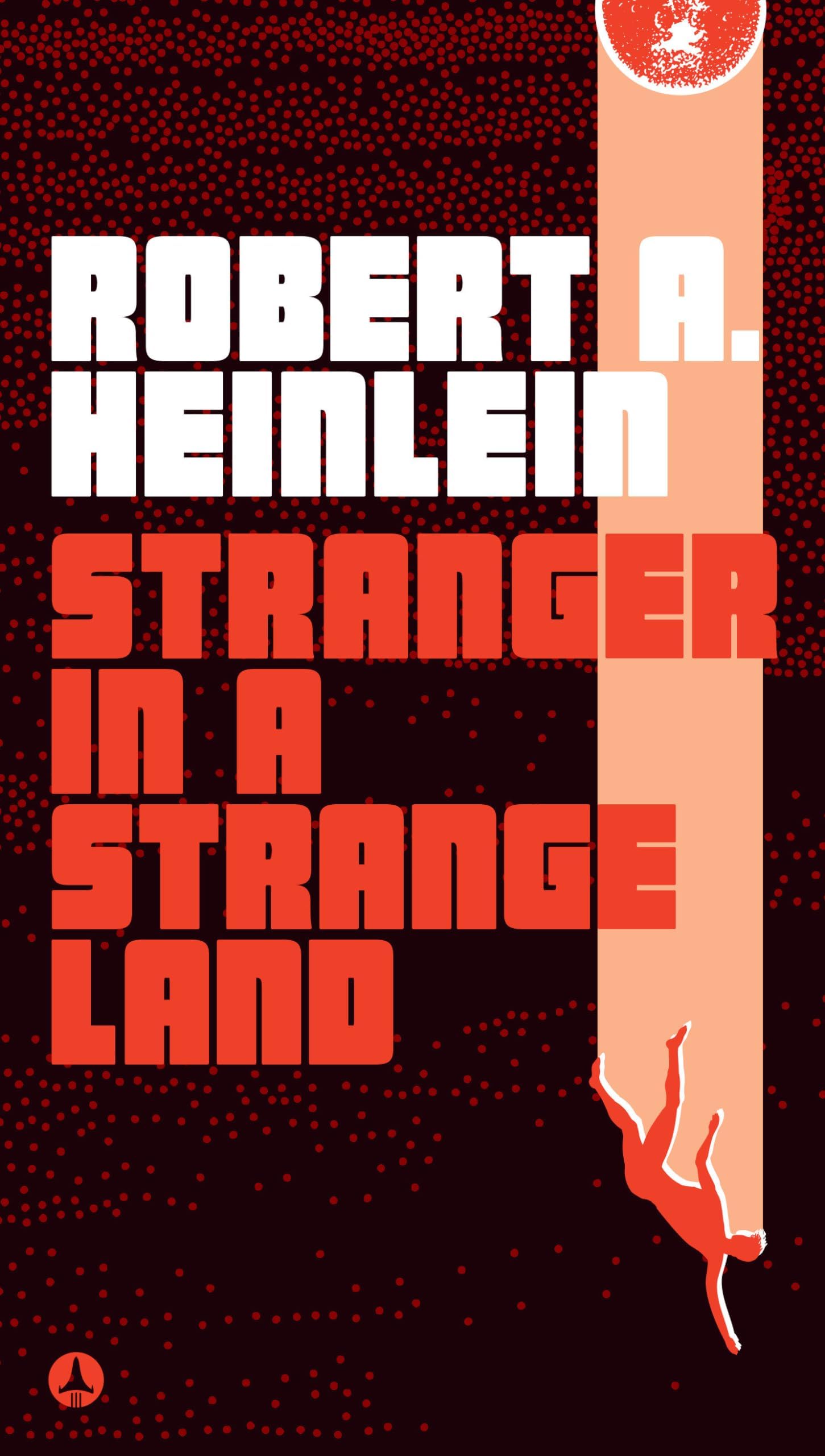
Stranger in a Strange Land
Product ID: 124663739
Desertcart purchases this item on your behalf and handles shipping, customs, and support to EGYPT.
Robert Heinlein's Hugo Award-winning all-time masterpiece, the brilliant novel that grew from a cult favorite to a bestseller to a science fiction classic. Raised by Martians on Mars, Valentine Michael Smith is a human who has never seen another member of his species. Sent to Earth, he is a stranger who must learn what it is to be a man. But his own beliefs and his powers far exceed the limits of humankind, and as he teaches them about grokking and water-sharing, he also inspires a transformation that will alter Earth’s inhabitants forever... Review: A Martian Named Smith - There is no question that Robert Anson Heinlein is one of the Fathers of Science Fiction. There is also no question that STRANGER IN A STRANGE LAND is his most famous work, having been called "the most famous science fiction novel ever written." Is it his best? Perhaps not. But it is a ground breaking classic, one that I enjoy reading again and again. STRANGER IN A STRANGE LAND is the story of Valentine Michael Smith (Mike), a male born of human parents on the first Earth colony ship to Mars. Literally born as the ship landed on Mars, Mike's parents and the rest of the crew died, and Mike was raised by Martians. 25 years later, a second Earth colony ship lands on Mars, and discovers Mike, the native inhabitants of Mars, and a host of unanswered questions. Mike returns to Earth, and STRANGER IN A STRANGE LAND is the detailed chronicle of his introduction to, interaction with, and transformation of human culture. STRANGER IN A STRANGE LAND was Heinlein's first truly adult science fiction novel, and he took on some pretty heady topics. Politics, religion, sex, equality, and the concept of a truly un-human culture (which happened to be superior), to name a few. Heinlein wove these themes into STRANGER IN A STRANGE LAND, each of which contributed to his idealistic vision of a perfect world.He intermixed shock value, logic, and plain good storytelling to get his points across, and I think he did so quite wonderfully. 1. Religion. Heinlein was not an atheist, as some have claimed. He did believe in a higher power; what he did not have any use for was organized religion. He believed in faith. If you had faith, true faith, then the trappings of religion were unnecessary and superfluous. They just did not matter. The Church of All Worlds in STRANGER IN A STRANGE LAND was set up to show that no matter what the religious trapping were, it was faith that really mattered. He also created a religion where happiness and self-belief were the main drivers, rather than fire, brimstone, and fear. Makes great sense to me. 2. Sex. Contrary to popular belief, STRANGER IN A STRANGE LAND did not promote promiscuity or free love. What Heinlein did was to create a world where people were open about sex, where it was enjoyable and exciting, but with it came great responsibility. In this world, sex wasn't hidden, secret, or naughty; rather it was honest and pure and fun. People who could develop this utopian attitude became happier, healthier, less jealous, more caring, and, yes, more sexual. Responsibility to partners, offspring, and an entire extended family became the norm. In his own way, by exploring sexuality, Heinlein was exploring and redefining the meaning of family. He was also trying to define sex as a miraculous union, and to show that humans should treat it as the miracle of bonding and "growing closer" that it is. 3. Equality. Before the sexual revolution and equality for women, Heinlein clearly believed in equality of the sexes, equality of the races, equality of faiths...basically the equality of all humans. Yes, he felt women should be treated with respect and reverence and be protected and nurtured because they gave birth and perpetuated the species, but he clearly believed that they were intelligent and capable. He also believed that women had sexual needs equal to those of men and had the right to pursue those needs. 4. Politics. In STRANGER IN A STRANGE LAND, Heinlein clearly had little use for government, politics, or politicians. He believed that government in general was a necessary evil, but preferred that it be kept small and out of his business. He didn't care what it was based on or what guided it - astrology was the ridiculous example used in STRANGER IN A STRANGE LAND - as long as it left him alone. Works for me. He also had little use for entitlements, and expected human beings to work for what they received. Again, works for me. 5. Un-Human, Superior Culture. Heinlein did a remarkable and revolutionary thing when he created the Martian culture of STRANGER IN A STRANGE LAND. The Martians of this novel are clearly not humanoids from another planet. They do not think like humans, act like humans, look like humans, reproduce like human, live like humans, or do anything like we do here on the planet Earth. There is nothing remotely recognizable about these Martians; they are completely alien. We can't them, and they can't understand us. They are older, more advanced, and can perceive the universe around them in ways that humans do not. But humans can, if properly taught, learn some of the things that Martians do. What a marvelous concept. In 1962 the original version of STRANGER IN A STRANGE LAND won the Hugo Award for the Best Science Fiction Novel of the Year. After Heinlein's death in 1988, his wife Virginia discovered the original uncut manuscript and arranged to have it published in 1991. It is interesting to read the two books side by side, to see the differences, and to compare them. I enjoy both versions very much, and am still not sure which is my favorite. Whatever version you choose, I HIGHLY RECOMMEND STRANGER IN A STRANGE LAND. Whether you have read it before or not, whether you love it or not, you will find it to be an interesting and thought-provoking read. Review: Sci-Fi the Stage Rather Than the Star - A Stranger in a Strange Land by Robert A Heinlein... it’s a divisive one this amongst the sci-fi fan community. Some are fanatical zealots of the book, preaching the virtues of the “uncut version” over the “cut version” and looking down their pious noses at those that aren't able (or don't care) to tell the former from the latter. Some consider it the greatest science fiction book ever written whilst others... well, they don’t. They find themselves enraged with the dated dialogue (I have to admit to seeing Jimmy Stuart playing half the characters when imagining a movie of the book) or the archaic attitudes towards women. Halfway through Stranger I was getting splinters from sitting so firmly on the fence; it could be in parts witty and engaging, whilst in others frustrating and awkward. However it is when you read this book less like a novel and more like a treatise on morality that its brilliance begins to shine. Sure some of the concepts are outdated (a few are even downright offensive), but think of it like your Grandpa; he’ll sometimes says things we don’t say nowadays, he means well, he's just from a different age (and you still love the old goat). I think that some of the difficulties the negative reviewers have with Stranger actually stem from their expectations of science fiction as a genre. Sci-fi is normally one of the go-to genres of choice for escapism, to switch-off and not think about the humdrum of everyday life; but if it’s a sweeping space opera with laser swords and robots that you’re after you may be a tad disappointed. There are spaceships and aliens, but they are a bit-part in a very human story. What R.A.H. has managed to do is to use science fiction as the stage rather than the star in order to explore human morality and the absurdities of religion from the eyes of someone experiencing it for the first time. It’s riveting, thought provoking and above all entertaining. So, the greatest science fiction ever written then? Well I'm not sure about that, but Stranger is certainly A great work of science fiction and one that all fans of the genre owe it to themselves to read.
| Best Sellers Rank | #15,077 in Books ( See Top 100 in Books ) #73 in Space Marine Science Fiction #88 in Alien Invasion Science Fiction #95 in First Contact Science Fiction (Books) |
| Customer Reviews | 4.3 out of 5 stars 12,075 Reviews |
K**N
A Martian Named Smith
There is no question that Robert Anson Heinlein is one of the Fathers of Science Fiction. There is also no question that STRANGER IN A STRANGE LAND is his most famous work, having been called "the most famous science fiction novel ever written." Is it his best? Perhaps not. But it is a ground breaking classic, one that I enjoy reading again and again. STRANGER IN A STRANGE LAND is the story of Valentine Michael Smith (Mike), a male born of human parents on the first Earth colony ship to Mars. Literally born as the ship landed on Mars, Mike's parents and the rest of the crew died, and Mike was raised by Martians. 25 years later, a second Earth colony ship lands on Mars, and discovers Mike, the native inhabitants of Mars, and a host of unanswered questions. Mike returns to Earth, and STRANGER IN A STRANGE LAND is the detailed chronicle of his introduction to, interaction with, and transformation of human culture. STRANGER IN A STRANGE LAND was Heinlein's first truly adult science fiction novel, and he took on some pretty heady topics. Politics, religion, sex, equality, and the concept of a truly un-human culture (which happened to be superior), to name a few. Heinlein wove these themes into STRANGER IN A STRANGE LAND, each of which contributed to his idealistic vision of a perfect world.He intermixed shock value, logic, and plain good storytelling to get his points across, and I think he did so quite wonderfully. 1. Religion. Heinlein was not an atheist, as some have claimed. He did believe in a higher power; what he did not have any use for was organized religion. He believed in faith. If you had faith, true faith, then the trappings of religion were unnecessary and superfluous. They just did not matter. The Church of All Worlds in STRANGER IN A STRANGE LAND was set up to show that no matter what the religious trapping were, it was faith that really mattered. He also created a religion where happiness and self-belief were the main drivers, rather than fire, brimstone, and fear. Makes great sense to me. 2. Sex. Contrary to popular belief, STRANGER IN A STRANGE LAND did not promote promiscuity or free love. What Heinlein did was to create a world where people were open about sex, where it was enjoyable and exciting, but with it came great responsibility. In this world, sex wasn't hidden, secret, or naughty; rather it was honest and pure and fun. People who could develop this utopian attitude became happier, healthier, less jealous, more caring, and, yes, more sexual. Responsibility to partners, offspring, and an entire extended family became the norm. In his own way, by exploring sexuality, Heinlein was exploring and redefining the meaning of family. He was also trying to define sex as a miraculous union, and to show that humans should treat it as the miracle of bonding and "growing closer" that it is. 3. Equality. Before the sexual revolution and equality for women, Heinlein clearly believed in equality of the sexes, equality of the races, equality of faiths...basically the equality of all humans. Yes, he felt women should be treated with respect and reverence and be protected and nurtured because they gave birth and perpetuated the species, but he clearly believed that they were intelligent and capable. He also believed that women had sexual needs equal to those of men and had the right to pursue those needs. 4. Politics. In STRANGER IN A STRANGE LAND, Heinlein clearly had little use for government, politics, or politicians. He believed that government in general was a necessary evil, but preferred that it be kept small and out of his business. He didn't care what it was based on or what guided it - astrology was the ridiculous example used in STRANGER IN A STRANGE LAND - as long as it left him alone. Works for me. He also had little use for entitlements, and expected human beings to work for what they received. Again, works for me. 5. Un-Human, Superior Culture. Heinlein did a remarkable and revolutionary thing when he created the Martian culture of STRANGER IN A STRANGE LAND. The Martians of this novel are clearly not humanoids from another planet. They do not think like humans, act like humans, look like humans, reproduce like human, live like humans, or do anything like we do here on the planet Earth. There is nothing remotely recognizable about these Martians; they are completely alien. We can't them, and they can't understand us. They are older, more advanced, and can perceive the universe around them in ways that humans do not. But humans can, if properly taught, learn some of the things that Martians do. What a marvelous concept. In 1962 the original version of STRANGER IN A STRANGE LAND won the Hugo Award for the Best Science Fiction Novel of the Year. After Heinlein's death in 1988, his wife Virginia discovered the original uncut manuscript and arranged to have it published in 1991. It is interesting to read the two books side by side, to see the differences, and to compare them. I enjoy both versions very much, and am still not sure which is my favorite. Whatever version you choose, I HIGHLY RECOMMEND STRANGER IN A STRANGE LAND. Whether you have read it before or not, whether you love it or not, you will find it to be an interesting and thought-provoking read.
K**K
Sci-Fi the Stage Rather Than the Star
A Stranger in a Strange Land by Robert A Heinlein... it’s a divisive one this amongst the sci-fi fan community. Some are fanatical zealots of the book, preaching the virtues of the “uncut version” over the “cut version” and looking down their pious noses at those that aren't able (or don't care) to tell the former from the latter. Some consider it the greatest science fiction book ever written whilst others... well, they don’t. They find themselves enraged with the dated dialogue (I have to admit to seeing Jimmy Stuart playing half the characters when imagining a movie of the book) or the archaic attitudes towards women. Halfway through Stranger I was getting splinters from sitting so firmly on the fence; it could be in parts witty and engaging, whilst in others frustrating and awkward. However it is when you read this book less like a novel and more like a treatise on morality that its brilliance begins to shine. Sure some of the concepts are outdated (a few are even downright offensive), but think of it like your Grandpa; he’ll sometimes says things we don’t say nowadays, he means well, he's just from a different age (and you still love the old goat). I think that some of the difficulties the negative reviewers have with Stranger actually stem from their expectations of science fiction as a genre. Sci-fi is normally one of the go-to genres of choice for escapism, to switch-off and not think about the humdrum of everyday life; but if it’s a sweeping space opera with laser swords and robots that you’re after you may be a tad disappointed. There are spaceships and aliens, but they are a bit-part in a very human story. What R.A.H. has managed to do is to use science fiction as the stage rather than the star in order to explore human morality and the absurdities of religion from the eyes of someone experiencing it for the first time. It’s riveting, thought provoking and above all entertaining. So, the greatest science fiction ever written then? Well I'm not sure about that, but Stranger is certainly A great work of science fiction and one that all fans of the genre owe it to themselves to read.
M**L
CLASSIC Science Fiction
In the wide-ranging genre of science fiction, there are plenty of classics, but only a few true CLASSICS. In this elite group are such works as the Foundation Trilogy by Isaac Asimov, Childhood's End by Arthur C. Clarke and Robert Heinlein's Stranger in a Strange Land. It may be one of the revered science fiction books ever, but does it really deserve that reputation? Maybe, maybe not: personally, I like the book, but I don't think of it as one of the best sci-fi novels ever. The Stranger in a Strange Land of the title is Valentine Michael Smith, the son of two of the initial colonists of Mars. The original colonists all died soon after landing, but the infant Michael survived and was raised by the native Martians. Around twenty-five years later, more colonists come to Mars and bring Michael "home" to Earth. Michael is completely naïve to the ways of humans, which makes him the target of all sorts of people. Legally, he has incredible wealth including "ownership" of Mars itself. The government wants to keep him locked away, but the nurse Jill Boardman breaks him free and brings him to attorney/doctor Jubal Harshaw. Harshaw extricates Michael from the worst of his legal problems, but new issues develop. Michael has all sorts of mental powers developed through his Martian schooling, including the ability to vaporize any enemies with a thought. His unique powers and his introduction of Martian culture to Earth - including the ideas of water brotherhood and grokking - help transform Michael into either a prophet or a messiah; he gains a following of other water brothers who have the potential to usher in a new age of mankind. All this is just the briefest of synopses of this satisfyingly complex book. While many might think that Michael is the central character in the novel, I feel it's really Jubal Harshaw. While it's always dangerous to closely link the author with a particular character, I tend to think that Harshaw is the mouthpiece for Heinlein. And if there's a weakness in this book, it's Harshaw's pontificating. He may have good points, but at times, it seems that Heinlein (through Harshaw, and to a lesser extent Michael and other characters) is preaching more than storytelling. This is also the difference between Heinlein and the other two members of the so-called "Big Three" of science fiction, Clarke and Asimov. The other two focus more on science, while Heinlein seems more interested in social issues. (That's not to say that Clarke and Asimov ignore these issues - or Heinlein ignores science - but just where the focus is.) Revisiting my original question, while this may not be the best book ever, it is still really good and deserves its CLASSIC status for its historic impact as much as its quality. Well-written and thought-provoking, this is Heinlein's masterpiece.
P**R
"I do know the slickest way to lie is to tell the right amount of truth- then shut up."
It's easy to see why this book is on so many 'must read' lists for sci-fi: there are several subversive ideas (at least, they were at the time of publication), some social commentary and more than a few statements or observations about the human condition/experience. That having been said, several of those articles either fall well short of the mark or, in the case of predictions, have developed so tangentially as to render their inclusion nearly as irrelevant as if they were never mentioned. There is a lot of good in this book. Unfortunately, you'll have to sift through a lot of dubious (or straight-up bad) in order to find it. "Stranger In A Strange Land" was no doubt a controversial book when it was published: casting (a form of) communism in a positive light; presenting sex as a healthy, positive, open enterprise as opposed to something secret or shameful; realizing and promoting personal, communal and romantic relationships that are strong and meaningful but eschew traditional institutions for development, recognition, validation or support. It also seems one of the central themes of the work is the underlying value of 'peace, love and understanding,' combined with patience, consideration and acceptance, might possibly be the means AND the end. That's an important and profound statement. It's unfortunate the characters don't grok that message in full, even though the reader is left with the impression that Mike, Jubal, Jill, Anne, Ben, Duke and the rest have done exactly that. It's possible this was the actual message all along, but I don't see the notion of 'fear partial success, as it paves the way to complacency' as being the real takeaway. TLDR: decent read, dated book. Another great example of the evolution of the genre through the mid-20th century. Also a good barometer of where progressive/prediction fiction was during the same period. Recommended for: people who want to disagree with core characters (Jubal has a lot of opinions about a lot of things, and those views don't always align with each other); fans of trippy sci-fi; those exploring or researching influential books in sci-fi; followers of Heinlein's catalog. "Everyone knows that jails and hospitals have one thing in common: they can be very hard to get out of." "There comes a time in the life of every human when he or she must decide to risk "his life, his fortune, and his sacred honor" on an outcome dubious. Jill Boardman encountered her challenge and accepted it at 3:47 that afternoon." "He did not expect reasonable conduct from human beings; most people were candidates for protective restraint." "Man is the animal who laughs," Jubal said." "But it's well to look at the new rascals before you turn your present rascals out." "He's an honest politician- he stays bought."
J**3
Outstanding!
I never read this in the 60s but I can see where it had a pronounced cultural impact. A unique and excellent book. If you haven’t read it, do!
F**H
A classic book from the 60s that is relevant to a recent public offering
This very fine science fiction book by one of the masters of that class of fiction was a major prize winner when it was published in the 1960s.. This well written story about a human male born on Mars and raised by Martians, was a best seller and remains a classic. Of course, it is much more than the one sentence I have written can describe. I picked it up again after reading it 60 or more years ago, because some of what I remember seemed directly relevant to the work and language of Elon Musk and the entry into the public securities markets of his Space X enterprise. Whether you are an investor and pick up the volume because it is very likely that Mr. Musk was influenced by it, or because you enjoy reading great fiction, you will not be disappointed.
W**.
Frequent scannos on Kindle version
One of my favorite books when I read it 15 years ago. Amazingly it isn't available to read through Libby, so I bought the Kindle version. Disappointed by frequent scannos (1-2 per page!) that get in the way of enjoying the book.
K**R
Wicked Satire, yet Strangely Familiar
Heinlein's satire is wicked and well-placed, reminiscent of Voltaire and Swift. IF you love British comedy, you'll love this book. Both come from the same sarcastic taproot. I'm still debating whether or not the main charter is Smith or Jubal. Maybe it is us, since we need to recognize that we are Juba, and must nurture, and eventually become like Smith. Smith's reflective, contemplative message, reminds of Thomas A Kempis ( The Imitation of Christ (Dover Thrift Editions) ), James Allen ( The Wisdom of James Allen : Including As a Man Thinketh, The Path to Prosperity, The Mastery of Destiny, The Way of Peace, and Entering the Kingdom (Radiant Life) ), Lao Tzu ( Tao Te Ching (Dover Thrift Editions) ). Smith's message is nothing new: as C. S. Lewis pointed out, "Really great moral teachers never do introduce new moralities: it is quacks and cranks who do that... The real job of every moral teacher is to keep on bringing us back, time after time, to the old simple principles which we are all so anxious not to see." Mere Christianity . In fact, Smith's slogan "Thou art God" is merely run-of-the-mill Christianity: * "Inasmuch as ye have done it unto one of the least of these my brethren, ye have done it unto me." * "Be ye therefore perfect, even as your Father which is in heaven is perfect." * "Therefore, what manner of men ought ye to be? Verily I say unto you, even as I am." * "Ye are gods; and all of you are children of the most High." * "God became man so that man might be god." * "It is a serious thing to live in a society of possible gods and goddesses to remember that the dullest and most uninteresting person you may talk to may one day be a creature which, if you saw it now, you would be strongly tempted to worship, or else a horror and corruption such as you now meet if at all only in a nightmare. . . . There are no ordinary people. You have never met a mere mortal, Nations, cultures, arts, civilizations, these are mortal, and their life is to ours as the life of a gnat. But it is immortals whom we joke with, work with, marry, snub, and exploit--immortal horrors or ever lasting splendours." The Weight of Glory . Heinlein seems to have stolen a page from Søren Kierkegaard, who tried to re-Christianize Christianity ( The Essential Kierkegaard , 458). To paraphrase John, "Brethren, I write no new commandment unto you, but an old commandment which ye had from the beginning." As I read this book, Smith struck me as oddly familiar. His first name, Michael, refers to the Archangel, the captain of the Lord's army. The second name, Valentine, is the patron saint of all shades of love, phileo, agape, eros, and romance. The last name, Smith, makes him Everyman. But I wonder if there is something more. What happens to Smith is common to all founders of religions--Abraham, Jesus, Mohammed, and so forth. There is evolution, turns and twists of fate, and eventual triumph. However, there is a deeper nuance. Society begins with vulgarized Christianity, then there was the Fosterite Revolution, and another apostasy and commercialization of religion as a Megachurch. And lastly comes along Smith, with his Martian philosophy. This bears a strong parallel to the life of Joseph Smith Joseph Smith: Rough Stone Rolling . In fact, both have a similar martyrdom: "Thou art God" versus "O Lord My God." The satire can get tedious at time, but I think this flaw is excusable. As I read, I kept thinking that this book could loose about 1/3rd of the text. But on the other hand, the artistry and beauty of the wicked satire forces me to say, "Leave it alone." Note: This book is the Q document for so much other fiction. I see shades of "Dune" here and there. Smith the new prophet is akin to Ender, the Speaker for the Dead. And if you have seen Star Trek: The Original Series episode "Charlie X," some of the elements will seem a bit too familiar. Keep in mind that this book came first, and that it does a much better job of mixing wit and wisdom than Kirk and Spock. There is no comparison--after reading this book, "Charlie X" rolls like a flat tire.
S**H
A classical hardcover .
The books came with a excellent shape ,quality of the book is awesome ...Classical reading of one of the gradmasters of sci fiction ,this book must belong to every fan of sci fi genre .
D**S
A Classic with current relevance
This is interestingly the "extended" version that Heinlein wrote before having to reduce it for publishers. Was great to revsit a book that helped shape my life so many years ago.
B**H
It's not what you expect.
There are three ways this book can be taken. 1) You are emotionally developed enough to comprehend it. You may or may not like the writing style, but you'll appreciate the content. You grokked it before you read it. You might grok it in more fullness on a second read. 2) You are not emotionally developed enough to comprehend it when you start reading it, but you are by the time you're done. By the end, you love it and recommend it to everyone. You grok it, but maybe not in fullness. 3) You are not emotionally developed enough to comprehend it, and may never be. You hate the content, and will use that hate to criticize the form. You don't grok it and may never. Every negative review I've read seems to fit into that last slot. It's possible to criticize the science (flying cars for heaven's sake), the dated lingo of the dialogue, the characters (they're not so 3d), but in the end, they do exactly what they're intended to. And they do what science fiction is best used for: exploring the the human condition as it is, and how it might be. To that end, the book is actually quite an accomplishment. Heinlein shows us our fatal flaws. And they are timeless ones. We are all jealous and fearful and flawed and pained. And in ways that we don't need to be if we just grokked each other a little bit more. If you read this book, you will understand humanity a little bit more. Unless you just don't get it. In which case...well, you oughta keep trying. I'd recommend the full version, which is the one published after 1991, with a forward by Virginia Heinlein and 60,000 more words. The ISBN for it is 9780340938348.
J**D
One of humanity's 'must reads'
Engaging characters and an in depth look at humanity, what makes people tick. Heinlein as always writes on two levels; one to make an interesting story to read and another to make you think about society.
I**A
go for it especially if you are into mysticism
life changer!
Trustpilot
2 weeks ago
1 week ago