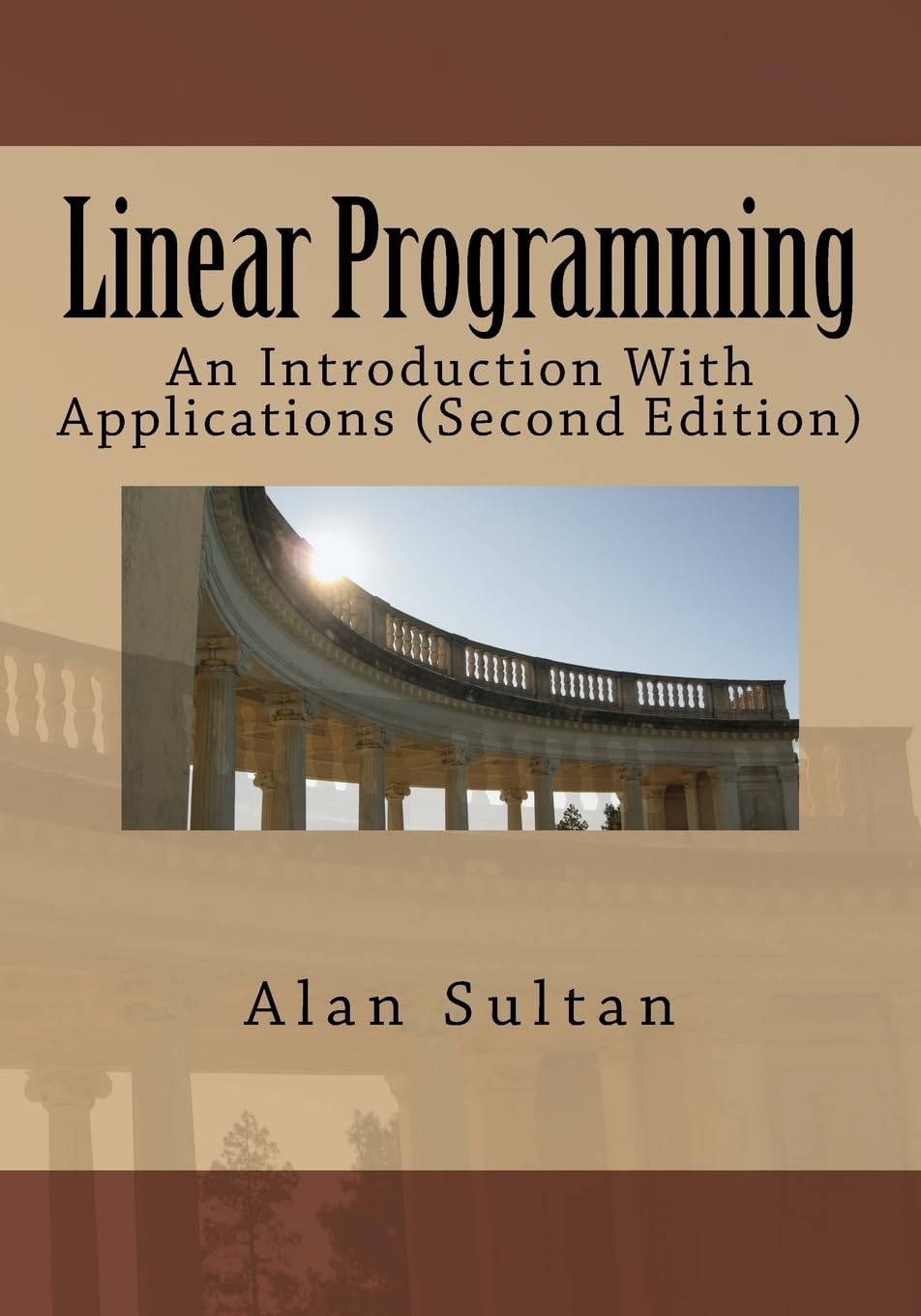
Linear Programming: An Introduction With Applications (Second Edition)
Product ID: 12839996
Buy anything from 5,000+ international stores. One checkout price. No surprise fees. Join 2M+ shoppers on Desertcart.
Desertcart purchases this item on your behalf and handles shipping, customs, and support to EGYPT.
Buy Linear Programming: An Introduction With Applications (Second Edition) on desertcart.com ✓ FREE SHIPPING on qualified orders Review: Perfect for its purposes! - This text book served it's purpose perfectly, and was high quality enough to get through the school year in one piece. Review: Excellent first book on LP - This book (the paperback 2nd edition) provides a very simple and very well written introduction to linear programming; In fact, I cannot imagine anyone writing a simpler treatment without sacrificing rigor. A college freshman could easily read this book on his/her own and learn the basic techniques. Calculus is not required...only a background in pre-calculus and advanced high-school algebra. This book introduces LP by way of the "corner point theorem" and this method is very effective in teaching the fundamental idea of LP. Beware that this book does not use Linear Algebra and is based on the simplex tableau. However, this is the preferred approach for the beginner. The reader interested in taking the next step may consult the following intermediate books that all emphasize linear algebra: 1. Solow, Linear Programming. This is an intermediate book that assumes knowledge of basic linear algebra but still attempts to review all background material. Interestingly this book also has a generic chapter on how to construct mathematical proofs. It then goes on to use these methods in the remainder of the text to prove Theorems and Lemmas related to LP. Overall this book is absolutely fantastic and not as well know as it should be. (Dover publications is re-releasing this book later in 2014) 2. Bertsimas, Introduction to Linear Optimization. Very nice modern treatment that uses linear algebra and ideas from convex geometry. Modern interior point methods are also covered. Senior level undergraduate level. 3. Matousek and Gartner, Understanding and Using Linear Programming. Nice modern linear algebra based treatment with also covers modern interior point methods. The authors actually have a sense of humor and this is a good first book if you have a solid linear algebra background. 4. Hadley, Linear Programming. This oldie but goodie was written in the early 1960's and presents a solid geometric treatment that covers all the required background linear algebra. 5. Kwon, Introduction to Linear Optimization. This is a new well-written short/compact treatment that emphasizes MATLAB. After reading Sultan to get the main geometric idea of what is going on, I feel that the best way to understand LP is by utilizing linear algebra which all the books listed above do. In my opinion, the matrix approach takes the mystery out of the simplex tableau. I should also mention that Gilbert Strang has a nice chapter on LP in his book Linear Algebra and its Applications, 3rd Edition.
| Best Sellers Rank | #2,567,099 in Books ( See Top 100 in Books ) #107 in Linear Programming (Books) #8,186 in Mathematics (Books) #15,329 in Computer Programming (Books) |
| Customer Reviews | 4.4 4.4 out of 5 stars (24) |
| Dimensions | 7 x 1.49 x 10 inches |
| Edition | 2nd |
| ISBN-10 | 1463543670 |
| ISBN-13 | 978-1463543679 |
| Item Weight | 2.95 pounds |
| Language | English |
| Print length | 659 pages |
| Publication date | July 12, 2011 |
| Publisher | CreateSpace Independent Publishing Platform |
A**R
Perfect for its purposes!
This text book served it's purpose perfectly, and was high quality enough to get through the school year in one piece.
S**P
Excellent first book on LP
This book (the paperback 2nd edition) provides a very simple and very well written introduction to linear programming; In fact, I cannot imagine anyone writing a simpler treatment without sacrificing rigor. A college freshman could easily read this book on his/her own and learn the basic techniques. Calculus is not required...only a background in pre-calculus and advanced high-school algebra. This book introduces LP by way of the "corner point theorem" and this method is very effective in teaching the fundamental idea of LP. Beware that this book does not use Linear Algebra and is based on the simplex tableau. However, this is the preferred approach for the beginner. The reader interested in taking the next step may consult the following intermediate books that all emphasize linear algebra: 1. Solow, Linear Programming. This is an intermediate book that assumes knowledge of basic linear algebra but still attempts to review all background material. Interestingly this book also has a generic chapter on how to construct mathematical proofs. It then goes on to use these methods in the remainder of the text to prove Theorems and Lemmas related to LP. Overall this book is absolutely fantastic and not as well know as it should be. (Dover publications is re-releasing this book later in 2014) 2. Bertsimas, Introduction to Linear Optimization. Very nice modern treatment that uses linear algebra and ideas from convex geometry. Modern interior point methods are also covered. Senior level undergraduate level. 3. Matousek and Gartner, Understanding and Using Linear Programming. Nice modern linear algebra based treatment with also covers modern interior point methods. The authors actually have a sense of humor and this is a good first book if you have a solid linear algebra background. 4. Hadley, Linear Programming. This oldie but goodie was written in the early 1960's and presents a solid geometric treatment that covers all the required background linear algebra. 5. Kwon, Introduction to Linear Optimization. This is a new well-written short/compact treatment that emphasizes MATLAB. After reading Sultan to get the main geometric idea of what is going on, I feel that the best way to understand LP is by utilizing linear algebra which all the books listed above do. In my opinion, the matrix approach takes the mystery out of the simplex tableau. I should also mention that Gilbert Strang has a nice chapter on LP in his book Linear Algebra and its Applications, 3rd Edition.
B**S
Wish I had this book when I was in college.
I am a retired PhD operations research analyst. I moved in with my daughter and she made me get rid of most of my books. [There was a space constraint on the number of books cases I was allowed.] My mind was going soft so I bought this book as a Christmas gift to myself. Wow, I wish I had this book as my introductory text to linear programming. Alan Sultan is clearly an educator; he writes to inform rather than impress. This book is clearly written with intuitive, easy-to-follow examples followed by proofs that don't break your mind, but are rigorous. The pattern of presentation is: an explanation of the type of problem to be solved; an example of a toy problem with two variables; a couple of more difficult examples; the mathematical proof in an easy to follow expository style; and, how to handle exceptions and special cases. I was taught in an old-school fashion by some of the founders of the field, which at times was difficult. Prof Sultan uses newer techniques that are easier to follow, more intuitive, and get the same results but faster (learning-wise). Dr. John
M**E
Easy useful information.
Wonderful book. There is so much to learn about linear optimization and this math books make you feel like you're in algebra 2 again.
1**N
Not as effective as I thought
I have no idea why I bought this book. I thought I read this would be a good textbook by which to begin learning optimization modeling and linear programming. I would definitely not rely on it, and if anyone wants to buy it from me for half price then contact me. It's in pristine condition as the professor just used PPT slides.
S**E
Great book for your money
Really great text book to learn LP. What's even better that it also includes Integer programming, quadratic programming and dynamic programming. Really great book. Wish they published hardcover too.
S**N
Good practice
C**A
I’ve had this textbook since the start of my semester and I’ve just come across some typos. They mis numbered the exercises.
Trustpilot
1 month ago
2 days ago