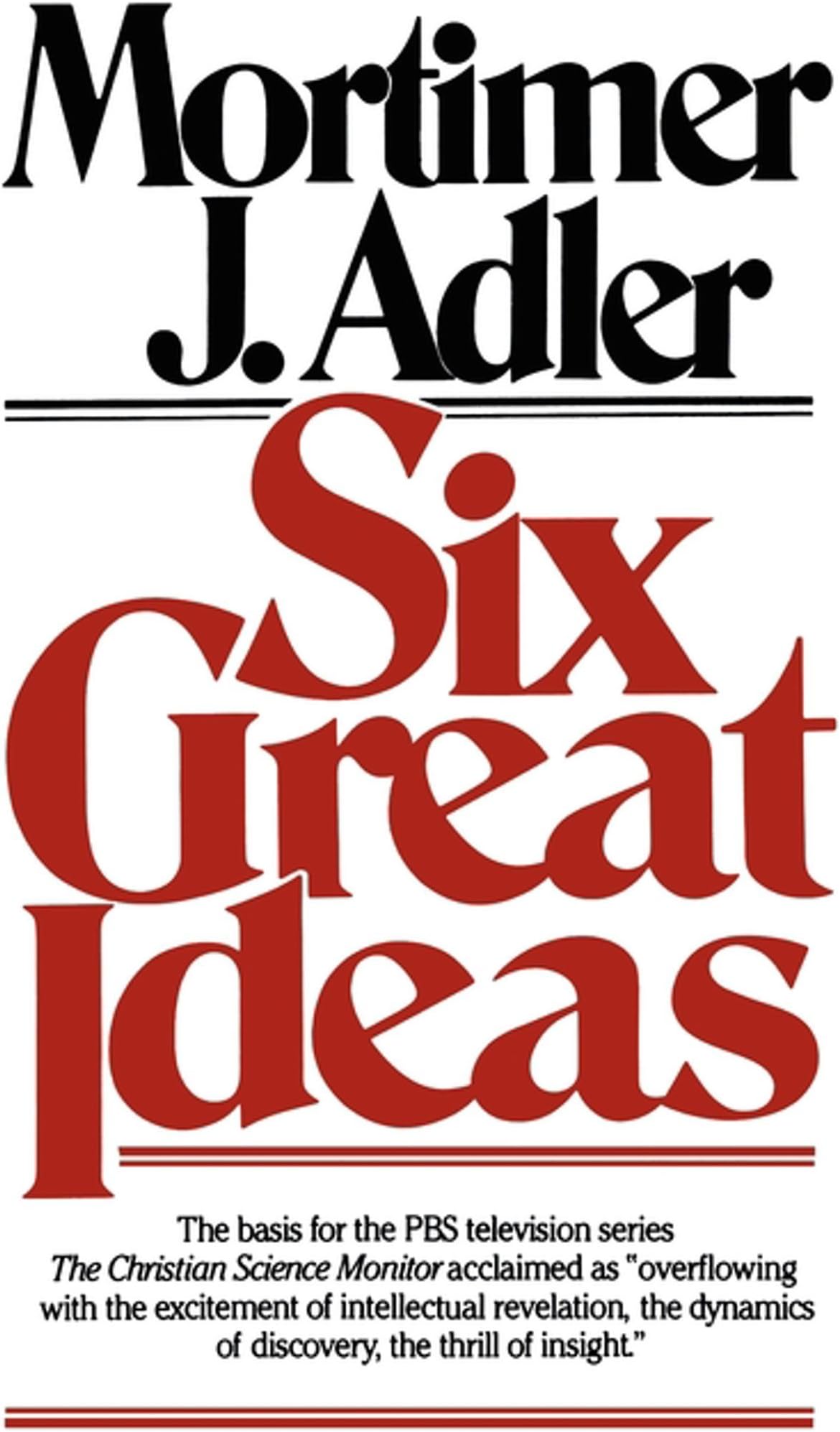
Six Great Ideas
Product ID: 13322075
🌍Universal ideas shaping society
📚Timeless philosophical insights
🧠Accessible deep thinking
Desertcart purchases this item on your behalf and handles shipping, customs, and support to EGYPT.
📖 Unlock the timeless ideas that shape your world — don’t just read philosophy, live it!
Six Great Ideas by Mortimer J. Adler distills centuries of Western philosophy into six essential concepts—Truth, Goodness, Beauty, Liberty, Equality, and Justice—making profound ideas accessible and relevant for today’s leaders and thinkers. Originating from a celebrated Aspen Institute seminar, this book invites readers to engage with foundational principles that influence personal and societal decisions, empowering a deeper understanding of the forces shaping modern life.
| Best Sellers Rank | #113,709 in Books ( See Top 100 in Books ) #104 in Social Philosophy #125 in Individual Philosophers (Books) #168 in Philosophy Metaphysics |
| Customer Reviews | 4.4 out of 5 stars 129 Reviews |
W**Y
Great book on conversation about six great ideas
I just finished listening to "Six Great Ideas" by Mortimer J. Adler on kindle using text to speech, and here is a brief summary of what I learned There has been a conversation going on during the past two or three thousand years in the classic writings of the western world, and there have emerged six common themes, or threads, that have been reoccurring in this literature. In Mortimer J Adler's book called Six Great Ideas, he says these six great ideas are: truth, goodness, beauty, justice, liberty, and equality. He notes that five of the six ideas are prominent in the three documents that are the prime source of the American testament; the Declaration of Independence, the Constitution, and the Gettysburg Address. The six great ideas consist of two triads: 1. those ideas that we judge by (truth, goodness, and beauty), and 2. those ideas that we act by (justice, liberty, and equality). Adler holds that truth is the sovereign idea by which we judge and justice reigns supreme.with regard to the ideas we act on. Ideas that we act on: 1. Truth - Historically, there have been three approaches to truth: a. Correspondence Theory - Truth occurs when statements agree with external reality. b. Consistency Theory - since we can never directly experience the external world, the closest we can get to truth is by figuring out what is most consistent with the empirical evidence. c. Pragmatic Truth - something is true if it works when you perform experiments that would support or disprove a statement. 2. Goodness - there are two classes of goods: apparent goods and real goods. The all-important question is how do we distinguish between the two. Adler says Real goods correspond to those dozen, or so, needs that are shared across the human race. These basic needs form the foundation of what is required for any individual to pursue happiness. These basic needs consist of the biological needs for water, food, shelter, health, etc. and the higher-level needs like the need for knowledge, equality, liberty, and justice. Apparent goods are more closely aligned with "wants" rather than "needs." By defining real goodness in terms of the few needs that are shared across the human race, it makes goodness something that can be objectively measured. Truth relates to goodness in that it can be used to know what is objectively good. 3. Beauty - beauty is an immediate knowing of the object of beauty that gives us instant satisfaction or good feelings upon having that knowledge. Beauty is more subjective than goodness, but it is not totally subjective. The fact that it is not totally subjective is indicated by the fact that we use experts that are well acquainted with a wide variety of the objects of beauty to help judge the beauty of dogs, art, etc. These experts have more information on the members and properties of those members in a class of objects. This shows that beauty does depend upon the properties of the members in the class of objects that are being judged. It also shows that there is some measure of objective truth involved in judgements of beauty. Some say that each property of an object corresponds to an internal feeling in us, and beauty results when the object of beauty causes us to feel a kind of harmony, or organization, of those feelings immediately upon our experience of the object of beauty. With regard to the three ideas (justice, equality, and liberty) related to action, justice is the supreme one that regulates liberty and equality. Justice is an unlimited good in that you can not have too much of it, but liberty and equality are limited in that you can have too much. Liberty is a necessary good in the pursuit of happiness, but too much liberty can infringe on other people or cause harm to them. For example, you do not have the liberty to shout the word fire while in a crowded theater. The fact that liberty needs to be limited shows that liberty must be subordinate to justice. Equality of opportunity and conditions of actions is essential for the pursuit of happiness, but too much equality would not be fair to everyone. The people that use what they have to improve their circumstances should be given more rewards than those that do not, but there must be a basic level of equality in order to give everyone the opportunity to pursue happiness. In order for a democracy to work well, the individual citizens need their basic needs (air, water, food, shelter, knowledge, liberty, justice, and equality) fulfilled so that they will have a strong foundation upon which to pursue happiness. We can think of the fulfilling of these basic needs as being like fertilizing the soil out of which flowers of happiness have the possibility of growing.
G**S
The Original "Philosophy for Everyone"
In his time, Mortimer Adler was a popularizer of Western philosophy and liberal arts education. Chances are if you've heard of him you already know that, but if you haven't, then this is a great book to pick up. He writes in a very down-to-earth manner and conveys his points with examples and language that is very clear. Philosophy is indeed all around us, whether we acknowledge it or not, society is built upon great ideas... not advancements in technology. Of these ideas, Adler identifies six that hold the greatest weight in Western civilization: Truth, Goodness, Beauty, Liberty, Equality, and Justice. These ideas are the "red pills" of our society (to borrow a term from The Matrix), and once you understand the thought process behind them, it will change the way you think about everything from your daily routine, entertainment, politics, and beyond. It is not entirely about "up in the air" stuff that where philosophy books tend to go. If you know somebody who is an intellectual, this book would be a great stocking-stuffer that they would eat up very quickly. If you know somebody who is NOT an intellectual and has a disdain for philosophy, it might be worth reading this book and then giving it to them so you can begin a conversation. It is a manual for thinking freely and wisely.
D**,
Required reading for a all how vote, plan to vote, or wan to be a good person
How can you vote in the best interest of the country if you don't understand what is true, what is a lie or what is untrue (those are not the same) Were Powels UN statements lies or untrue? Were those calling Powel and Bush liars, themselves liars? How can you vote for the best candidate if you don't understand good from evil from bad? How can you be a good citizen and apply justice, liberty, and equality in your daily living if you can't explain those ideas. What is the pursuit of happiness? These ideas are what America is supposed to be about but if you don't understand these ideas how can you make sure we are on the right track or not. Adler is one of there great minds and writers of the last century. His easy to read and precisely worded books will teach you how to think for your self and judge others and live a good life so that you will be happy. If you can't distinguish wants from needs you will be more stressed by following a chaotic (maybe pleasurable) path in your life but will never be happy and content. This is the best book to start with. Then move on to Philosophical Mistakes, How to Read, Aristotle Made Easy, and most importantly the syntopticon. If you take this book to heart and live by it, it will change your life and will help you see who is fair and balanced and who is lying to you to advance their misguided (at best) agenda. It will give you the best chance for happiness.
P**I
A Great Book!
A little slow and hard to follow in the beginning, but perseverance will reward you!
R**E
18L holds Z8 and 600 PF w Hood on
what may seem like a recitation of common sense ideas nobody could disagree with, is actually the foundations for the common sense views with regard to the more most important ideas in our philosophical vocabulary. Adler gives his own direct philosophical answers to the most basic philosophical questions. what is goodness? What are rights? What does it mean to say that something is true? Is beauty only in the eye of the beholder? If you read this book thoughtfully, you’ll be able to give coherent answers to those questions. And you’ll be able to do so based on common sense principles. If you master the ideas in this book, you’ll start to feel that there’s something wrong with the intelligensia out there: that they can’t even manage to understand the basic building blocks of the game dead we judge by and live by.
R**G
American philosopher Mortimer Adler - a must-read modern philosophy book
In this book, Six Great Ideas, Adler meticulously breaks down six well known concepts into two triads. Truth, beauty & goodness are the first three concepts while justice, liberty and equality are the next. This is a brilliant text albeit Adler's writing style and depth of discussion is initially challenging. This book is a fine complimentary foundation for one to begin their journey in search of the truth. It is highly rational, not academic in voice and reveals wisdom that would be beneficial to all. Adler spices up the discussion when he notes that five of the six ideas are encapsulated in our nation's Declaration of Independence. He also warns us that it only in the realm of doubt that we can pursue the truth. Adler tackles one of the big questions in life, how do we know good from bad, when he writes that 'good is when we desire what we need [to survive]/' Get the context: get the book.
A**R
The kind of book you will read more than once...
Fortunately, I have just started homeschooling so I can put it in as required reading! This book takes some pretty deep stuff and makes it accessible to everyone without watering it down or talking down to you. Don't skip anything. I used to go straight to chapter 1 when I start a book. I have learned that skipping an introduction or preface can be cheating myself of something valuable. You don't want to miss anything he has to say. added later- I snuggled up with my 11 year old and and have been reading it to him a chapter or two at a time. Sometimes I re-read the last chapters we covered. He seems to be 'getting it', and I have learned a bit myself. Obviously when reading 'heavy' material with an older child you want to read more slowly. I also recommend Time for Truth: Living Free in a World of Lies, Hype, and Spin by Os Guinness
M**K
The content is great
but the condition of the book was just acceptable, not what it was listed and sold as which is a bit irritating.
D**C
Five Stars
Very happy with my order!
N**D
Four Stars
It is a good book to add in my collection.
T**I
I love reading books.
It is too deep, heavy to digest, although l have studied philosophy before.
A**N
deep yet fun
Deep truths presented thoughtfully yet accessible to all. Good apologetics, solid on faith without being preachy nor dry. A good read.
Trustpilot
2 months ago
4 days ago