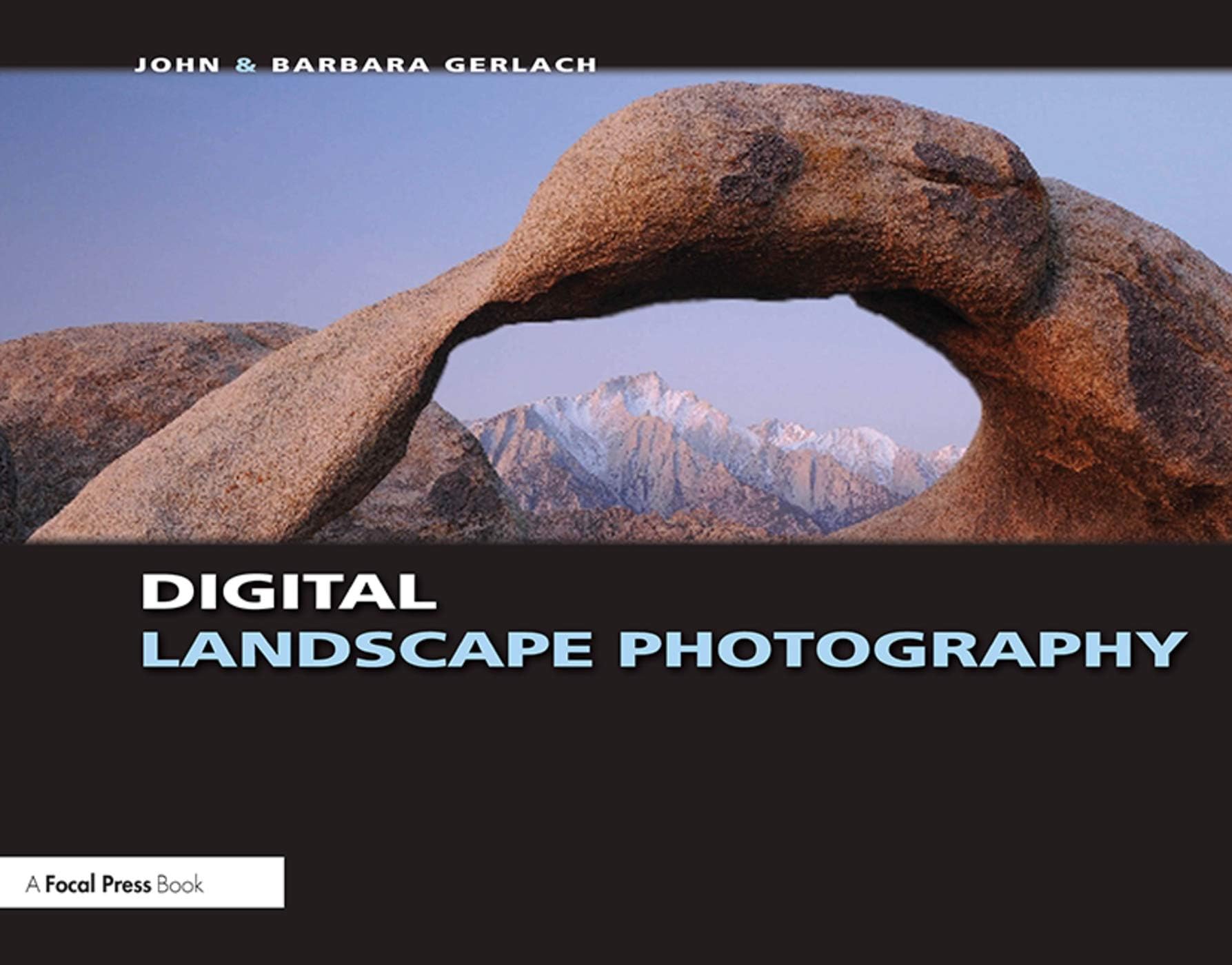
Digital Landscape Photography
Product ID: 14259834
Desertcart purchases this item on your behalf and handles shipping, customs, and support to EGYPT.
Photographing landscape with a film camera is different than with a digital camera. There are several books on the market that cover landscape photography but few of them are specifically for the digital photographer. This book is what you are looking for! Digital Landscape Photography covers: * equipment such as accessories and lenses * exposure from shutter speed and other common mistakes * shooting * light and its importance * composing your perfect photo * printing * and a special section on specific subjects such as waterfalls and sunrises Digital Landscape Photography, written by experts that have been shooting outdoors for decades, is a fresh look at current ways to shoot landscapes by making the most of digital format. Review: John and Barbara Gerlach are not only gifted nature photographers they are gifted teachers! - I recently purchased this book and Digital Nature Photography The Art And The Science, by the same Authors. I have read both books cover to cover and then some. I studied photography part time for a year in school, but there is so much to learn and often things you miss or don't get at the time, this book fills in the gaps! It is easy to read and understand and also gives good practical advice on purchasing equipment, including the advantages and disadvantages of each piece. It answers questions on where to meter, what mode to meter in, how and when to compensate, for the best exposure, focussing, how to get the sharpest images, including different techniques and how to do them. The histogram, how to understand it, how to use it well and why you use it. Working the subject, composition. It even has a section on cleaning your lenses and how to use that plastic bag correctly, in extreme temperatures to save condensation problems. I could go on and on about this book and how happy I am that I purchased it and their Digital Nature Photography book. Every chapter is informative and of assistance to anyone pursuing their love of landscape photography, who feel that they still need to hone their skills. It covers light, colour casts, where they occur, and why and what to do about them. Polarizers, ND Filters, warming filters, how to use them, when and where and why we use them. The chapter on HDR Images, how to shoot for them and how to process them is great. Those of us who understand f/stops, aperture, speed, ISO, depth of field, histograms etc. can skip those pages, although I chose to read them, because sometimes these authors come up with something that you should know and that no-one else thought to tell you and you never know on which page, that tid bit of info will turn up. All of that and then the beautiful photographs that inspire. If your looking for post capture techniques this book is not for you, if your looking to hone your in-camera techniques, that will definitely save you time in post capture, then buy this book. These Authors to my mind are great teachers, there are those who are excellent at imparting their knowledge and John and Barbara certainly fall into this category! they obviously love their craft and they love to teach it! I highly recommend this book!! Review: A solid introduction into landscape photography - I have read two very similar photography books both published in 2010 by Focal Press. Strangely enough, both have the same title: Digital Landscape Photography. The one, also reviewed here, by Michael Frye has a subtitle "In the Footsteps of Ansel Adams and the Great Masters" to help differentiate them. I have read the two books one after the other and I can not help comparing them. Both are meant to be read by beginners and provide info on aperture values, shutter speeds, ISO values etc.. Gerlachs' book is longer and bigger with more text (and info!). If you are accustomed to digital SLR cameras and call yourself an advanced amateur, you are unlikely to find much new information in any of them. If you have just bought your first DSLR with the kit lens, you may find these books worthy of attention. They both offer beautiful landscape images and some sound advice accompanying them. Frye's book offer more software tips; if you are not familiar with the basic operations (levels, curves etc.) it may serve you better. If, on the other hand, you think you want to know more down to earth (literally) advice on finding & selecting a location and need more advice on the use of a DSLR camera in the field, Gerlachs' book offers a lot more. Here, a great variety of landscape shooting scenarios are handled in detail. This probably reflects the authors' experience with workshops. The authors admit they have their own preferences and freely quote their equipments throughout the book. I have just disregarded some of those comments as my equipment is different and at least as capable ;) There is nothing wrong if you buy both of these books. However, their content overlaps significantly and they both use repetitions freely to stress the basics. If you think you can buy just one of them, Gerlachs' book offers more scope and info. It is also organized better. HDR and exposure blending techniques as well as panoramas are handled in a more detailed fashion here. The image and paper quality is very good. However, as was pointed out by another viewer, the text is printed gray for some aesthetic reason that escapes me. Certainly, this is a good book on "digital landscape photography" for a beginner.
| Best Sellers Rank | #5,173,380 in Books ( See Top 100 in Books ) #384 in Photography Lighting (Books) #870 in Photography (Books) #1,863 in Landscape Photography |
| Customer Reviews | 4.6 out of 5 stars 56 Reviews |
J**G
John and Barbara Gerlach are not only gifted nature photographers they are gifted teachers!
I recently purchased this book and Digital Nature Photography The Art And The Science, by the same Authors. I have read both books cover to cover and then some. I studied photography part time for a year in school, but there is so much to learn and often things you miss or don't get at the time, this book fills in the gaps! It is easy to read and understand and also gives good practical advice on purchasing equipment, including the advantages and disadvantages of each piece. It answers questions on where to meter, what mode to meter in, how and when to compensate, for the best exposure, focussing, how to get the sharpest images, including different techniques and how to do them. The histogram, how to understand it, how to use it well and why you use it. Working the subject, composition. It even has a section on cleaning your lenses and how to use that plastic bag correctly, in extreme temperatures to save condensation problems. I could go on and on about this book and how happy I am that I purchased it and their Digital Nature Photography book. Every chapter is informative and of assistance to anyone pursuing their love of landscape photography, who feel that they still need to hone their skills. It covers light, colour casts, where they occur, and why and what to do about them. Polarizers, ND Filters, warming filters, how to use them, when and where and why we use them. The chapter on HDR Images, how to shoot for them and how to process them is great. Those of us who understand f/stops, aperture, speed, ISO, depth of field, histograms etc. can skip those pages, although I chose to read them, because sometimes these authors come up with something that you should know and that no-one else thought to tell you and you never know on which page, that tid bit of info will turn up. All of that and then the beautiful photographs that inspire. If your looking for post capture techniques this book is not for you, if your looking to hone your in-camera techniques, that will definitely save you time in post capture, then buy this book. These Authors to my mind are great teachers, there are those who are excellent at imparting their knowledge and John and Barbara certainly fall into this category! they obviously love their craft and they love to teach it! I highly recommend this book!!
B**N
A solid introduction into landscape photography
I have read two very similar photography books both published in 2010 by Focal Press. Strangely enough, both have the same title: Digital Landscape Photography. The one, also reviewed here, by Michael Frye has a subtitle "In the Footsteps of Ansel Adams and the Great Masters" to help differentiate them. I have read the two books one after the other and I can not help comparing them. Both are meant to be read by beginners and provide info on aperture values, shutter speeds, ISO values etc.. Gerlachs' book is longer and bigger with more text (and info!). If you are accustomed to digital SLR cameras and call yourself an advanced amateur, you are unlikely to find much new information in any of them. If you have just bought your first DSLR with the kit lens, you may find these books worthy of attention. They both offer beautiful landscape images and some sound advice accompanying them. Frye's book offer more software tips; if you are not familiar with the basic operations (levels, curves etc.) it may serve you better. If, on the other hand, you think you want to know more down to earth (literally) advice on finding & selecting a location and need more advice on the use of a DSLR camera in the field, Gerlachs' book offers a lot more. Here, a great variety of landscape shooting scenarios are handled in detail. This probably reflects the authors' experience with workshops. The authors admit they have their own preferences and freely quote their equipments throughout the book. I have just disregarded some of those comments as my equipment is different and at least as capable ;) There is nothing wrong if you buy both of these books. However, their content overlaps significantly and they both use repetitions freely to stress the basics. If you think you can buy just one of them, Gerlachs' book offers more scope and info. It is also organized better. HDR and exposure blending techniques as well as panoramas are handled in a more detailed fashion here. The image and paper quality is very good. However, as was pointed out by another viewer, the text is printed gray for some aesthetic reason that escapes me. Certainly, this is a good book on "digital landscape photography" for a beginner.
L**M
Comprehensive Advice for Improving Landscape Images
As an advanced amateur with years of photography experience, I find the Gerlachs' Digital Landscape Photography a useful and attractive book to read, display, and refer to for tips and review. The authors appeal to photography enthusiasts at all levels of competency. The husband and wife authors openly share their expertise for "seeing and eyeing" creative landscapes. Information about basic camera features such as megapixel capacity, sensor size, and memory cards is presented in a balanced manner for users of any digital cameras. Discussion about shooting images with tripods, cable releases and using built in features to DSLRs such as the self-timer and mirror lock-up features emphasize the importance of avoiding any camera movement in order to capture quality images. The authors effectively discuss the role of lenses and filters and exposure options to capture effective well composed landscapes that communicate the drama of nature. The superb images in the book - which almost make it a "coffee table" art volume - help to take the mystique out of capturing effective landscapes. More advanced advice about areas such as back button focusing, capturing effective light, and composition and more help to enhance and improve both technique and how one sees potential images. The Gerlach author team convey an excitement and energy for getting up early to capture images at first light and being will to wait at sunset or even return for the right light for an image.
J**N
A Classic
This book sets the standard for digital landscape photography. The serious reader will learn three fundamental concepts that will vastly improve his or her images. The first is the use of the RGB histogram, requiring the photographer to move the color channel that is farthest to the right without clipping. This technique produces perfectly exposed highlights and avoids potentially serious problems caused by working with the camera's large luminous histogram. The second technique is back-button focusing, a term coined by the Gerlachs and a technique which they have used for years. This technique enables the photographer working on a tripod to focus on an important subject in the frame, recompose the image, and take the shot without losing the original focus. This technique will be of enormous benefit for obtaining sharp focus on the critical element in the frame. The third technique is using manual exposure, which avoids, among other things, the problem caused by light coming through the viewfinder and thereby altering the camera's meter and causing underexposure. Manual exposure is a foolproof method for avoiding this problem and is to be preferred to autoexposure in most circumstances. There is a great deal more in the book than the three techniques mentioned above, and the book is rich in additional information for the digital landscape photographer. However, I believe that adopting these three techniques alone will produce an enormous improvement in one's landscape photography. The Gerlachs are to be congratulated for producing such an important book that I believe will become a classic in photography.
S**S
Outstanding Resource
I read the Gerlach's first book Digital Nature Photography - The Art and The Science. I thought that book was extremely good. This book is just as good and might even better. While reading this book I developed three lists: (1)features to check on my camera to make sure I am using them effectively;(2)accessories to buy; and (3) techniques to use to make me a better photographer. The Gerlachs do a wonderful job of clearly breaking down for the beginner to intermediate photographer exactly how to assess if you have the proper exposure and how to correct for it when you do not. They also do a terrific job of discussing autofocusing and how to deal with focusing challenges. These are but two examples of the book's well presented content. The Gerlachs explain in detail why they use a particular approach. The practical guidance they share throughout the book, such as on the equipment needed for landscape photography as opposed to other forms of photography or how to shoot in the wind when you must do so, are equally helpful. If I had one suggestion for future books it would be to provide information like the camera body, lens, focal length, aperture, shutter speed, and ISO with the photos published in the book.
P**M
Very practical advice
This must be one of the best landscape photography books that I've read in a while. Written in a very non-sophisticated style, John and Barbara offer page after page of highly practical advice on how to obtain better landscape photos. John uses the Canon system and Barbara the Nikon system, together giving a broad spectrum of tips for whichever system you use. Chapters range from discussions of camera systems, best choice of lenses, and other equipment issues, to composing the photo, seeking optimal lighting, setting the proper exposure, obtaining the best sharpness in the photo, to post-processing issues like producing HDR and panorama shots. They are not shy to mention which special equipment they might use, most of which is inexpensive and readily available in the USA. To supplement their discussions, multiple examples of their photography are offered, demonstrating how their techniques successfully produce splendid landscape photos. This is a book that will be re-studied from time to time, and not set to collect dust in some obscure portion of my bookshelves.
C**S
wonderful book - cheap print
The book is wonderful, the two authors spend most of their time discussing how to take excellent images in the field, rather than wasting too much time on hardware (one chapter) or digital post-processing (two chapters dealing with HDR and panoramas). The rest deals with exposure, how to obtain sharp images, light conditions, composition etc. I like the author's style, stating their preferences where they think they matter and discussing the options where the personal needs or preferences of the individual photographer have to be considered. The book is illustrated with many superb images throughout. What is not superb, however, is the overall print quality. On many pages the text is either faded or has a bluish tinge, making reading in low light difficult. That detracts from an otherwise excellent book. Still an excellent purchase - one of my favorite books right now.
S**K
Very helpful for a beginner.
I've shot for years with film cameras and P&S digital but I wanted to expand my horizons a bit and try to learn something about taking better landscape photos with the new Canon G1x I just bought. This book took me from the basics of exposure to a much more nuanced look at using histograms (especially the RGB), focus control and the reasoning behind utilizing manual controls both in exposure and focus. I realize that for accomplished photographers this may be pretty basic stuff I but I am enjoying the very down to earth explanations. I haven't completed the book yet but I am glad to give it a thumbs up review since I'm enjoying it as well as learning a lot of great information. I recommend it to anyone who's just dabbled in landscape photography on their own but never really taken the time to learn the fundamentals. I believe this book will improve my photography considerably.
T**D
Excellent
This is a very informative book written in plain language. It is a very comprehensive course on landscape photography Would recommend to anyone interested in landscape work
M**W
Landscape Photography
An excellent, informative book with first class photos. Many useful tips. A bit heavy on waterfalls and some chapters better suited to American readers.
Trustpilot
1 week ago
3 days ago