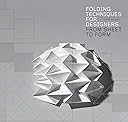
Folding Techniques for Designers: From Sheet to Form (How to fold paper and other materials for design projects)
Product ID: 1581077
"This highly practical release covers more than 70 different techniques, and teaches designers how to make such works through step–by–step examples – Computer Arts Folding Techniques for Designers is a practical handbook, written by an expert in paper folding and origami, with specially commissioned step–by–step drawings and photographs clearly explaining over 70 folding techniques. Many, if not most designers use folding techniques in their work to make 3D forms from 2D sheets of fabric, cardboard, plastic, metal and many other materials. This unique book explains the key techniques of folding, such as pleated surfaces, curved folding and crumpling. It has applications for architects, product designers, and jewelry and fashion designers. Folding Techniques for Designers explains over 70 different folds, explained with clear step–by–step drawings, crease pattern drawings, and specially commissioned photography. All crease pattern drawings are available to view and download at laurenceking.com Author Paul Jackson has released more than 30 books on paper arts and crafts. He has taught the techniques of folding on more than 150 university–level design courses in the UK, Germany, Belgium, the US, Canada and Israel. These include courses of Architecture, Graphic Design, Fashion Design, Textile Design, Jewelry, Product Design, Packaging, Ceramics, Industrial Design, Fine Art, Basic Design and Interior Design. From the introduction: "All designers fold. That is, all designers crease, pleat, bend, hem, gather, knot, hinge, corrugate, drape, twist, furl, crumple, collapse, wrinkle, facet, curve or wrap two–dimensional sheets of material, and by these processes of folding, create three–dimensional objects. These objects will perhaps not be origami–like in appearance, or the folding may only be a detail, but most will nevertheless have been folded – wholly or in part – in some way. Since almost all objects are made from sheet materials (such as fabric, plastic, sheet metal or cardboard), or are fabricated from components used to make sheet forms (such as bricks – a brick wall is a sheet form), folding can be considered one of the most common of all design techniques. And yet, despite being so ubiquitous, folding as a design topic is rarely studied. Perhaps this is because the folded content in a designed object is often unrecognized, or merely incidental, or because folding is synonymous with origami, with brightly colored squares and children's hobbycrafts (an image of origami now several decades out of date). Folding is rarely an inspiration for designers. At least, that is how it used to be. In recent years, more and more designers of all disciplines have turned to folding to create a wide range of handmade and manufactured objects, both functional and decorative. A little time spent looking through design and style magazines will reveal a significant number of folded products, from apparel to lighting and from architecture to jewelry. Origami is one of the most vibrant buzzwords in contemporary design." — Paul Jackson Review: Yes. Even if just for the fun of it. - Who knew that there could be a right way and a wrong way to do a simple fan-fold? Yet, when this book is studied, it leaves no doubt that there certainly is a right way. Who knew that there is a right and a wrong way to crumple paper? This is not an origami book. It is more like: what you should know before you try folding those origami things. It is a fascinating read. Every chapter is a revelation. Every chapter is a fun read. I started with a kindle version of the book but think it might have worked better in paper format. I tend to write all over books that I like. Paper works better for that. Review: The Design of paper folding - An extremely useful volume on the art and intricacies of paper folding. The instructions are very clear. The layout and photography are both good and inspirational. The title says it all, the folding techniques are modeled for designers. I just received my Masters in Landscape Architecture and found this book to be invaluable. I created a number of compelling sketch models with it that drove my explorations and iterations of my designs. I often recommend it to friends and am hard pressed to find fault with the book.

| Best Sellers Rank | #1,902,416 in Books ( See Top 100 in Books ) #531 in Decorative Arts #2,897 in Graphic Design (Books) #150,938 in Reference (Books) |
| Customer Reviews | 4.5 out of 5 stars 536 Reviews |
D**R
Yes. Even if just for the fun of it.
Who knew that there could be a right way and a wrong way to do a simple fan-fold? Yet, when this book is studied, it leaves no doubt that there certainly is a right way. Who knew that there is a right and a wrong way to crumple paper? This is not an origami book. It is more like: what you should know before you try folding those origami things. It is a fascinating read. Every chapter is a revelation. Every chapter is a fun read. I started with a kindle version of the book but think it might have worked better in paper format. I tend to write all over books that I like. Paper works better for that.
B**Y
The Design of paper folding
An extremely useful volume on the art and intricacies of paper folding. The instructions are very clear. The layout and photography are both good and inspirational. The title says it all, the folding techniques are modeled for designers. I just received my Masters in Landscape Architecture and found this book to be invaluable. I created a number of compelling sketch models with it that drove my explorations and iterations of my designs. I often recommend it to friends and am hard pressed to find fault with the book.
L**I
Great book for getting a jump into moving into sculptural origami.
If you're familiar with tessellation type origami this book will be a great launch pad for ideas. (Not a book for kids so much but still presents ideas in a basic model for you to then expand on.) I'm not an origami master but have jumped into trying the tessellation and can actually understand this book for the most part. I must admit though I'm good with patterns and sculpting.
I**2
Very Good!
Really clear, practical and full of really nice diagrams. It's perfect for a good methodology in paper crafts and creativity.
E**A
An Important book in its field.
This book is not a step-by step book about how to do simple folding projects in an afternoon. There are plenty of books within that line (I own many). This book is more oriented to the student and professional artist/designer who is looking for a solid basement in the world of folding, not only paper, but any other material that comes in sheets. Paul Jackson has witten a treasure of a book. There was nothing like it in the market until this book came out. Thanks, Paul, for sharing your knowledge with us. I personally highly appreciate it.
P**Z
Must Have
Finally, a good book that methodically explain tesselated folds with a clear visual language. It's not the first book that deals with folding tesselations, but the first one many people will feel confident to achieve succesfully all the examples shown. The final part dealing with simple curvature folds with pinches is a great plus.
A**T
Great book for artists and designers
I have been using this book in my foundation classes in which we focus on content and skill development by exploring different materials, in this case, paper. My students have been very responsive to the book, and the sample constructions, which are also available on a CD (included in the book). Strongly recommend it!
B**.
my my son loved it. And the artwork in it is worth ...
The origami in this book is spectacular. It isn't for the feint of heart as it's advanced stuff, my my son loved it. And the artwork in it is worth looking at even if you aren't an origami master yourself.
S**X
Probably one of the best books on the fundamentals of paper art/design.
Excellent crash course on the fundamentals of folding and creasing techniques and constructing patterns and 3d forms. Clear concise instructions with clearly presented diagrams and illustrations. Beautiful photography to accompany the illustrations and for the finished product. Also delves into design philosophies and theories. The graphic design and layout of the book is outstanding, it is a very beautiful looking book overall. This book is very accessible and perfect for anybody of any skill level to get good at paper design. This book isn't really focused on origami, more-so fundamentals for industrial designers, architectural designers, 3D modellers and paper artists/engineers. The exercises range from basic to complex, so there is something for all skill levels in this book. If you're a designer looking to get serious about using paper to fulfill your design ideas, I would highly recommend you buy this book along with Paul Jackson's other book "Structural Packaging: Design your own Boxes and 3D Forms (Paper engineering for designers and students)" it is just as informative but has more emphasis on packaging and structural designs.
O**R
Wirkling interessante Falt-Patterns
Dieses Buch ist wirklich empfehlenswert, für alle die sich komplexere Faltmuster interessieren. Wohlgemerkt: Das ist kein Buch zum Falten von Blumen, Origami-Tieren oder Geschenkschachteln! Das will es aber auch gar nicht sein, hier geht es vielmehr um die Faszination für die interessanten Strukturen die aus deinem simplen Blatt Papier entstehen können. Das Buch ist dabei gut bebildert, die Patterns werden gut klar. Auf der letzten Seite ist noch eine CD angebracht, die sämtliche Faltmuster enthält sodass man diese leicht und schnell selbst ausdrucken und nachfalten kann (der Inhalt der CD ist auch online zu finden und legal runterladbar). Ein bisschen fehlt in dem Buch, wie die Teile tatsächlich gefaltet werden, gerade bei komplexeren Strukturen mit sehr vielen Faltungen gibt es ja vielleicht dafür ein paar hilfreiche Kniffe. Den Preis (bei mir rund 16€) finde ich durchaus gerechtfertig für ein gutes Buch welches ja wie erwähnt auch noch die Patterns enthält. Das Buch ist englisch aber nicht zu kompliziert, eine deutsche Version ist für einen deutlich höheren Preis und in gebundener Fassung hier auch erhältlich. Wenn man wie ich das englische Taschenbuch bestellt muss man einige Tage länger auf die Lieferung warten können, da aus dem Ausland versendet wird. In meinem Fall kam das Buch aus dem UK und war nach 6 Werktagen Lieferzeit vor der Türe. Besonders hervorheben möchte ich den sehr aufmerksamen und freundlichen Kundenservice des Anbieters: Da meine CD gebrochen und ölig verschmiert ankam bot dieser mir eine unkomplizierte und entgegenkommende Lösung an. Dieser Drittanbieter hat sich für mich auch 5 Sterne im Kundenservice verdient. » Fazit: Wenn man weiß was einen in diesem Buch erwartet und sich auch wirklich dafür interessiert ist das ein hervorragendes Buch, um sich mit dem Thema Falten/Oberflächen/Strukturen näher zu beschäftigen und neue Inspiration zu finden. Von mir wurde das Buch vor allem im Rahmen meines Produktdesign-Studiums verwendet und begeisterte später auch den Chef meines Praxissemesters. Ich kann es also guten Herzens weiterempfehlen
H**S
沢山のフォルムを検討できる
建築系の学生です。非常勤のプロダクトデザイナーが持っていて興味を持ち、購入しました。様々な蛇腹折りが載っています。 アクセサリーから建築の屋根など異なるスケールのstudyで蛇腹を試しました。 実際いくつかのプロダクト(課題ですが)を製作しました。 こちらは英語版ですが、英語が読めなくても図を見れば折れます。 折るには紙質とコツがいりますが笑 持っていて損のない一冊だと思います。
C**N
muy bueno
muy buen libro y como en casi todos los casos al mejor precio del mercado. Está en inglés pero creo que ni existe la versión en español. Si existe será difícil de encontrar.
D**N
Fantastic book full of easy to follow folding ideas
I brought this book for inspiration to teach college students in a paper manipulation project. It is full of folding techniques and ideas, it was easy to follow and each technique is available as a PDF file on a disc that comes with the book. The techniques were a challenge and once mad look fantastic. I would recommend this book to all designs, fantastic reference book and the students loved it and created some amazing 3D structures.
Trustpilot
2 days ago
5 days ago