
Desertcart purchases this item on your behalf and handles shipping, customs, and support to EGYPT.
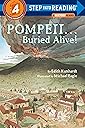
A Step 4 HISTORY reader. "The drama of natural disasters provides prime material to entice young independent readers. In this volume, the account of the eruption of Mount Vesuvius describes village life 2,000 years ago, the eruption itself and its aftermath, and the excitement when the buried town is rediscovered centuries later. A lively and factual glimpse of a devastating moment in history, in an accessible, attractive package."-- Publishers Weekly. Step 4 Readers use challenging vocabulary and short paragraphs to tell exciting stories. For newly independent readers who read simple sentences with confidence. With full-color illustrations. Review: Excellent kid-friendly look at an ancient disaster - Excellent short book for kids on Pompeii and the eruption of Mount Vesuvius in AD 79. Very good illustrations by Michael Eagle, who also illustrated The Trojan Horse, a childhood favorite from the same Step into Reading series. The first chapter offers a kid-friendly look at daily life in a Roman city, with attention given to home life, religion—including the often-overlooked household shrine—slaves, and typical activity in a town market. Throughout, the author and illustrator—by keeping Vesuvius, “a sleeping giant,” lurking in the background of the pictures and by repeating the refrain “No one knew that something terrible was going to happen”—build a powerful sense of foreboding. The chapter dealing with the eruption itself is vivid but not too graphic or—hopefully—disturbing. We see characters in varying states of panic with some escaping by sea (Pliny the Elder, unmentioned in the book, being partly responsible for evacuation operations) and many others left to their fates in the city. The stages of the eruption are well-described and illustrated, with the town suffering rains of pumice, ash, and finally the pyroclastic flow that wiped out human life down to the sea (including Pliny). Again—well done in a kid-friendly way, avoiding jargon and describing the power of the mountain in understandable terms. The final chapter, in the spirit of The Trojan Horse’s chapter on Heinrich Schliemann, describes Pompeii after its destruction, gradually covered over by earth and only rediscovered with the birth of modern archaeology (inspired by the eyewitness account of Pliny the Younger, who does figure in the story) and a few accidental discoveries. The story bookends with scientists monitoring “the sleeping giant” Vesuvius. A good, well-illustrated account that could introduce kids to Roman life, archaeology, geology and seismology all at the same time. Highly recommended. Review: Exellent history, well illustrated - This is a great little book about the eruption of Mt. Vesuvius in 79 AD. And what happened to the people and houses of Pompeii. The writing is excellent and to the point. My three year old granddaughter was raptly attentive when I read this to her. The illustrations are equally accurate and informative. (It's a pleasure to see realistic children's illustrations rather than the too common grotesque caricatures so prevalent today.)


| Best Sellers Rank | #19,440 in Books ( See Top 100 in Books ) #4 in Children's Archaeology Books #17 in Children's Ancient History #25 in Disaster Books for Children |
| Customer Reviews | 4.7 out of 5 stars 863 Reviews |
J**S
Excellent kid-friendly look at an ancient disaster
Excellent short book for kids on Pompeii and the eruption of Mount Vesuvius in AD 79. Very good illustrations by Michael Eagle, who also illustrated The Trojan Horse, a childhood favorite from the same Step into Reading series. The first chapter offers a kid-friendly look at daily life in a Roman city, with attention given to home life, religion—including the often-overlooked household shrine—slaves, and typical activity in a town market. Throughout, the author and illustrator—by keeping Vesuvius, “a sleeping giant,” lurking in the background of the pictures and by repeating the refrain “No one knew that something terrible was going to happen”—build a powerful sense of foreboding. The chapter dealing with the eruption itself is vivid but not too graphic or—hopefully—disturbing. We see characters in varying states of panic with some escaping by sea (Pliny the Elder, unmentioned in the book, being partly responsible for evacuation operations) and many others left to their fates in the city. The stages of the eruption are well-described and illustrated, with the town suffering rains of pumice, ash, and finally the pyroclastic flow that wiped out human life down to the sea (including Pliny). Again—well done in a kid-friendly way, avoiding jargon and describing the power of the mountain in understandable terms. The final chapter, in the spirit of The Trojan Horse’s chapter on Heinrich Schliemann, describes Pompeii after its destruction, gradually covered over by earth and only rediscovered with the birth of modern archaeology (inspired by the eyewitness account of Pliny the Younger, who does figure in the story) and a few accidental discoveries. The story bookends with scientists monitoring “the sleeping giant” Vesuvius. A good, well-illustrated account that could introduce kids to Roman life, archaeology, geology and seismology all at the same time. Highly recommended.
P**.
Exellent history, well illustrated
This is a great little book about the eruption of Mt. Vesuvius in 79 AD. And what happened to the people and houses of Pompeii. The writing is excellent and to the point. My three year old granddaughter was raptly attentive when I read this to her. The illustrations are equally accurate and informative. (It's a pleasure to see realistic children's illustrations rather than the too common grotesque caricatures so prevalent today.)
T**E
Fun read!
My daughter and I really enjoyed this book together! It was engaging and had great illustrations. We recommend it highly!
M**W
Wonderful for a volcano-loving 1st grader
Wonderful for a volcano-loving new 1st grader. A good level for autumn in 1st grade for a medium speed reader. Besides teaching the kids history and a bit on volcanoes, the book is a good conversation starter on the Roman empire, volcanoes, living in a dangerous area (like San Francisco) and slavery. The school likes to make my kid read Clifford the red dog and similar happy but slightly nonsense stories. I like that this book gives the kids a chance to reflect on how their life is compared to the people of Pompeii. Why were people willing to take the risk of living on a volcano? YES - we read it a lot
J**.
Highly recommended
I love these books. I'm constantly looking for interesting nonfiction texts for my classroom. These are perfect for my third graders and they can not get enough of them. Kids are constantly coming up to me and telling me new facts that they have learned from the books in this series. Great for science, reading, social studies, history, vocabulary, etc. Highly recommended!
S**R
Very Nice
I bought this for my seven year old granddaughter who is very interested in the Pompeii exhibit at the museum. She loved the descriptions and the way the story was presented. My only disappointment was that the reading was more difficult than I thought it would be. I understood this would be more of a beginning reader when it was suited more for third or fourth grade.
M**M
Great book for a beginner reader
I went to Italy this summer and returned to the inquiring minds of my 4 and 6 year old grandsons. They wanted to know where I went and why I went there. This book was perfect to explain why I went back to Pompeii and why it was important. Perfect reading for my bright six-year old to read aloud to his four year old brother. Love it!
L**T
Great as a creative writing starter!
Except for the fact that this book doesn't cover all the Pompeian’s who DID heed the warning signs that Vesuvius was about to blow (the majority of the estimated population of 10,000 to 15,000) I use it as a creative writing prompt for students up to 5th grade. It has plenty of sensory details and images of everyday life back then. After I read it, I ask students to write a first-person POV account of the day before the eruption. Especially inspiring because archeological discoveries dove-tail with Roman historian Pliny the Younger's written account, encouraging them to view journal writing as a form of history..
F**K
Interessanter Inhalt auf leichtem Niveau
Mein Sohn (9, vierte Klasse) geht in eine englischsprachige Schule im Ausland, seine Muttersprache ist Deutsch. Ich fand es immer schwer interessante Bücher für sein Englischniveau und seine Altersstufe zu finden - dieses hier hat genau gepasst, wir haben dann noch ein weiteres Buch aus der Serie gekauft (Cave), das ihm auch gefallen hat. Es ist ein kurzes Buch, wenig Text pro Seite, Bilder auf allen Seiten, nicht zu schwierige Vokabeln, aber doch interessanter Inhalt - ein Erfolgerlebnis für noch nicht so gute Englischleser. Es ist ein Sachbuch. (Wer eine spannende Abenteuergeschichte auf leichtem Niveau sucht für diese Altersgruppe (8-10)... ich kann "dragon masters" empfehlen)
P**R
Good Early Readers
A easy to read and historically correct introduction for elementary level kids
F**A
Ótima oportunidade de aprender Inglês e História
Muito bom! Estou selecionando livros em inglês para meu filho (8a), alguns deles ainda é necessário que eu oriente a leitura. Comprei pelos comentários de outros e concordo, a história está bem completa, vários detalhes interessantes como da questão geológica do vulcão, das testemunhas oculares (Plínio, o jovem), da redescoberta de Pompéia, da "reconstrução" dos vestígios, dos cuidados atuais... Com ilustrações belíssimas! Vale a aquisição.
A**R
Great book for early readers.
A great book, well written with some helpful pronunciations of tricky words for early readers. Information well presented through drawings and illustrations only.
J**I
Informative and simple reading
My daughter was studying about Roman times and I had told her about Pompeii and my visit many years before, so to find a book at her reading level on the subject was very exciting. She enjoyed reading it and has a better understanding of what happened. The images are very nice and it is told in more of a story format than with fact boxes (a few might have been nice) so it was easy going for a six-year-old.
Trustpilot
1 week ago
1 month ago