
DOWNLOAD THE APP


Customer Services
Copyright © 2025 Desertcart Holdings Limited
DOWNLOAD THE APP



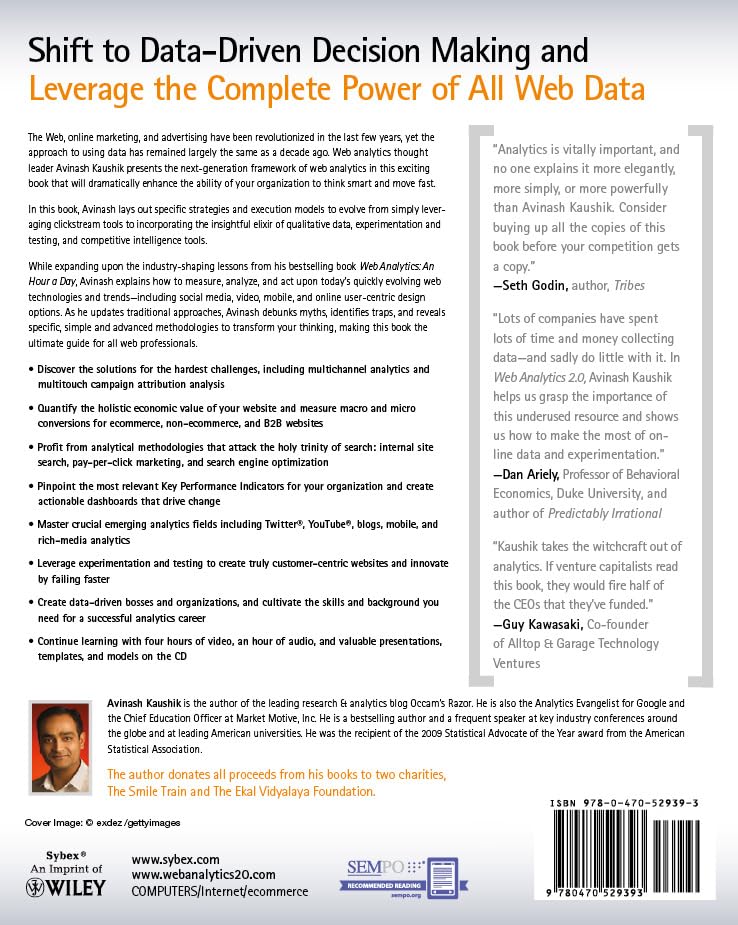
Web Analytics 2.0: The Art of Online Accountability and Science of Customer Centricity [Kaushik, Avinash] on desertcart.com. *FREE* shipping on qualifying offers. Web Analytics 2.0: The Art of Online Accountability and Science of Customer Centricity Review: Even better than the first book! - Although it is only January, I can say with a pretty high degree of confidence, that the analytics book of the year is Avinash Kaushik's new book Web Analytics 2.0. As a follow up to his first book, Web Analytics: An Hour A Day, I think Avinash out did himself with this book. Web Analytics 2.0 is a nice balance of theory and practical tips, but more importantly, provides guidance for readers with a wide range of skill and experience. Over the 14 chapters of the book, Kaushik covers almost every aspect of web analytics, from competitive analytics to optimization, even guides for picking a solution vendor and starting a career in the industry. Overall the book is an easy read for anyone interested. Avinash's causal writing style and frequent examples makes the text engaging and entertaining. For the most part, you can dive into any area of the book without missing too much context from the rest of the book. Of course I recommend reading the whole thing, but even if you just read one chapter, say on social measurement, you'll still get a lot out of it. On top of being a well-written resource, all of the profits from this book (and his previous one) go to two charities: The Smile Train and The Ekal Vidyalaya Foundation. Get the book and start the new year off right with a quick education on the in's and out's of web analytics. Review: What a fun to read author and a great book - What a fun to read author! This is one book I actually looked forward to reading, not only for how absolutely informative it was, but for the author's fun sense of humor. Kaushik is a foremost authority on all things "web metrics" and has a great blog as well as being a great author. I can't imagine anyone being disappointed with this book as far as wanting to learn the basics (or remembering what is important, for those already experienced). For beginners, Kaushik covers the most important things to focus on early, so you don't get overwhelmed. He then provides the extras that are good to incorporate once you get comfortable with the beginning stuff. For experienced users, Kaushik reminds you of how going back to the basics and getting out of the weeds will improve your results, and again, provides the advanced concepts as well. This book was easy to understand for me, as a beginner and had lots of great examples.
| Best Sellers Rank | #141,933 in Books ( See Top 100 in Books ) #125 in Web Marketing (Books) #131 in E-Commerce (Books) #139 in Internet & Telecommunications |
| Customer Reviews | 4.4 4.4 out of 5 stars (399) |
| Dimensions | 7.3 x 1.3 x 9.2 inches |
| Edition | 1st |
| ISBN-10 | 0470529393 |
| ISBN-13 | 978-0470529393 |
| Item Weight | 1 pounds |
| Language | English |
| Print length | 475 pages |
| Publication date | October 26, 2009 |
| Publisher | Sybex |
S**.
Even better than the first book!
Although it is only January, I can say with a pretty high degree of confidence, that the analytics book of the year is Avinash Kaushik's new book Web Analytics 2.0. As a follow up to his first book, Web Analytics: An Hour A Day, I think Avinash out did himself with this book. Web Analytics 2.0 is a nice balance of theory and practical tips, but more importantly, provides guidance for readers with a wide range of skill and experience. Over the 14 chapters of the book, Kaushik covers almost every aspect of web analytics, from competitive analytics to optimization, even guides for picking a solution vendor and starting a career in the industry. Overall the book is an easy read for anyone interested. Avinash's causal writing style and frequent examples makes the text engaging and entertaining. For the most part, you can dive into any area of the book without missing too much context from the rest of the book. Of course I recommend reading the whole thing, but even if you just read one chapter, say on social measurement, you'll still get a lot out of it. On top of being a well-written resource, all of the profits from this book (and his previous one) go to two charities: The Smile Train and The Ekal Vidyalaya Foundation. Get the book and start the new year off right with a quick education on the in's and out's of web analytics.
L**Z
What a fun to read author and a great book
What a fun to read author! This is one book I actually looked forward to reading, not only for how absolutely informative it was, but for the author's fun sense of humor. Kaushik is a foremost authority on all things "web metrics" and has a great blog as well as being a great author. I can't imagine anyone being disappointed with this book as far as wanting to learn the basics (or remembering what is important, for those already experienced). For beginners, Kaushik covers the most important things to focus on early, so you don't get overwhelmed. He then provides the extras that are good to incorporate once you get comfortable with the beginning stuff. For experienced users, Kaushik reminds you of how going back to the basics and getting out of the weeds will improve your results, and again, provides the advanced concepts as well. This book was easy to understand for me, as a beginner and had lots of great examples.
E**X
Some Problems...
Lots of good information, but there are no descriptions for any software or how to get the reports seen in the book. I am trying to recreate these reports using Google Analytics, Coremetrics and Omniture. It seems that most of the reports are the standard reports out of Google Analytics, but I am having a difficult time recreating some of these with other software. I think this was a great book, but I have a few things I disagree with: Page 85, he says if he could only have one report, it would be Outcomes by All Traffic Sources. This report shows Goal Conversion Rates, but he does not describe what these are. In Google Analytics, these are custom, so this could be anything. I am disappointed, he does say it is important to measure ROI, but does not talk about how to do this. The author says that you can do this by comparing the data from Google to your campaign data. It is not that easy. You have to know how much was spent, and you have to know how much incremental revenue came in from SEO/PPC efforts. It is not an easy task. Test and control or some other method should have been addressed. In calculating ROI for PPC in chapter 11, he assumes that all visits from PPC are ones you would not have without the ad. Not necessarily true. In Chapter 7, testing is finally addressed. I disagree with his method of testing the impact of PPC by turning it off and on completely; this does not take into account any seasonality that may occur naturally in web traffic. This is also a problem if there is a lot of variation in web visits and sales over time. Why not try test and control markets: turning it off in some regions and have it on in others? This method would allow you to compare the on and off markets and find incremental sales. In the marginal attribution model from page 368, you change the spending for one type of online marketing, then attribute any sales higher than last month sales to the additional marketing. In my experience, web sales tend to have a large variation in sales from month to month making it difficult to say what the cause of any increase is without any kind of confidence bounds. The "controlled experiment" on page 375 is a really bad example. The ad is run at the same time in all markets and then compared to pre and post ad time periods. What if at the same time as the ad, some celebrity tweeted that they loved your product or some news program aired a warning about your product. There are too many uncontrollable situations to compare pre and post ad sales. You should have test and control markets to compare sales in the same time period. On page 377, the Author says: "The analyst at Walmart.com can use the previous URL to track how many people use the website and then visit the store." A view the store locator on the web does NOT equal a visit to your store. In his example, a user on walmart.com views a camera and then the store locator. It is very possible that the customer viewing the camera at walmart.com may also go to target.com and find the same camera at a similar price and find that the target store was much more convenient to visit. There is no way in this case to tie a store locator and product page view to an offline purchase. Using a discount code or unique offer would provide a better method of tracking online to offline behavior. In Chapter 14, the BMI is introduced. But on page 419, the author says this method is preferred because it has a scale of 0 to 100. It actually has a scale of -100 to 100. If 5 responders all gave a Not Satisfied or a Not At All Satisfied, the score would be [(0+))-(5):]/5*100=-100. The other method, weighted means can also give a scale of -100 to 100 if the right weights are used. Not Satisfied At all:=-1 Not Satisfied =-.5 Satisfied=0 Very Satisfied= .5 Extremely Satisfied= 1 With these weights the scale is also -100 to 100.
J**N
This book helped me so much and this is probably on the market the best book to learn Web Analytics and more specifically Google Analytics. We used this book in a master degree Web Analytics class and I really enjoyed my read. I am not a native english speaker and the author bring you the subject with humor and an extremelly easy pedagogic way. Yes, tu book could have probably be 200 pages, but all the contexts and stories told by the author help you to understand and memorize more easily the concepts. I would highly recommend any work from Avinash Kaushik whom I consider the best Web Analytics guru.
A**Z
insghtful
L**S
Livro pode ser antigo, mas as dicas que dão serve, ainda serve para hoje
H**M
I re-read this wonderful book over the weekend. The time was right for a refresher now that we've redesigned our company website and have it up and running in 40+ countries. Now is the time for really driving actionable insight and this book reminded me that we have to keep it simple as well as giving some really good examples of the macro metrics to really get underneath. Beautifully written, easy to understand and fantastic pointers. I'd recommend following up by using his blog!
S**N
If you want to understand the fundamentals of Digital Analytics this is a must have book. The best way to read the book after first few chapters is to practice reports on your Analytics account.
Trustpilot
2 weeks ago
3 weeks ago