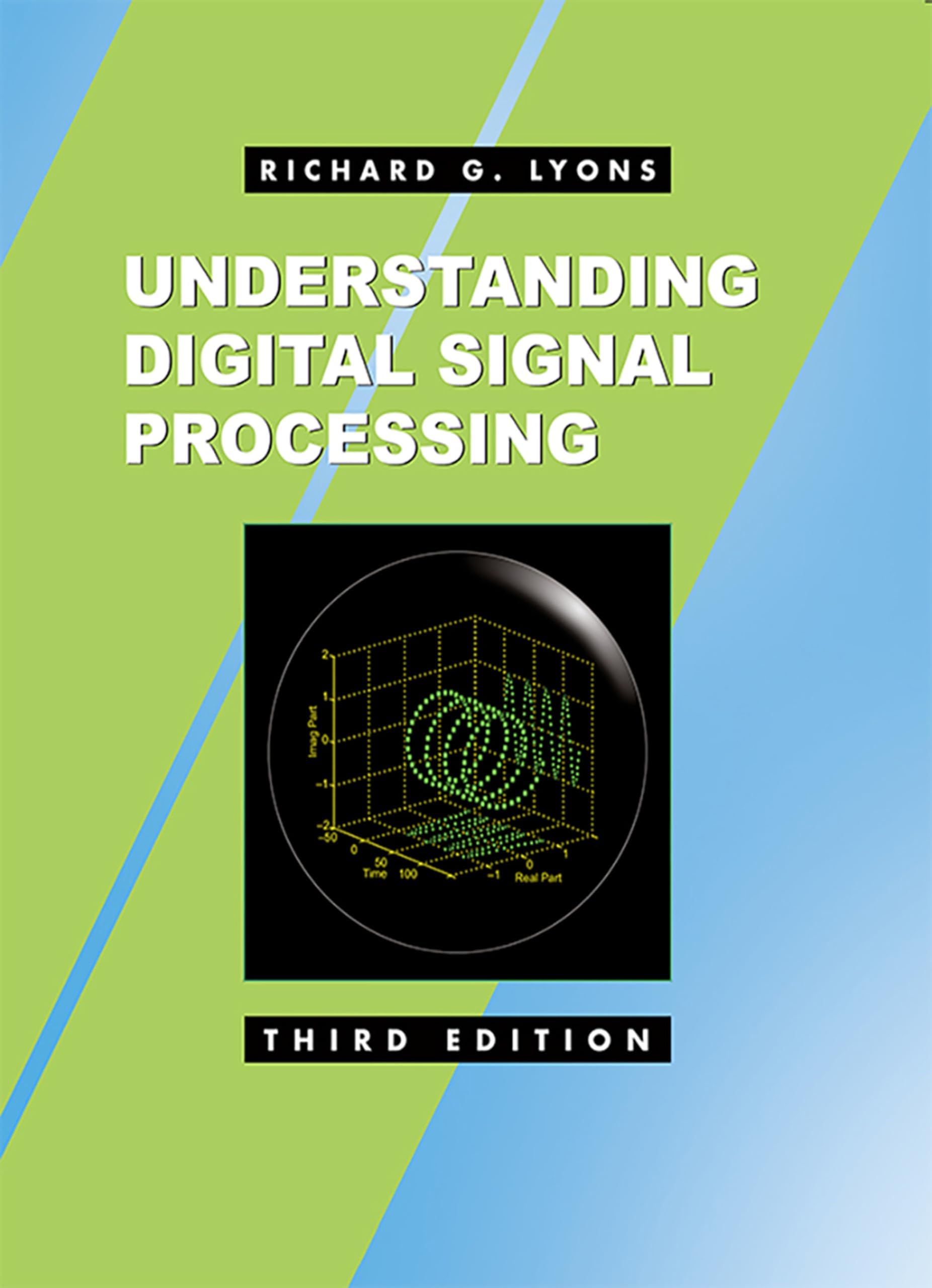
Understanding Digital Signal Processing
Product ID: 1704135
Buy anything from 5,000+ international stores. One checkout price. No surprise fees. Join 2M+ shoppers on Desertcart.
Desertcart purchases this item on your behalf and handles shipping, customs, and support to EGYPT.
Understanding Digital Signal Processing [Lyons, Richard] on desertcart.com. *FREE* shipping on qualifying offers. Understanding Digital Signal Processing Review: academic art - I very rarely write reviews **this book is a must purchase** lucid explanations abound - and I especially appreciate the presentation as I came from undergrad compsci into graduate EE. Lyons' ability to make you arrive at the inevitable conclusion that is the concept is as delightful as it is Socratic. personal highlights: chapter 5 presentation of convolution and FIR filters. I legit instantly grasped the concept of convolution that had been "taught" to me many times before. I immediately understood why we "reverse" one signal in time for convolution. I recognized why passband ripple was inevitable without modifying one's window chapter 8 explanation of imaginary/complex numbers, Euler's identity and relations, in-phase/quadrature, negative frequency, and how a real signal can be composed of real and imaginary sinusoids. ***this chapter, alone, is worth picking up the book.*** I do not say that lightly! this book does not teach inasmuch as it facilitates one's realization that certain phenomena MUST arise due to the underlying mathematics. but it does not take anything beyond even vague familiarity with Calculus 2. given the subject matter, that is absolitely incredible. for context, I took Calc 2 15 years ago and was able to keep pace. beyond that, the book incurs an obvious intuition that is lacking in so many texts I genuinely wish I had been exposed to this book wayyy earlier Review: Best DSP textbook - I got this book to help learn DSP. This wasn't the textbook assigned for the course, but it's the best one I could find. It's helped me learn the subject tremendously.
| Best Sellers Rank | #245,123 in Books ( See Top 100 in Books ) #3 in Computer Hardware DSPs #7 in Signal Processing #262 in Internet & Telecommunications |
| Customer Reviews | 4.5 4.5 out of 5 stars (127) |
| Dimensions | 9.2 x 7.1 x 1.4 inches |
| Edition | 3rd |
| ISBN-10 | 0137027419 |
| ISBN-13 | 978-0137027415 |
| Item Weight | 3.15 pounds |
| Language | English |
| Print length | 954 pages |
| Publication date | November 1, 2010 |
| Publisher | Pearson |
A**S
academic art
I very rarely write reviews **this book is a must purchase** lucid explanations abound - and I especially appreciate the presentation as I came from undergrad compsci into graduate EE. Lyons' ability to make you arrive at the inevitable conclusion that is the concept is as delightful as it is Socratic. personal highlights: chapter 5 presentation of convolution and FIR filters. I legit instantly grasped the concept of convolution that had been "taught" to me many times before. I immediately understood why we "reverse" one signal in time for convolution. I recognized why passband ripple was inevitable without modifying one's window chapter 8 explanation of imaginary/complex numbers, Euler's identity and relations, in-phase/quadrature, negative frequency, and how a real signal can be composed of real and imaginary sinusoids. ***this chapter, alone, is worth picking up the book.*** I do not say that lightly! this book does not teach inasmuch as it facilitates one's realization that certain phenomena MUST arise due to the underlying mathematics. but it does not take anything beyond even vague familiarity with Calculus 2. given the subject matter, that is absolitely incredible. for context, I took Calc 2 15 years ago and was able to keep pace. beyond that, the book incurs an obvious intuition that is lacking in so many texts I genuinely wish I had been exposed to this book wayyy earlier
K**N
Best DSP textbook
I got this book to help learn DSP. This wasn't the textbook assigned for the course, but it's the best one I could find. It's helped me learn the subject tremendously.
B**S
A great reference for actual applications
I had been searching for a good DSP reference book, when I found Understanding Digital Signal Processing 3rd ed. in Amazon. The reviews regarding the 2nd ed. we're positive, so I decided to get a copy. At the same time I was working on a software defined radio for the HF amateur bands. I had little knowledge of I and Q signals, analytic signals, Hilbert transforms - a lot of things that make single sideband modulation/demodulation possible in an SDR. This book, in addition to extensive coverage of FIR/IIR filtering and related topics, also covers complex/quadrature signals, upconversion/downconversion, Hilbert transform, sample rate conversion, polyphase filtering, etc. in a way that's understandable and applicable. The math is there as one would expect, but then the author also explains things in a physical/real sense. I was able to learn these topics and actually apply them - the fact that I was able to make my SDR work is a testimony to the book. To summarize - if I need to brush up on a DSP topic, or learn something new, but then APPLY it, this book is an wonderful reference. If you're considering this book, be sure and review the Table of Contents - there's a lot in this book. The Processing Tricks section has been very helpful as well. I can highly recommend this book.
A**O
The presentation language is easy to follow
This book is really impressive! The various topics are presented in a simple and intuitive manner, starting from the experience and then moving into the math. Contrary to other text books, where the math seems to be the only way to understand digital processing concepts, here it is a tool. The fundamentals of digital processing are very well described and expanded from the simplest to the more complex. The presentation language is easy to follow. I really recommend this book, specially if you have been through the frustation of trying to understand DSP by reading one of those text books (inlcuding those considered to be the pilions in DSP education...) and end up with the feeling that something is still missing in your understanding. Excellent work!
M**1
Very well written. Clear concise explanations. Lacks solutions to problems.
Needs some solutions. This would be a great text book in a typical classroom setting, but, for a self-learner, I find it terribly dissatisfying that there are no solutions to the many problems provided in each chapter. I understand that the book loses value for the classroom if solutions are provided. But, again, from a self-learning perspective, I would give this book 5 STARS if even half of the problem solutions were provided (e.g. odd numbers only), or, if there were even just a small subset of challenging problems/solutions (5-7 for each chapter to capture the key concepts). This would make this text MUCH more valuable to me as a self-learner. I'm a "hand's on" learner. Almost everything makes sense to me when I read a well-presented topic. However, when I attempt to apply what I've learned, I often realize my understanding was inadequate. So working problems and being able to check solutions is absolutely critical to my learning. Add some problems with solutions and this book would be 5-star.
P**R
Edges of pages 328-329 unglued ! The book was fereseen for a library - multiple users over longer time - does not have the quality. We propose price reduction (Gutschschrift Amazon account) or replacemet by new copy. To fix the mancament professionally some 40€ must be spent. We wonder that by so expesive book there is a quality problem !
F**R
This is a great quality textbook. It covers each topic with good depth. I find the explanations to be just about right. The problems at the end of each chapter add considerable value of the book. My only complaint is that you can't look up the answers to the problems. I understand that many students would cheat if the answers were available, but it makes it harder this book for self study.
A**R
Great book, content is well presented by the author(s) but the kindle edition makes the formula / math generally too hard to read hence the low review score. Without this issue it would be a solid 5 stars. Consider the print copy instead or hopefully someone will see this and fix the size of the images of the math.
T**.
Un ottimo libro per imparare la teoria dei DSP, lo consiglio dopo aver letto (magari on line) il libro di Steven Smith. Da leggere solo se avete una certa familiarità con la matematica, altrimenti andate diretti sull'altro
D**A
Me and my colleagues share the same opinion. This is a very good book and even though it covers only basics of DSP it's still worth having. I was dealing with DSP for some time and have been applying many algorithms / filters / transfer functions which I had not have a full understand. Thanks to this book my results became clear. I recommend this book.
Trustpilot
3 weeks ago
1 month ago