We remain fully operational. Our teams are working around the clock to ensure your deliveries continue safely.

DOWNLOAD THE APP


Customer Services
Copyright © 2025 Desertcart Holdings Limited
DOWNLOAD THE APP
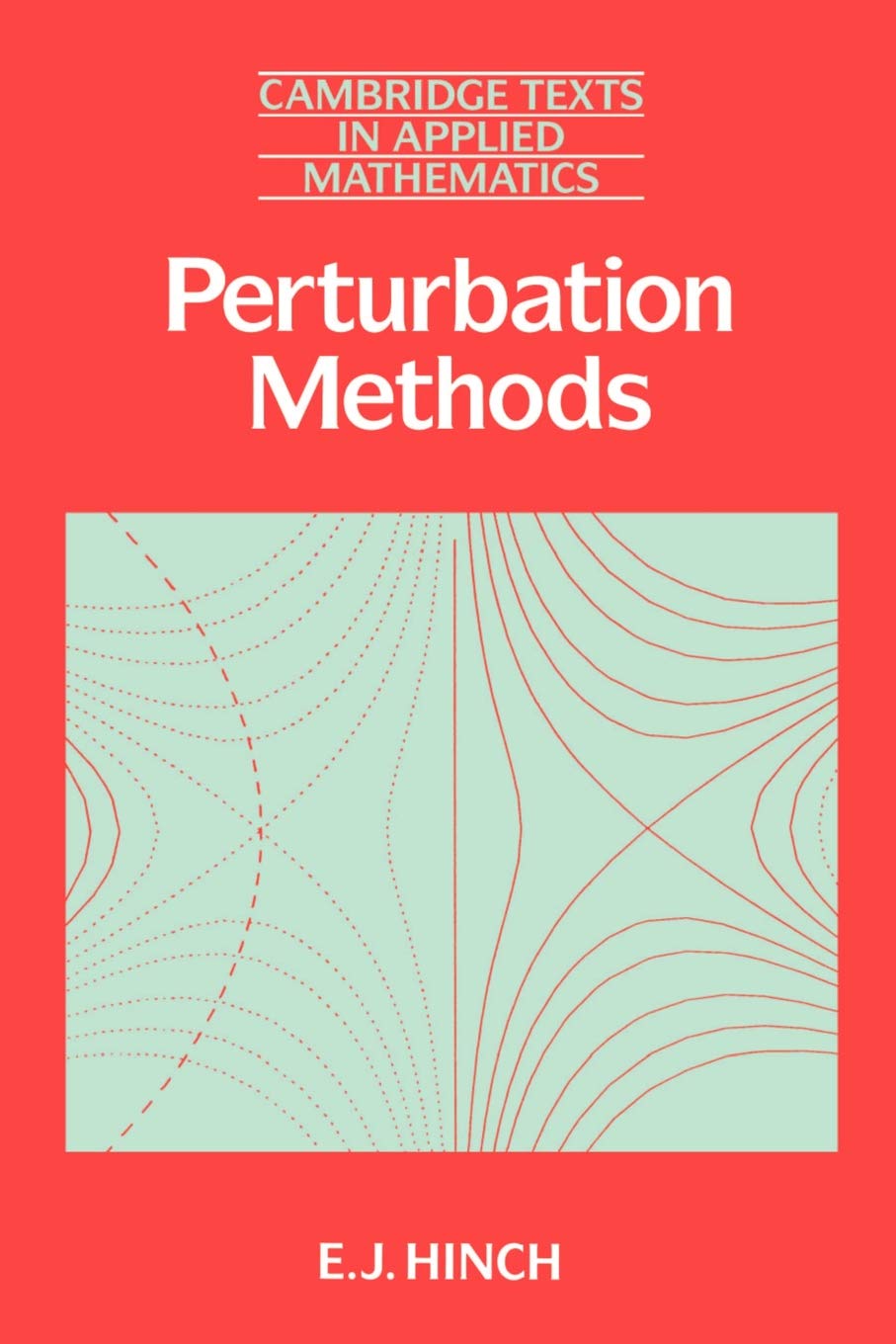
Buy Perturbation Methods (Cambridge Texts in Applied Mathematics, Series Number 6) on desertcart.com ✓ FREE SHIPPING on qualified orders Review: Good - This is a concise and precise text. This book amplified my understanding of asymptotics (which is limited) and is an excellent complement to Bender and Orszag. I found the discussion of the limitation of convergence of series (unless it is extremely rapid), the value of divergent series, the art of the approach by analyzing the behaviour (order) of the functions within sections of the domain helpful conceptually. The more complex middle and end of the book are subjects I hope to return to (this is a personal limitation not a criticism of the book). The first half, however, significantly improved my understanding. Review: Disappointing; James Murdock says it best. - I was disappointed with this book. I came excited to learn a new field, but found a book which was frustratingly non-rigorous. This would be forgivable from an author like V. I. Arnold, C. Lanczos, or T. Needham (who provide brilliant motivation) but I found Hinch to be poorly motivated, surprisingly difficult, terse, and frankly quite boring. James Murdock's 'Perturbations' is better, though if there's a true 'classic' in the field I'm yet to find it. I whole-heartedly agree with Murdock's review of Hinch in AMS. After highlighting a key distinction between uniform ordering and uniform validity (a distinction Hinch brushes over - hence the comment re. non-rigorous above), he ends with the following summary: "It is not entirely clear for which audience the book is intended; it would seem to be difficult to find a reader who knows most of the things the author assumes but not most of the things that he says. The book is much too short and sketchy and hurries too rapidly into difficult examples to serve as an introduction. Yet it does treat elementary topics, which would not be required by an advanced reader. Most of the difficult examples are treated so briefly that they are best regarded as exercises with ample hints. For the Van der Pol example, the reader is expected to know immediately that A3 and I3 are Bessel functions (they are never identified), to know their asymptotic properties, and to know how they are used to solve Airy equations; all of this is passed over in one line. An acquaintance with fluid mechanics is also assumed. The book will probably find its greatest usefulness as a reference book for those with considerable background, but, for this purpose, one would wish for a better bibliography."
| ASIN | 0521378974 |
| Best Sellers Rank | #2,357,130 in Books ( See Top 100 in Books ) #554 in Differential Equations (Books) #7,496 in Mathematics (Books) |
| Customer Reviews | 4.2 4.2 out of 5 stars (15) |
| Dimensions | 6 x 0.44 x 9 inches |
| ISBN-10 | 9780521378970 |
| ISBN-13 | 978-0521378970 |
| Item Weight | 8.8 ounces |
| Language | English |
| Part of series | Cambridge Texts in Applied Mathematics |
| Print length | 176 pages |
| Publication date | October 25, 1991 |
| Publisher | Cambridge University Press |
U**N
Good
This is a concise and precise text. This book amplified my understanding of asymptotics (which is limited) and is an excellent complement to Bender and Orszag. I found the discussion of the limitation of convergence of series (unless it is extremely rapid), the value of divergent series, the art of the approach by analyzing the behaviour (order) of the functions within sections of the domain helpful conceptually. The more complex middle and end of the book are subjects I hope to return to (this is a personal limitation not a criticism of the book). The first half, however, significantly improved my understanding.
T**6
Disappointing; James Murdock says it best.
I was disappointed with this book. I came excited to learn a new field, but found a book which was frustratingly non-rigorous. This would be forgivable from an author like V. I. Arnold, C. Lanczos, or T. Needham (who provide brilliant motivation) but I found Hinch to be poorly motivated, surprisingly difficult, terse, and frankly quite boring. James Murdock's 'Perturbations' is better, though if there's a true 'classic' in the field I'm yet to find it. I whole-heartedly agree with Murdock's review of Hinch in AMS. After highlighting a key distinction between uniform ordering and uniform validity (a distinction Hinch brushes over - hence the comment re. non-rigorous above), he ends with the following summary: "It is not entirely clear for which audience the book is intended; it would seem to be difficult to find a reader who knows most of the things the author assumes but not most of the things that he says. The book is much too short and sketchy and hurries too rapidly into difficult examples to serve as an introduction. Yet it does treat elementary topics, which would not be required by an advanced reader. Most of the difficult examples are treated so briefly that they are best regarded as exercises with ample hints. For the Van der Pol example, the reader is expected to know immediately that A3 and I3 are Bessel functions (they are never identified), to know their asymptotic properties, and to know how they are used to solve Airy equations; all of this is passed over in one line. An acquaintance with fluid mechanics is also assumed. The book will probably find its greatest usefulness as a reference book for those with considerable background, but, for this purpose, one would wish for a better bibliography."
K**E
Not the best
This wasn't one of the best textbooks I've used. The explanations were short and not very helpful. If you're thinking about buying this for any reason other than it being required for a class, look elsewhere. There have to be better texts on perturbation methods out there.
A**,
Not good for beginners
I purchased this book because i am trying to understand the SABR expansion carried out by Hagan (a topic in mathematical finance). However I guess this book requires more mathematical maturity in asymptotic expansion theory than I possess at the moment. Hopefully I can return to this book when I have acquired it. As it stands I need to look elsewhere for the introduction that I need. This book is no good to anyone seeing this material for the first time.
B**S
Decent Book
This was a decent book. It is especially good for graduate level students. I purchased the book to teach myself perturbation methods for my research project. I used the book in conjunction with Perturbation Methods in Fluid Mechanics. Together I was able to get a complete understanding. Overall this a decent book with a few examples.
G**S
Starting Perturbations
This is a nice place to start when learning basic perturbation methods. There are numerous examples and the material is clearly presented. However, there are weak points. One is brevity, as pointed out by the first reviewer. The coverage of the subject of perturbation methods is minimal and some of the topics that are covered are done so with little depth. Another drawback is the emphasis, when discussing applications, on fluids and to a lesser extent mechanics. This makes it somewhat old fashioned. The greatest drawback is the exercises. It is impossible to learn mathematics, and perturbation methods in particular, without doing lots of problems. This text, unfortunately, falls far short in the number and range of problems it provides the reader.
M**K
An excellent book on the subject. One of the best written by a world expert.
Trustpilot
2 days ago
1 month ago