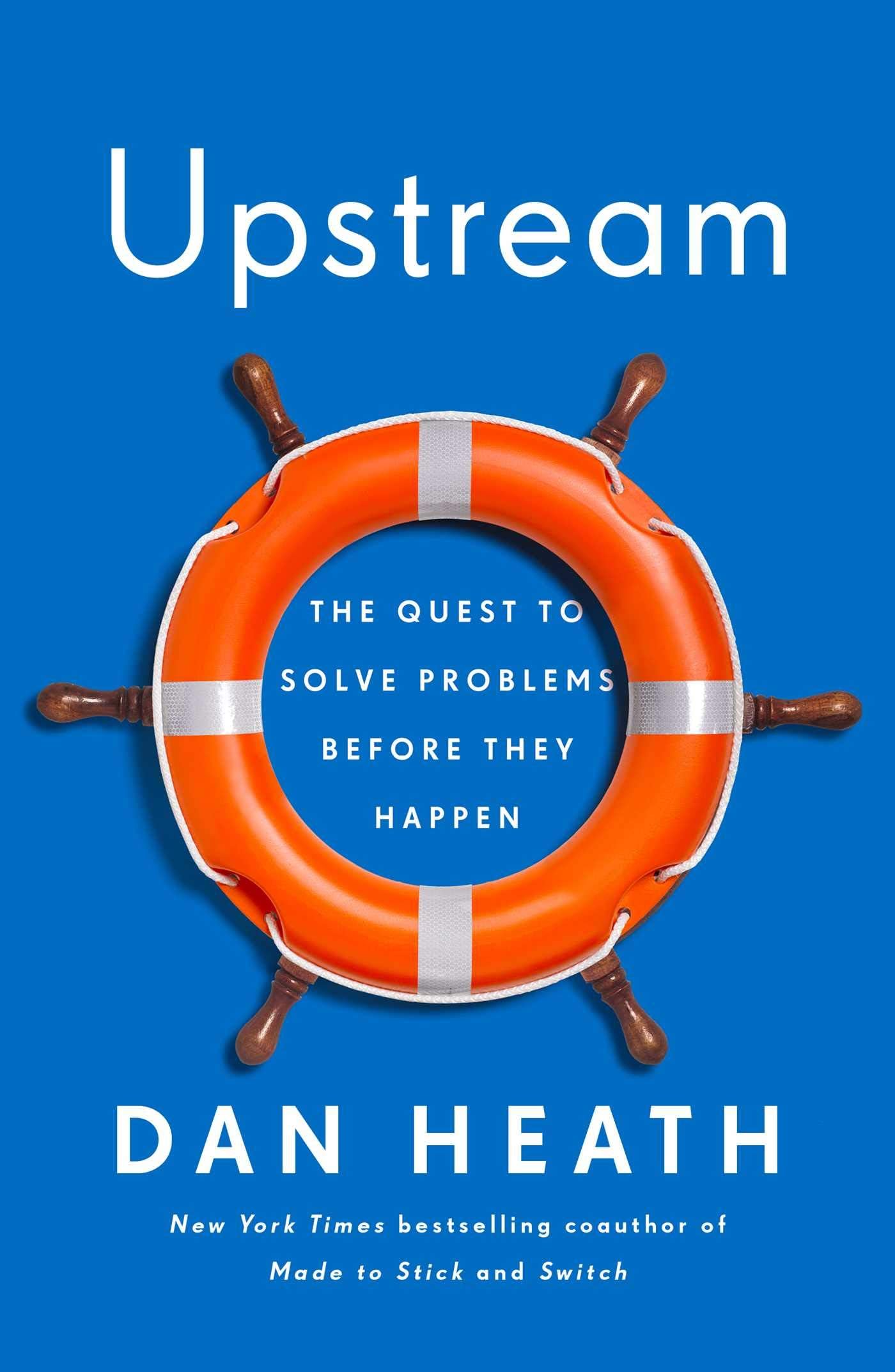
Upstream: The Quest to Solve Problems Before They Happen
Product ID: 179696398
Desertcart purchases this item on your behalf and handles shipping, customs, and support to EGYPT.
Wall Street Journal Bestseller New York Times bestselling author Dan Heath explores how to prevent problems before they happen, drawing on insights from hundreds of interviews with unconventional problem solvers and showing how leaders, teams, and organizations can shift from reaction to prevention. So often in life, we get stuck in a cycle of response. We put out fires. We deal with emergencies. We stay downstream, handling one problem after another, but we never make our way upstream to fix the systems that caused the problems. Cops chase robbers, doctors treat patients with chronic illnesses, and call-center reps address customer complaints. But many crimes, chronic illnesses, and customer complaints are preventable. So why do our efforts skew so heavily toward reaction rather than prevention? Upstream probes the psychological forces that push us downstream—including “problem blindness,” which can leave us oblivious to serious problems in our midst. And Heath introduces us to the thinkers who have overcome these obstacles and scored massive victories by switching to an upstream mindset. One online travel website prevented twenty million customer service calls every year by making some simple tweaks to its booking system. A major urban school district cut its dropout rate in half after it figured out that it could predict which students would drop out—as early as the ninth grade. A European nation almost eliminated teenage alcohol and drug abuse by deliberately changing the nation’s culture. And one EMS system accelerated the emergency-response time of its ambulances by using data to predict where 911 calls would emerge—and forward-deploying its ambulances to stand by in those areas. Upstream delivers practical solutions for problem prevention, systems change, and better decision-making rather than reacting to them. How many problems in our lives and in society are we tolerating simply because we’ve forgotten that we can fix them? Review: Trial and Error, Error, Error - During this COVID-19 marathon, could there be a more relevant, timely book than “Upstream,” by bestselling author Dan Heath? No way. The big idea: solve problems before they happen. Customer complaints, crimes (and get this!)—chronic illnesses are preventable. RELEVANT! We must experiment. Heath quotes systems thinker Donella Meadows. “Remember, always, that everything you know, and everything everyone knows is only a model. Get your model out there where it can be shot at. Invite others to challenge your assumptions and add their own….The thing to do, when you don’t know, is not to bluff and not to freeze, but to learn. “The way you learn is by experiment—or, as Buckminster Fuller put it, by trial and error, error, error.” TIMELY! Don’t make the problem worse. Heath notes, “When we fail to anticipate second-order consequences, it’s an invitation to disaster, as the ‘cobra effect’ makes clear. The cobra effect occurs when an attempted solution to a problem makes the problem worse.” That happened in India, during the UK’s colonial rule. “A bounty on cobras was declared,” and citizens received cash for producing dead cobras. You guessed it—the entrepreneurs began breeding more cobras. INSIGHTFUL! Data—the centerpiece of upstream efforts. Heath quotes Joe McCannon who uses “data for the purpose of learning” as distinguished from “data for the purpose of inspection.” Read chapter five (gulp!) to learn why you never hear about data systems “that are useful for people on the front lines.” (Maybe Heath was channeling our new physician hero, Ambassador Deborah Birx.) Forget all the other “must-reads” I’ve cajoled you into reading. This is the must-must-read of the year. “Upstream: The Quest to Solve Problems Before They Happen,” by Dan Heath, was just published March 3, 2020, and—here at home, hunkered and bunkered—I naively thought, “For once, I’ll read a book without a pen. Just enjoy it. Learn. Reflect.” Not! The two blank pages in the front of my book are now smothered with 47 page numbers and notes. Forty-seven! There’s no way to cram all this good stuff into a short review. Sorry! I waded into “Upstream” while reading Sam Walker’s “Captain Class” column in “The Wall Street Journal.” The headline: “Covid-19 was a Leadership Test. It Came Back Negative. One lesson from the coronavirus is that we need leaders who prevent crises more than we need managers who scramble to handle them.” Walker’s column included this: “Last year, before this virus began to spread, I learned about a parable that’s well-known in public-health circles. It goes something like this: “Two friends are sitting by a river when they spot a child drowning in the water. Both friends immediately dive in and pull the child to safety. But as soon as they do, another struggling child drifts into view. Then another. Then another. After completing several rescues, one of them climbs out of the water. “‘Where are you going?’ the other friend asks. “‘I’m going upstream to tackle the guy who’s throwing all these kids in the water.’” This parable is on page one in “Upstream”—and it’s the metaphor for the next 243 pages, followed by a “Next Steps” section, a one-page graphic summary of the book (Brilliant—why doesn’t every author give me a one-page summary?), and a discouraging two-page appendix, “Scaling Programs in the Social Sector.” (Heath: “My own take is that this is largely an unsolvable problem—that there are few programs for improving the lives of human beings that are as easy to reproduce on a large scale as fried chicken or lattes.”) So here are four options for this must-must-read: --Option 1: Delegate your reading to a team member for a report at your next weekly meeting on Zoom. --Option 2: Read the book yourself! --Option 3: Listen to the audio book, an hour a day, during your daily exercise routine this week. (You're exercising, right?) --Option 4: Don’t read or listen to the book—and continue to manage your “willy-nilly” systems (per the downstream approach to the homeless problem previously used in Rockford, Illinois). MY TOP-10 TEASERS (and a bonus): #10. BOXES. The Dutch bicycle company VanMoof reduced shipping damage by 70% to 80% when “they started printing images of flat-screen televisions on the side of their shipping boxes, which are very similar in shape to flat-screen TV boxes.” (page 104) #9. BARRIERS. Illustrating the three barriers to Upstream Thinking (problem blindness, a lack of ownership, and tunneling), Heath praises Chicago Public Schools for thinking upstream—and assigning their BEST teachers to ninth grade students, during the “whopper of a transition,” their vulnerable move from elementary school (K to 8) to high school. Where do you assign your best team members? (page 25) #8. BRACELETS. In a sleepy New England town, north of Boston, a “Danger Assessment” tool brought agencies together to address domestic abuse instead of the previously splintered response. Dan Heath attacks silos like COVID-19 attacks those who don’t social distance. One simple “upstream” innovation—attach GPS bracelets to released offenders BEFORE they leave jail, not two days later at their first parole appointment. I know, “Duh!” But…read the book and you’ll find the finger pointing at you. (page 82) #7. BUMMERS. Yikes #1: “Choosing the wrong short-term measurements can doom upstream work.” Yikes #2: “Getting short-term measures right is frustratingly complex.” Yikes #3: A ghost victory occurs “when measures become the mission.” (Did I mention “must-read?” See chapter nine, “How Will You Know When You’re Succeeding?”) #6. BUNKERS. How does one city use “predictive modeling to accelerate ambulance response time? By forward-deploying ambulances around the city, based on the model.” Thus without that system, Heath suggests you bunker down near a fire station! “This could become a selling point for real estate agents: First floor master—AND just a three-minute drive from the fire station!” (page 138) #5. BUSINESS. Read chapter eight, “How Will You Get Early Warning of the Problem?” and then view the witty IBM Watson TV commercial online. #4. BONKERS! Yikes! An Illinois school district tech director was concerned about phishing attacks—so with a security firm’s help, he sent a “phishing test to the district’s staffers from a weird email address they’d never seen before. The email announced that a suspected security breach had happened earlier in the week and encouraged them to click a link to change their passwords.” Yikes—29% of the staff clicked on the link. (page 221) #3. BRILLIANT! Read how LinkedIn earned “tens of millions of dollars annually” by reducing the churn rate on a product. Attention: Church Leaders & Association Execs—a member’s first 30 days are the most important. Brilliant. (page 135) #2. BROWNIE. Did I mention relevant? In the twelfth chapter, “The Chicken Little Problem: Distant and Improbable Threats,” you’ll weep when you read about the “Hurricane Pam” simulation. “The assignment: Create hurricane response plans for New Orleans and the surrounding region.” The July 2004 week-long gathering (amazing collaboration among agencies) launched the planning effort. Except…the follow-up meetings were cancelled because FEMA would not approve the additional $15,000 in travel expense. By the way, Heath notes that Congress ultimately funded $62 billion (not a typo) for the devastation wrought by Hurricane Katrina which hit 13 months later in 2005. #1. BUREAUCRATS (see “LAZY”). When your team finally commits to upstream efforts—and you’re pondering how to measure success, Heath has five questions to prevent “pre-gaming” your results—aka “the careful consideration of how the measures might be misused.” They include: 1. The “rising tides” test 2. The misalignment test 3. The lazy bureaucrat test 4. The defiling-the-mission test 5. The unintended consequences test BONUS TEASER: BIBLE-READING! One of Heath’s three types of “ghost victories” (where “it’s possible to ace your measures while undermining your mission”) is his youthful account of his father’s offer to pay him $1.00 for every book of the Bible he read. Younger Heath gamed the system—and instead of reading from Genesis to Revelation to earn $66—he started by fast-tracking through Second John, Third John, and Philemon—the three shortest books in the Bible—and then asked his Dad for his first cash payout—three bucks! Note: I just shipped this book to my favorite state senator in California. You might want to do the same in your state. BONUS BOOK! You’ll also enjoy reading (or listening to) the bestselling book by Dan Heath, and his brother Chip Heath (I named it my 2017 book-of-the-year), “The Power of Moments: Why Certain Experiences Have Extraordinary Impact.” You'll appreciate the ideas in this book when planning the “Welcome Back!” celebration at your office, church, or classroom. Review: An Easy and Informative Read - Our team is about looking to the future with an eye toward fostering positive outcomes and preventing negative ones, so it should be no surprise that our team is reading Upstream on nights and weekends. Upstream was written by Dan Heath who is a New York Times best selling author. Upstream explains how to prevent problems before they occur. Heath created the book from interviews and stories about unconventional problem-solvers. The purpose of the book is to make that unconventional, but successful, problem-solving, conventional among the masses. In preparation for our team's upcoming discussion, I have pulled a few quotes: "Downstream actions react to problems once they've occurred. Upstream efforts aim to prevent problems from happening." [page 3] "To succeed upstream, leaders must detect problems early, target leverage points in complex systems, find reliable ways to measure success, pioneer new ways of working together, and embed their successes into systems to give them permanence." [page 29] "Data for the purpose of learning [available to those on the front lines] is different from data for the purpose of inspection [available those managing those on the front lines]." [page 89] "A well-designed system is the best upstream invention." [page 103] "We can settle for a pretty good solution that's equipped with so many built-in feedback loops that it can't help but get better over time." [pages 181-182] "Three suggestions: Be impatient for action but patient for outcomes... Macro starts with micro [(solve an instance of a problem first and apply what's learned to the whole)]... Favor scoreboards [(system changes with feedback)] over pills [(one-time remedies)]." [page 234-237] The real magic of this book is the set of stories that accompany the guidance. They bring the lessons to life. This is a book that I found very easy to read. There's even a website (www.upstreambook.com) with additional resources on problem prevention and solving. I highly recommend this book. Here are some examples of the kinds of issues our team is applying Upstream learnings to: * Without changes in education, will today's students be ill-equipped for the jobs of the future? * Will people's trust in technology be challenged by concerns around data, algorithms, and privacy? * When technology gives us the ability to sense, simulate, and visualize complex systems in ever greater fidelity, will it also equip us to better understand unintended negative consequences? What problems could you prevent?



| Best Sellers Rank | #19,203 in Books ( See Top 100 in Books ) #77 in Popular Social Psychology & Interactions #105 in Business Decision Making #106 in Business Processes & Infrastructure |
| Customer Reviews | 4.6 out of 5 stars 2,074 Reviews |
J**N
Trial and Error, Error, Error
During this COVID-19 marathon, could there be a more relevant, timely book than “Upstream,” by bestselling author Dan Heath? No way. The big idea: solve problems before they happen. Customer complaints, crimes (and get this!)—chronic illnesses are preventable. RELEVANT! We must experiment. Heath quotes systems thinker Donella Meadows. “Remember, always, that everything you know, and everything everyone knows is only a model. Get your model out there where it can be shot at. Invite others to challenge your assumptions and add their own….The thing to do, when you don’t know, is not to bluff and not to freeze, but to learn. “The way you learn is by experiment—or, as Buckminster Fuller put it, by trial and error, error, error.” TIMELY! Don’t make the problem worse. Heath notes, “When we fail to anticipate second-order consequences, it’s an invitation to disaster, as the ‘cobra effect’ makes clear. The cobra effect occurs when an attempted solution to a problem makes the problem worse.” That happened in India, during the UK’s colonial rule. “A bounty on cobras was declared,” and citizens received cash for producing dead cobras. You guessed it—the entrepreneurs began breeding more cobras. INSIGHTFUL! Data—the centerpiece of upstream efforts. Heath quotes Joe McCannon who uses “data for the purpose of learning” as distinguished from “data for the purpose of inspection.” Read chapter five (gulp!) to learn why you never hear about data systems “that are useful for people on the front lines.” (Maybe Heath was channeling our new physician hero, Ambassador Deborah Birx.) Forget all the other “must-reads” I’ve cajoled you into reading. This is the must-must-read of the year. “Upstream: The Quest to Solve Problems Before They Happen,” by Dan Heath, was just published March 3, 2020, and—here at home, hunkered and bunkered—I naively thought, “For once, I’ll read a book without a pen. Just enjoy it. Learn. Reflect.” Not! The two blank pages in the front of my book are now smothered with 47 page numbers and notes. Forty-seven! There’s no way to cram all this good stuff into a short review. Sorry! I waded into “Upstream” while reading Sam Walker’s “Captain Class” column in “The Wall Street Journal.” The headline: “Covid-19 was a Leadership Test. It Came Back Negative. One lesson from the coronavirus is that we need leaders who prevent crises more than we need managers who scramble to handle them.” Walker’s column included this: “Last year, before this virus began to spread, I learned about a parable that’s well-known in public-health circles. It goes something like this: “Two friends are sitting by a river when they spot a child drowning in the water. Both friends immediately dive in and pull the child to safety. But as soon as they do, another struggling child drifts into view. Then another. Then another. After completing several rescues, one of them climbs out of the water. “‘Where are you going?’ the other friend asks. “‘I’m going upstream to tackle the guy who’s throwing all these kids in the water.’” This parable is on page one in “Upstream”—and it’s the metaphor for the next 243 pages, followed by a “Next Steps” section, a one-page graphic summary of the book (Brilliant—why doesn’t every author give me a one-page summary?), and a discouraging two-page appendix, “Scaling Programs in the Social Sector.” (Heath: “My own take is that this is largely an unsolvable problem—that there are few programs for improving the lives of human beings that are as easy to reproduce on a large scale as fried chicken or lattes.”) So here are four options for this must-must-read: --Option 1: Delegate your reading to a team member for a report at your next weekly meeting on Zoom. --Option 2: Read the book yourself! --Option 3: Listen to the audio book, an hour a day, during your daily exercise routine this week. (You're exercising, right?) --Option 4: Don’t read or listen to the book—and continue to manage your “willy-nilly” systems (per the downstream approach to the homeless problem previously used in Rockford, Illinois). MY TOP-10 TEASERS (and a bonus): #10. BOXES. The Dutch bicycle company VanMoof reduced shipping damage by 70% to 80% when “they started printing images of flat-screen televisions on the side of their shipping boxes, which are very similar in shape to flat-screen TV boxes.” (page 104) #9. BARRIERS. Illustrating the three barriers to Upstream Thinking (problem blindness, a lack of ownership, and tunneling), Heath praises Chicago Public Schools for thinking upstream—and assigning their BEST teachers to ninth grade students, during the “whopper of a transition,” their vulnerable move from elementary school (K to 8) to high school. Where do you assign your best team members? (page 25) #8. BRACELETS. In a sleepy New England town, north of Boston, a “Danger Assessment” tool brought agencies together to address domestic abuse instead of the previously splintered response. Dan Heath attacks silos like COVID-19 attacks those who don’t social distance. One simple “upstream” innovation—attach GPS bracelets to released offenders BEFORE they leave jail, not two days later at their first parole appointment. I know, “Duh!” But…read the book and you’ll find the finger pointing at you. (page 82) #7. BUMMERS. Yikes #1: “Choosing the wrong short-term measurements can doom upstream work.” Yikes #2: “Getting short-term measures right is frustratingly complex.” Yikes #3: A ghost victory occurs “when measures become the mission.” (Did I mention “must-read?” See chapter nine, “How Will You Know When You’re Succeeding?”) #6. BUNKERS. How does one city use “predictive modeling to accelerate ambulance response time? By forward-deploying ambulances around the city, based on the model.” Thus without that system, Heath suggests you bunker down near a fire station! “This could become a selling point for real estate agents: First floor master—AND just a three-minute drive from the fire station!” (page 138) #5. BUSINESS. Read chapter eight, “How Will You Get Early Warning of the Problem?” and then view the witty IBM Watson TV commercial online. #4. BONKERS! Yikes! An Illinois school district tech director was concerned about phishing attacks—so with a security firm’s help, he sent a “phishing test to the district’s staffers from a weird email address they’d never seen before. The email announced that a suspected security breach had happened earlier in the week and encouraged them to click a link to change their passwords.” Yikes—29% of the staff clicked on the link. (page 221) #3. BRILLIANT! Read how LinkedIn earned “tens of millions of dollars annually” by reducing the churn rate on a product. Attention: Church Leaders & Association Execs—a member’s first 30 days are the most important. Brilliant. (page 135) #2. BROWNIE. Did I mention relevant? In the twelfth chapter, “The Chicken Little Problem: Distant and Improbable Threats,” you’ll weep when you read about the “Hurricane Pam” simulation. “The assignment: Create hurricane response plans for New Orleans and the surrounding region.” The July 2004 week-long gathering (amazing collaboration among agencies) launched the planning effort. Except…the follow-up meetings were cancelled because FEMA would not approve the additional $15,000 in travel expense. By the way, Heath notes that Congress ultimately funded $62 billion (not a typo) for the devastation wrought by Hurricane Katrina which hit 13 months later in 2005. #1. BUREAUCRATS (see “LAZY”). When your team finally commits to upstream efforts—and you’re pondering how to measure success, Heath has five questions to prevent “pre-gaming” your results—aka “the careful consideration of how the measures might be misused.” They include: 1. The “rising tides” test 2. The misalignment test 3. The lazy bureaucrat test 4. The defiling-the-mission test 5. The unintended consequences test BONUS TEASER: BIBLE-READING! One of Heath’s three types of “ghost victories” (where “it’s possible to ace your measures while undermining your mission”) is his youthful account of his father’s offer to pay him $1.00 for every book of the Bible he read. Younger Heath gamed the system—and instead of reading from Genesis to Revelation to earn $66—he started by fast-tracking through Second John, Third John, and Philemon—the three shortest books in the Bible—and then asked his Dad for his first cash payout—three bucks! Note: I just shipped this book to my favorite state senator in California. You might want to do the same in your state. BONUS BOOK! You’ll also enjoy reading (or listening to) the bestselling book by Dan Heath, and his brother Chip Heath (I named it my 2017 book-of-the-year), “The Power of Moments: Why Certain Experiences Have Extraordinary Impact.” You'll appreciate the ideas in this book when planning the “Welcome Back!” celebration at your office, church, or classroom.
S**D
An Easy and Informative Read
Our team is about looking to the future with an eye toward fostering positive outcomes and preventing negative ones, so it should be no surprise that our team is reading Upstream on nights and weekends. Upstream was written by Dan Heath who is a New York Times best selling author. Upstream explains how to prevent problems before they occur. Heath created the book from interviews and stories about unconventional problem-solvers. The purpose of the book is to make that unconventional, but successful, problem-solving, conventional among the masses. In preparation for our team's upcoming discussion, I have pulled a few quotes: "Downstream actions react to problems once they've occurred. Upstream efforts aim to prevent problems from happening." [page 3] "To succeed upstream, leaders must detect problems early, target leverage points in complex systems, find reliable ways to measure success, pioneer new ways of working together, and embed their successes into systems to give them permanence." [page 29] "Data for the purpose of learning [available to those on the front lines] is different from data for the purpose of inspection [available those managing those on the front lines]." [page 89] "A well-designed system is the best upstream invention." [page 103] "We can settle for a pretty good solution that's equipped with so many built-in feedback loops that it can't help but get better over time." [pages 181-182] "Three suggestions: Be impatient for action but patient for outcomes... Macro starts with micro [(solve an instance of a problem first and apply what's learned to the whole)]... Favor scoreboards [(system changes with feedback)] over pills [(one-time remedies)]." [page 234-237] The real magic of this book is the set of stories that accompany the guidance. They bring the lessons to life. This is a book that I found very easy to read. There's even a website (www.upstreambook.com) with additional resources on problem prevention and solving. I highly recommend this book. Here are some examples of the kinds of issues our team is applying Upstream learnings to: * Without changes in education, will today's students be ill-equipped for the jobs of the future? * Will people's trust in technology be challenged by concerns around data, algorithms, and privacy? * When technology gives us the ability to sense, simulate, and visualize complex systems in ever greater fidelity, will it also equip us to better understand unintended negative consequences? What problems could you prevent?
W**T
Solving the Root Cause of Problems Rather Than the Symptoms
I thoroughly enjoyed this Dan Heath book. As a Continuous Improvement professional, I push my clients to look at root causes and not just symptoms. Dan gets us thinking about how to do this on some very large initiatives. The same approach can be done on smaller scale problems. I did deduct one star because there is a gap in the book that I think Dan could address better: measuring progress, particularly when we are looking to eliminate risk. How do you measure efforts to eliminate things from happening? Yes, we can see a reduction in problems, but that's not what Dan's book is about. This is talking about addressing the issues SO THERE ARE NO PROBLEMS LATER. How do you measure the success of those efforts? Quantifiably? If there is a single incident, can the critics say that all the efforts were in vain? Of course not. But what is the value of preventing problems, not eliminating them? The chapter on measuring progress was very vague and while it had come good examples of how very specific problems were solved, it did not focus on PREVENTATIVE ACTIONS. Preventing problems is always better than trying to fix them after the fact. Overall, I would recommend this book, but be aware that you'll find the chapter on measuring prevention lacking details and specifics.
D**R
A stitch in time saves 99: An inspiring, enjoyable manifesto on effective problem prevention
What's the best time to prevent a burglary? When the criminal is still in his mother's belly, that's when. "Upstream" espouses that radical shift in thinking: going to the source of the problem, as far back as we can go, to solve it *before* it arises. Prevention is like a vaccine: having nothing bad happen may not be as sexy as heroic corrective measures, but it is far cheaper and more efficient. For example, there's a firm called P3 that uses complex motion capture technology "to micro-analyze athletes as they run, jump, and pivot." It then tells them which injuries they're most susceptible to, and re-trains them to prevent those injuries. Magic! But how? "To succeed upstream, leaders must: detect problems early, target leverage points in complex systems, find reliable ways to measure success, pioneer new ways of working together, and embed their successes into systems to give them permanence." Before you can do that, you need to overcome three obstacles: 1) Problem blindness: "You can’t solve a problem that you can’t see, or one that you perceive as a regrettable but inevitable condition of life.” If you think 'athletes just get injured', you'll never prevent injuries. 2) Lack of ownership: 'Ain't my problem!' Got to own it to solve it. 3) Tunneling: "I just can't deal with that right now." The more stressed you are (e.g. because of poverty), the more you're reacting to immediate concerns ("Can't pay the bills gaaah!") and the less you can engage in the "systems thinking" required to see the bigger picture. Two concepts that particularly resonated with me: • "Surround the problem": Realize that problems are embedded in systems, and recruit all the stakeholders to solve the problem. For example, to reduce teenage delinquency from 50% to near zero in Iceland, they brought on board parents, coaches, teachers, and the kids. • "Immerse yourself in the problem": Med students at Hackensack Meridian School of Medicine at Seton Hall go into the community and spend hours with patients *in their homes* from day one. That way, they find out about the social determinants of health, e.g. how a patient's diabetes can go uncontrolled because he can't go to the store himself. Heath shares many inspiring stories of heroic, effective problem solving that stay with you long after finishing the book (which I did in one sitting): how Jacquelyn Campbell's "Danger Assessment" tool prevents deadly domestic violence; Anthony Ramirez-Di Vittorio's "Being a Man" homicide prevention program in Baltimore; and Rockford, Illinois's successful eradication of homelessness. Of course, "nowhere is the need for this shift [from reaction to prevention] more evident in the $3.5 trillion healthcare industry." I really appreciate Dan Heath's clarion call of moral responsibility, instead of merely making the business case that prevention saves money: "Nothing else in health care, other than prevention, is viewed through this lens of saving money... This is madness. The reason to house the homeless or prevent disease or feed the hungry is not because of the financial returns but because of the moral returns. Let’s not sabotage upstream efforts by subjecting them to a test we never impose on downstream interventions." If you're a problem-solver of any kind -- parent, teacher, scientist, politician, entrepreneur -- this book is required reading. The shift from reactive to upstream thinking is also the shift from small-scale to systems thinking, undergirding our success as families, societies, and a species (think: climate change). I'll be re-reading this one regularly. -- Ali Binazir, M.D., M.Phil., Happiness Engineer and author of The Tao of Dating: The Smart Woman's Guide to Being Absolutely Irresistible , the highest-rated dating book on Amazon, and Should I Go to Medical School?: An Irreverent Guide to the Pros and Cons of a Career in Medicine
R**D
Read the book, accept the challenge, change the world around you
Upstream by Dan Heath is a must-read for anyone serious about solving problems before they escalate — especially in healthcare. As our team is focused on “prevention before intervention” in an age where intervention generates the most revenue, I found this book both affirming and energizing. It’s helped reinforce how our team approaches patient care, systems design, and long-term impact. This concept has the potential, if applied, to change our current model of "sick"care back to healthcare.
A**R
Really enjoyable book especially if you work in healthcare or education
I don’t normally like books by the Heath brothers, but I REALLY enjoyed this one. It starts with a great example of Expedia employees executing excellently on a terrible process (solving the same problem quickly rather than preventing the problem completely). Only when looking at the causes was it obvious the focus should be on prevention. And as soon as that focus switched the excellence delivered powerfully. I found the book particularly useful as a manager - give data to your team so they learn and solve problems rather than for you to inspect your team - and as I work in health care - what a dysfunctional industry it is that we know and love. The book has inspirational and actionable stories and frameworks, I highly recommend it. Plus it’s written in the usual highly enjoyable style you can expect from a Heath. PS I listened to the audio book, read by the author, his passion comes through and he has a soothing voice.
W**K
Upstream is not nearly as good or insightful as the books the Heath Brothers did together.
I read the Heath brothers' books and liked them. I thought Upstream: The Quest to Solve Problems Before They Happen by Dan Heath would be the same kind and quality. I may buy another book they write together, but I will never buy another book that Dan Heath wrote by himself. I expected deep thinking and fresh insights. Upstream is light on analysis. The business issues are standard business problems dressed up in a new suit of words. The opening example in the book is about a problem at Expedia. Many customers phoned for a copy of their itinerary after they'd completed their reservations on the Expedia site. They should have been able to do that themselves on the site. Result: soaring call center costs. No one noticed the problem because it wasn’t in anyone’s job description to look for it. You can find similar problems in other business books. The one that came immediately to mind for me is the opening problem in Jan Carlson's book Moments of Truth. You must notice a problem to solve it. If you do notice it, it's usually a standard business problem. Why do customers do that? How can we arrange things so they don't need to? There a LinkedIn case in the book, too. There, the issue was getting more people who signed up for a trial to continue using it when the trial expired. Every business that has offered a subscription or a trial period has faced that problem. They solve it in different ways. That’s two business cases. Based on Heath brothers books I read, I expected primarily business examples. Nope. There are four examples of companies solving business problems. Two of them are Expedia and LinkedIn. The other two are a 40-person accounting firm and a comfort food restaurant. The other examples, like the one on the Chicago school system or the one on domestic violence, were interesting reading, but not what I was expecting. The other Heath Brothers books was the little aids, like summaries and checklists. They help you understand the content and how to apply it. There was none of that in this book. In A Nutshell Upstream is not nearly as good or insightful as the books the Heath Brothers did together. If you're considering buying this book, first borrow a copy from the library to see if you want to spend your money on it. If you are thinking of buying Upstream to help you in your business, don't bother. There's not much business-related content in the book. What is, is neither new nor insightful.
N**F
A Surprising 5-Star Read
Let me explain the title of this review: I have read the Heath brothers' books in the past, and have been more impressed with some (Made to Stick- very impressed) than others (Power of Moments- somewhat disappointed), but overall would not have pre-ordered it if I didn't think it had a shot to be at least good. So why was I surprised I liked it so much? Upon reading the first chapter, I thought that the book would have been better served as a New York Times article, as the point of the book was made very quickly and it didn't seem to warrant 250 pages of redundancy. I was even tempted to put it down after the first section because I thought I had gotten all out of it that I would. But as I thought about ways to put the take-home-point of the book into play in my own life, I became more and more interested in the finer points of the topic, so I kept reading on. And I am very glad that I did. I am not sure how long this will last, but I find myself uttering the phrase "That's Thinking Upward" over and over again since I finished the book (which took two only two days of casual reading). Any book that creates a language for my day-to-day life warrants a 5 star rating, and this book certainly did so. Hats off to Dan Heath for turning around an otherwise stubborn reader!
B**T
Ignore this book at your peril. Everyone's future depends on solving problems that begin upstream.
I wish I had read this book decades ago before I embarked on a career in medicine which contributes 10% to the health of the population with 98% of 'health budgets' allocated to downstream healthcare. Upstream is where the 90% of determinants of health are located and yet this is ignored. Dan has illuminated this fact and provided a framework to tackle what might seem overwhelming wicked problems. His narrative skills make this a fascinating read which is distinctly lacking in academic texts. It should be required reading for all medical students, nurses, healthcare professionals, policy makers, funders of all human services, business managers, politicians... I could go on to include everyone in fact.
C**A
Llego en mal estado, pegajoso y mojado
Llego mojado.
K**N
Insightful book
In his book 'Upstream', Dan Heath provides a very interesting explanation and analysis of 'upstream thinking'. The writing style is very clear and the varied case studies referred to are understandable and accessible. I remarked several times on how points made in the book reflected my own experience of trying to change status quo thinking via social entrepreneurship. In one particular case, the author articulated my own long-held views about the way that social funding is often so dissipated by layers of intermediaries that relatively little of it ends up being provided to help the people it was intended to help. In my opinion this is a unique recognition and articulation of what is probably an unintended consequence of seeking to ensure value for money with public and social funding. 'Upstream' is highly recommended to anyone who wonders (a) why inappropriate measures are often used to assess the benefit of projects with a social purpose or (b) why it can seem to be so hard to make progress with what may seem to be self-evidently sensible programmes. The book points to alternative ways of thinking and will help you develop stories that will increase the chance of getting support for your own projects.
L**I
Great purchase
The book came on time and in perfect condition and we are currently enjoying reading it
S**A
Motivational book
A must read book for every person who is in administration or management work.
Trustpilot
1 week ago
2 weeks ago