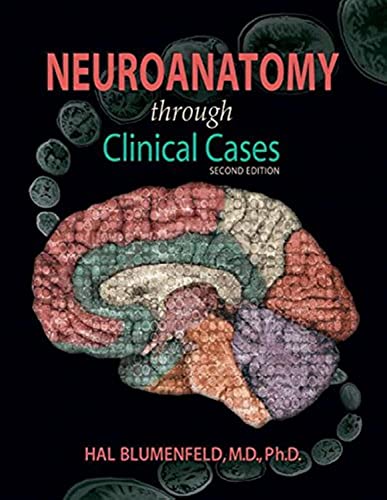


Neuroanatomy through Clinical Cases: 9780878936137: Medicine & Health Science Books @ desertcart.com Review: Buy It. Just Do It. - I am a second year medical student in California. I have recently boarded the struggle bus that is neuroanatomy. I have never taken neuroanatomy prior to medical school, and to say its overwhelming is an understatement. Another note - I own the Haines Atlas(9th E), this text, FA, and Firecracker. Professional students have a limited budget and need to find the most high yield resources. This is the one. I never usually buy textbooks because they suck. This is the anti-textbook. It actually is designed to be read, in order, and it is engaging, relevant, and interesting. The pictures are bomb. It constantly checks your understanding, references other section of the text (THAT MAKE SENSE AND ARE RELEVANT), and everything is clinically relevant. Finally, a book written by a clinician for clinicians, not researchers or academics. Purchase it. Read it. See how it effortlessly owns all other texts and actually pushes you to GET neuroanatomy to HELP PATIENTS, not uselessly memorize that the trigeminal system has 4 nuclei, or that there are 5 descending motor tracts, or remember some research extraneous bullcrap that fills the volume of much of our medical textbooks. Dr. Blumenfeld, if you are listening, can you make a trip to California to school your colleagues about how to write clinically oriented organ systems based texts and teaching materials? Review: Best for for beginer-intermediate students/professionals - So comprehensive, intuitive, and simple yet complete, an incredible book for those learning neuroanathomy, amazing to learn from pretty much the start or if youre a clinician looking for quick references in your practice, it has so many amazing charts and imagen too
| ASIN | 0878936130 |
| Best Sellers Rank | #217,360 in Books ( See Top 100 in Books ) #39 in Neurology (Books) #180 in Neuroscience (Books) #473 in Medical Reference (Books) |
| Customer Reviews | 4.8 4.8 out of 5 stars (534) |
| Dimensions | 10.9 x 1.1 x 8.4 inches |
| Edition | 2nd |
| ISBN-10 | 9780878936137 |
| ISBN-13 | 978-0878936137 |
| Item Weight | 4.65 pounds |
| Language | English |
| Print length | 1032 pages |
| Publication date | March 8, 2010 |
| Publisher | Sinauer Associates is an imprint of Oxford University Press |
F**T
Buy It. Just Do It.
I am a second year medical student in California. I have recently boarded the struggle bus that is neuroanatomy. I have never taken neuroanatomy prior to medical school, and to say its overwhelming is an understatement. Another note - I own the Haines Atlas(9th E), this text, FA, and Firecracker. Professional students have a limited budget and need to find the most high yield resources. This is the one. I never usually buy textbooks because they suck. This is the anti-textbook. It actually is designed to be read, in order, and it is engaging, relevant, and interesting. The pictures are bomb. It constantly checks your understanding, references other section of the text (THAT MAKE SENSE AND ARE RELEVANT), and everything is clinically relevant. Finally, a book written by a clinician for clinicians, not researchers or academics. Purchase it. Read it. See how it effortlessly owns all other texts and actually pushes you to GET neuroanatomy to HELP PATIENTS, not uselessly memorize that the trigeminal system has 4 nuclei, or that there are 5 descending motor tracts, or remember some research extraneous bullcrap that fills the volume of much of our medical textbooks. Dr. Blumenfeld, if you are listening, can you make a trip to California to school your colleagues about how to write clinically oriented organ systems based texts and teaching materials?
A**O
Best for for beginer-intermediate students/professionals
So comprehensive, intuitive, and simple yet complete, an incredible book for those learning neuroanathomy, amazing to learn from pretty much the start or if youre a clinician looking for quick references in your practice, it has so many amazing charts and imagen too
A**X
Solid book! Enjoyable too.
I love this book. In my humble opinion I’d say the second edition is possibly the gold standard for learning basic neuroanatomy right now. My Professor (who was a board certified neurologist with a PhD in cognitive neuroscience as well) handpicked this text and required my class to get it for a 400 level undergraduate class in neuroanatomy I took last year. It was honestly really hard for me but A lot of fun too I must say. My major is cell as molecular biology with a special emphasis on neuroscience. I’ve been ok with the chem, bio, and cog psy parts but I never established a solid foundation in the anatomy of the very organ I study. This book has helped me start building a real foundation and become more well rounded. All the material is very practical in the book. There is a lot of information but none of it ever gets out in left field like other larger books tend to have happened. All very useful stuff and the author is constantly making you think of ways to apply what you learn. It’s a handy reference to have once your class is over too! That’s when the real learning starts. In the end though what you get out of this book will be a direct reflection of what you put in.
J**P
absolutely necessary
I bought this book at the beginning of the term and didn't open it until I got desperate halfway through. Other than the drugs, cancer, and histology&pathology sections of the course, this book had everything. It is laid out better, it is integrated from clinical presentation, to exam, imaging, diagnosis and discussion. I read the book from cover to cover, and went from failing miserably to passing with better than class average. If you read the book as it is laid out, you will build on the concepts and it will introduce key points at relevant times. By the end, you will be able to think through the anatomy instead of trying to just remember a bunch of factoids. The imaging in the book is amazing and well explained, and the cases are real. The language is very descriptive, and the illustrations and figures are great. The cranial nerves and blood supply chapters are highlights. It shouldn't be your ONLY Neuro book, but you will use it every day even after reading it. If I ever see Dr. Blumenfeld, I'm going to hug his leg like a little child.
Z**R
It's neuro...
Studying the brain is just enough to give you an aneurysm. This book definitely makes it manageable by being very succinct and concise (although it is big enough to kill someone if thrown). With fantastic diagrams and written descriptions of the circuits, it provides an adequate academic and physiologic understanding. Where this book shines is right in the title, "Clinical Cases". You can understand the central nervous system all you want but if you get a lesion, say in the motor cortex, you'd have to track down every pathway (nevermind pathways with the cerebellum and basal ganglia) and spend probably ten minutes figuring all that mess out. To help with this they provide cases containing certain patient symptoms and histories to provide a practical picture for what I feel is the most abstract of organ systems. Not for PhD candidates. Half this book would be useless to you.
D**S
It's great for getting started
Blumenfeld in this book makes an easy path to comprehend the basics before stepping on more complex books like, Gray's Clinical Neuroanatomy. It served me as training wheels before going deep on specific themes. Something that I didn't like in the way this book was written is the fact that goes divagates a lot before concreting a concept, however it makes pretty easy to get started studying neuroanatomy. Some highlights from this book are that has great illustrations of different pathways and the way the author integrated the cases was seamless compared to other books whose cases were apart from the main text. Overall it's a great companion book since it only describes briefly the main paths and circuitries, beyond that you'll need other texts. In regards of the clinical integration it's just great.
P**P
Ottimo libro, un ponte interessante tra la neuroanatomia e la neurologia/neuroradiologia/neurochirurgia. Tuttavia, per quanto riguarda il corso di medicina, non può sostituire un libro di anatomia e tantomeno uno di neurologia. Immagini splendide, chiarissime, pieno di casi clinici e neuroimaging. Inglese molto chiaro e semplice. Contiene nozioni molto spesso trascurate dagli standard libri di anatomia, molto interessante. Pieno di tricks per memorizzare le nozioni più "scomode". Un po' deficitario per quanto riguarda il sistema nervoso periferico. Praticamente assente la neurofisiologia. Ottimo acquisto, prezzo ottimo, consegna velocissima.
N**K
この本の特徴は、clinical caseの項が有り臨床例を通して神経解剖学、症候学、そして神経学そのものを勉強する事ができる事である.疾患については成書が必要であるが、必要最低限の事は盛り込まれている. またe-bookを使用する権利もついており、素晴らしい画像をcopy, pasteで使えるのは貴重である. Neuroexam.comにつなげば著者の神経学的診察が見られる. 至れり尽くせりで非常にcost-performanceが高い本である. 英語は平易で、何しろ図か素晴らしく、 学生ばかりでなく神経内科医、脳外科医、PT/OT等にお勧めである.
A**I
me parece un libro estupendo para estudiar la neuroanatomía ya que pone en relación las bases neuroanatómicas con la clínica
A**A
The best you can read... It is not only about neuroanatomy... It explaines you how to examine, how to integrate anatomical and topographical diagnosis, clinical clues, cases, neuro images... The best way to introduce to the neurology... And the pictures are excellent 😌😌😌
R**D
Talvez o melhor livro de neurologia que eu já tenha lido. Comprei depois de ver muitas críticas positivas on-line e de um colega da área. Como sempre, um livro impresso é muito melhor que uma versão digital. Posso dizer com segurança que é a melhor literatura inicial para um acadêmico ou residente de neurologia. É muito evidente a preocupação e o trabalho do autor, que se esforçou para explicar com muita clareza tópicos complexos, com uma linguagem acessível e ilustrações simplesmente brilhantes que você não encontra em outro livro. Sentimos que estamos ENTENDENDO, e não apenas decorando um determinado assunto. O autor, inclusive, vai além da neuroanatomia, explicando os princípios de neurorradiologia (inclui um atlas radiográfico como referência), e em outros capítulos explica outros exames complementares, como por exemplo os fundamentos de eletroneuromiografia (no capítulo de nervos periféricos). Também faz uma introdução à fisiopatologia e tratamento das doenças mais comuns dos diferentes sistemas. Não bastasse o texto e as imagens, no final de cada capítulo há uma série de casos clínicos com descrição do exame físico e exames de imagem para pôr em prática o que acabamos de aprender. Na resolução destes casos acabamos por aprender algumas dicas práticas, como se estivéssemos em uma discussão em equipe ou "round". Lembrando que o livro se propõe a ensinar neuroanatomia básica e os fundamentos de localização em neurologia. Não é um tratado e muito menos um livro de exame neurológico. Sugiro começar por este para depois cair pra dentro do DeJong ou Brazis sem se perder.
Trustpilot
2 days ago
1 week ago