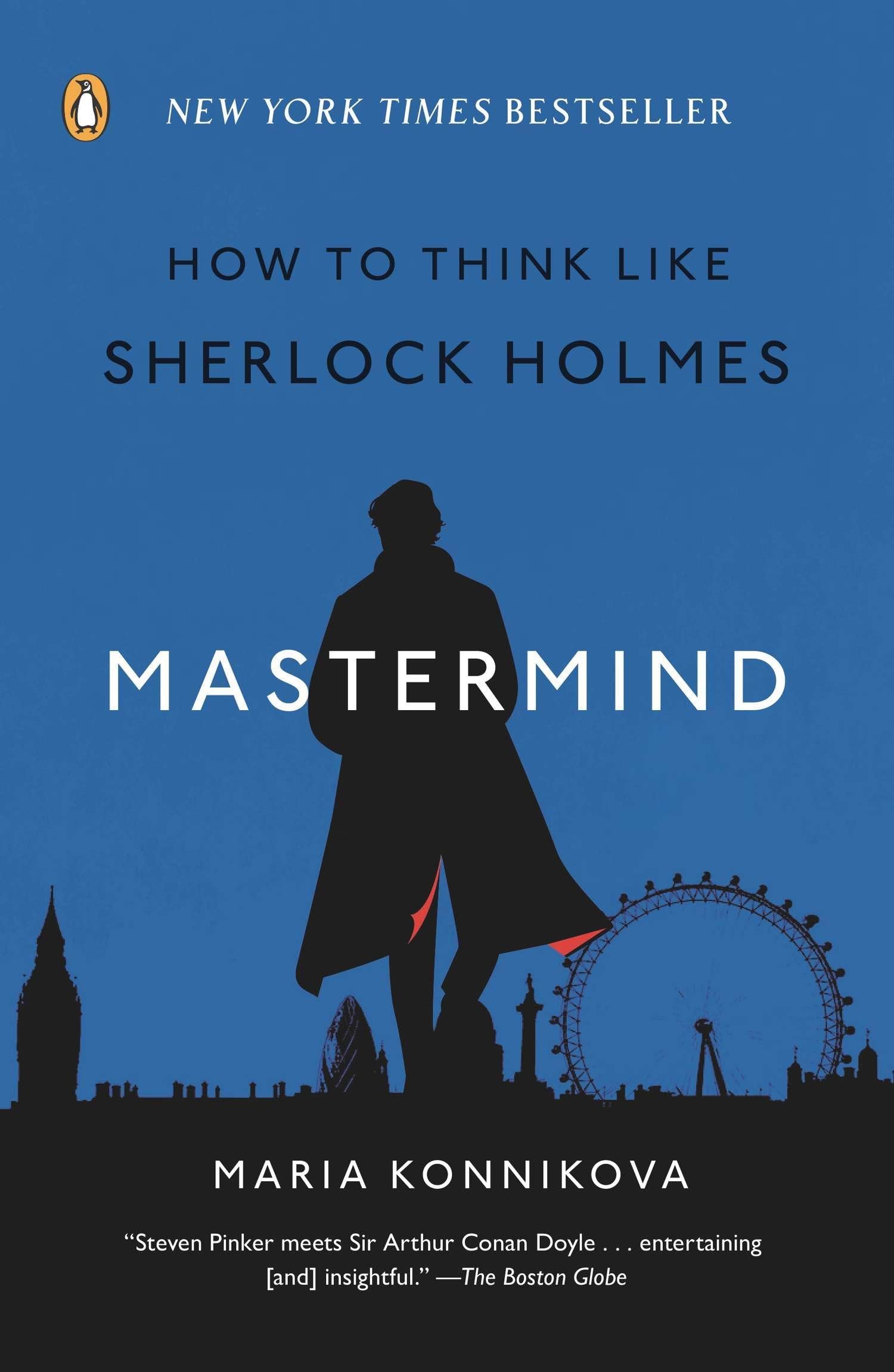
Mastermind: How to Think Like Sherlock Holmes
Product ID: 1945691
Desertcart purchases this item on your behalf and handles shipping, customs, and support to EGYPT.
The New York Times bestselling guide to thinking like literature's greatest detective. "Steven Pinker meets Sir Arthur Conan Doyle" (Boston Globe), by the author of The Confidence Game . No fictional character is more renowned for his powers of thought and observation than Sherlock Holmes. But is his extraordinary intellect merely a gift of fiction, or can we learn to cultivate these abilities ourselves, to improve our lives at work and at home? We can, says psychologist and journalist Maria Konnikova, and in Mastermind she shows us how. Beginning with the “brain attic”—Holmes’s metaphor for how we store information and organize knowledge—Konnikova unpacks the mental strategies that lead to clearer thinking and deeper insights. Drawing on twenty-first-century neuroscience and psychology, Mastermind explores Holmes’s unique methods of ever-present mindfulness, astute observation, and logical deduction. In doing so, it shows how each of us, with some self-awareness and a little practice, can employ these same methods to sharpen our perceptions, solve difficult problems, and enhance our creative powers. For Holmes aficionados and casual readers alike, Konnikova reveals how the world’s most keen-eyed detective can serve as an unparalleled guide to upgrading the mind. Review: How the Science of Deduction and Analysis can make sense of "a pink elephant world" - Frankly, I have never read another book quite like the one Maria Konnikova has written. Almost immediately after I began to read it, I thought of the television series, The Mentalist, whose lead character (Patrick Jane, played by Simon Baker) is a consultant for the California Bureau of Investigation. Each week, he demonstrates the intellectual curiosity as well as observation and analytical skills for which Arthur Conan Doyle's Sherlock Holmes is renowned. Both possess a "mastermind" that has been highly developed over an extended period of time during a wealth of experiences with the best and worst of human nature. Its most dominant characteristic is "mindfulness." As Konnikova explains, "The idea of mindfulness itself is by no means a new one. As early as the end of the nineteenth century, William James, the father of modern psychology wrote that 'the faculty of voluntarily bringing back a wandering attention over and over again, is the very root of poor judgment, character, and will...An education which should improve this faculty would be the education par excellence.' That faculty, at its core, is the very essence of mindfulness. And the education that James proposes, an education in a mindful approach to life and to thought." Cleverly, to make several key points, Konnikova juxtaposes two stereotypes from Conan Doyle's characters: "System Watson" and "System Holmes." The former personifies "our naive selves, operating by the lazy though habits -- the ones that come naturally, the so-called path of least resistance -- that we've spent our whole lives acquiring." As for the latter, System Holmes, it "treats every thought, every experience, and every perception of the way [Holmes] would a pink elephant. In other words, begin with a healthy dose of skepticism instead of credulity that is your mind's [and Watson's mind] natural state of being. Don't just assume anything is the way it is [or seems to be]. Think of everything as being as absurd as an animal that can't possibly exist in nature." These are among the dozens of passages I found to be of greatest interest and value, also listed to suggest the range of subjects covered during the course of the book's narrative: o Pitfalls of the Untrained Brain (17-21) o A Prime Environment: The Power of the Incidental (49-54) o Paying Attention Is Anything but Elementary (67-74) o The Four Elements of Mindfulness (76-108) o Learning to Overcome Imaginative Doubt (115-128) o Sustaining Your Imagination: The Importance of Curiosity and Play (150-152) o The Difficulty of Proper Deduction: Our Inner Storyteller at the Wheel (160-168) o The Improbable Is Not Impossible (177-184) o Bringing Habits Back from Mindlessness to Mindfulness (193-197) o Learning to Spot the Signs of Overconfidence (201-205) o System Holmes: A Five-Step Process (213-222) o The Mindset of a Hunter (240-249) In Chapter One, Konnikova cites a reminder from Holmes worthy of our consideration. "Like all other arts, the Science of Deduction and Analysis is one which can only be acquired by long and patient study nor is life long enough to attain the highest possible perfect in it." That said, Konnikova has convinced me that in order to move from a System Watson to a System Holmes, one must combine highly developed Mindfulness (in the sense of constant practice of mind) and highly developed Motivation (in the sense of active engagement and desire). "To think like Sherlock Holmes, we must [begin italics] want [end italics], actively, to think like him." Those who are self-motivated always outperform those who aren't...and such motivation requires both desire and effort. I now intend to re-read this book again because I am determined to increase and strengthen my understanding of the scientific method, guided and informed by an abundance of information, insights, and counsel that Maria Konnikova provides. More specifically, "to understand and frame the [given] problem; observe; hypothesize (or imagine); test and deduce; and repeat." It's time, now, to conclude this brief commentary and resume my search for pink elephants. Review: A Brief Summary and Review - *A full summary of this book is available here: An Executive Summary of Maria Konnikova's 'Mastermind: How to Think Like Sherlock Holmes' The main argument: Sir Arthur Conan Doyle's character Sherlock Holmes is as popular today as when he was created back in the late 19th century. This comes as no surprise, of course, since there is just something about Holmes' peculiar qualities--his keen observation, clever imagination, and incisive reasoning capabilities--that is both awe-inspiring and inspirational. We admire Holmes for cutting through the errors of thought that are so common to us in our daily lives (and that are reflected in Holmes' sidekick, Watson). And yet we recognize that there is nothing in Holmes' thought that is entirely out of reach for us. Indeed, his qualities are not so much superhuman as human plus: human qualities taken to their extreme. Still, human qualities taken to their extreme are intimidating enough, and we may find ourselves doubting whether we could ever really think like Sherlock--even if we put our minds to it. But for cognitive psychologist Anna Konnikova, we should think again. Holmes' prowess, Konnikova argues, rests no so much in his mental powers as in his mental approach. Specifically, Holmes has succeeded in making his thought methodical and systematic--essentially bringing the scientific method and scientific thinking to his detective work. This is an approach to thinking which, Konnikova argues, we can all practice. More importantly, it is an approach to thinking that can extend well beyond sleuthing. Indeed, it is a general approach that can help us get at the truth in virtually any arena, as well as help us solve virtually any problem. It is simply a matter of bringing a little science to the art of thought--and it is this very thing that Konnikova aims to help us achieve in her new book 'Mastermind: How to Think like Sherlock Holmes'. Konnikova breaks down Holmes' method into 4 parts: 1. Background knowledge; 2. Observation; 3. Imagination; and 4. Deduction. To begin with, Holmes keeps an extensive and well-organized knowledge base to help him solve new cases. What's more, he is vigilant in ensuring that he is ever assimilating new and important information that could help him in the future. Second, Holmes uses careful, mindful, and unbiased observation to glean what is important about the various characters and circumstances of each case. Next, Holmes uses the evidence that he has gathered--in conjunction with his far-reaching (though disciplined) imagination--to formulate multiple scenarios that could explain the mystery. Finally, Holmes uses his acute powers of reasoning to cut away the scenarios that just don't hold up, until ultimately there is but one scenario left: the only one that is possible, however improbable. While this approach seems straightforward enough, it is easier said than done. Indeed, our minds can and often do go wrong at any one of the steps. Konnikova construes it like this: our minds have two distinct modes of thought. The first of these modes operates quickly and automatically. It is our default mode, in that it is the one that we rely on as a matter of course. While it may be quick and effortless, it is also very error-prone. Our second mode of thought is slower and more deliberate. It has the potential to be far more accurate than our default mode, but it takes effort, and this is effort that we often aren't willing to expend. Still, Konnikova contends that activating the second mode is worth the effort. What's more, the more we employ this mode of thought, the more habitual and the less effortful it becomes. (These modes of thought correspond to System 1, and System 2 in Daniel Kahneman's 'Thinking, Fast and Slow', though Konnikova refers to them here as our Watsonian and Holmesian systems). At each step of Holmes' method, Konnikova points out the errors of thought that our Watsonian system is wont to draw us into (as exemplified by a series of psychological experiments). In addition, she points out numerous tricks and pointers that can help us use our Holmesian system to best advantage in order to overcome these errors (exemplified by still other psychological experiments). In the end, it is really a matter of being ever mindful and careful in our thinking, and this is something that we could all certainly do more of. Readers of Kahneman's 'Thinking, Fast and Slow' will no doubt recognize many of the experiments talked about here. However, unlike in Kahneman's book, Konnikova makes much more of an effort to explain how we can overcome the errors of our Watsonian system (system 1). I found these efforts to be worthwhile for the most part (4 stars). Also, I found Konnikova's style easy enough to follow; however, I would not say that I was a huge fan of it: it comes across as patronizing at times, and she does engage in a fair bit of repetition. Still a good and worthwhile read. A full summary of the book is available here: An Executive Summary of Maria Konnikova's 'Mastermind: How to Think Like Sherlock Holmes'


| Best Sellers Rank | #59,140 in Books ( See Top 100 in Books ) #137 in Popular Applied Psychology #251 in Cognitive Psychology (Books) #273 in Creativity (Books) |
| Customer Reviews | 4.4 out of 5 stars 1,489 Reviews |
R**S
How the Science of Deduction and Analysis can make sense of "a pink elephant world"
Frankly, I have never read another book quite like the one Maria Konnikova has written. Almost immediately after I began to read it, I thought of the television series, The Mentalist, whose lead character (Patrick Jane, played by Simon Baker) is a consultant for the California Bureau of Investigation. Each week, he demonstrates the intellectual curiosity as well as observation and analytical skills for which Arthur Conan Doyle's Sherlock Holmes is renowned. Both possess a "mastermind" that has been highly developed over an extended period of time during a wealth of experiences with the best and worst of human nature. Its most dominant characteristic is "mindfulness." As Konnikova explains, "The idea of mindfulness itself is by no means a new one. As early as the end of the nineteenth century, William James, the father of modern psychology wrote that 'the faculty of voluntarily bringing back a wandering attention over and over again, is the very root of poor judgment, character, and will...An education which should improve this faculty would be the education par excellence.' That faculty, at its core, is the very essence of mindfulness. And the education that James proposes, an education in a mindful approach to life and to thought." Cleverly, to make several key points, Konnikova juxtaposes two stereotypes from Conan Doyle's characters: "System Watson" and "System Holmes." The former personifies "our naive selves, operating by the lazy though habits -- the ones that come naturally, the so-called path of least resistance -- that we've spent our whole lives acquiring." As for the latter, System Holmes, it "treats every thought, every experience, and every perception of the way [Holmes] would a pink elephant. In other words, begin with a healthy dose of skepticism instead of credulity that is your mind's [and Watson's mind] natural state of being. Don't just assume anything is the way it is [or seems to be]. Think of everything as being as absurd as an animal that can't possibly exist in nature." These are among the dozens of passages I found to be of greatest interest and value, also listed to suggest the range of subjects covered during the course of the book's narrative: o Pitfalls of the Untrained Brain (17-21) o A Prime Environment: The Power of the Incidental (49-54) o Paying Attention Is Anything but Elementary (67-74) o The Four Elements of Mindfulness (76-108) o Learning to Overcome Imaginative Doubt (115-128) o Sustaining Your Imagination: The Importance of Curiosity and Play (150-152) o The Difficulty of Proper Deduction: Our Inner Storyteller at the Wheel (160-168) o The Improbable Is Not Impossible (177-184) o Bringing Habits Back from Mindlessness to Mindfulness (193-197) o Learning to Spot the Signs of Overconfidence (201-205) o System Holmes: A Five-Step Process (213-222) o The Mindset of a Hunter (240-249) In Chapter One, Konnikova cites a reminder from Holmes worthy of our consideration. "Like all other arts, the Science of Deduction and Analysis is one which can only be acquired by long and patient study nor is life long enough to attain the highest possible perfect in it." That said, Konnikova has convinced me that in order to move from a System Watson to a System Holmes, one must combine highly developed Mindfulness (in the sense of constant practice of mind) and highly developed Motivation (in the sense of active engagement and desire). "To think like Sherlock Holmes, we must [begin italics] want [end italics], actively, to think like him." Those who are self-motivated always outperform those who aren't...and such motivation requires both desire and effort. I now intend to re-read this book again because I am determined to increase and strengthen my understanding of the scientific method, guided and informed by an abundance of information, insights, and counsel that Maria Konnikova provides. More specifically, "to understand and frame the [given] problem; observe; hypothesize (or imagine); test and deduce; and repeat." It's time, now, to conclude this brief commentary and resume my search for pink elephants.
A**T
A Brief Summary and Review
*A full summary of this book is available here: An Executive Summary of Maria Konnikova's 'Mastermind: How to Think Like Sherlock Holmes' The main argument: Sir Arthur Conan Doyle's character Sherlock Holmes is as popular today as when he was created back in the late 19th century. This comes as no surprise, of course, since there is just something about Holmes' peculiar qualities--his keen observation, clever imagination, and incisive reasoning capabilities--that is both awe-inspiring and inspirational. We admire Holmes for cutting through the errors of thought that are so common to us in our daily lives (and that are reflected in Holmes' sidekick, Watson). And yet we recognize that there is nothing in Holmes' thought that is entirely out of reach for us. Indeed, his qualities are not so much superhuman as human plus: human qualities taken to their extreme. Still, human qualities taken to their extreme are intimidating enough, and we may find ourselves doubting whether we could ever really think like Sherlock--even if we put our minds to it. But for cognitive psychologist Anna Konnikova, we should think again. Holmes' prowess, Konnikova argues, rests no so much in his mental powers as in his mental approach. Specifically, Holmes has succeeded in making his thought methodical and systematic--essentially bringing the scientific method and scientific thinking to his detective work. This is an approach to thinking which, Konnikova argues, we can all practice. More importantly, it is an approach to thinking that can extend well beyond sleuthing. Indeed, it is a general approach that can help us get at the truth in virtually any arena, as well as help us solve virtually any problem. It is simply a matter of bringing a little science to the art of thought--and it is this very thing that Konnikova aims to help us achieve in her new book 'Mastermind: How to Think like Sherlock Holmes'. Konnikova breaks down Holmes' method into 4 parts: 1. Background knowledge; 2. Observation; 3. Imagination; and 4. Deduction. To begin with, Holmes keeps an extensive and well-organized knowledge base to help him solve new cases. What's more, he is vigilant in ensuring that he is ever assimilating new and important information that could help him in the future. Second, Holmes uses careful, mindful, and unbiased observation to glean what is important about the various characters and circumstances of each case. Next, Holmes uses the evidence that he has gathered--in conjunction with his far-reaching (though disciplined) imagination--to formulate multiple scenarios that could explain the mystery. Finally, Holmes uses his acute powers of reasoning to cut away the scenarios that just don't hold up, until ultimately there is but one scenario left: the only one that is possible, however improbable. While this approach seems straightforward enough, it is easier said than done. Indeed, our minds can and often do go wrong at any one of the steps. Konnikova construes it like this: our minds have two distinct modes of thought. The first of these modes operates quickly and automatically. It is our default mode, in that it is the one that we rely on as a matter of course. While it may be quick and effortless, it is also very error-prone. Our second mode of thought is slower and more deliberate. It has the potential to be far more accurate than our default mode, but it takes effort, and this is effort that we often aren't willing to expend. Still, Konnikova contends that activating the second mode is worth the effort. What's more, the more we employ this mode of thought, the more habitual and the less effortful it becomes. (These modes of thought correspond to System 1, and System 2 in Daniel Kahneman's 'Thinking, Fast and Slow', though Konnikova refers to them here as our Watsonian and Holmesian systems). At each step of Holmes' method, Konnikova points out the errors of thought that our Watsonian system is wont to draw us into (as exemplified by a series of psychological experiments). In addition, she points out numerous tricks and pointers that can help us use our Holmesian system to best advantage in order to overcome these errors (exemplified by still other psychological experiments). In the end, it is really a matter of being ever mindful and careful in our thinking, and this is something that we could all certainly do more of. Readers of Kahneman's 'Thinking, Fast and Slow' will no doubt recognize many of the experiments talked about here. However, unlike in Kahneman's book, Konnikova makes much more of an effort to explain how we can overcome the errors of our Watsonian system (system 1). I found these efforts to be worthwhile for the most part (4 stars). Also, I found Konnikova's style easy enough to follow; however, I would not say that I was a huge fan of it: it comes across as patronizing at times, and she does engage in a fair bit of repetition. Still a good and worthwhile read. A full summary of the book is available here: An Executive Summary of Maria Konnikova's 'Mastermind: How to Think Like Sherlock Holmes'
M**E
great psychological insights
The book Mastermind is an expression of a deep appreciation of the Sherlock Holmes stories, which were evidently read to the author as a young girl, and inspired her. Her psychological viewpoint on the main characters, Watson and Holmes, is interesting, and has motivated me to read the Arthur Conan Doyle tales of Sherlock Holmes. We can see Watson and Holmes, quite often, as we read Dr. Konnikova’s book, as personifications of different ways of reacting to events: A fast, efficient, possibly easily erroneous approach (the Watson approach), and a more disciplined, possibly quite inefficient, but thoughtful, sometimes counterintuitive approach (the Holmes approach). This is somewhat stereotypical, and also draws on fairly familiar psychological schemes, but, when mixed all together, and personalized in this way, it is actually quite interesting. By showing this as stereotypes, we see how to think like Watson (our more common mode of thinking) and how to think like Holmes (in a more thoughtful and mindful way). In addition, we see the interactions between Watson and Holmes, and that the success of Holmes often depends to some extent on first making some quick (Watson), incorrect assessments, so that one (the Mastermind) is thrown to focus on certain important observations. The idea that the Mastermind is, to a certain extent, a combination or amalgam, an interaction between Watson and Holmes, and not Holmes, himself, that prepares Holmes to deal with the subtle deceptions and deviousness of the criminal mind, is a powerful picture. However, if we see this person emerging, say, as the author of the tales (Arthur Conan Doyle), we must still bear in mind that even the Mastermind is only human, and a product of his or her times and points of view. This is emphasized in the last chapter of the book, where we see Arthur Conan Doyle’s judgment at fault in an amusing, but deceptive situation, which we look at with modern eyes, from a very different culture and a very different viewpoint. I recommend this book strongly as the Dr. Konnikova truly communicates her love for the Sherlock Holmes tales, and also illuminates the Mastermind for us.
K**R
Are you a mastermind? Do you want to be? This modestly priced book can be your first step.
As I read the other reviews of this book they all seemed to be saying "yes but what the author says is so simple, so obvious surely anyone with common sense will see all of these principles". Well, I thought, what the heck its only a few dollars I'll give it a quick read. Not far into the book the irony washed over me like the tsunami. Watson always said "yes Holmes but what you've deduced is so simple surely anyone could see it" But they didn't see it...ever. Holmes saw everything, all the time. Yes mindfulness is so obvious; but just try it for a few minutes, then a few hours. It is very, very hard work I can assure you. "What good is it?" you say, most of what you observe is useless, wasted effort. Once I was waiting at a red light, the light changed and I started forward (this is a true story). I caught some movement in my left eye. A car was approaching from the left down the center lane and it was mostly obscured by a line of cars on either side. I saw only the roof and the antenna. Something made me slam on the brakes. At once honking ensued from most of cars behind me; "what's that idiot doing?". The approaching car ran right between the two lines of cars on either side and straight through the intersection at high speed. The honking immediately stopped. If I'd kept going I wouldn't be writing this now. From then on I tried to notice everything, all the time. The habit of seeing everything gave me a very successful career and great success in the stock market. If you want to be mindful without the near-death experience I'd give this book a read. What the heck it's only a few dollars, you should give it a quick read.
M**.
Excellent title, but slightly disappointing content
The first thing that strikes you as you read through the book is that it feels like a collection of essays and articles stretched into a book more than a fluid book itself. Indeed, Mastermind was based on a series of articles that the author wrote for two different web sites: Big Think and Scientific American. Another issue with the book is that it isn't quite sure if it wants to be a psychology book, explaining key cognitive concepts through the framework of Sherlock Holmes, or a pop culture book, looking at what Sherlock Holmes can tell us about cognition and psychology. As a result, it fails to really be either. The book alternates between analyzing the deductive prowess of Sherlock Holmes and explaining current research in cognitive psychology, but the switch between the two is sometimes jarring. There isn't a fluid amalgamation of the two. Furthermore, it struggles to be an elaborate analysis of Holmes' deductive reasoning, with latter chapters reframing concepts from earlier ones. The book takes a very long time to explain too few concepts that require less detail than what is actually given. The book ultimately might be mistitled. One would expect a book subtitled "How to Think Like Sherlock Holmes" to actually have instructive steps and exercises, but it does not. The only clear recommendation is to maintain a journal. Other elements are analyzed, but no actual instructions are given on how to successfully implement them in daily life. For example, after reading extensively about mindfulness, you really only come away with the idea that you have to be more mindful, and very little on how exactly to set up a successful regimen to train yourself to be more mindful. Most of the book can be summed up with the idea of simply being mindful of your surroundings and your thinking methodology - essentially meta-thinking - yet the book only approaches a few key elements of critical thinking, and there is not enough of an examination of the actual process of deductive reasoning. It talks about imagination and knowing your own weaknesses, but fails to cover any significant ground on memory techniques to improve recall. Holmes wasn't just a great deductive logician, but also had a keen memory. Lastly, much of the final chapter seems like it was tacked on for good measure, but it was wholly unnecessary. In fact, the final chapter is mostly an examination of Sir Arthur Conan Doyle's spiritualism and foray into a faerie investigation. Konnikova seems almost apologetic for Doyle's folly, asking us to remember to see things through the context of Doyle's life and surroundings. It seemed vastly out of place. Mastermind is an excellent choice for those who are fans of Sherlock Holmes and want to see how his abilities relate to cognitive psychology, but if you've taken a college level course on memory and learning, you'll already be familiar with the concepts presented in this book. If you're looking for instructions on how to actually think like Sherlock Holmes, you'll come away with about four or five ideas to ponder as you think about your own thought processes, but ultimately you'll want to examine reasoning and critical thinking topics in other books for more details.
R**L
A book on mindfulness - incredibly good read!
I've always admired this fictional detective's ability to discern things others miss, but always thought that Sir Arthur Conan Doyle embellished a bit, as it seemed that Holmes was more often more "lucky than good" (something he would have deplored being described as! to be sure). As it turns out, the thought-processes that Holmes had developed are indeed within the reach of everyone, and can be developed through exercise and interest. Indeed, there is no doubt that doctors - well, good ones - use this technique to some degree, since diagnosis is basically deduction at its core. So, no accident that one of Doyle's models for Holmes was indeed a doctor. I've found Maria's dissertation on the technique an excellent, engaging read. her writing style is lively and keeps the interest, so that what *could* be a dry psychology lesson is instead a compelling discussion on the benefits of exercising the mind to develop skills that sit dormant and just need a bit of guidance. And practice. I would put this right up there with Betty Edwards' "Drawing on the Right Side of the Brain" as a must-read... Betty showed me I could draw reasonably well - all without being an artist - Maria shows me I can be as perceptive as Holmes, if I so chose to be.
J**E
If you are a fan of Sherlock Holmes and his detective skills you may want to check out this book.
As a retired Police Officer who also worked as a Detective, I have always been interested in Sir Arthur Conon Doyle’s Sherlock Holmes and other detective stories. Even though I am well into my senior years I continue to be a voracious reader all kinds of books. When I saw this 273 page soft cover book (Mastermind: How to think like Sherlock Holmes by Maria Konnikova) on Amazon I just had to purchase it. One of the many things we learned as police officers and detectives was the importance of developing our observation skills. As the old saying goes “the devil is always in the details.” This excellent book explores the various crime cases and the reasons behind Sherlock Holmes success in solving them as one of the world’s smartest and most successful detectives. This volume is organized in four detailed parts: The first part (Understanding yourself) covers the basics of the scientific method of the mind and the brain attic: what is it and what’s in there? The second part (From observation to imagination) explores stocking the brain attic: the power of observation, and exploring the brain attic: the value of creativity and imagination. Part three (The art of deduction) deals with navigating the brain attic: deduction from facts, maintaining the brain attic: education never stops. The final part (The science and art of self-knowledge) focuses on the dynamic attic: putting it all together and we’re only human. There is no question that to be a good detective one has to learn how to observe, think, reason and evaluate every detail possible when investigating a crime scene. Indeed, as I am sure Holmes would point out, one must not ignore even the most mundane or seemingly irrelevant detail in order to solve the crime puzzle. First off, you should know that this is not always an easy to read book and the techniques and principles must be studied in order to become anywhere near a Sherlock Holmes kind of observer; nevertheless, I found this book to be an interesting and informative read. If you are a fan of Sherlock Holmes and detective work this is a book you should check out. Rating: 4 Stars. Joseph J. Truncale (Author: Tactical Principles of the most effective Combative Systems).
K**E
Unlocking the Inner Holmes
A brilliant topic, using one of literature's most famous characters as a springboard toward exploring how the mind works: Konnikova makes the point that studying how Sherlock Holmes solved his cases is more about noting that he was a man of intensely logical observation, not unfathomably magical powers; we're reminded that the character is human, after all. So we, too, can enrich our lives and world by becoming more intuitive and deductive, both. Most engaging and persuasive is the argument that there's no such thing as "multi-tasking": Short-lived focus on many things sequentially isn't the same as harnessing keener powers of presence and mindfulness. The book is written beautifully, and it's fun to read, with psychological information presented in a lively, palatable way; one needn't be an expert on the detective to enjoy hearing how our "brain attics" act as repositories out of which we all build the narrative threads of our lives. The caution that there's no easy path to true creative depths helps keep us honest as we explore how to free ourselves from our usual hazy thinking, which directly determines how rich and exciting our days end up. The reader emerges wanting to re-read all of Sir Arthur Conan Doyle's work--a bonus; there's also an invigorating sense by the end that we are capable of tackling and refining what we store in our minds, the better to use it in ways that might astonish us.
S**R
Fun read, not groundbreaking
Language was not well used but it's a fun read for an afternoon.
G**F
Great Analytical Work
This was a very good read about observation and having a deductive mindset (Holmes) vs a reactive mindset (Watson). I was quite impressed with how the author laid out the distinction, focusing on the fictional character Sherlock Holmes and how that character's mindset is extremely analytical built from the constant practice and refinement of being observant. The author does a good job comparing Holmes' way of assessing situations compared to that of his partner Watson, who is more reactive and will quickly assess what he views at a scene, thinking instantly what the result must be and often overlooking essential items. The author also touches on the dangers of over-confidence in one's own abilities, often derived from a string of successes in correctly deducing conclusions. There is more in this book then the aforementioned. Overall, the author has done an excellent job breaking down how to think like Sherlock Holmes. In addition she has also listed some excellent follow-up reference materials I look forward to checking out. I categorize this book as a kind of self-help book and as such one can learn a lot from it with self-reflection. I know I have. 5 stars. I look forward to reading her other 2 works.
A**T
Génial !
Je l’ai dévoré ! Ce livre est génial !
ミ**ケ
マスターマインド:シャーロックホームズ
息子へのプレゼントで、本人に感想を聞いたところ、『期待通りの作品でした。 とても私は気に入っています。』とのことです。
S**E
Lots of information often hard to follow but worth the ...
Lots of information often hard to follow but worth the read I will read again to get a clearer picture
Trustpilot
5 days ago
3 days ago