
DOWNLOAD THE APP


Customer Services
Copyright © 2025 Desertcart Holdings Limited
DOWNLOAD THE APP
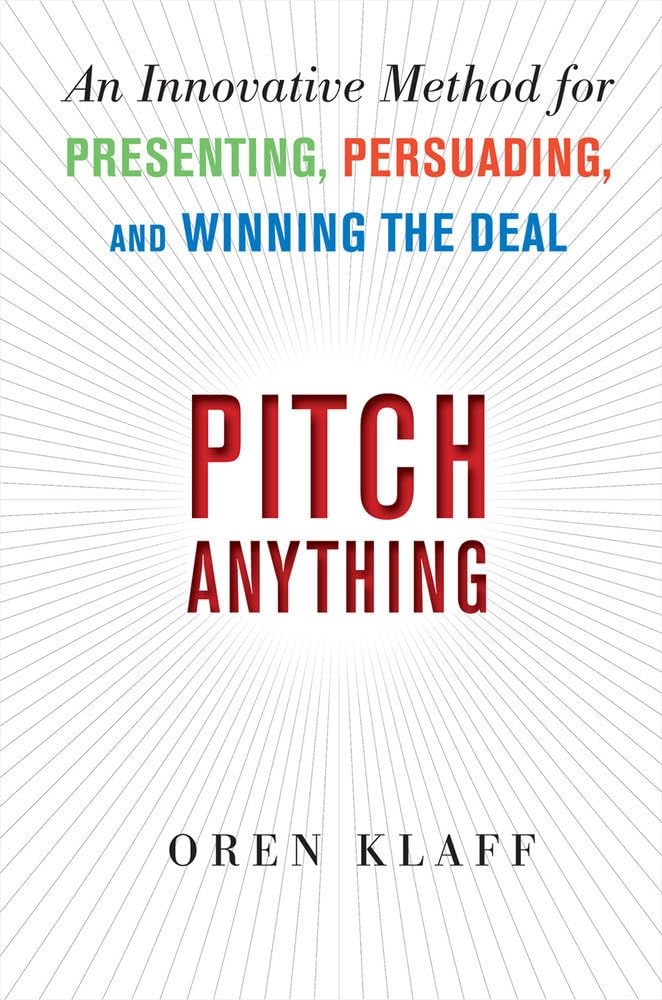
Pitch Anything: An Innovative Method for Presenting, Persuading, and Winning the Deal [KLAFF] on desertcart.com. *FREE* shipping on qualifying offers. Pitch Anything: An Innovative Method for Presenting, Persuading, and Winning the Deal Review: Klaff Provides Valuable Insights - A Must-Read for Those Seeking to Improve Their Pitching Skills - Pitching is highly valued today. It is an ‘art form’ requiring knowledge of human nature, how the brain receives information, communication skills, courage and a lot of practice. Pitching is essential to leadership in all aspects of life – motivating others to act, gaining traction for an idea, raising capital, landing the job or promotion you seek, raising children, and reaching consensus on key issues with your spouse. Pitching for me is integral to my work which is creating new companies in health care. Primary tasks include developing a core value proposition, creating a team – executive team, board of directors, advisors – and raising capital. I know the value of effective pitching firsthand and have had many great teachers – Charan, Gallo, Duarte, Weissman – who have helped me shape my pitching style. I can now add Oren Klaff and his “Pitch Anything” to the list. Klaff who is the Director of Capital Markets at Intersection Capital has written a gem of a book on pitching. “Pitch Anything” from my point of view is a must-have for novices and those seeking to improve their “pitching method.” Its’ subtitle, “An Innovative Method for Presenting, Persuading, and Winning the Deal,” describes perfectly what you will gain from this book. I have learned in my work with start-ups that many entrepreneurs and inventors build their pitch around what they want their audience to know, rather than what the audience needs to make a decision. There is a big disconnect between the way the pitch is given and the way it is received by the “target”. Entrepreneurs and inventors have incredible knowledge about their subject and make the most important points clearly, but despite being well organized and passionate, their pitch is not convincing and they lose an opportunity. First impressions are lasting. The book begins with an overview of Klaff’s preferred and proven six-step method for pitching, STRONG. 1. Set the frame 2. Tell the story 3. Reveal the intrigue 4. Offer the prize 5. Nail the hook point 6. Get the deal He has used this six step method to raise tens of millions of dollars for his clients. He continues with two excellent chapters on the importance of frame control (who owns the frame/power) and of status. Understanding and managing these contextual issues will influence the receptivity of your audience. ' Frame control - Everyone brings a frame to his or her social encounters. Only one frame will dominate and it will crowd out the weaker frame. This happens below the surface in every business meeting, every sales call and in every person-to person business communication. If your frame wins, you will enjoy frame control. ' Status - How others view you is critical to your ability to establish the dominant frame, and then to hold onto power you gained after taking control. Status is not earned by being polite. It is not earned through small talk. Neither according to Klaff will serve you well as they only reduce your status. Klaff shows how to create situational status so you can positively alter the way people think about you. Klaff then outlines a good pitch and uses a case study to underscore each of the keys to success. Several key takeaways include: • Let the audience know how much time you will take to put the “target” at ease. Why? They do not know how long they are going to be stuck listening to a stranger. This will help in keeping their attention. • Introduce your idea in one minute without details. The idea introduction pattern – “for _____(target customers who are dissatisfied with the current offerings in the market)…my _____is a _______(new idea or product category) that provides _______(key problem/solution features). Unlike _______(the competing product), my idea/product is ______(describe key features).” Then let them in on the “secret sauce” and the budget. • Make sure they know that the most important deliverable is you. • Use frame-stacking and hot cognitions (a whole chapter is dedicated to this) to lead them to a positive decision. Most major decisions are not made by cold cognitive processes such as evaluation analysis, but instead by hot cognition. Data is generally used to justify decisions only after the fact. This is only a snapshot of what Klatch describes. You will find much more detail with ‘how to” guides that are extremely helpful in crafting and delivering a successful pitch. Another key subject area that is covered in the book is ‘neediness’. Pitching or selling does not come without rejection no matter how skilled you are in the art form. The disturbing thing about rejection is that you really never get used to it. It’s natural and unavoidable to become disappointed when you get a “no”. You are human. If you let it, though, it will lead to validation-seeking behavior which is the number one deal killer. Klaff provides several key sources of neediness that come from within. We fall into validation-seeking behaviors when: 1. We want something that only the target can give us 2. We need cooperation from the target and can’t get it 3. We firmly believe that the target can make us feel good by accepting our pitch 4. The target seems uninterested in our pitch, begins to withdraw, or shift his or her attention to something else. The formula for thwarting this deal-killing behavior follows the rules of Tao: 1. I want nothing – eliminate your desires 2. Focus only on the things you do well – be excellent in the presence of others 3. Announce your intention to leave the social encounter – withdraw at crucial moment when they are expecting you to come after them. Success here will make them come after you. Those who pitch MUST consider that the brain has limited focus and capacity. For most, 90% of the message will be discarded. “Pitch Anything” provides a guide to pitching so you can get and keep the attention needed to own the room, drive emotions, and “hook ‘em” to the conclusion you seek. Review: A must-read before starting a conversation pitch. - Great book. Highly recommend reading this book before starting to pitch. It's not about polishing pitch decks and numbers; the techniques taught here are confidence-building skills that prepare you for a conventional pitch. I enjoyed it very much.


| Best Sellers Rank | #16,710 in Books ( See Top 100 in Books ) #3 in Running Meetings & Presentations (Books) #20 in Communication Skills #21 in Sales & Selling (Books) |
| Customer Reviews | 4.6 4.6 out of 5 stars (3,895) |
| Dimensions | 6 x 0.73 x 9 inches |
| Edition | 1st |
| ISBN-10 | 0071752854 |
| ISBN-13 | 978-0071752855 |
| Item Weight | 2.31 pounds |
| Language | English |
| Part of series | BUSINESS SKILLS AND DEVELOPMENT |
| Print length | 240 pages |
| Publication date | January 26, 2011 |
| Publisher | McGraw-Hill |
T**E
Klaff Provides Valuable Insights - A Must-Read for Those Seeking to Improve Their Pitching Skills
Pitching is highly valued today. It is an ‘art form’ requiring knowledge of human nature, how the brain receives information, communication skills, courage and a lot of practice. Pitching is essential to leadership in all aspects of life – motivating others to act, gaining traction for an idea, raising capital, landing the job or promotion you seek, raising children, and reaching consensus on key issues with your spouse. Pitching for me is integral to my work which is creating new companies in health care. Primary tasks include developing a core value proposition, creating a team – executive team, board of directors, advisors – and raising capital. I know the value of effective pitching firsthand and have had many great teachers – Charan, Gallo, Duarte, Weissman – who have helped me shape my pitching style. I can now add Oren Klaff and his “Pitch Anything” to the list. Klaff who is the Director of Capital Markets at Intersection Capital has written a gem of a book on pitching. “Pitch Anything” from my point of view is a must-have for novices and those seeking to improve their “pitching method.” Its’ subtitle, “An Innovative Method for Presenting, Persuading, and Winning the Deal,” describes perfectly what you will gain from this book. I have learned in my work with start-ups that many entrepreneurs and inventors build their pitch around what they want their audience to know, rather than what the audience needs to make a decision. There is a big disconnect between the way the pitch is given and the way it is received by the “target”. Entrepreneurs and inventors have incredible knowledge about their subject and make the most important points clearly, but despite being well organized and passionate, their pitch is not convincing and they lose an opportunity. First impressions are lasting. The book begins with an overview of Klaff’s preferred and proven six-step method for pitching, STRONG. 1. Set the frame 2. Tell the story 3. Reveal the intrigue 4. Offer the prize 5. Nail the hook point 6. Get the deal He has used this six step method to raise tens of millions of dollars for his clients. He continues with two excellent chapters on the importance of frame control (who owns the frame/power) and of status. Understanding and managing these contextual issues will influence the receptivity of your audience. ' Frame control - Everyone brings a frame to his or her social encounters. Only one frame will dominate and it will crowd out the weaker frame. This happens below the surface in every business meeting, every sales call and in every person-to person business communication. If your frame wins, you will enjoy frame control. ' Status - How others view you is critical to your ability to establish the dominant frame, and then to hold onto power you gained after taking control. Status is not earned by being polite. It is not earned through small talk. Neither according to Klaff will serve you well as they only reduce your status. Klaff shows how to create situational status so you can positively alter the way people think about you. Klaff then outlines a good pitch and uses a case study to underscore each of the keys to success. Several key takeaways include: • Let the audience know how much time you will take to put the “target” at ease. Why? They do not know how long they are going to be stuck listening to a stranger. This will help in keeping their attention. • Introduce your idea in one minute without details. The idea introduction pattern – “for _____(target customers who are dissatisfied with the current offerings in the market)…my _____is a _______(new idea or product category) that provides _______(key problem/solution features). Unlike _______(the competing product), my idea/product is ______(describe key features).” Then let them in on the “secret sauce” and the budget. • Make sure they know that the most important deliverable is you. • Use frame-stacking and hot cognitions (a whole chapter is dedicated to this) to lead them to a positive decision. Most major decisions are not made by cold cognitive processes such as evaluation analysis, but instead by hot cognition. Data is generally used to justify decisions only after the fact. This is only a snapshot of what Klatch describes. You will find much more detail with ‘how to” guides that are extremely helpful in crafting and delivering a successful pitch. Another key subject area that is covered in the book is ‘neediness’. Pitching or selling does not come without rejection no matter how skilled you are in the art form. The disturbing thing about rejection is that you really never get used to it. It’s natural and unavoidable to become disappointed when you get a “no”. You are human. If you let it, though, it will lead to validation-seeking behavior which is the number one deal killer. Klaff provides several key sources of neediness that come from within. We fall into validation-seeking behaviors when: 1. We want something that only the target can give us 2. We need cooperation from the target and can’t get it 3. We firmly believe that the target can make us feel good by accepting our pitch 4. The target seems uninterested in our pitch, begins to withdraw, or shift his or her attention to something else. The formula for thwarting this deal-killing behavior follows the rules of Tao: 1. I want nothing – eliminate your desires 2. Focus only on the things you do well – be excellent in the presence of others 3. Announce your intention to leave the social encounter – withdraw at crucial moment when they are expecting you to come after them. Success here will make them come after you. Those who pitch MUST consider that the brain has limited focus and capacity. For most, 90% of the message will be discarded. “Pitch Anything” provides a guide to pitching so you can get and keep the attention needed to own the room, drive emotions, and “hook ‘em” to the conclusion you seek.
L**N
A must-read before starting a conversation pitch.
Great book. Highly recommend reading this book before starting to pitch. It's not about polishing pitch decks and numbers; the techniques taught here are confidence-building skills that prepare you for a conventional pitch. I enjoyed it very much.
F**E
Disorganized, fails to deliver. High rating because the fragments of information are useful. just not what is promised
Entertaining, but poorly organized. The chapters are a MESS. There's not even a specific chapter allocated to (or so much as named after) each of the items in his acronym: STRONG. They're strewn across and mixed up between chapters. He never designates what category each item falls under, and frequently goes back to previous ideas which are also used in later ideas. It begins to feel like a mess of concepts and ideas which you use more fluidly, less of a step-by-step system. Other issues...: -He makes repeated promises throughout the story to "come back to that" and never does. -He actually never tells you how to "Nail the hookpoint" or even commits any substantial time to this. From what I can gather... it just happens after you "frame stack" on people? More on that in the next bullet...: -Many of the examples he uses are ridiculously extreme. For instance, in discussing stacking frames, he talks about the "Moral Frame." Now, from re-reading multiple vague sections, this is a required tactic for the hookpoint (I think? he never actually says if its an option or a requirement). His two examples of a moral frame are: 1) Mother Theresa, and 2) guilt tripping a $100 million con-artist. Yeah. Super useful, I'm sure I'm bound to meet Mother Theresa or a professional con-artist. Overall, the author repeatedly pitches you on the book, but then when you stop and think back, you realize that you got very few examples of how to implement except for ridiculous, grandiose, single-story case studies. The book would've benefitted from less bravado and more specifics. The single case-study extreme examples seem more of "oh I succeeded, lets try to guess what it is and then give it a name" than some tried and true system. Four stars because it was educational, interesting, and gave me a lot of helpful info. It simply isn't something that will truly give me many advantages in a pitch outside of trying to raise VC money for a tech company.
青**ス
This book is a powerful pitch, itself. Once you start to read, you never can stop or take break. When I complete reading with landing after 6 hours flight, I became a "croc brain" negotiator instead of "one of those guy". Thank you Oren!
D**S
Estava muito ansioso por esse livro e chegou bem antes do previsto.
J**N
If you are looking for some help with presenting any sort of information to an audience with the idea of getting a response, this book is for you. The author explains how the brain works when processing information on the side of the information sender and the information receiver. He lays out the concept of framing and status and how everyone's perspective influences how your information or presentation is received. He provides various solutions on how to breach those perspectives to convey your point and achieve the desired outcome. The book is very well written and thus easy to read. It does pick up scientific concepts here and there but does not go into a lot of detail on those. If this is what you are looking for, then you should look for another book. This book is more focused on getting the point across and references research and personal experience along the way. The author does a great job at summarising main points and referring back to them throughout the book which makes it easy to follow and retain. It also helps to find the right spot to re-read paragraphs. Main points are illustrated with stories from the author's life and he pauses every once in a while to highlight the points the example is referring to. The stories are interesting and helpful. They made me want to read "one more page" constantly. If this review was helpful, please click the button below.
J**.
Das Buch habe ich eher per Zufall gekauft, weil mich der Titel angesprochen hat. Dann habe ich das angefangen zu lesen und innerhalb von 3 Tagen durchgearbeitet, nicht nur durchgelesen. Das Buch ist für viele wahrscheinlich zu schwierig zu lesen, weil es extrem viel Verbindungen, Verknüpfungen und Vorwissen benötigt. Das Buch von Oren Klaff hat extrem viel wertvolle Informationen, die aber im Buch verstreut sind und eine literarische Schnitzeljagd verlangen. Und wer das rockt, wird viele coole Aha-Momente erfahren.
C**N
El mejor libro de mi año hasta ahora
Trustpilot
2 months ago
2 weeks ago