
DOWNLOAD THE APP


Customer Services
Copyright © 2025 Desertcart Holdings Limited
DOWNLOAD THE APP
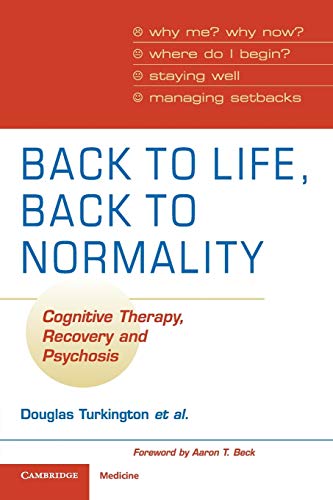
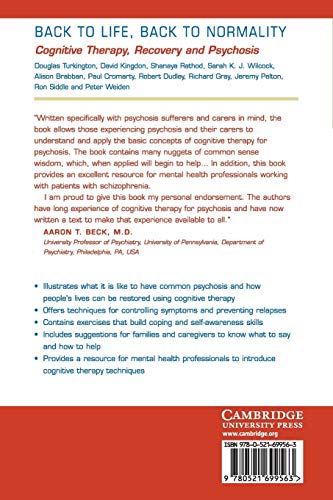

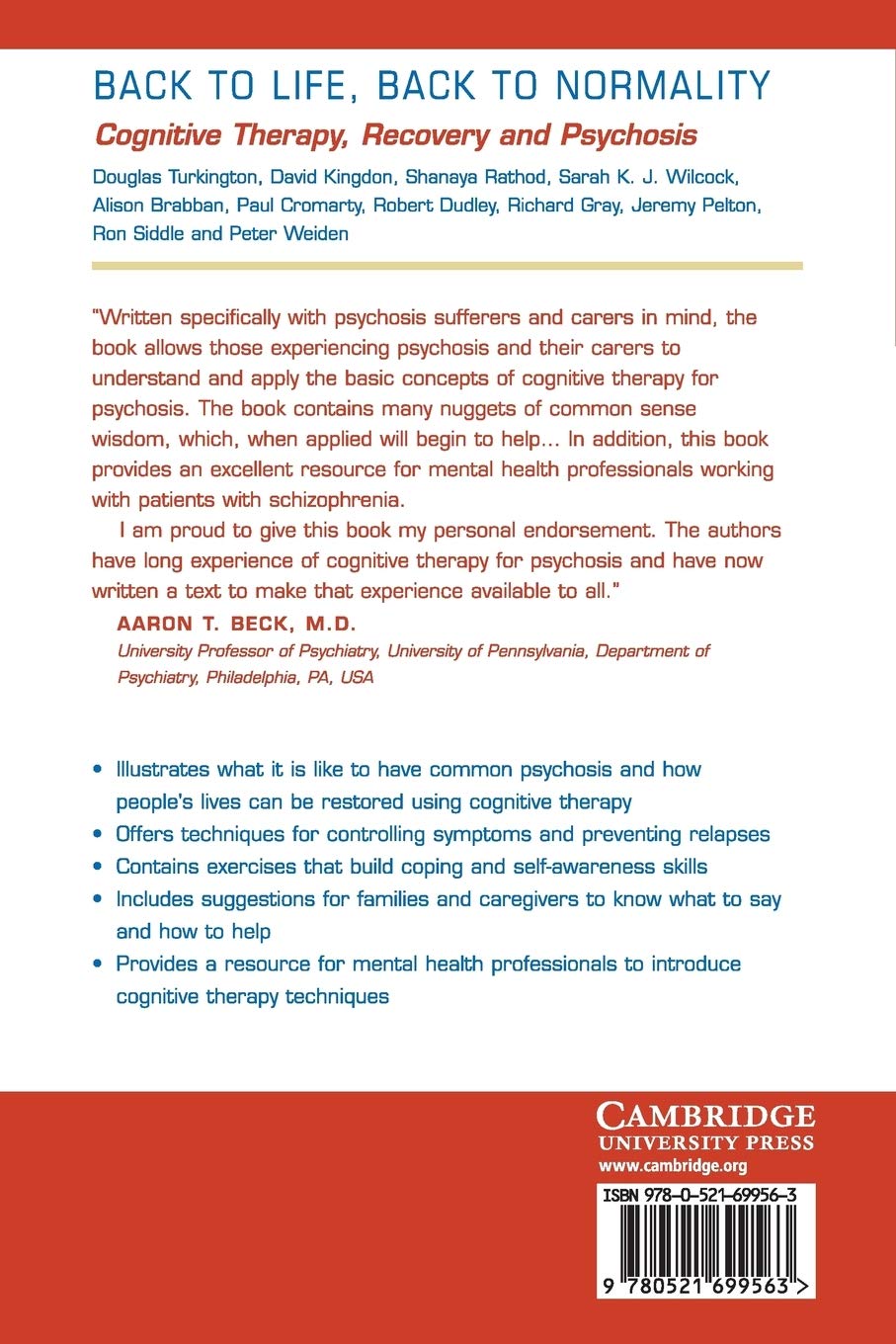
Buy Back to Life, Back to Normality: Volume 1: Cognitive Therapy, Recovery and Psychosis by Brabban, Alison, Kingdon, David, Turkington, Douglas, Pelton, Jeremy, Cromarty, Paul, Gray, Richard, Dudley, Robert, Siddle, Ron, Wilcock, Sarah K. J., Rathod, Shanaya online on desertcart.ae at best prices. ✓ Fast and free shipping ✓ free returns ✓ cash on delivery available on eligible purchase. Review: Very insightful and well written. Clear, easy to understand language, gives useful tips for dealing with anxiety. Very useful for the people helping the individuals going through psychosis. Highly recommend. Review: A concise and well-organised book which focusses in turn on precisely those areas which are likely to prove most problematic for individuals and their families. The emphasis is placed firmly on recovery and I liked the metaphors for susceptibility (the stress/vulnerability bucket, for example). On the downside it seems to me that this book avoids more complicated and enduring cases. The chapter on delusions seems to focus mainly on paranoia and would benefit, I think, from including more detail about other, perhaps more extreme experiences and distressing delusions. The book also seems to me to talk up the role of meds. To my mind the example of one individual gaining 3 stones whilst on Olanzapine then, after some work on her diet and over a period of 3 months, managing to lose a mere 4 pounds is not an optimistic or encouraging read. And, although Clozapine is mentioned for those who see little or no effect from other meds, there is no consideration given to those who, having failed to benefit, decide that medication is not for them. Someone who has already gained a lot of weight on Olanzapine and failed to benefit from another atypical anti-psychotic might not want to hear about another drug which comes with weight gain as a side effect. Overall impression - a good book for motivated individuals and their families, especially those with good insight and faith in the medical model. Well written and very clearly laid out. In my opinion, though, more challenging difficulties, especially in cases with poor insight, aren't given sufficient depth or coverage. There is also very little detail on how to cope with or address the so-called negative symptoms. I am left to wonder whether any of the authors have actually lived with anyone with psychosis and fully understand the toll that these symptoms can take on a family. This book represents an excellent start but to my mind would benefit from much more detail and a more serious attempt to address the day-to day problems that are often experienced - low motivation, poor personal care, disrupted sleep patterns etc. Basic CBT & sleep hygiene represent the sort of approach I'd expect from a low intensity IAPT therapist, NOT professionals advising on serious mental illness. Although this book does set out with a cognitive approach, it'd have to be much more sophisticated to convince me that this really could work in all but the most straightforward cases.
| Customer reviews | 4.4 4.4 out of 5 stars (37) |
| Dimensions | 15.6 x 1.17 x 23.39 cm |
| Edition | Illustrated |
| ISBN-10 | 0521699568 |
| ISBN-13 | 978-0521699563 |
| Item weight | 345 g |
| Language | English |
| Print length | 200 pages |
| Publication date | 12 March 2009 |
| Publisher | Cambridge University Press |
E**N
Very insightful and well written. Clear, easy to understand language, gives useful tips for dealing with anxiety. Very useful for the people helping the individuals going through psychosis. Highly recommend.
M**A
A concise and well-organised book which focusses in turn on precisely those areas which are likely to prove most problematic for individuals and their families. The emphasis is placed firmly on recovery and I liked the metaphors for susceptibility (the stress/vulnerability bucket, for example). On the downside it seems to me that this book avoids more complicated and enduring cases. The chapter on delusions seems to focus mainly on paranoia and would benefit, I think, from including more detail about other, perhaps more extreme experiences and distressing delusions. The book also seems to me to talk up the role of meds. To my mind the example of one individual gaining 3 stones whilst on Olanzapine then, after some work on her diet and over a period of 3 months, managing to lose a mere 4 pounds is not an optimistic or encouraging read. And, although Clozapine is mentioned for those who see little or no effect from other meds, there is no consideration given to those who, having failed to benefit, decide that medication is not for them. Someone who has already gained a lot of weight on Olanzapine and failed to benefit from another atypical anti-psychotic might not want to hear about another drug which comes with weight gain as a side effect. Overall impression - a good book for motivated individuals and their families, especially those with good insight and faith in the medical model. Well written and very clearly laid out. In my opinion, though, more challenging difficulties, especially in cases with poor insight, aren't given sufficient depth or coverage. There is also very little detail on how to cope with or address the so-called negative symptoms. I am left to wonder whether any of the authors have actually lived with anyone with psychosis and fully understand the toll that these symptoms can take on a family. This book represents an excellent start but to my mind would benefit from much more detail and a more serious attempt to address the day-to day problems that are often experienced - low motivation, poor personal care, disrupted sleep patterns etc. Basic CBT & sleep hygiene represent the sort of approach I'd expect from a low intensity IAPT therapist, NOT professionals advising on serious mental illness. Although this book does set out with a cognitive approach, it'd have to be much more sophisticated to convince me that this really could work in all but the most straightforward cases.
N**K
This book is for patients & caregivers by British (land of socialized medicine) psychiatrists & social services personnel--& provides URLs: British Assn. of Behavioral & Cognitive Psychotherapies: [...], British psych society: [...], & [...]. Chapters are by different authors with significantly different styles & depth. Meant for laymen, it has little technical languaging, but it needs considerable editing for style/grammar, & its' reading level is VERY low. However, per Rathod, p. 176: "Once you have sought expert help, it is important to get on & try to help yourself." Indeed, authors assume patients (suffering from psychosis, paranoia, schizophrenia, etc.) are on anti-psychotic medication while employing Cognitive Therapy (CT). It ignores Freud's subconscious & Jung's unconscious yet asserts that CT can effect cures. I find that difficult to believe--rather CT seems to be a coping technique like Behavioral Modification (which can quickly & effectively reduce symptoms & improve the quality of life for phobias & other ailments). But it's directed at symptoms not causes. But, per p. 53: paranoid is just an extreme of the norm & per p. 63, voice hearing is normal. Thus, IMHO the best part of this book is its' problem solving techniques & analysis of assumptions. The vast majority of "normal" people suffer from the same suppositions & lack knowledge of problem-solving, e.g. decision theory. Cromarty & Dudley pp. 48-57, Siddle p. 80, Gray p. 122, Brabban pp. 132-134, & Rathod p. 177 elucidate what Brabban's Table 7-1 calls Cognitive Distortions: black & white thinking, over-generalization, mental filters, jumping to conclusions, & emotional reasoning. Cromarty & Dudley add attribution--attributing specific motivations to other people when in truth p. 49: "Chance events happen frequently, & if we are really looking for coincidence & meaning there are actually lots out there to find" & p. 52: "We may have to work very hard to consider we could be mistaken." Or, per Brabban, p. 132: "Our schema or core beliefs lead us to sometimes distort the information that is available to us. We are likely to focus on aspects of the situation that fit with our own beliefs & discount the bits that don't tally with what we believe." So, per Rathod, p. 177: "Try & gather as much real evidence as you can before making any decisions about other people's intentions" & per Brabban, p. 161: "It is important to remember that our core elements, i.e., thoughts, feelings, & behavior can change & affect one another." Appropos IMHO! However, the VERY simple checklists, forms, childlike explanations & examples--remind me of the movie "Idiocracy" & "The Dumbing of America." Still, per Turkington, p. 77: [it's] not the presence of the voice...[but] the attitude toward it [that matters]. I suggest, regarding hearing voices, that the authors employ Buddhist shamatha (tranquil abiding) meditation--a meditator just watches thoughts go by without delving into their content--like seeing spam show up in your spam folder--just "let it be." Regular practice increases the delay between thoughts/words. Pema Chodron thinks "thinking" when she perceives a thought ( How to Meditate with Pema Chodron: A Practical Guide to Making Friends with Your Mind & Bodhisattva Mind: Teachings to Cultivate Courage and Awareness in the Midst of Suffering ), but with mental patients, I'd substitute the word spam. It's important to identify words/voices as something you have or experience--NOT part of you or defining you. Per Rathod p. 175, "Would others (e.g. Dr Who) think this way?"
J**N
I wanted to read this book because I am familiar with the cognitive therapy techniques pioneered by the late Dr. Albert Ellis and have a great deal of respect for the man and his work. The publisher says the book is "[w]ritten specifically with sufferers and carers in mind, to help them understand and apply the basic concepts of cognitive therapy for psychosis". That claim made me very curious. My mental image of psychotics is of people who are completely out of touch with reality. I am glad that I took the time to read the book. While I am not a carer or a psychotic, I was surprised to learn as much as I did about caring for psychotics, what psychosis actually is and how cognitive therapy can be applied not only by carers, the expression denoting those who care for psychotics in various ways and can include not only professionals, such as nurses, but family as well, but also by the psychotic person. I can't really rate the book as a carer: I'm not one. And I don't think I am a psychotic. But the book still proved to be unusually interesting and informative. It describes the wide range of psychotic thinking, some of which is just barely removed from "normal" thinking. The concept of normalcy is also discussed. The application of cognitive therapy by carers and psychotics themselves lends to some fascinating discussions. (Nine authors contributed to the volume.) I don't know how to describe the audience for this book outside its intended one of carers and sufferers. If it weren't for my prior knowledge of Dr. Ellis and his theories of cognitive therapy, I wouldn't have been interested. The book certainly broadened by knowledge of what psychosis is and how cognitive therapy can be used by those supporting and caring for a psychotic and the psychotic patient themselves. An unusual read for someone not directly involved, but a good one. Jerry
S**T
To provide a baseline on my perspective, I have no formal education in psychology, psychiatry, or medicine, but I am overeducated in general and I have an immediate family member who has had severe unipolar depression with psychotic episodes for the last 12 years. So I am pretty knowledgeable on psychosis for a layperson, but by no means a mental health professional. I'll say right off the bat that this book is really going to be of interest to people who have experienced or are experiencing psychotic episodes or disorders, their caregivers, and healthcare professionals, and probably not anyone else. It is a pretty concrete how-to sort of book, not a general background text on psychosis. This is also a book which is focused on therapy, recovery, and maintaining recovery; it is not a crisis intervention manual. If you have a loved one who is in the psychiatric unit at city hospital on a 72-hour hold because they tried to commit suicide, this is not a book to bring them in the hospital, or for you to read while they're in the hospital. This is more of a book to read after the crisis has passed and the patient is stabilized but not back to functioning as well as they did before the crisis, as part of a program to achieve as full a recovery as possible. In that light, I think it could be quite helpful and is somewhat unique among books on psychosis. Cognitive therapy basically deals with the linkage between our thoughts and what we do in response to those thoughts, and how all this affects our experience of the world around us. So there is a lot of focus on identifying specifically what you are thinking, how that makes you feel, what you do in response to those feelings, and whether that chain results in outcomes that are positive for you. If the outcomes are not positive, then a big part of cognitive therapy involves identifying ways of changing your thoughts, changing the feelings you experience as a result of your thoughts, and changing the actions you take in response to those feelings, to produce more positive outcomes for your life. The book provides a set of questions, exercises, and checklists for self-application of cognitive therapy techniques to situations and symptoms common to many psychotic disorders, including paranoia, hearing voices, delusions. etc. It also deals with antipsychotic medications and decisions about continuing or discontinuing their use. There is a chapter specifically advising caregivers, as well. Each chapter follows a somewhat similar structure, opening with some background on the chapter topic, as well as some "normalizing" information (for example, paranoia is something that everyone experiences, and depending on the situation and degree of the paranoia is not necessarily a psychotic symptom...being afraid to ride the subway at midnight carrying a large sack of cash is a lot different than being afraid to walk down the driveway to the mailbox because you think your mailman wants to kill you). If you're familiar with "The Feeling Good Handbook" or "A Guide to Rational Living," then the checklists and exercises in "Back to Life" will seem very familiar to you. The key difference is that the two former books provide a set of tools for applying cognitive behavioral therapy for the "average" person experiencing problems which may be stressful and trying (marital problems, anxiety about your job, feelings of inadequacy, mild depression, etc.) but are not necessarily related to any sort of neurobiological disorder (e.g., bipolar disorder, schizophrenia, etc.). This book is a guide to applying these tools for people who are experiencing psychotic episodes. So whereas an example problem from "The Feeling Good Handbook" might be "I don't like to go out in public because I'm extremely overweight and every time people look at me I feel like they're thinking about how fat I am," this book might have an example such as "I don't like to go out in public because every time someone looks at me I believe they are an agent of the sinister government conspiracy against me." Although the level of the material is pretty accessible to a layperson, if you are approaching it as an absolute beginner you will probably want to supplement it with some general reading on specific mood or thought disorders, since the book really focuses mostly on responding to various symptoms common in psychosis rather than giving a lot of background on mental illnesses. The book is written by British doctors, which is obvious from the tone and colloquialisms, although I think there is nothing that the average American reader would have issues with. It does, however, mean that some of the specific information about services that are available (such as advance care directives and crisis intervention teams) may not apply in other countries (such as the USA, where procedures and services vary considerably from state to state, and even within states by county or city).
Trustpilot
2 months ago
1 month ago