
Desertcart purchases this item on your behalf and handles shipping, customs, and support to EGYPT.
📈 Elevate your teaching game—be the champion your students deserve!
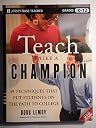
Teach Like a Champion is a best-selling educator’s toolkit featuring 49 specific, research-backed techniques designed to improve classroom management, student engagement, and academic outcomes. This edition includes a DVD with 25 video demonstrations, making it easy for teachers—especially early-career professionals—to implement effective strategies immediately. Praised for its practical, flexible approach, the book empowers educators to build a disciplined, inclusive, and high-performing classroom culture that prepares students for college and beyond.


| Best Sellers Rank | #112,225 in Books ( See Top 100 in Books ) #1,032 in Education (Books) #1,061 in Instruction Methods |
| Customer Reviews | 4.6 out of 5 stars 899 Reviews |
S**N
Great book, worth the money and time!!
Teach Like A Champion is hands down the best book that I have read (to date) that aims to improve one's teaching skills. What is especially nice about it is Lemov's tone. As you reading his book, he is very humble about his suggestions and reassures you that all of the techniques he mentions are not some new fancy development that he's invented but rather simple observations he's noted various successful teachers enacting. Another helpful aspect of this book is the way the techniques are broken down. Most of his techniques are discussed in less than one-two pages. He is very concise and deliberate about his wording so that you are sure to understand and remember the content of his suggested techniques without having to re-read the passage again and again. Yet another beneficial feature of Lemov's book is the numerous examples he provides for his readers. He makes sure to use examples from a wide range of topics and not just one content area or grade level and they are all easy to visualize for teachers with any sort of experience. All of the techniques he mentions are also age and subject indiscriminate so an educator of any class would benefit from reading the entire book cover to cover. The techniques are also able to work with any demographic of students whether they are privileged or underprivileged, urban, rural or suburban, with or without disabilities. Although you might not agree with all of the techniques or his reasoning for including them, you will undoubtedly walk away from reading the book with a clearer understanding of how to implement good teaching. His techniques help you build a classroom culture revolving around discipline (how to do the right thing), management ("reinforcing behavior by consequences and rewards"), control, influence, and engagement. Again, what he has outlined is not magic but with a conscious effort and practice anyone using even just a combination of some of Lemov's techniques is bound to see an improvement in classroom participation, student confidence, student behavior/misbehavior, and overall classroom efficiency. Lemov's book functions on the assumption that the students entering your classroom do not behave the way they should because they do not know any better, therefore, once you explicitly teach them what you expect of them, with enough practice most, if not all students, will fall into line. When done properly your students will certainly be college and career ready!
H**L
Ideas on what to DO.
I first learned about Lemov's book after reading a NY Times article about the author, bought the book when it first came out last spring, and have spent the last few months implementing the ideas. I am excited about the changes these techniques brought to my classroom! If you are a teacher, finish reading my review, then click that add to cart button. This is the resource you have been looking for if you want practical and SPECIFIC things to actually do in your class. If your college ed classes were like mine, they were all about theory and never showed you things that you should DO. This book helps solve that. Unlike most technique books, Teach Like a Champion (yes, yes, terrible title) is not some regimented "system" that expects you to take it whole or not at all. Rather, it is essentially a list of techniques that highly successful teachers often use. The tools come from KIPP and other charter schools that take the "no-nonsense" approach. I thought I wasn't that type of teacher. I thought I was about encouraging self-learning and academic exploration. But after seeing the academic success of his ideas, and seeing how they RESULT in the type of student I had hoped mine were (but weren't yet), I'm pragmatic enough to change course. Lemov breaks the techniques down into basic categories like lesson planning, behavior management, etc. Each technique is given a pithy name, which I found to be surprisingly useful. By naming the techniques the way he did, he makes them more easily implemented. In the heat of the moment, when I only have half a second to think, the names allow me to intentionally use them. It's a lot easier to say to yourself "okay, I'm going to positive frame" than it is to think "okay, I'm going to describe what it is that I want to see, instead of describing what I currently am seeing." They're mnumonics. After naming each technique, Lemov explains his theory behind it and provides examples, scripts, etc. Some of the ideas are complex. It is impossible to actually absorb the book all at once, especially since so many of the techniques take practice to do well. But you can reflect on the things you most want to try and there is enough information to get you started. I began with Cold-Calling (calling on students that I want to hear from, not by who raised their hand). After I was practiced enough, I could tack on another tool. And after that another. And so on. Nobody uses all of the techniques. Maybe the idea won't fit the student's age group, or the teacher's personality, or the school's culture. Lemov encourages flexibility instead. And I like his pragmatism; if it works great! If not, try something else. I teach high school, so some ideas (like an entry song) won't fly. But others will. I thought enforcing SLANT (sit-up, listen, ask questions, nod, track speaker) wouldn't work, but my students had strong buy-in and in-class discussions noticeably improved. Most importantly, every week I can tell my craft is improving.
J**R
An Essential Resource
New and experienced teachers alike will find much benefit from buying and using the strategies in Doug Lemov's new book, "Teach Like a Champion". Featured prominently in a recent New York Times Magazine, Lemov observed in many different schools, and began compiling strategies that effective teachers were using in their classroom, creating a list and eventually, this book. The end result is an easy book to "dive into", or read cover to cover (Lemov recommends the latter, but says you can do the former), and have it improve your teaching practice quickly. Lemov organizes his book into two parts. The first details the strategies that impact teaching, learning, and instruction. The second focuses briefly on reading strategies. The first part is organized into: Setting High Academic Expectations, Planning that Ensures Academic Achievement, Structuring and Delivering Your Lessons, Engaging Students, Creating a Strong Classroom Culture, Setting and Maintaining High Behavioral Expectations, Building Character and Trust, Improving Your Pacing, and Challenging Students to Think Critically. An area of interest of mine was "Building Character and Trust", so I immediately jumped to that section. There, I found strategies such as using positive framing (correctly behavior with a positive spin, instead of negative reinforcement), and the power of precise praise. Nothing in this section is revolutionary, or even would create a dramatic and philosophical change in my practice. But I think that's truly a strength of this. All teachers can use these reminders (as it is some of our most experienced colleagues that forget this). To have many of these collected in one resource can be both a time saver, and a most usable resource in a classroom. Lemov has captured the essence of teaching in this new, powerful book. I would only hope that every teacher in American takes a look at this book.
A**R
Well worth the purchase
I have to admit, I knew nothing about Doug Lemov's book, Teach like a Champion, nor did I review it before making my purchase. It was going to be one of the designated texts for one of my first master's courses, and I had so-so expectations. I have read a lot of instructional books before, and too many of them have left a dry taste in my mouth, so I was pleasantly surprised by what Lemov's book had to offer. Lemov's book has this ease and natural voice that doesn't suck away your life energy like some of the educational texts out there. He makes great use of bold and shading sections, so you are really able to take out the most important concepts in each chapter. Plus, he offers videos and mentions real life teachers who have inspired his writing; it creates pragmatism for the overall book. This book is not heavily weighted down by unnecessary and sometimes overwhelming details and research. Now if you are research enthusiast--this is probably not the book for you. Lemov's book never goes into concrete data or statistics when discussing his techniques for "champion teaching." For me, this was one of the text's best features. Lemov's writing is light and straightforward and goes directly into techniques and ideas to help with the classroom. He discusses so much: from classroom culture to classroom management, reading to questioning--there are some easy, simple, but notable ways for educators to improve their classrooms. Some of his hidden gems are "Cold Call," "Everybody Writes," and "No Opt Out." "Cold Call" and "No Opt Out" creates classroom accountability for every SINGLE STUDENT, and everyone participates. No excuses. No shrug offs. How many times have teachers heard crickets in the classroom when asking a question, or gotten the "umf, Idunno" response. He offers some solutions and the beauty is it works! His ideas are so simple, but they create a new understanding of responsibility for the teacher, the student, and the entire classroom. They are often unadorned techniques, but effective tips that educators need to think about, or be reminded of. The 49 techniques he reviews are applicable, and are offered because they can create results. Even though I consider my teaching skills "well seasoned" before reading this book, Lemov still has new ideas, as well as old ideas that teachers need to review. Teachers of all levels can find value in his book, and it is written clearly and efficiently so you can pick and choose what you want to review and apply it yourself--no matter your grade level or classroom. Now some of his concepts may feel elementary, but there is still merit in some of his other chapters for secondary teachers; for instance "change the pace," which means moving students to new activities every 10-15 minutes is not just needed in elementary classrooms. Teenagers can get just as antsy and his idea of switching up the activities, but not the topics, is something every teacher--at every level--needs to think about. My only complaint about the book is when Lemov uses financial and business analogies to describe students and their learning. Lemov discusses a "Hit Rate" and the level of student productivity and output....well, I still can't put it down in words clearly myself, because I am still pretty befuddled with these comparisons. That was the only weak spot in the text, but it appeared later on, in the last chapters; he already sold me on his 49 main techniques at the start of the book, so forgave him. Still, Lemov's book overall is a beneficial read, and I could see it be used for new teachers, as well as select chapters or strategies being reviewed by some of our veterans teachers as well--it well worth the purchase.
B**H
The Section on Teaching Reading is Fantastic
I enjoyed this book and am excited to implement many of the 49 techniques in my classroom (some of them won't, I don't think, work for my inner city 11th graders, a point made in other reviews). Just based on the 49 techniques, I might have given the book four stars, since I think a bit of discussion of age-levels might have been useful (the DVD is almost all, or all, middle and elementary school). But almost half the book presents material beyond the 49 techniques, including very useful discussions of lesson pacing and teaching reading. The latter section was like an entirely other book, and was among the most interesting discussions I've read on the topic (and since I'm a high school English teacher just finishing up the Johns Hopkins teaching Masters, I've read a fair bit on it). Two of the insights that I need to discuss with my school and investigate further, and which have HUGE potential ramifications: 1) He advocates homogeneous grouping (by ability) for maximum student achievement (I wish he'd said more about this and provided references). If he's right, he could make a huge positive impact by pushing this harder; my school does the opposite, as do many schools, and I've thought it's a big problem, but there's not much willingness to challenge it; the science is, I thought, against my instincts... 2) He spends quite a bit of time dissing the standard method of teaching reading that uses comprehension strategies. He is especially disdainful of "visualization," but isn't kind to any of them other than summarizing. He's convincing, but again I'd have appreciated citations. My school is using Strategies That Work, and while his arguments make serious intuitive sense, I would have enjoyed a bit more reference to studies and/or elaboration on his points. Overall, this book will improve my teaching significantly, and will thus have a positive impact on the lives of the few hundred kids I'll teach this year. It must feel good to be Doug Lemov.
N**N
Best single book about teaching that I have ever read
Disclaimer: I have bachelor's and master's degrees from a nationally-ranked College of Education at a large public university in the southeast. I spent 6 years in higher education learning how to teach and about education. One-thid of that time was specific to middle schools, where I reach now. I have read hundreds of books or excerpts from books about all sorts of topics in education. This book is the most practical of all of those. I first read about this book in a New York Times magazine article entitles "Building a Better Teacher." After reading excerpts online, I decided that I should preorder it. I am very thankful that I did. It is the single best book about the specific practices of teaching that I have ever read. I have told every teacher I know about it, with the recommendation that they need to purchase it to see how it can transform their practice. Doug Lemov distinguishes between strategies and techniques. Strategies are generalized statements (i.e. have high expectations, promote student engagement, encourage students to read), while techniques are the specific actions that accomplish those strategies (in Lemov's language, No Opt Out, Strong Voice, etc). This book focuses on techniques to use in the classroom, which makes it incredibly helpful. Lemov gives specific instructions for each technique to addresses, as well as possible dialogue and teacher responses. There is also an accompanying DVD with many of the techniques filmed in the some of the best classrooms in the northeast. I have tried several of the techniques in my sixth grade math classroom, and each has worked. Some, like No Opt Out, must be used in concert with your expectations and classroom culture. Others, like the technique of interrupting yourself if students are taking when you are giving directions ("Please turn to your partn-") work amazingly well if getting the attention of my students, even the one who struggle to behave appropriately. I would recommend this book to every teacher, both novice and experienced. As a novice teacher, I have found techniques that have made my job much easier, which has made me a much more effective teacher. Experienced teacher who I know have read the book say that they are learning techniques to implement their heightened academic or behavioral expectations, which has renewed their excitement about teaching. There are excerpts available through Google Books and on the publisher's website (the Josey-Bass webpage for this book). Read them, and then buy this book. You will not regret it.
K**C
The Good, the Bad, and the Ugly
I bought TEACH LIKE A CHAMPION despite its admittedly cheesy title and without knowing that it was featured by the NY TIMES (which I gather from a sampling of other reviews). Before finishing Doug Lemov's introduction, I realized I was reading a book from "the charter camp" or the "standardized tests slash data is everything" camp. OK. Not having a closed mind (last I checked), I took a deep breath and dove in. Coming out the other end of the rabbit hole, I see that Lemov's Wonderland is not for everybody, but there's something in it for everybody. I said someTHING (or things). Others may find it far too elementary (literally -- given the age groups covered -- and figuratively). And though all of Lemov's teachers and examples come from private and charter schools and most of them are from the Uncommon Schools he himself is a part of, public school teachers can glean something from this mixed bag, too. Let's start with the good: TEACH LIKE A CHAMPION is a practical book with strategies that can be used immediately in the classroom. You can use all, some, or a few if you wish. Why do I mention this first? Many teachers who invest in professional development books complain that their purchases are too much on theory and not enough on practical ideas. That won't be the case here. Satisfied? Next: this is about as basic a nuts and bolts text as you can buy. Lemov names things experienced teachers might not even bother to, such as "No Opt Out" (meaning: it's bad to let a kid say, "I don't know") and "Right Is Right" (meaning: you have to answer the question fully and accurately). Still, what looks obvious to teachers already in the trenches might not be to newbies and interested parents. Also, if you're a new teacher who feels like you're being fed to the lions with only platitudes from the veterans for assistance, you'd do well to hang your hat on this book's techniques before you review your notes from college education courses or repeat the mantra "Don't smile until Easter." The Uncommon Schools are mostly inner city ones proving that socio-economic factors can be negated if a school develops a business-like attitude with predictable structures and techniques. So even if you're in a public school, many of these ideas -- if used consistently and rigorously -- might help. Now for the bad (if it strikes you as ugly, so be it): Veteran teachers will mostly shrug because little if anything is new. Also, many of the approaches -- and this is confirmed by the accompanying DVD in the book's sleeve -- seem hopelessly regimented. Even fun is planned, boxed, and labeled -- in this case, into something called "Vegas" (performing for the kids or kids performing for you -- briefly now!) and the "J-Factor" ("J" stands for -- surprise! -- "Joy" and includes competitive games, dance, and song, but only briefly now!). The brief jokes are only half in jest. Lemov is constantly reminding you that time is of the essence, that you own the classroom, that you'd best get back on task ASAP or the kids' standardized scores and chances for going to college will plummet. To which I can only say, "Good grief." Spontaneity and tangents in the classroom can often lead to wonderful places where learning and enrichment DO occur (even if it wasn't planned and even if it has no silly name). And the video. Well, each clip is designed to show a strategy (though not all are shown -- not by a long shot). The trouble is, you might see a teacher showing one strategy while not observing another. For instance, a teacher could be showing the "Right Is Right" technique while students in the clip are not observing the SLANT (Sit Up/ Listen/ Ask and Answer Questions/ Nod/ Track the Speaker) one. They're slouched in their seats or doodling and certainly not looking at the speaker. And one clip demonstrates a means of "Tight Transitions" by showing a teacher instructing kids on how to pass out papers quickly and to a timer (lots of timers in these clips -- remember, "regimented"). The object is to pass papers across by row so kids don't "waste time" twisting around while passing it back. And yet SLANT demands that kids "track" the speaker -- and because of the traditional seating arrangements favored by Lemov et. al. (it has a name, of course -- "Draw the Map"), kids have no choice but to "waste time" by twisting in their seats to look at classmates in back. You also see gimmicks like one or two claps, a brief cheer, all timed and clipped neatly, much like military instructions and echoes. OK, my next technique I'm going to name "Wrap Up." Here goes: I'd recommend TEACH LIKE A CHAMPION to new teachers, struggling teachers, and teachers in need of classroom management help. Veterans -- especially of the public schools -- might get a bit indignant at the way the obvious is gussied up here. They also might take issue with some of Lemov's opinions. For instance, he dismisses silent reading for enjoyment in class as wasteful chiefly because it is not "measurable" and you cannot guarantee that every child is actually reading. But what if even 19 out of 25 ARE reading, and what if they get hooked and finish the book at home (especially if the wise English teacher assigns 30 minutes of independent reading for homework)? What if constant reading time improves fluency, widens the students' interests in books (especially as they hear their classmates talk about THEIR books)? Lemov seems to be losing a lot of baby with this bathwater. Oddly, while he condemns SSR, Lemov advocates the ancient practice of reading aloud popcorn-style (which can be torturous and brutally boring, even while applying Uncommon strategies... sorry). Isn't it possible that the non-reading kids are also not reading along or paying attention, just as with SSR? Lemov believes random picking of non-volunteering students (technique label: "cold-calling") will cure this, but you'd have to cold-call frequently (a problem unto itself) to keep EVERYbody on his or her toes. Is the book food for thought? Some. Is it grist for the argument mill? That, too. How about worth your money? Check your demographic. And politics. Then give it a name, will you? < clap, clap -- track the reviewer! >
M**E
Techniques is probably the wrong word anyway (more like Luther's theses
Get the kid's book. Don't let his youth or his sales-like, one size fits all approach put you off. He's right, and I wish I had known this stuff 28 years ago, when I first started. There are more than 49 techniques, because each one assumes you have a skill set. Techniques is probably the wrong word anyway (more like Luther's theses?), and they're not presented in the best order (Strong Voice might should be first, and it's clearly not a technique or even a skill, it's a mindset), but don't let any of that keep you from reading his book. He's right about each one of them, he's done more research than any education prof I ever had or knew about, and he's nailed what I always assumed was elusive or dependent on factors beyond my control. This is really an earth-shattering book for teachers. I couldn't even read it in bed. I had to get up, move into the kitchen where I had set up my getting-ready-for-school power station, and study the kid's book. It's that incredible. What I always thought was something I would never have as a teacher, command and control, he has explained to me (and, there's even a video included) in incredibly intricate detail and with remarkable simplicity. There is no jargon here, just crisp prose. I'd keep lauding this book, but I forgot what technique 22 was, so I have some more studying to do.
S**R
Excellent set of take-awayable-techniques backed up with common sense and not vague theories
Excellent book written by a man who comes across as insightful and blessed with real common sense. This books reads like it wants to help you become a better teaching and not showcase how great the author is. I have taught in extremely challenging schools for ten years and have consistently been graded as a good to outstanding teacher by both my peers and the government and I was better the following day after reading the first few chapters. For the last 8 years I have been involved with the mentoring of trainee and new teachers and in the delivering of whole school CPD - this role just got easier. The trick to getting the most out of this book is to read it with an very open and honest mind - many, many of the tips are familiar, but do you really do them well and do you really do them all the time. If you add consistency to the tips in this book you will fly. There are even some brilliant and decievingly simple techniques that border on the micro management of the class, but as a practioner that runs a behaviour unit I can wholeheartedly endorse this approach. I have started using this book in a weekly 30 minute coaching breakfast and the attendees get better by committing to a couple of techniques every week - I recommend teachers to buy this book and not let the title put them off.
C**A
Excellent guide
This book arrived in excellent condition, and was well packaged. This is going to be a read for the coming weeks so I can't evaluate the book itself, aside from I would have bought it having flipped through it in person.
A**R
Be a great teacher. Add it to the curriculum of every ...
Apply these lessons. Be a great teacher. Add it to the curriculum of every University. It's that good.
S**R
Go for it...
Nice Book
M**R
Recommended to all my staff
The book and strategies are very good and I have recommended that all my teaching staff purchase it. Good read.
Trustpilot
2 weeks ago
1 month ago