
DOWNLOAD THE APP


Customer Services
Copyright © 2025 Desertcart Holdings Limited
DOWNLOAD THE APP
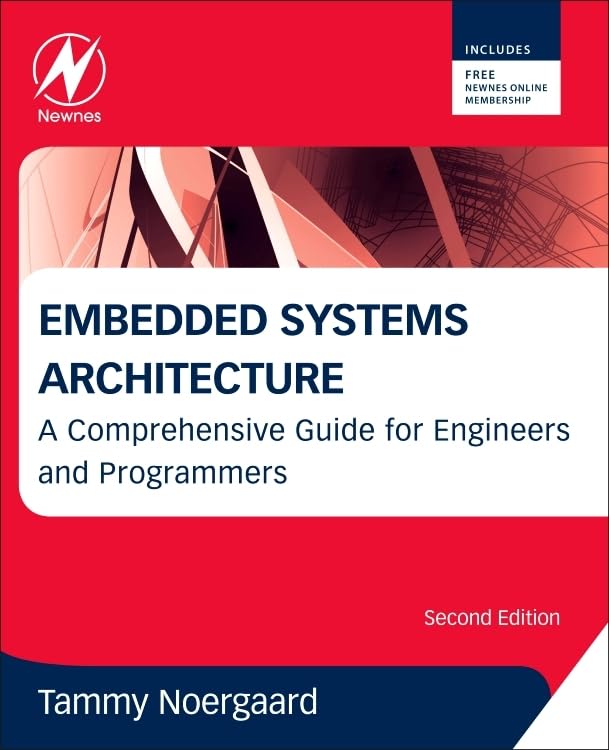
Buy Embedded Systems Architecture: A Comprehensive Guide for Engineers and Programmers 2nd Revised edition by Tammy Noergaard (ISBN: 9780123821966) from desertcart's Book Store. Everyday low prices and free delivery on eligible orders. Review: The first edition of this text became the premier source for both new Engineers and Programmers in Embedded systems (ES), and the go-to reference work for experienced users. Tammy covered ALL aspects of ES in the first edition, and this astonishing new edition updates the very latest changes in parallel processing, FPGAs and numerous other details. Both big picture and excruciating detail are given, and not just for obvious applications like Noergaard's own digital TVs and the expected Automobile chips. Medical devices, servers, network routers, office automation, cell phones... they're all here! Regardless of whether you're new to systems engineering or an old pro-- the rest of your career will surely relate to embedded systems, because the day of the old general processor is fading fast-- everything today IS or HAS ES! Even server farms are controlled and linked with embedded controllers. If you didn't get the first edition, you're still in for a real treat. Tammy FILLS the pages with well over 1,000 schematics and diagrams, from the 30,000 foot design level down to middleware, assembly implementation and overcoming heat and memory nightmares. Common errors are explored in depth with solutions. Although intended for self study and reference for Programmers and Engineers, this also would make an outstanding text for a 2 or 4 semester course on ES. At nearly 700 pages, there are numerous logical "breaks" that could make excellent course modules. The online (downloadable) material is wonderful, including the code. Like most ES we're still talking about C rather than C++ or C# in most cases, but that's still what 90% of the processors are built to support. Extensive code is given thoughout as well as circuit diagrams, operating systems and application software. I teach embedded systems in online courses via classpros dot com and have used the top 14 texts in this field. NONE have the depth, breadth and completeness, or currency, of this edition! If you want an overview of the entire field, or just a reference that's missing nearly nothing, this is it. A breathtaking accomplishment and a must have for any Software/ EE library. NOTE: Because of its comprehensive nature, "architecture" is not the entire focus as other reviewers have said, and if you're expecting this to be 700 pages just on architecture, it isn't! Library Picks reviews items only for the benefit desertcart shoppers and our library acquisition editors, and we have nothing to do with the author, publisher or desertcart. We ALWAYS purchase the titles we review-- thanks for your consideration and happy designing! Review: The book is worded in a very burocratic, sense-eluding manner, with countless repetitive self-referencing passages of style "this topic is very important and hard". No explanation of any topic whatsoever. The best part are the pseudocode insertions that allegedly explain something but in reality just provide examples of pointless desperate attempts to look professional. Book is full of out-of-context insertions from various vendors that are included only to increase the size of the book e.g. "look, MPC860 has I2C, here it is" followed by an image with 3 dozen vendor specific acronyms with the I2C rectangle highlighted by the author. There would be no reference to this image after that, untill 3 pages later it's repeated this time with another acronym highlighted by author. Feels like playing "Where's Waldo". It happens hundreds of times within the book and each and every time the included diagram/schematics/table is left without any comments, analysis or justification of why it was necessary to mention it in the first place. Sincerely, I wasn't able to think of any reason why would anyone read this book. Wikipedia article on any topic in the book would be more readable, insightful and useful. Special surprise was to find the poor quality of layout and editing. OK, the material is bad but what prevented from structuring it good? Font size is all over the place, tables have empty cells, illustrations and schematics have lines dangling in free space instead of terminating somewhere.
| Best Sellers Rank | 2,737,438 in Books ( See Top 100 in Books ) 936 in Computer Architecture & Microprocessors 1,436 in Electronics & Telecommunications Engineering 2,463 in Computer Hardware (Books) |
| Customer reviews | 3.9 3.9 out of 5 stars (7) |
| Dimensions | 20.32 x 5.08 x 25.4 cm |
| Edition | 2nd Revised edition |
| ISBN-10 | 0123821967 |
| ISBN-13 | 978-0123821966 |
| Item weight | 1.36 kg |
| Language | English |
| Print length | 768 pages |
| Publication date | 8 Jan. 2013 |
| Publisher | Newnes |
P**Z
The first edition of this text became the premier source for both new Engineers and Programmers in Embedded systems (ES), and the go-to reference work for experienced users. Tammy covered ALL aspects of ES in the first edition, and this astonishing new edition updates the very latest changes in parallel processing, FPGAs and numerous other details. Both big picture and excruciating detail are given, and not just for obvious applications like Noergaard's own digital TVs and the expected Automobile chips. Medical devices, servers, network routers, office automation, cell phones... they're all here! Regardless of whether you're new to systems engineering or an old pro-- the rest of your career will surely relate to embedded systems, because the day of the old general processor is fading fast-- everything today IS or HAS ES! Even server farms are controlled and linked with embedded controllers. If you didn't get the first edition, you're still in for a real treat. Tammy FILLS the pages with well over 1,000 schematics and diagrams, from the 30,000 foot design level down to middleware, assembly implementation and overcoming heat and memory nightmares. Common errors are explored in depth with solutions. Although intended for self study and reference for Programmers and Engineers, this also would make an outstanding text for a 2 or 4 semester course on ES. At nearly 700 pages, there are numerous logical "breaks" that could make excellent course modules. The online (downloadable) material is wonderful, including the code. Like most ES we're still talking about C rather than C++ or C# in most cases, but that's still what 90% of the processors are built to support. Extensive code is given thoughout as well as circuit diagrams, operating systems and application software. I teach embedded systems in online courses via classpros dot com and have used the top 14 texts in this field. NONE have the depth, breadth and completeness, or currency, of this edition! If you want an overview of the entire field, or just a reference that's missing nearly nothing, this is it. A breathtaking accomplishment and a must have for any Software/ EE library. NOTE: Because of its comprehensive nature, "architecture" is not the entire focus as other reviewers have said, and if you're expecting this to be 700 pages just on architecture, it isn't! Library Picks reviews items only for the benefit Amazon shoppers and our library acquisition editors, and we have nothing to do with the author, publisher or Amazon. We ALWAYS purchase the titles we review-- thanks for your consideration and happy designing!
R**N
The book is worded in a very burocratic, sense-eluding manner, with countless repetitive self-referencing passages of style "this topic is very important and hard". No explanation of any topic whatsoever. The best part are the pseudocode insertions that allegedly explain something but in reality just provide examples of pointless desperate attempts to look professional. Book is full of out-of-context insertions from various vendors that are included only to increase the size of the book e.g. "look, MPC860 has I2C, here it is" followed by an image with 3 dozen vendor specific acronyms with the I2C rectangle highlighted by the author. There would be no reference to this image after that, untill 3 pages later it's repeated this time with another acronym highlighted by author. Feels like playing "Where's Waldo". It happens hundreds of times within the book and each and every time the included diagram/schematics/table is left without any comments, analysis or justification of why it was necessary to mention it in the first place. Sincerely, I wasn't able to think of any reason why would anyone read this book. Wikipedia article on any topic in the book would be more readable, insightful and useful. Special surprise was to find the poor quality of layout and editing. OK, the material is bad but what prevented from structuring it good? Font size is all over the place, tables have empty cells, illustrations and schematics have lines dangling in free space instead of terminating somewhere.
A**R
Good stuff.
Trustpilot
2 weeks ago
2 days ago