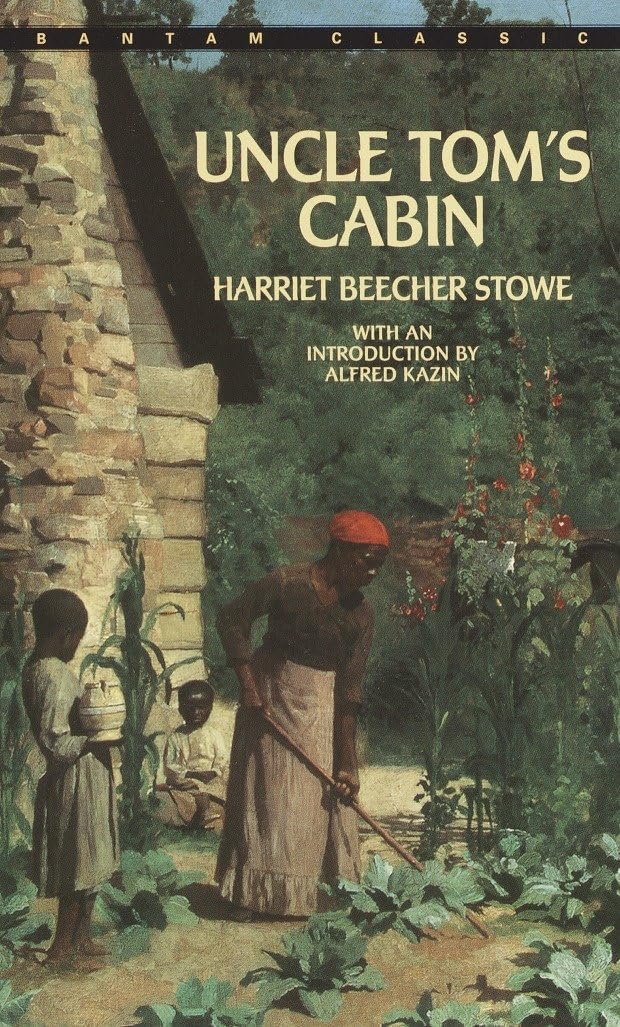
Uncle Tom's Cabin (Bantam Classics)
Product ID: 344806289
Buy anything from 5,000+ international stores. One checkout price. No surprise fees. Join 2M+ shoppers on Desertcart.
Desertcart purchases this item on your behalf and handles shipping, customs, and support to EGYPT.
Uncle Tom, Topsy, Sambo, Simon Legree, little Eva: their names are American bywords, and all of them are characters in Harriet Beecher Stowe's remarkable novel of the pre-Civil War South. Uncle Tom's Cabin was revolutionary in 1852 for its passionate indictment of slavery and for its presentation of Tom, "a man of humanity," as the first black hero in American fiction. Labeled racist and condescending by some contemporary critics, it remains a shocking, controversial, and powerful work -- exposing the attitudes of white nineteenth-century society toward "the peculiar institution" and documenting, in heartrending detail, the tragic breakup of black Kentucky families "sold down the river." An immediate international sensation, Uncle Tom's Cabin sold 300,000 copies in the first year, was translated into thirty-seven languages, and has never gone out of print: its political impact was immense, its emotional influence immeasurable. Review: Should be Required Reading - This story of 19th Century slave culture is foreign to our present consciousness; that is why we should require its reading for high school students. It presents the domestic world of the 19th Century, social attitudes, beliefs and socially accepted illusions, political developments, and their effects on people of differing social classes in a vivid and memorable way. How does a society tolerate such an evil as slavery? This novel helps us understand that people of many societies accommodate evil to some extent or another, and confronts us with the issue of our willingness to pay the price to do what is right. This may be the reason why those who believe in “progress” are reluctant to read this ground-breaking novel, for it pierces the self-satisfaction of those who simply do what is socially accepted, and point out that human virtue and goodness are rather rare in every society. For example, the New England woman who comes South to assist her cousin St. Claire care for his daughter Eva, because the mother is a self-persuaded invalid, is morally shocked by slavery, but also finds the Blacks repulsive. She must confront her own prejudice against the slave she is given to teach, and she must develop a caring relationship, a genuine love, before her teaching can overcome the slave-girl’s dysfunctional approach to life (arising from early neglect). In this, the child Eva, who has a genuine affection for the slave members of the household who have cared for her, leads the way, dying before adolescence leads her to that conforming to society which teaches us implicitly what evils to shun and which to tolerate and just accept without acknowledgment. There is ample fodder in this story for the argument that society makes otherwise good people do evil things, in other words that structure molds our morals. It begins with a “good” Kentucky family which treats their slaves well. These latter include Uncle Tom who functions as a steward of the estate, even carrying sums of money unsupervised for his owner to other states, and returning. Also included is Eliza, married to a slave from another farm, and their son Jim Crowe. Eliza is a mulatto (half-Black/half white), with features appealing to white men, but she is safe in the family that owns her. However, the owner has taken financial chances and his debts have been bought up by a slave trader who threatens to foreclose, forcing the owner to sell his three most valuable slaves, Eliza, Tom, and Eliza’s amusing son. Finding it easier to act first and reconcile later, he makes the sale, but before the Eliza and son can be seized by the dealer, Eliza flees, and when she reaches the Ohio River, has to leap from ice floe to ice floe to escape into free territory. There by chance she meets up with her husband who has escaped from his resentful master at a Quaker settlement and they eventually make it to Ontario. By the end of their story, he has obtained an education in France, secured freedom in American law, but determines his identity to be with the African ancestors rather than his white ancestors and decides to settle in Liberia. Tom, on the other hand, accepts his sale and separation from his wife and children as a trial and his treatment by the dealer is detailed, a mix of unnecessary humiliation, and relaxation of this for good behavior. On the river boat down to New Orleans, a wealthy man’s daughter, the Eva we spoke of earlier, takes a fancy to him, in part because of his gentleness and in part because of his skill in entertaining children with makeshift toys, etc. She persuades her father, St. Claire, to purchase him, and Tom finds himself part of this easy-going family. St. Claire inherited slaves with his brother, but while the brother had the firmness (and necessary cruelty) to keep his in order, St. Claire shrinks from becoming brutilized. His brother took after their father who was a worldly man, but he was more like his mother, a fervent Catholic who regarded the slaves, if not as equals, then at least as people worthy of respect and consideration. Having adopted a fashionable skeptic air, St. Claire struggles between these two poles of his life, and admires the dignity, faith, and integrity of Tom who becomes his spiritual mentor. St. Claire determines to give Tom his freedom, and even discusses it with his New England cousin who urges him not to delay. He insist that he has all the time in the world, and the next night goes to the tavern. In attempting to break up a fight he gets stabbed in the gut with a Bowie knife, dying the next day. Tom is again sold as the estate is liquidated and the hypochondriac widow returns to her father’s plantation. Tom’s interim with other slaves is described as they await the day of their auction. They are well fed for healthy, cheerful slaves fetch the highest prices. The humiliation of prospective buyers who grope the slaves to feel their muscles (especially of the women) and the examination of teeth, as is done with horse-selling, is described with a restraint that allows the reader to react to the thing described rather than to the Author’s rhetoric. Tom, it turns out, is purchased by greedy ruffian, Simon Legree, a man determined to become rich by working his slaves as hard as he can, without paying heed to what others might think right or humane. Instead of a wife he takes a slave or two as mistress; similarly, the two slaves he can train to be his foremen he makes subordinate companions in drinking and amusement, if they can brutalize the others and so keep them working. Tom gets into trouble with these for assisting the slaves who fall behind in their work. He is warned by a slave woman who seems to be immune to the foremen’s threats, not to help others, just accept the way things are. Because he is cooperative and learns quickly, Legree thinks initially of making Tom a foreman; but when Tom refuses to degrade a woman by stripping her and administering a beating, Legree has Tom receive the beating, and treats him with the resentment he feels arising from the moral judgment implicit in Tom’s refusal to do what is beneath him. Tom’s former owners in Kentucky, the wife and the son of the man who had sold him had promised to buy Tom’s freedom when they had the means, and when the husband/father passed away, their notion of honor was less tied up in preserving the family plantation and more in keeping their promise. Thus the son, now after eight years, a man of 20, comes to New Orleans to track down Tom, and finally comes to Simon Legree’s Arkansas plantation. Alas, Tom has just died in a selfless act, and Legree treats the dead slave with no more dignity that of a horse’s carcass, and allows the young man to have the body, which he buries decently before returning to Kentucky. The family agrees to free all their slaves but employ them on the farm if they chose. At this announcement, Tom’s example of faith, courage, and goodness to others is to be remembered every time they pass by Uncle Tom’s cabin.” The story has several subplots which develop several personalities, for better or worse. Tom is clearly a Christ figure whose faith and suffering changes hearts and leads to the freedom of many of his people. Grace is present even in oppressive conditions. A strength of the writing is the various portraits of persons of different stations of life; the natural superiority of some persons over others, not by virtue of race but by moral sensitivity that transcends mere selfishness. The flaws in the slave system which allow one man to determine the fate of another, and to ignore the sacred ties of marriage and family for economic consideration are effectively exhibited. That many slaveholders saw themselves as kind, indulgent, and looking out for the good of their slaves is cheerfully portrayed; but their heirs or immediate family might have differing views which allow no consideration of the slave’s welfare to influence their decisions about them. One criticism of the novel is that it is melodramatic. Eva, the child full of love for her flawed parents and the slaves in the household, who dies tragically early, may strain the reader’s credulity, but even here, the differing tastes of readers in the 1840’s may be a valuable lesson, comparable as it is to some of Charles Dickens' creations. Perhaps a more troublesome issue for modern readers, especially on the high school level is the use of the n-word, accepted then but regarded as intolerable today. Twain’s “Huckleberry Finn” has been banned from several high schools for that reason. But, if we can teach students to imitate the good and not the evil they encounter in literature, this should not be a definitive objection. Few women can claim to have influenced American history as much as the author Harriet Beecher Stowe; and yet it is not fashionable to put her forth as a model for women today. Her strict moral outlook and appeal to Christian sensibilities, as well as her faithful representations of what people were like in 19th Century America is not congruent with Marxist-inspired wokeness which insists that traditional religion is the source rather than the enemy of social evil, and that in order to have influence we must break barriers rather than respect them. Similarly, the Marxist turn of the Civil Rights movement which tended to admire Malcom X rather than Martin Luther King has turned the very name of “Uncle Tom” into an epithet of contempt used for those who cowardly cooperate with the oppressor rather than fight for rights. This is ironic in that the book’s hero is, in fact, the most courageous and principled character in the book, admired and envied by every individual of good will. But not everyone wants to be a martyr, and it was (according to “The Root” website) a supporter of Marcus Garvey and his back-to-Africa movement who in a 1919 speech proclaimed separation rather than cooperation to be the only path for self-respecting Negros. It really boils down to what we regard as the salvation envisioned for American Blacks- if separation, then there is no use for Beecher’s hero; if the races are to live together in peace then the figure of Uncle Tom as a man of courage, integrity, and faith, is one to inspire emulation of all races. Review: What You Need to Know - Way too many fancy words. I don't see her using such words in conversation. I found the book boring most of the times with some high points. I feel the words did not come off the page and resonate with me. I think she "tells" the reader rather then "Showing" the reader. I made it half way and closed the book

| Best Sellers Rank | #7,361 in Books ( See Top 100 in Books ) #20 in African American Demographic Studies (Books) #154 in Classic Literature & Fiction #513 in Literary Fiction (Books) |
| Customer Reviews | 4.6 out of 5 stars 15,633 Reviews |
"**E
Should be Required Reading
This story of 19th Century slave culture is foreign to our present consciousness; that is why we should require its reading for high school students. It presents the domestic world of the 19th Century, social attitudes, beliefs and socially accepted illusions, political developments, and their effects on people of differing social classes in a vivid and memorable way. How does a society tolerate such an evil as slavery? This novel helps us understand that people of many societies accommodate evil to some extent or another, and confronts us with the issue of our willingness to pay the price to do what is right. This may be the reason why those who believe in “progress” are reluctant to read this ground-breaking novel, for it pierces the self-satisfaction of those who simply do what is socially accepted, and point out that human virtue and goodness are rather rare in every society. For example, the New England woman who comes South to assist her cousin St. Claire care for his daughter Eva, because the mother is a self-persuaded invalid, is morally shocked by slavery, but also finds the Blacks repulsive. She must confront her own prejudice against the slave she is given to teach, and she must develop a caring relationship, a genuine love, before her teaching can overcome the slave-girl’s dysfunctional approach to life (arising from early neglect). In this, the child Eva, who has a genuine affection for the slave members of the household who have cared for her, leads the way, dying before adolescence leads her to that conforming to society which teaches us implicitly what evils to shun and which to tolerate and just accept without acknowledgment. There is ample fodder in this story for the argument that society makes otherwise good people do evil things, in other words that structure molds our morals. It begins with a “good” Kentucky family which treats their slaves well. These latter include Uncle Tom who functions as a steward of the estate, even carrying sums of money unsupervised for his owner to other states, and returning. Also included is Eliza, married to a slave from another farm, and their son Jim Crowe. Eliza is a mulatto (half-Black/half white), with features appealing to white men, but she is safe in the family that owns her. However, the owner has taken financial chances and his debts have been bought up by a slave trader who threatens to foreclose, forcing the owner to sell his three most valuable slaves, Eliza, Tom, and Eliza’s amusing son. Finding it easier to act first and reconcile later, he makes the sale, but before the Eliza and son can be seized by the dealer, Eliza flees, and when she reaches the Ohio River, has to leap from ice floe to ice floe to escape into free territory. There by chance she meets up with her husband who has escaped from his resentful master at a Quaker settlement and they eventually make it to Ontario. By the end of their story, he has obtained an education in France, secured freedom in American law, but determines his identity to be with the African ancestors rather than his white ancestors and decides to settle in Liberia. Tom, on the other hand, accepts his sale and separation from his wife and children as a trial and his treatment by the dealer is detailed, a mix of unnecessary humiliation, and relaxation of this for good behavior. On the river boat down to New Orleans, a wealthy man’s daughter, the Eva we spoke of earlier, takes a fancy to him, in part because of his gentleness and in part because of his skill in entertaining children with makeshift toys, etc. She persuades her father, St. Claire, to purchase him, and Tom finds himself part of this easy-going family. St. Claire inherited slaves with his brother, but while the brother had the firmness (and necessary cruelty) to keep his in order, St. Claire shrinks from becoming brutilized. His brother took after their father who was a worldly man, but he was more like his mother, a fervent Catholic who regarded the slaves, if not as equals, then at least as people worthy of respect and consideration. Having adopted a fashionable skeptic air, St. Claire struggles between these two poles of his life, and admires the dignity, faith, and integrity of Tom who becomes his spiritual mentor. St. Claire determines to give Tom his freedom, and even discusses it with his New England cousin who urges him not to delay. He insist that he has all the time in the world, and the next night goes to the tavern. In attempting to break up a fight he gets stabbed in the gut with a Bowie knife, dying the next day. Tom is again sold as the estate is liquidated and the hypochondriac widow returns to her father’s plantation. Tom’s interim with other slaves is described as they await the day of their auction. They are well fed for healthy, cheerful slaves fetch the highest prices. The humiliation of prospective buyers who grope the slaves to feel their muscles (especially of the women) and the examination of teeth, as is done with horse-selling, is described with a restraint that allows the reader to react to the thing described rather than to the Author’s rhetoric. Tom, it turns out, is purchased by greedy ruffian, Simon Legree, a man determined to become rich by working his slaves as hard as he can, without paying heed to what others might think right or humane. Instead of a wife he takes a slave or two as mistress; similarly, the two slaves he can train to be his foremen he makes subordinate companions in drinking and amusement, if they can brutalize the others and so keep them working. Tom gets into trouble with these for assisting the slaves who fall behind in their work. He is warned by a slave woman who seems to be immune to the foremen’s threats, not to help others, just accept the way things are. Because he is cooperative and learns quickly, Legree thinks initially of making Tom a foreman; but when Tom refuses to degrade a woman by stripping her and administering a beating, Legree has Tom receive the beating, and treats him with the resentment he feels arising from the moral judgment implicit in Tom’s refusal to do what is beneath him. Tom’s former owners in Kentucky, the wife and the son of the man who had sold him had promised to buy Tom’s freedom when they had the means, and when the husband/father passed away, their notion of honor was less tied up in preserving the family plantation and more in keeping their promise. Thus the son, now after eight years, a man of 20, comes to New Orleans to track down Tom, and finally comes to Simon Legree’s Arkansas plantation. Alas, Tom has just died in a selfless act, and Legree treats the dead slave with no more dignity that of a horse’s carcass, and allows the young man to have the body, which he buries decently before returning to Kentucky. The family agrees to free all their slaves but employ them on the farm if they chose. At this announcement, Tom’s example of faith, courage, and goodness to others is to be remembered every time they pass by Uncle Tom’s cabin.” The story has several subplots which develop several personalities, for better or worse. Tom is clearly a Christ figure whose faith and suffering changes hearts and leads to the freedom of many of his people. Grace is present even in oppressive conditions. A strength of the writing is the various portraits of persons of different stations of life; the natural superiority of some persons over others, not by virtue of race but by moral sensitivity that transcends mere selfishness. The flaws in the slave system which allow one man to determine the fate of another, and to ignore the sacred ties of marriage and family for economic consideration are effectively exhibited. That many slaveholders saw themselves as kind, indulgent, and looking out for the good of their slaves is cheerfully portrayed; but their heirs or immediate family might have differing views which allow no consideration of the slave’s welfare to influence their decisions about them. One criticism of the novel is that it is melodramatic. Eva, the child full of love for her flawed parents and the slaves in the household, who dies tragically early, may strain the reader’s credulity, but even here, the differing tastes of readers in the 1840’s may be a valuable lesson, comparable as it is to some of Charles Dickens' creations. Perhaps a more troublesome issue for modern readers, especially on the high school level is the use of the n-word, accepted then but regarded as intolerable today. Twain’s “Huckleberry Finn” has been banned from several high schools for that reason. But, if we can teach students to imitate the good and not the evil they encounter in literature, this should not be a definitive objection. Few women can claim to have influenced American history as much as the author Harriet Beecher Stowe; and yet it is not fashionable to put her forth as a model for women today. Her strict moral outlook and appeal to Christian sensibilities, as well as her faithful representations of what people were like in 19th Century America is not congruent with Marxist-inspired wokeness which insists that traditional religion is the source rather than the enemy of social evil, and that in order to have influence we must break barriers rather than respect them. Similarly, the Marxist turn of the Civil Rights movement which tended to admire Malcom X rather than Martin Luther King has turned the very name of “Uncle Tom” into an epithet of contempt used for those who cowardly cooperate with the oppressor rather than fight for rights. This is ironic in that the book’s hero is, in fact, the most courageous and principled character in the book, admired and envied by every individual of good will. But not everyone wants to be a martyr, and it was (according to “The Root” website) a supporter of Marcus Garvey and his back-to-Africa movement who in a 1919 speech proclaimed separation rather than cooperation to be the only path for self-respecting Negros. It really boils down to what we regard as the salvation envisioned for American Blacks- if separation, then there is no use for Beecher’s hero; if the races are to live together in peace then the figure of Uncle Tom as a man of courage, integrity, and faith, is one to inspire emulation of all races.
J**L
What You Need to Know
Way too many fancy words. I don't see her using such words in conversation. I found the book boring most of the times with some high points. I feel the words did not come off the page and resonate with me. I think she "tells" the reader rather then "Showing" the reader. I made it half way and closed the book
B**B
Amazing and moving...Why isn't this REQUIRED reading in schools?
Uncle Tom's Cabin was a book I KNEW about, but only as a historical artifact--a story that helped ignite the Civil War....but little else. The trivial fact that it was the first American novel to sell 1,000,000 copies was tucked away in my mind, and the disparaging label of someone being called an "Uncle Tom" was about the extent of my knowledge of Stowe's masterpiece. Now, having read the entire book, I am ashamed at having never taken the time before. The power in the narrative and the characters in the story is enough to keep you turning the pages to see what happens next! To my surprise, even though it is more than 150 years old, it was not difficult to understand... UTC essentially tells two stories at once--two slaves are set to be sold from a Kentucky plantation/farm they have lived all their lives. One is the older, well-respected Uncle Tom, and the other is the young, pretty Eliza. Tom accepts his fate, confident in his faith that God will protect him. Eliza, fearful of losing her child (with good reason) decides to run away to Ohio, where she hopes to find freedom. Along the way, both of these good souls have trials and tribulations...times of fear, hope, friendships and pain. Nothing is guaranteed for them....and sometimes their travels through life are blessed, and sometimes they are shook by sudden, unexpected pain. Tom's journey from Kentucky is primarily south; to a land where generally slaves are subject to much rougher conditions than in his native border state. Eliza, of course, is going north to Ohio, and eventually, she hopes, to Canada. But fugitive slaves are still hunted in Ohio, so there are no guarantees. The most difficult part of the reading for me was getting acclimated to the style in which Stowe portrays the conversation of the slaves. Because the language is more coarse, uneducated and casual, it took a little while to completely understand what a slave was saying. At times, I had to stop and "sound out" what the words were, just to get the jist of what was meant. After a little while, though, this became easier. The most surprising aspect of the story...and perhaps this explains the current absence of Stowe's novel in the modern mind...was the unambiguous and unapologetic Christian timber replete throughout the pages. Stowe rightfully believed that true Christianity did not endorse the idea of one man being the property of another. In her day, some religious leaders excused slavery in the states by creating contrived arguments supposedly developed from the Bible. Stowe challenges those preposterous notions headon! UTC is filled with direct references to Scripture and Christian hymns. Even one of the most irreligious characters, a one-time owner of Tom, Augustine St. Clare, is able to see how the slave trade is altogether UN-Christian, though he also finds it difficult to give up his "servants". The deeply religious Quakers, who help run the fugitive slaves to freedom, are also portrayed as true followers of Jesus. Most touching is how they even tend to the injuries of an evil bounty hunter--a man who would have killed them if it meant recapturing a slave. Uncle Tom's faith is described in great detail, and his ability to endure in times of want reminds one of the Old Testament story of Job. He strives to maintain trust in his Savior. My review ends here; to give away the ending might discourage someone from picking up the story and reading it for themselves. The time spent absorbing Stowe's novel is well-spent. One can fully understand how it shook the conscience of the nation in the 1850s.
C**L
Important classic provokes thought
All my life I've heard about "Uncle Toms" and known there was a book called Uncle Tom's Cabin. With recent increased awareness of racial inequities in my country (USA), I have sought to better understand what is at the heart of the matter. Stowe provides historical context by describing the conditions to which American slaves were subjected. Moreover, she describes the thinking of all concerned, the language used, the justifications made -- all to great effect. The reader becomes acquainted with slaver and enslaved, freed slaves, those who helped slaves escape through means both legal and illegal. We come to know and care about families torn apart by overt action or by philosophical difference. It is not an easy or comfortable read, but I believe it is a necessary one. Stowe passionately decries a system that permits unspeakable cruelty for the sake of economics and convenience. She challenges citizens to wake up and speak up. The weakness I find in this book is it's preachiness. This can be forgiven, in that Stowe was a Christian trying to spur Christians to action. The final pages of the book become tedious for one who is not so ardent. The inclusion of Christian teaching and action, and even martyrdom, throughout the text are not inappropriate, however. Christian faith was one of the few things of value America offered slaves once they were here. It was a source of comfort and strength. Deprived of homeland, tradition, culture, family and community, Christian influence was better than nothing. For me, this book is but one stop on a journey of research, discovery and enlightenment. As an American of European descent, this is my only hope for understanding the captive, the slave, and the conquered native. There is a tremendous amount of material to cover, as our young country has a distressing inclination to exploit or destroy people ironically deemed to be "other" on our quest for liberty and justice for all.
R**O
On 1/10/1776 Thomas Paine published a 48 page pamphlet...
On 1/10/1776 Thomas Paine published a 48 page pamphlet titled 'Common Sense' , which was an argument for freedom from British rule. In 1851 Harriet Beecher Stowe published Uncle Tom's Cabin as an argument for the freedom of all slaves in the United States. Both books ignited a fire, pro and con, for liberty in the United States. Stowe's book sold over 300,000 copies in the first year. The previous year the United States passed the legislative act of 1850 prohibiting aiding and abetting escaping slaves! President Millard Fillmore and Congress passed that law as a compromise between the North and the South to avoid hostilities. What were they thinking? Luckily, many Northerners didn't heed the law, especially the Quakers. Stowe met President Lincoln at the White House in 1862 and he called her " the little woman who started this great war." According to Stowe the characters are drawn from real life. The incidents described in the book are real. That's egregious information, because this book was ( and still is ) an emotional time bomb in disguise. She was asked many times whether the narrative was a true one and her general answer was " The separate incidents that compose the narrative are, to a very great extent, authentic, occurring, many of them, either under her own observation, or that of her personal friends. She or her friends have observed characters the counterpart of almost all that are here introduced; and many of the sayings are word for word as heard herself, or reported to her." The character Uncle Tom is probably one of the most enduring of all time in the world of literature. Who could forget this honest, loyal and pious Christian slave, who is so badly treated. Stowe fashions Uncle Tom's trials and tribulations to that of Jesus Christ. Who can overlook the angelic and tragic life of little Eva, the daughter of the kindly white estate owner, Augustine St. Clare. The slave Eliza carrying her baby across the Ohio River, dashing over ice chunks while being pursued by slave catchers is a documented fact. The slaves Cassy and Emmeline are two of the best side-characters that I've come across covering all genres of writing. Then we have the most infamous and scurrilous character of all time, Simon Legree, the hated owner of a cotton plantation in New Orleans. The empathy and hate feelings that the reader acquires reading this novel are monumental. As Uncle Tom passes from one slave owner to next, the reader hopes for the best. The slave owners see nothing wrong with breaking families up at auction, ripping away a child from it's mother and selling the crying child to a different plantation! Woe is me! Yet the slaves held on to the hope that Jesus Christ would save them. According to Stowe, she believed that the slaves would eventually be " no longer despised and trodden down..." because to paraphrase..." of their gentleness, affection, and facility of forgiveness". Even the kind owners of the slaves did them wrong by not protecting them from unforeseen factors. If a considerate owner suddenly died without preparing freedom papers for his slaves, his widow would auction the slaves off to pay the estate's debts, thus breaking up families again. This happens many times in this saddest of sad novels. On page 475, Stowe writes " We have walked with our humble friend ( Uncle Tom ) thus far in the valley of slavery; first through flowery fields of ease and indulgence, then through heart-breaking separations from all that man holds dear." Uncle Tom was sold the first time because the estate owner, Mr. Selby was heavily in debt and Tom was his most valuable asset. So his reward for loyalty is to be sold away from his wife and children! Woe is me! Harriet Beecher Stowe's brilliant novel is actually two stories in one. You already know about the trials of Uncle Tom. The coinciding story is that of Eliza, her baby, and her husband George Harris, a mulatto slave from a neighboring estate. Eliza is also on the estate of the troubled Shelbys and finds out that Mr. Shelby has sold her baby to the despicable slave trader, Dan Haley. That evening she tells Uncle Tom that she is fleeing to Canada! Meanwhile, her husband on a different estate has had enough of abuse and also heads for Canada. Their adventures occupy many chapters and the final result is most rewarding to the reader. Uncle Tom didn't try to escape because Eliza also heard Mr. Shelby say that if he couldn't sell Tom, he would have to sell all the other slaves instead. That's something our hero, Uncle Tom wouldn't let happen. So poor Uncle Tom is separated from his wife Aunt Chloe, his two sons and his baby! Woe is me! Will he ever see them again? I'm not going to tell you. This is the most meaningful novel that I've ever read. Do yourself a favor and read this piece of American history! It is an awesome event!
S**R
"Uncle Tom" is NOT who people think... he was a GREAT man! Don't miss reading this book!!
Wow! My husband Philip and I finished reading "Uncle Tom's Cabin" together. It's the most vivid read about pre-Civil War American life, and its most disgusting practice of slavery, ever written, I suspect. It's no wonder President Lincoln is later quoted as saying of the book's writer, Harriett Beecher Stowe, "So you're the little lady that started this war!" Mrs. Stowe took all of America to task in this stunning book. We had trouble putting it down night after night. Philip was born and raised in Louisiana... probably the most prevalent slave-trade area and port in all America. He and I cried several times as we read, thinking how little even Philip knew of the real face of slavery as it was in his home state a couple generations before. Just in the telling of those various characters' lives, the book had to turn America upside-down, cutting into the hearts and convictions of SOUTHERNERS (some being the vicious and greedy slave traders and plantation owners; and the kinder slave-owners who none-the-less stood with those who allowed such a sickening law of the land. Also NORTHERNERS & OTHERS who, like the Germans of WW2, remained ignorant or turned a "blind" eye to the concentration camps and allowed Hitler to squash lives by the millions, and went on with their lives in silence to the blaring inhumanity that used a race of people without conscience, sympathy or justice. But, there were also those who (black and white) risked their lives to stand against it, in the face of much opposition. THIS BOOK NEEDS TO BE READ BY EVERYONE... especially students who need to know where America was once; how far we've come, but how much more reason there is to live so SLAVERY and any could never happen again here. For certain, we DO NOT need to practice a demeaning, FALSE sympathy for black or any other Americans in our society, regarding what those participants to such debauchery did to oppress the very human bounty of Africa back then. We MUST not hurt them further (or anyone else), by enslaving them to dependence on government handouts (on the backs of taxpayers) that are meant only to secure power for the so-called "compassionate”, “progressive” leaders of our country--ever! Handing out special privileges, special wages, special positions of power, or special treatment over others (even the descendents of those who once enslaved them), portends that the problem of bigotry will never be resolved. We are only, truly free when ALL Americans (of every color) honestly see themselves as Americans--not a Socialist state where, no matter how hard you work or NOT, you get equal pay. ALL of us today have equal opportunities for education; to make right choices; to get over our prejudices and bitterness on all sides; to dream our dreams and become WHATEVER we dream, IF WE ARE WILLING TO WORK at it. We are, as Uncle Tom, equal in God’s eyes. Many of the most successful people who call themselves Americans were and are black. We all need to be EQUAL to the task of being the best possible citizens, no matter our ethnicity or station in life. The opportunities ARE out there! The Lord gave us equal opportunity to choose--LIFE or not. Our path is OUR choice! Praying many will read this powerful, eye-opening, lovingly convicting book, "Uncle Tom's Cabin," that goes a long way to show the way to that equality!
T**5
Amazing Historical Book
This book isn't the greatest read ever, but it is a compelling, well-written story. It is also an important piece of US history, in that President Lincoln himself is reputed to have credited this book with starting the Civil War. According to the author most of the events in the book are based on true accounts. The story itself follows different slaves as they are sold to new masters or as they escape from their current masters. The author was a strong Christian, and the theme of Christianity is very strong throughout the book. We see how Uncle Tom, a slave who is a Christian, reacts to cruelty with unearthly love & forgiveness. While Uncle Tom himself believes its his Christian duty to serve his masters, he also believes its his Christian duty to protect his fellow slaves, does what he can to help fellow slaves escape, & refuses to aid his masters in recovering escaped slaves. We see how another slave who had been brought up a Christian, has given up belief in a benevolent God, due to the cruelties she has suffered. All the stories of the different slaves are compelling. The violence described in the book is very "PG-rated" by todays standards, there are no gory descriptions of the violence that undoubtedly occurred. While the book uses more vocabulary than is often found in modern books, the book is still very readable. All of these points, make this a great book that every educated person should read However, I don't think its the greatest book ever, especially by modern standards. The author frequently stops the story to lecture the adult on the horrors of slavery. Perhaps this was needed 150 years ago, when many people were not convinced of the horrors of slavery, but reading it today gives a condescending & unnecessary feel. The ending also was....(mild spoiler)...too unbelievable, too fortuitous to have really occurred (in spite of the author's statement that such fortuitous occurrences were common among escaped slaves & that truth is stranger than fiction.) I can accept (and enjoy) a certain amount of unbelievability in fiction books, but I found the ending too much, and consider rating the book 4 stars for that reason alone. But I decided that would be too harsh, and its not fair for me to judge this book written 150 years ago in comparison to modern books.
E**D
Weak literature, good argument
For some reason, I never got around to reading this when I was young. When I found it as a free download, I thought I might as well do it now. Generally, I agree with many of the other commenters. The book isn't great as literature, but as a propaganda piece, it's pretty effective. As literature, much of the book is overly dramatic and sentimental. The characters are two-dimensional, and the story wraps up pretty neatly. The writing is decent. There's never a moment, though, in which you forget that the story is the carrier for the message, rather than the other way around. On the propagandist front, Stowe makes a very good effort at showing several sides of the key issues: religion and slavery. There's no question which side she is on, but there are nuances even among the slave owners, and she castigates Northerners just as thoroughly. All in all, it's a very effective piece of anti-slavery propaganda, often through fairly direct argument to the reader. If anything, she's light on the horrible effects of the slave trade, focusing most often on emotional disruption. Unfortunately, while consciously fighting the evil of slavery, Stowe often relies heavily on stereotype (blacks are naturally generous, credulous, and good cooks; women are emotional and not naturally suited to business). That's largely a sign of the time, of course, and she was much more progressive than most, so it doesn't grate as much as it might otherwise. Equally troubling is the inescapable religious message. Stowe is clearly a Christian, and the solution to just about everything in the world is just for people to accept Christ into their lives. Do that, and you can die happy, even as a beaten, tortured man who's been ripped from his own family and several others. Conversely, in the final chapter - a direct appeal to readers - she suggests that only Christian Americans have a responsibility to do anything about slavery; atheists apparently get a free pass. To her credit, Stowe offers a reasonably balanced portrait of an agnostic in the book, but her underlying message about Christianity is hammered in, page after page. She never considers that 'Africans' might have their own beliefs, but that's pretty much true for everyone else she describes as well. All in all, worth reading for its historical value as an argument against slavery at a crucial time in the United States, if not as a work of dramatic literature. * It seems unfair that the book is associated with the term 'Uncle Tom'. While in some ways the usage is accurate, the Uncle Tom in the book acts the way he does in part because he's a pious Christian, and he's only one of a range of slave characters shown. More to the point, despite Tom's obedience, he doesn't come out of things very well.
J**L
Truly inspirational
No wonder this book is a classic and apparently at one point the second most read book after the bible. I absolutely loved it. I thought I was going to have difficulty with the southern dialect and broken English but I got used to it surprisingly easily. A wonderful account of the harrowing times that people endured. It is hard to believe what the slaves went through. I can only associate it to the horror of how cruelly animals are still treated in some countries and the shock that any one who had any kind of conscience could do the barbaric things they do. But worse these slaves were treated worse than animals. No rights. No education. Pulled apart from their families and abused. But out of this horror as you would not be encouraged to read this book otherwise, is the wonderful trials and tribulations of individuals who came through it and believed in themselves. The book refers to many religious passages but these are all very relevant to the time and God truly gave a lot of people the strength to get through the terrible hardships. How slavery was allowed to on as long as it did is terrifying, but I truly believe that people were more afraid of what the world would become from the release of these slaves, with no education and who would have to be responsible for righting these wrongs. A must read!
T**Y
A LONG STORY BUT VERY INTERESTING
I AM A CANADIAN LIVING IN CANADA, I FIRST BECAME AWARE OF AFRICAN SLAVERY WHEN MY WIFE AND I WATCHED ROOTS ON TELEVISION SOME YEARS AGO AND THEN WATCHED IT AGAIN A MONTH AGO. I THEN NOTICED THAT AMAZON HAD "UNCLE TOM'S CABIN " AVAILABLE FOR MY KINDLE-NO CHARGE- AFTER READING THE WHOLE STORY ON KINDLE, I BORROWED A VIDEO FROM OUR LOCAL LIBRARY ON THIS OLD MOVIE."UNCLE TOM'S CABIN". MY WIFE AND I WATCHED THIS AMAZING PORTRAYAL OF THE LIFE OF UNCLE TOM AND HIS FAMILY AND MASTERS. THE KINDLE STORY AND THE MOVIE ARE ALMOST IDENTICAL, HOWEVER THE BEATINGS AND LASHINGS THESE POOR AFRICAN PEOPLE RECEIVED FROM SOME OF THEIR MASTERS WAS GRUESOME. MY WIFE AND I HAD TO TURN AWAY AT TIMES. HOWEVER AS IT TURNS OUT THE AMERICAN PEOPLE HAVE ACCEPTED THE BLACK RACE INTO THEIR OWN CULTURE, EVEN NOW VOTING IN A BLACK PRESIDENT FOR THE SECOND TERM. I AM VERY PROUD TO HAVE MY AMERICAN COUSINS LIVING CLOSE, JUST ACROSS FROM OUR COMBINED BORDER. THANK YOU TO OUR U.S. NEIGHBORS.
A**O
perfect
perfect!!!
M**A
Small letters
The letters are very small thats why too hard to read
A**R
Esclavitud en USA
La cruda realidad de los esclavos en el siglo XVIII y XIX. Aunque la esclavirud despues fue trasladada a los paises del tercer mundo
Trustpilot
2 weeks ago
1 week ago