


Desertcart purchases this item on your behalf and handles shipping, customs, and support to EGYPT.
⚡ Unlock Accurate Current Insights — The Pro’s Secret Weapon!
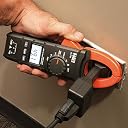
The Klein Tools 69409 Line Splitter is a must-have accessory for professionals using clamp meters to measure current on standard North American 120V outlets. It isolates hot from neutral and ground wires, enabling precise current measurements up to 15 amps without interrupting power. Featuring a 10x multiplier mode, it enhances measurement accuracy on low-current circuits and is compatible with all Klein clamp meters and many others. Built tough for daily use, this handheld tool delivers reliable, hassle-free electrical diagnostics and troubleshooting.




| ASIN | B01B7RTNSO |
| Best Sellers Rank | #24,575 in Tools & Home Improvement ( See Top 100 in Tools & Home Improvement ) #76 in Tool Sets (Tools & Home Improvement) |
| Brand | KLEIN TOOLS |
| Brand Name | KLEIN TOOLS |
| Color | Black |
| Compatible Devices | All Klein Clamp Meters |
| Customer Reviews | 4.8 out of 5 stars 1,964 Reviews |
| Global Trade Identification Number | 00092644694097 |
| Included Components | Line Splitter 10x |
| Item Dimensions | 6.6 x 4.3 x 1.7 inches |
| Item Type Name | Klein Tools 69409 Line Splitter 10x |
| Item Weight | 3.8 ounces |
| Item dimensions L x W x H | 6.6 x 4.3 x 1.7 inches |
| Manufacturer | Klein Tools |
| Measurement Type | Multimeter |
| Minimum Operating Voltage | 120 volts |
| Model | 69409 |
| Number of Items | 1 |
| Part Number | 69409 |
| Power Source | Corded Electric |
| Specification Met | UL |
| Style | Handheld |
| Style Name | Handheld |
| UPC | 092644694097 |
| Unit Count | 1 Count |
| Upper Temperature Rating | 896 °F |
| Warranty Description | 1 year manufacturer |
J**N
Does Exactly What It Advertises – A Must-Have Klein Tools Accessory
This Klein Tools line splitter works exactly as advertised and earns every bit of 5 stars. For anyone using a clamp meter to measure current draw on standard North American outlets, this little tool is genuinely indispensable. The 10x measurement multiplier makes it easy to get accurate, readable current readings on low-draw circuits where a standard clamp meter alone struggles to give a precise result—just divide by 10 and you have your actual amperage. It handles up to 15A comfortably, covers the most common outlet configurations you'll encounter, and the build quality is exactly what you'd expect from Klein Tools—solid, reliable, and made to last. Whether you're doing electrical diagnostics, troubleshooting appliances, or checking circuit loads in a home or RV, this line splitter makes the job cleaner and more accurate. A simple, well-made tool that delivers exactly what it promises every single time.
H**Ć
Klein Quality – Reliable and Easy to Use
Klein never disappoints, and this is no exception. It’s a simple tool, but it works exactly as it should and makes measuring current with a clamp meter much easier. Build quality is solid and durable, like you’d expect from Klein. It feels like it can handle regular use without any issues. It’s easy to use and gives accurate readings without any hassle, which is exactly what you want when working with electrical. Overall, dependable, well-made, and does the job right.
B**H
Great and handy tool
High quality but don’t forget it multiplies current by 10x. At first I was surprised by the draw until I read the instructions.
J**D
It appears as a high quality product.
Arrived with no damage to package. Waiting on the clamp multimeter to test it out.
A**R
Great item. Delivers on Klein brand.
Good for measuring current on outlets and power cords.
B**J
Value for money
Quality item. Dont be confused by the multiplier.
J**.
Works great and is compact
This item works great, and it’s compact to boot. Judging from instructions for clamp meters and accessory current clamps, many folks don’t seem to realize that one cannot measure current in a multiconductor flexible cord with a clamp meter, because the magnetic fields cancel. I’ve seen more than a few people—including a former boss—tripped up by this. What’s needed is a line splitter. Interestingly, none of my Fluke instructions suggest that as the solution. It’s possible to make your own splitter, as I did (picture 3). It works fine, but it’s a bit awkward to carry. It’s much easier—and less expensive—to use a commercial splitter. Commercial splitters are also more compact (pictures 1 and 4). The homemade splitter has one advantage, though: it’s made with #12 AWG wire, so it should safely handle 20 A. It’s also possible to do direct measurements using a multimeter’s current inputs, but connecting everything can be a chore. I have a device that connects directly to a meter’s current inputs (picture 2), simplifying the process. But it’s dicey when trying to measure more than 10 A on most meters without blowing a fuse. I also have an Extech splitter (https://www.amazon.com/dp/B0000YHN9W), which also works well and offers a 1× reading as well as 10×. But the 1× loop is more a curiosity than anything else, and the extra loop makes it longer. I probably got it simply because previous splitters I had included 1× sections. There’s really no reason to not use the 10× multiplier, which effectively provides an extra digit of resolution—often a big deal when measuring small currents. The Extech splitter does include voltage test points, so it’s possible to measure voltage and current when the device is operating—sometimes useful if the device is drawing enough current to cause noticeable voltage drop. Measuring voltage and current simultaneously requires a second meter, but if the load is steady, the measurements can be made sequentially with a single meter. When making simultaneous measurements, keeping the voltage test leads in the test holes on the Extech splitter can be a bit of a pain. It’s much easier to use a Klein 69357 adapter (https://www.amazon.com/dp/B0BN2LTKTB/) for the voltage measurement, as shown using a Fluke 323 clamp meter for the current and a Fluke 112 DMM for the voltage. So perhaps the lack of voltage test points isn’t really much of a disadvantage—and the splitter is more compact without them. A comparison of all of these methods using a Fluke 87 (with a Fluke i400 current clamp for the splitters) got results that were within about ±0.02 A actual current—more than close enough for government work. There are other splitters, like the Triplett ET200 (https://www.amazon.com/dp/B07YT6LQBH) and FLIR TA55 (https://www.amazon.com/dp/B00NMVR2DM) that will probably also do the job. I can only really comment on the Extech and Klein; I would recommend either one. At least one reviewer has suggested using a power meter (I have the P3 P4400 Kill A Watt Electricity Usage Monitor, https://www.amazon.com/dp/B00009MDBU). Though it’s more expensive than most line splitters, it’s very easy to use and doesn’t require a meter. I can’t imagine an electrician showing up with one, but for someone who only needs occasional measurements, this could be a good option—and it provides much additional information. I wouldn’t trust it like the Fluke meters, but the indicated values were mighty close to those given by the high-priced tools. Again, close enough for government work. I guess I also would recommend this. There are less-expensive similar devices that I have not tried. If you need to measure current in a plug-connected device, a line splitter is essential—don’t leave home without one.
D**E
Check your amps before you burn the house down
First off, I am not an electrician but I do know how to use an amp clamp and a multimeter. Those skills are critical to know how this line splitter works. I bought this device to check how many amps my home networking lab was drawing. I only have a handful of devices but each group of devices is plugged into a power strip, so I found it easy to plug this tester into an outlet then apply the power strip. I was a bit shocked at how close to over loading my breakers on a couple setups. Since then I've used this device to plan and distribute load more appropriately to allow some slack in each circuit. I also find this device is highly useful for checking new appliances and again being aware of the load on any particular circuit breaker. For example a new laptop draws 10amps!!!!. Overall the design of this is pretty straight forward, just put it inline and go to town measuring with a clamp. So far construction and durability are fantastic. I would recommend this line splitter to anyone, including curious individuals or even a typical homeowner.
M**C
Quick ship
Nice items and good quality.
C**Z
Muy útil herramienta para medir amperaje
Desde hace mucho esperaba una herramienta así y no sabía que existía. Gracias Klein tools por pensar en todo
C**S
Happy with new unit.
Brand-new unit. Works as expected.
L**.
Excelente
Muy buena calidad y funcionalidad. Super útil
M**N
Son utilité
Idéal pour vérifier le courant sur un appareil 120 volts Au lieu d'avoir un " split cord" pour pouvoir placer l'amperemetre..il suffit de brancher votre équipement a vérifier dans le socle et l'appareil en fiche..vs placez l'amperemetre dans le " beignet" de détection Moi je le laisse dans mon kit d'amperemetre
Trustpilot
2 days ago
1 month ago