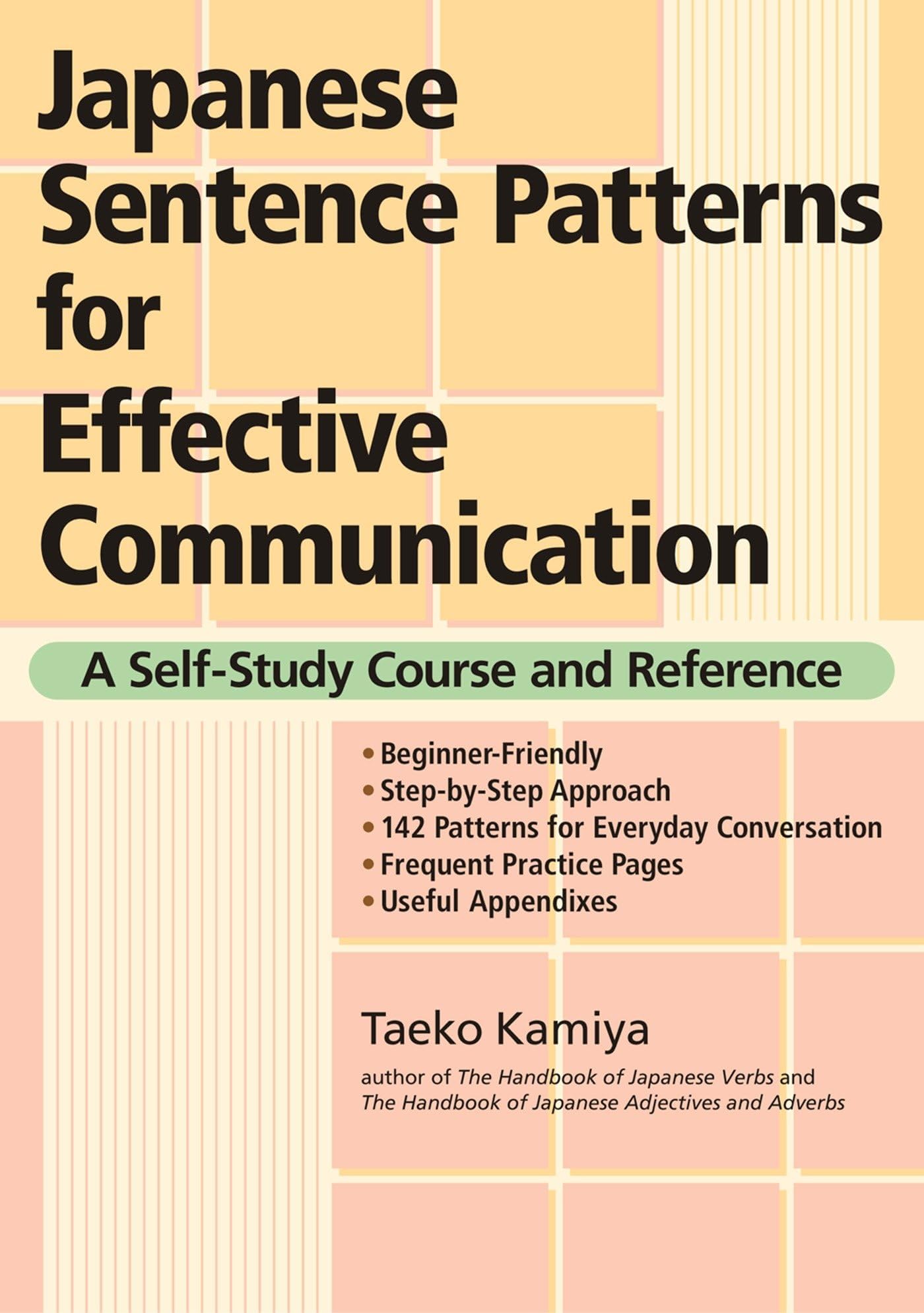
Japanese Sentence Patterns for Effective Communication: A Self-Study Course and Reference
Product ID: 4665555
Buy anything from 5,000+ international stores. One checkout price. No surprise fees. Join 2M+ shoppers on Desertcart.
Desertcart purchases this item on your behalf and handles shipping, customs, and support to EGYPT.
An indispensable tool for acquiring basic communication skills in a limited amount of time. With Japanese Sentence Patterns for Effective Communication , even absolute beginners can learn to communicate in Japanese in a matter of days. Designed specifically for native-English speakers approaching Japanese as a second language, this book presents 142 essential Japanese sentence patterns, first by giving equivalents in English, then following with Japanese translations. Each pattern is accompanied by a concise, easy-to-follow explanation and several Japanese example sentences that demonstrate its usage. In addition, practice sections for each pattern allow the student to test his or her understanding of the material presented. Japanese Sentence Patterns for Effective Communication is organized into twelve chapters according to communicative function, including such tasks as making simple, declarative statements about people and things in the world; making comparisons; talking about events in the past, present and future; expressing desire, conjecture and intention; stating causes or reasons; making requests; asking and giving permission; and using the passive and causative-passive voices. Extensive charts at the back of the book outline the rules for inflecting and conjugating adjectives and verbs—essential to fluent communication. Review: Hounto ni sugoi nihongo no hon da! - I really like this book. It has so much vocabulary and grammar structures to learn that you really get a wealth of information for the money you spend. It's just as good or better as more expensive books I've read. Examples are written in Katakana, Hiragana, and Kanji, and defined in romaji, so beginners need not feel intimidated, and students who already read Kana will be able to pick up new kanji and learn to read by example. I also like how the author explains the concepts. It's not overwhelming or filled with jargon, it's pretty clear and easy to understand. I'd highly recommend this book because it's compact, yet has all the information you need to understand sentences in Japanese. Review: JAPANESE SPEAKERS AND JAPANESE LOVERS GET THIS - I really like this book because it shows you the mistakes that you are making and it has plenty of examples on how to improve your grammar in Japanese. I like how it's soo simple and it gives you the sentences that are essential in mastering Japanese. In other words, it doesn't teach you grammar that you'll never use in real life. I like how they give you common vocab. words too. If you've been struggling with Japanese and you don't know why GET THIS BOOK! It'll literally open your eyes and make you see Japanese in a different light. I also like how it gets down right to the basics which is necessary and boosts your confident with Japanese! Overall, if you feel you're not good at Japanese and have low self esteem at it get this book! You'll feel a lot better ;) It's also a lot better than a lot of Japanese Grammar textbooks because some of the other books are unorganized and don't provide you with enough examples. This provides you with enough examples and sentences for you to practice with! That's the key to learning this language PRACTICE
| Best Sellers Rank | #118,570 in Books ( See Top 100 in Books ) #51 in Communication Reference (Books) #238 in Foreign Language Instruction (Books) |
| Customer Reviews | 4.7 out of 5 stars 492 Reviews |
C**S
Hounto ni sugoi nihongo no hon da!
I really like this book. It has so much vocabulary and grammar structures to learn that you really get a wealth of information for the money you spend. It's just as good or better as more expensive books I've read. Examples are written in Katakana, Hiragana, and Kanji, and defined in romaji, so beginners need not feel intimidated, and students who already read Kana will be able to pick up new kanji and learn to read by example. I also like how the author explains the concepts. It's not overwhelming or filled with jargon, it's pretty clear and easy to understand. I'd highly recommend this book because it's compact, yet has all the information you need to understand sentences in Japanese.
B**Y
JAPANESE SPEAKERS AND JAPANESE LOVERS GET THIS
I really like this book because it shows you the mistakes that you are making and it has plenty of examples on how to improve your grammar in Japanese. I like how it's soo simple and it gives you the sentences that are essential in mastering Japanese. In other words, it doesn't teach you grammar that you'll never use in real life. I like how they give you common vocab. words too. If you've been struggling with Japanese and you don't know why GET THIS BOOK! It'll literally open your eyes and make you see Japanese in a different light. I also like how it gets down right to the basics which is necessary and boosts your confident with Japanese! Overall, if you feel you're not good at Japanese and have low self esteem at it get this book! You'll feel a lot better ;) It's also a lot better than a lot of Japanese Grammar textbooks because some of the other books are unorganized and don't provide you with enough examples. This provides you with enough examples and sentences for you to practice with! That's the key to learning this language PRACTICE
K**E
One of the best sentence books for beginners.
This book is designed for upper-beginner learners of Japanese. I say this because if you've studied Genki 1, you'll pretty much know how to do everything in this book. However, even if you have studied Genki 1, this is a great book to use for additional practice and will teach you more sentence structures then Genki 1. The examples are written in natural Japanese (Kanji + hiragana/katakana) and then written again in romanji. This means you don't need to know how to read Japanese to use this book. However, if you're a serious learner of Japanese, I'd highly highly recommend learning to read being the first thing you do. Losing the crutch of romanji is one of the best things you can do the first day you start learning. Learn Hiragana and Katakana first. Kanji is takes longer to learn but it's not hard, just tedious. The book does not provide furigana (kana above the kanji), but this is not needed because if you know how to read Japanese, it's extremely easy to spot the reading of the kanji in the romanji text. This book has one main goal in mind. That goal is to teach you tons of different sentence structures which is essential to know in pretty much every language. If you're a upper beginner, you most likely will not know all the vocab, but you will learn how to use most vocab once you've learn them. After mastering this book, you'll be able to express yourself in various different ways and structures. This book would work best if you're already an upper-beginner with a decent amount of vocabulary in your grasp. The best way to practice would be to study each section, then try to make as many sentences with the structures you've learn using the vocab you already know. Since this book does start off slow, I'd recommend it to a beginner of any level. Also to any lower intermediates who want to refreshen up on their sentence structures.
J**C
Great Book!!!
This book gives examples of sentence structures in every shape and form. Its useful for looking up structures for speaking and writing. One thing that I must point out; it contains a lot of Kanji without furigana. But don't be afraid because all examples are also written in romanji. Another point that I'd like to stress to any beginner is that you MUST learn the Kana's very early in your studies. Also, every book, dictionary, workbook, or program that you are interested in assumes that you have a solid grasp on English Grammar. When I say English Grammar, I'm not talking about your conversation skills; I'm talking about the elements of the English language. Do you know the difference between a transistive and intransistive verb? Or what about nouns, pronouns, adverbs, adjectives, subjects, objects, synonym's, or antonym,s? I couldn't remember all that junk from school so I had to buy a little grammar book to learn English before I could really begin Japanese. Oh well, to make a long story short; get this book because it really helps. It's easy to read, has lots of practice excersises and has tons of info in the back. Have Fun Gang!!!
O**E
nearly perfect!
Addition of Hiragana would be ideal would pay bit more for a slightly bigger hard-cover edition
D**N
An essential reference
Many books deal with Japanese grammar somewhat in a vacuum, whereas this book provides an index of different English meanings, ideas, and sentence structures, and explains how the same (or a similar) idea would be conveyed in Japanese. The book is very well structured, with the index in the front of the book grouped by broad categories (describing actions, making comparisons, explaining causes and reasons, etc.), and each individual concept is listed with one or more pairs of English sentences and corresponding Japanese translations, as well as the page number for the detailed lesson. In many cases, simply looking at this index may be enough to jog your memory, but if not, every lesson is presented in detail with example sentences, one or more paragraphs of explanation, and several practice exercises where you are given an English sentence, and asked to translate the statement to Japanese using the concepts provided in the lesson. I recommend using a highlighter, and going through the index highlighting the relevant word/particle/structure for each Japanese example, as this will make it even easier to find what you're looking for. This book is an easy recommendation for anybody studying Japanese.
J**D
The Perfect Grammar Book
This is book is simply amazing. Grammatical coverage is methodical and logically ordered. Plenty of example sentences are offered in both kanji and romaji. I would have liked kana/furigana as well, but the scheme the author chose works well and is nice for reading practice. The romaji is printed under the kanji examples; so it is easily covered with the included bookmark if you want to test yourself. The book is organized by grammar point. There are 142 grammar points in all. Each grammar point consists of: 1) A simple demonstrative example in large print 2) A short paragraph explaining the usage of the grammar point 3) Three to five additional example sentences to shown usage variations 4) A small translation quiz consisting of 3 English sentences that require the grammar point (answers provided) Also included is 45 pages of appendix material, which provides charts/tables covering: * Numerals - Cardinal and ordinal numbers * Counters (measure words) * Adjective inflection for common I- and Na- adjectives * Verb conjugation for common verbs I study vocabulary ordered by common usage frequency using iKnow -- words are introduced (with audio) along with an example sentence (also with audio). This book helps in understanding some of the more complex example sentences. Conversely, the vocabulary gained through iKnow makes reading this grammar book much easier and natural. In short, if you have an external regimented vocabulary study program, this book might very well be the only textbook you need as you progress into upper-intermediate territory.
S**.
I wish I had this book when I was studying in college...
I love this book. And I really wish I had it when I was studying Japanese in college for four years, because this really would have helped me with some of the sentence formations I struggled with. Whether your a beginner, intermediate learner, or someone who studied years ago and wants to practice again, this is the perfect book for you. I find things I had forgotten coming back to me quickly, and other things I struggled with suddenly come to me. The book breaks everything down, and every other page there are practices. I find these incredibly useful. It only takes a few minutes a day, but you will definitely make progress. My recommendation is that if you're going to take a course in college - or high school - get this book as well. It's cheap. Genki is a good textbook, but I didn't have the luxury of using that one. Instead, Nakama was forced upon me, and there were some things that were difficult for me to learn. If you have to use Nakama as well, do yourself a favor and get this book. You won't regret it.
G**U
ESSENTIAL
Great and very thorough
A**O
Japonês
Didático.
C**R
Self-study course and reference
Very happy with this book, what I was looking for, format is perfect too and I am already into it, thankyou for the well done delivery!
D**S
Very good
Very useful book for self study
E**I
Clair et pratiques.
Très utile surtout si vous apprenez le japonais en autodidacte.
Trustpilot
1 day ago
3 weeks ago