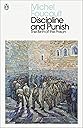

Discipline and Punish: The Birth of the Prison
Desertcart purchases this item on your behalf and handles shipping, customs, and support to EGYPT.
Description
'Imaginative, illuminating and innovative' The New York Times Book Review The grisly spectacle of public executions and torture of centuries ago has been replaced by the penal system in western society - but has anything really changed? In his revolutionary work on control and power relations in our public institutions, Michel Foucault argues that the development of prisons, police organizations and legal hierarchies has merely changed the focus of domination from our bodies to our souls. Even schools, factories, barracks and hospitals, in which an individual's time is controlled hour by hour, are part of a disciplinary society. 'Foucault's genius is called forth into the eloquent clarity of his passions ... his best book' Washington Post
Specifications
| Dimensions | 13 x 2 x 19.8 cm |
| Generic Name | Book |
| Importer | Penguin Random House India Pvt Ltd |
| Isbn 10 | 0241386012 |
| Isbn 13 | 978-0241386019 |
| Item Weight | 269 g |
| Language | English |
| Net Quantity | 750.00 Grams |
| Packer | Penguin Random House India Pvt Ltd |
| Print Length | 352 pages |
| Publication Date | 1 April 2020 |
| Publisher | Penguin Classics |
Reviews
User
Quality
The book quality is perfect and good to read ...
User
Masochism in the making.
I began to punish myself after reading this book. This book has helped me become a masochist. Thanks to this Foucault.
User
Good
Good
User
One of the best books of all times
One of the best books of all times. Foucault has challenged our ideas of prison and the concept of punishment in this treatise Discipline and Punish.
User
Deep. Deep. Deep
I must say that "Discipline and Punish" is a difficult book to review. It is excellent, and it is deep. The book starts with the description of a prisoner being tortured and killed. The final stages of the torture, and the execution used to take place in the public sphere.We may be squeamish today, but we cannot state that torture has disappeared from the world. It has just disappeared from the public eye.From there, he moves on to the concept of punishment, and the various theories that prevailed. And, of course, the practices. For me, the most interesting chapters were those that pertained to discipline, the panopticon, and delinquency.I don't think that 'the birth of the prison' is a good subtitle. This book is much deeper than that.
User
Poor Quality Paper used for Printing
Paper quality too poor
User
Page quality
Page quality is not great.
User
Three Stars
Good
User
Ripped From the Headlines
It’s a curious fact, but if you want to understand some of today’s most controversial issues, you have to read the works of a French philosopher who died in 1984.That philosopher is of course Michel Foucault. His most influential works were genealogies of phenomena as diverse as modern sexuality, clinics and prisons.The key to understanding him is to understand what Foucault meant by a genealogy. It was not a history or even a history of ideas. It was instead how a body of knowledge, or science, had developed and been used to seize and wield power. Explicitly denying the fact that objective sciences of humanity were possible, he saw psychology, criminology and even to an extent physiology as merely tools of power.That’s why he begins Discipline and Punish with a subject as seemingly esoteric as the classical theory that any crime was an attack on the king’s metaphorical body. Thus, he describes the elaborate public ritual where redress was made on the prisoner’s physical body.What Foucault wants is to convince the reader that this archaic form of punishment was rational to the men of that day. By this, he can shake from the reader’s head any idea that the modern system of prisons is any more rational than this was.It’s an ingenious and influential work—although in my opinion too influential. While I cannot argue with Foucault’s genealogy—nobody has read more or could trace lineages better than he—I will point out that, after destroying the rationale for imprisonment, he puts nothing in its place. Perhaps, it’s unfair to demand that he should have single-handedly come up with his own theory of retributive justice, but for those of us who have to live in this world, it’s rather discomfiting to see prisons torn down and nothing erected in their place.Ingenious, important but ultimately pernicious, in my opinion. Still an incredibly rewarding work of modern philosophy. Highly recommended.
User
Insightful and informative.
Quite possibly one of the best books I have ever read. Not an easy read, but kept my mind occupied whilst lounging on a sunbed in Tenerife. A must-read for anyone interested in prisons, education, prison reform.
User
Just what I wanted
Really quick delivery. No damage. My son in law will be happy.
User
A very interesting viewpoint
Except for Foucault's twisted and tangled style of building up an idea and making a point, I personally found the book to be spectacular. It is a very interesting read.If you will enjoy this book, I recommend you to also try Ivan Illich. Maybe "Deschooling Society", or another book. You can find most of them on amazon.fr.
User
Good
The books looks new!
Common Questions
Trustpilot