
DOWNLOAD THE APP


Customer Services
Copyright © 2025 Desertcart Holdings Limited
DOWNLOAD THE APP
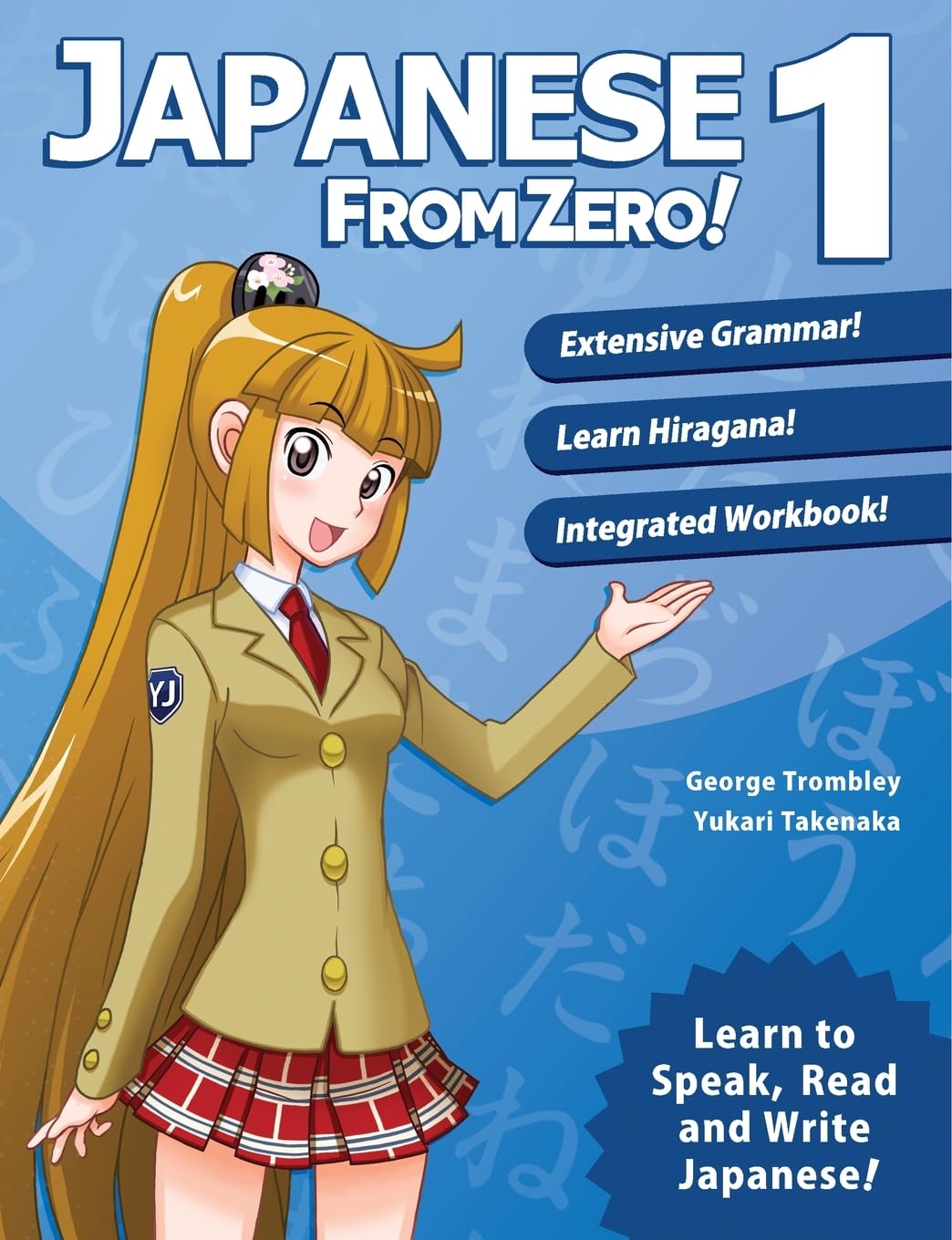
Buy Japanese from Zero! 1: Proven Methods to Learn Japanese with Integrated Workbook and Online Support 5th Edition by Trombley, Mr. George, Takenaka, Ms. Yukari (ISBN: 9780976998129) from desertcart's Book Store. Everyday low prices and free delivery on eligible orders. Review: Japanese from Zero 1 - I have studied Japanese on and off for many years, but when I decided to 'get serious' with studying this wonderful language, this is the book I chose to study from. The accompanying videos on YouTube were a huge consideration for me. This is extremely clear to work from and the explanations make it easy to grasp the concepts of forming sentences and using the language you learn. It even manages to explain quite complex ideas in a clear way and for the first time I fully understand how to conjugate verbs and can now do so with Japanese verbs. This felt like a HUGE win for me. This starts off with simple concepts and builds upon them to give you confidence and useful knowledge. This book has a workbook built into it, with reading and writing exercises (with an answer guide in the back) and these exercises really help you grasp and solidify what you have learnt in that chapter. This books also teaches you Hiragana and I love the way that as you progress through the book the words are gradually built up with each Hiragana you learn, until by the end everything is written in Hiragana and you can read and understand written Japanese. Of course there is Katakana (which is covered in book 2) and Kanji which comes in book 3 onwards. The author has also written a book called Kanji from zero, which covers Kanji a little more. But learning Hiragana so quickly and effortlessly is a huge win and will impress native Japanese and will also enrich your experience when you travel in Japan. This isn't necessarily a book that'll teach you lots of phrases you can use on your holidays, right off the bat, but instead builds a solid language framework and introduces vocab, so you can build your own sentences and actually understand the language. This is much better than simply learning by rote. I also like how the author teaches a style of Japanese that is actually used and which is useful when in the country. Some courses will teach very formal and stilted Japanese, and whilst the author does teach you polite forms, he also teaches langauage that sounds more natural. A simple example of this is 'ja arimasen', compared to 'junai'. They both mean 'not' but one is more stuffy and the other will make you sound more natural (I'll let you read the book to find out which!). As someone who wishes to use Japanese when I am in the country, this is essential for me and will hopefully open up another side of Japan that I may not have seen. My personal way to use this book was to read through each chapter to familiarise myself with the material, then watch the accompanying YouTube video for that lesson to get a clearer idea of pronounciation and any tough parts. Then I'd go back and work though the chapter in a slower, more methodical way, answering the exercies and making notes. I used the Ankidroid app to make up flashcards for all the words and phrases from each chapter, so I could study and test myself when out and about. And I also used a notebook to write up mind maps and mneumonic techniques for the more 'non-sticky' words. In conjunction with this course I also listened to Michel Thomas cd's in the car and used an excellent Particles dictionary (which I have also reviewed on desertcart). Using all these techniques together has really helped the info in this course sink in and start to build a decent framework to build upon. This course is great to work from. You quickly grasp difficult concepts, feel as if you actually understand the way the language is formed and the accompanying videos are light hearted and a wonderful additional media to aid your study. I can't recommend this book enough and if you wish to seriously learn Japanese and unlock your full potential, then give this a try and see what it can do for you. Review: One of the best Japanese learning tools. - Japanese from Zero I purchased this book way back in 2012 when I first began the long and daunting path of learning Japanese as a hobby. However, I can easily say that even after building up an impressive collection of Japanese language books over the years, this is still the standout one along with the rest in the series. They have been written by George Trombley who actually grew up in Japan yet is not Japanese themselves. This helps as they are able to give a first-hand experience of the ‘Text book’ way and the ‘everyday’ way of talking and also boast strong English skills to help translate the subject better. A good example is saying something simple like what is your name. 99% of Text books will tell you to say, “Watashi no namae wa _____ desu” However, in this one you will be told to say “_____ to moushimasu” instead as it is a more natural way that a real Japanese person would say it. After speaking to many Japanese people over the years I can also confirm this to be true. The book covers a huge range of areas for the level such as simple introduction (Hello, my name is, goodbye) counting numbers as well as time and dates. Reading Hiragana and much more. It has questions on almost every page with a full list of answers at the back of book and a dictionary of all the words you will learn in this book. Of the four current books available, this is probably one of the most difficult in the series mainly because it is the first one so it has a lot more ground to cover. The later books are more about improving or adding to what you know and by that point you will have a strong understanding and grasp of the subject. However you shouldn’t let that put you off. A good example of how much you will learn in the first book is by how much your questions will improve without realising it. At the start, you will learn to ask the question. “What is it?” (Nani desu ka) Then after one chapter it will become, “What colour is it?” (Nani iro desu ka) next chapter, “What colour is your car?” (Nani iro no Kuruma desu ka) “What colour is your mothers car?” (Anata no okaasan no kuruma wa nani iro desu ka) While that may not look very impressive when looking at the English side, it really is a huge amount of information to learn in such a short amount of time. If you look at the words in the brackets, you can see how much information you can learn in just a matter of a few weeks. One of the things this book does that I really have not seen another learning book do is slowly add the Japanese Hirigana to the Romanji words. (Romanji is Japanese letters translated into an English format) For example, it will teach you the Hiragana vowels, A,I,U,E,O and then replace those in the Romanji format. It is very hard to explain but it does work and is a very good way of teaching the letters. So to summarise, while my Japanese level is way beyond this book at this point, I really do owe a lot of that to this series. Even today, I still find myself coming back to it from time to time to brush up on some old knowledge. If you are thinking of learning Japanese or have just begun to then I highly recommend this book. You will use this one repeatedly and for the rest of your learning experience.


| Best Sellers Rank | #11,956 in Books ( See Top 100 in Books ) #3 in Japanese Language Instruction (Books) |
| Book 1 of 5 | Japanese From Zero! |
| Customer Reviews | 4.8 4.8 out of 5 stars (8,304) |
| Dimensions | 7.44 x 0.85 x 9.69 inches |
| Edition | 6th |
| ISBN-10 | 0976998122 |
| ISBN-13 | 978-0976998129 |
| Item Weight | 1.2 pounds |
| Language | English, Japanese |
| Print length | 376 pages |
| Publication date | August 22, 2014 |
| Publisher | Learn From Zero |
S**O
Japanese from Zero 1
I have studied Japanese on and off for many years, but when I decided to 'get serious' with studying this wonderful language, this is the book I chose to study from. The accompanying videos on YouTube were a huge consideration for me. This is extremely clear to work from and the explanations make it easy to grasp the concepts of forming sentences and using the language you learn. It even manages to explain quite complex ideas in a clear way and for the first time I fully understand how to conjugate verbs and can now do so with Japanese verbs. This felt like a HUGE win for me. This starts off with simple concepts and builds upon them to give you confidence and useful knowledge. This book has a workbook built into it, with reading and writing exercises (with an answer guide in the back) and these exercises really help you grasp and solidify what you have learnt in that chapter. This books also teaches you Hiragana and I love the way that as you progress through the book the words are gradually built up with each Hiragana you learn, until by the end everything is written in Hiragana and you can read and understand written Japanese. Of course there is Katakana (which is covered in book 2) and Kanji which comes in book 3 onwards. The author has also written a book called Kanji from zero, which covers Kanji a little more. But learning Hiragana so quickly and effortlessly is a huge win and will impress native Japanese and will also enrich your experience when you travel in Japan. This isn't necessarily a book that'll teach you lots of phrases you can use on your holidays, right off the bat, but instead builds a solid language framework and introduces vocab, so you can build your own sentences and actually understand the language. This is much better than simply learning by rote. I also like how the author teaches a style of Japanese that is actually used and which is useful when in the country. Some courses will teach very formal and stilted Japanese, and whilst the author does teach you polite forms, he also teaches langauage that sounds more natural. A simple example of this is 'ja arimasen', compared to 'junai'. They both mean 'not' but one is more stuffy and the other will make you sound more natural (I'll let you read the book to find out which!). As someone who wishes to use Japanese when I am in the country, this is essential for me and will hopefully open up another side of Japan that I may not have seen. My personal way to use this book was to read through each chapter to familiarise myself with the material, then watch the accompanying YouTube video for that lesson to get a clearer idea of pronounciation and any tough parts. Then I'd go back and work though the chapter in a slower, more methodical way, answering the exercies and making notes. I used the Ankidroid app to make up flashcards for all the words and phrases from each chapter, so I could study and test myself when out and about. And I also used a notebook to write up mind maps and mneumonic techniques for the more 'non-sticky' words. In conjunction with this course I also listened to Michel Thomas cd's in the car and used an excellent Particles dictionary (which I have also reviewed on Amazon). Using all these techniques together has really helped the info in this course sink in and start to build a decent framework to build upon. This course is great to work from. You quickly grasp difficult concepts, feel as if you actually understand the way the language is formed and the accompanying videos are light hearted and a wonderful additional media to aid your study. I can't recommend this book enough and if you wish to seriously learn Japanese and unlock your full potential, then give this a try and see what it can do for you.
M**.
One of the best Japanese learning tools.
Japanese from Zero I purchased this book way back in 2012 when I first began the long and daunting path of learning Japanese as a hobby. However, I can easily say that even after building up an impressive collection of Japanese language books over the years, this is still the standout one along with the rest in the series. They have been written by George Trombley who actually grew up in Japan yet is not Japanese themselves. This helps as they are able to give a first-hand experience of the ‘Text book’ way and the ‘everyday’ way of talking and also boast strong English skills to help translate the subject better. A good example is saying something simple like what is your name. 99% of Text books will tell you to say, “Watashi no namae wa _____ desu” However, in this one you will be told to say “_____ to moushimasu” instead as it is a more natural way that a real Japanese person would say it. After speaking to many Japanese people over the years I can also confirm this to be true. The book covers a huge range of areas for the level such as simple introduction (Hello, my name is, goodbye) counting numbers as well as time and dates. Reading Hiragana and much more. It has questions on almost every page with a full list of answers at the back of book and a dictionary of all the words you will learn in this book. Of the four current books available, this is probably one of the most difficult in the series mainly because it is the first one so it has a lot more ground to cover. The later books are more about improving or adding to what you know and by that point you will have a strong understanding and grasp of the subject. However you shouldn’t let that put you off. A good example of how much you will learn in the first book is by how much your questions will improve without realising it. At the start, you will learn to ask the question. “What is it?” (Nani desu ka) Then after one chapter it will become, “What colour is it?” (Nani iro desu ka) next chapter, “What colour is your car?” (Nani iro no Kuruma desu ka) “What colour is your mothers car?” (Anata no okaasan no kuruma wa nani iro desu ka) While that may not look very impressive when looking at the English side, it really is a huge amount of information to learn in such a short amount of time. If you look at the words in the brackets, you can see how much information you can learn in just a matter of a few weeks. One of the things this book does that I really have not seen another learning book do is slowly add the Japanese Hirigana to the Romanji words. (Romanji is Japanese letters translated into an English format) For example, it will teach you the Hiragana vowels, A,I,U,E,O and then replace those in the Romanji format. It is very hard to explain but it does work and is a very good way of teaching the letters. So to summarise, while my Japanese level is way beyond this book at this point, I really do owe a lot of that to this series. Even today, I still find myself coming back to it from time to time to brush up on some old knowledge. If you are thinking of learning Japanese or have just begun to then I highly recommend this book. You will use this one repeatedly and for the rest of your learning experience.
A**R
الكتاب كبير وممتاز ولكن الغلاف معفط للاسف مو مرره جديد
A**E
Recomendado como introducción para el aprendizaje del idioma japonés, tiene muchas actividades, va de lo simple a lo complejo y tiene buena dinámica de inserción de nuevo vocabulario y escritura japonesa progresiva. No es un libro infantil, es más para adolescentes y adultos. Se puede complementar el aprendizaje al avanzar de nivel los libros de niveles posteriores.
I**N
Awesome guide for beginner … go for it !!
A**R
This book is structured for beginner's learning of Japanese. I have learnt how to read Hiragana from this book. And I even understand simple conversation and request.
A**A
Questo è il libro perfetto per chi non ha mai toccato (e dico mai toccato nulla) che sia inerente al giapponese. Il libro parte proprio dal sillabario hiragana (nel secondo il katakana, cioè il sillabario per termini stranieri) su come scrivere ogni singolo carattere, partendo poi con le frasi più basilari ( ad esempio nella prima lezione la presentazione, poi i numeri etc) con tanto di piccole sezioni dedicate a vocaboli ad inizio capitolo (con tanto di scrittura in romaji, hiragana e kanji), grammatica e note culturali per ogni capitolo, passando poi infine agli esercizi (domanda e risposta) e traduzione.Il libro può trarre in inganno le persone adulte dando perscontato che sia un libro adatto solo per bambini per via della copertina ma non è così, il libro spiega in modo molto semplice e chiaro tutta la grammatica e struttura della frase giapponese.Questo è solo il primo libro e per ora ne conta in totale 4, in arrivo forse il quinto. Posso dire che ho il libro della hoepli e il genki (il genki poi costa un botto) e tra questi 3 preferisco proprio japanese from zero, forse perché spiega in maniera meno schematica e monotona rispetto agli altri due, contando anche che questi due libri sono più rivolti ad uno studio scolastico, mentre japanese from zero è rivolto di più verso gli autodidatti. Forse l'unica pecca è che il libro non è proprio adatto ad un neofita (non sono né neofita ma neanche ad un livello intermedio) e trovare le frasi scritte (parlo di frasi, non della singola parola) scritte solo in hiragana può essere un po' fastidioso ma...nulla di grave alla fine.Conosco quasi tutti i kanji a memoria (intendo quelli del libro di Heisig) e vedere solo la versione in hiragana fa quasi sentire l'apprendimento un po' parziale, non del tutto completo.Ad ogni modo è perfetto per qualunque categoria, sia per chi non sa nulla ma anche per chi sa già qualcosa, è sempre un buon strumento per rispolverare la lingua.La cosa che trovo molto carina è la fase progressiva di come i romaji (i nostri caratteri) vengono sostituiti nel tempo dagli hiragana dopo l'apprendimento di alcuni di essi dopo ogni capitolo. Ad esempio, se io trovo la frase -> kuruma desu ka? dopo 2 capitoli diventa kuるma deすか? e poi くるまですか? ed infine con l'aiuto dei kanji inseriti per ogni vocabolo 車ですか?. Altra pecca (ma è soggettiva come cosa) è che il libro è disponibile solo in lingua inglese, quindi non adatto a chi non conosce la lingua.Per chi invece ha dubbi può consultare la versione kindle e farsì lì direttamente un'idea più o meno chiara se acquistarlo o meno. Vi assicuro comunque che il libro è che scritto in un inglese molto semplice e che tutti (o almeno la maggioranza) può benissimo acquistarlo con tutta la serenità possibile, ve lo assicuro :). Ultima cosa che ho dimenticato di citare è che il libro non ha in dotazione il cd, ma credo che per la maggior parte delle persone non sarà un problema per via della diffusione di manga e anime; ma per chi non ha mai avuto a che fare con il giapponese, vi posso rassicurare che la sua fonetica è come quella italiana, per cui non sarà un problema.
Trustpilot
2 weeks ago
1 day ago