Some deliveries may take a little longer than usual due to regional shipping conditions.

DOWNLOAD THE APP


Customer Services
Copyright © 2025 Desertcart Holdings Limited
DOWNLOAD THE APP
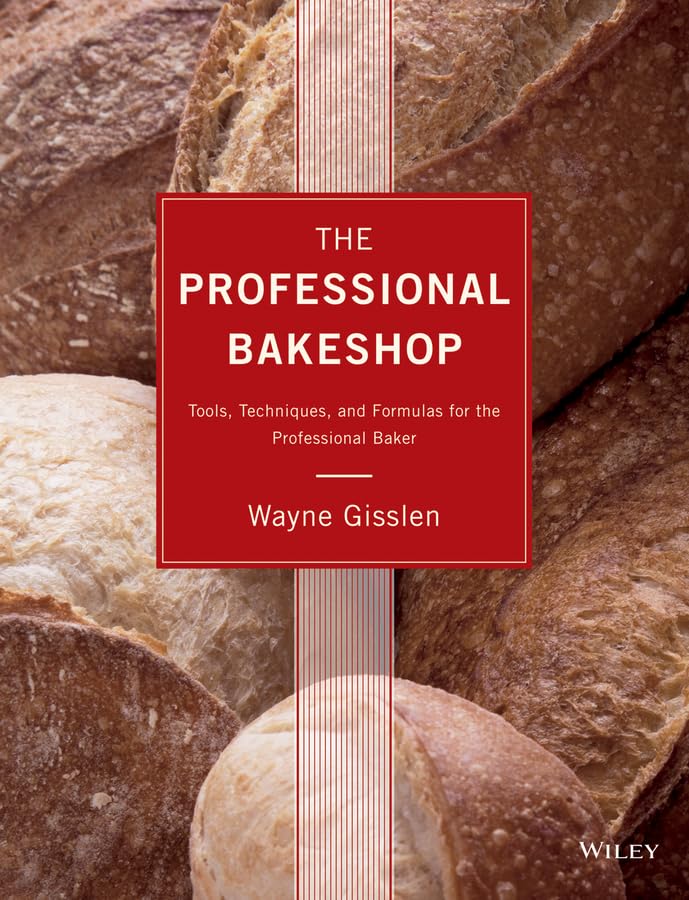
The Professional Bakeshop: Tools, Techniques, and Formulas for the Professional Baker : Gisslen, Wayne: desertcart.co.uk: Books Review: Good book - This is shortened and simplified version of a book Professional baking by Wayne Gisslen. This should be more obvious from description. The formulas in this book are excellent - from cookies, creams, breads to cakes, etc. Compared to other professional baking books the formulas are rounded so you'll not see any 0.19 grams or 3.58 grams as in other books but rather 5 grams or 1250 grams. Recipes are basic, really good but outdated with the lack of new ideas (this is not an issue for professionals but may be important for home baker). Explanation on techniques and ingredients is probably the best I've seen in any book. The fact that this book is only shortened Professional baking is noticeable for example in the recipe for Panettone p. 111 - there are missing important steps 4 and 5. Another example is on p. 39 - author is mentioning the sidebar with the formula for single acting baking powder, but there's no sidebar. This issues may not be relevant for professional but are simply mistakes made when shortening the Professional baking. For the book printed in 2013 there's not enough pictures of finished products and the ones in the book look like from 80s and some illustrations are simply pointless - p. 45 The crumb and crust of bread, p. 351-352 Cake-cutting guides, p. 368- Speciality cakes (cross section of assembled cakes are helpful, but all the cakes are very simple and the pictures of finished cakes would be much better). This book is good but I would definitely recommend to invest in Professional baking instead. Review: This has been a wonderful addition to my [bread] baking library, though it covers much more than bread baking alone. The introductory chapters have a lot of information that is often overlooked by many authors, including notes on determining friction factor (i.e. the degree to which a mixer or hand-kneading will raise the temperature of a dough), maintaining appropriate dough temperatures by adjusting the temperature of water added to doughs - even including a formula for determining how much ice needs to be added to a volume of water to cool it to the appropriate level to maintain dough temperatures. As mentioned, the first few chapters are rather dry and technical, but these chapters are crucial in understanding how baking works and, in taking the time to read and understand these chapters, one can gain the technical prowess needed to troubleshoot baking problems and ultimately greatly improve their baking. The remainder of the book is dedicated to formulas, and let me tell you the formulas are fantastic. Note that there are NO VOLUMETRIC FORMULAS INCLUDED - ALL THE FORMULAS ARE DONE BY MASS (GRAMS/OUNCES)! For those of us that wish to have consistent, excellent results, this is no surprise and is very much welcomed. Personally, I tend to avoid baking books that give formulas in cups and tablespoons rather than grams, as I don't want to have to do all the conversions to mass (and ultimately bakers percentages) myself. The ingredient lists in the formulas (recipes) are given in 3 columns: US weights (pounds, ounces), metric weights (grams) and finally (and most useful) bakers percentages. After the ingredient list, the procedure is clearly listed in a step-by-step manner that ensures mistakes are avoided. I've only tried a handful of the formulas, but they seem to be very solid and, the few that I've tried, have produced great results. I've looked over many of the formulas and compared some of them (like the brioche formula, for instance) to my more tried and true formulas - those that I've tested and know to be successful. My brioche formula, for instance, is based on the one described by Raymond Calvel in "The Taste of Bread." The sugar in Gisslen's formula is less than half of that used in Calvel's; Gisslen uses 15% more butter in his formula than Calvel does. Aside from this, the differences are rather minimal, differing by only around 5-10%. The procedure itself bears some similarities to Calvel's, and I'm interested to see how the final products compare. Gisslen's formulas use instant yeast, and although I prefer formulas that use fresh yeast (which are increasingly hard to find), instant yeast is the next best choice (as opposed to active dry). If you prefer fresh yeast or active dry, the conversion is rather easy to do, so it won't be a problem to adapt these formulas to your own yeast preference. The level of detail and illustrations and photos that accompany many (or most) of the formulas are superb, and I have yet to come across a book that does a better job using visual aids (photos, diagrams, etc.). Specifically, the chapter on 'Advanced and Specialty Cakes' includes a cross-sectional diagram that shows exactly how the cake should be assembled, layer by layer, ingredient by ingredient. Although my primary interest is bread and this book devotes only a small portion of its near 600 pages to bread, I still say that this book is an indispensable addition to any serious baker's library, and would serve as a wonderful "jumping off point" for novice bakers wishing to take their baking to the next level, or for intermediate or advanced bakers wishing to hone their skill or expand their repertoire. Although a bit more expensive than many other books in the same category, the extra price is evident in the quality and content of this exceptionally well put-together publication. Highly recommended for novice and advanced bakers alike.
| ASIN | 1118314107 |
| Customer reviews | 4.3 4.3 out of 5 stars (14) |
| Dimensions | 22.61 x 3.81 x 28.45 cm |
| Edition | 6th |
| ISBN-10 | 9781118314104 |
| ISBN-13 | 978-1118314104 |
| Item weight | 1.05 kg |
| Language | English |
| Print length | 576 pages |
| Publication date | 27 Sept. 2013 |
| Publisher | Wiley |
T**H
Good book
This is shortened and simplified version of a book Professional baking by Wayne Gisslen. This should be more obvious from description. The formulas in this book are excellent - from cookies, creams, breads to cakes, etc. Compared to other professional baking books the formulas are rounded so you'll not see any 0.19 grams or 3.58 grams as in other books but rather 5 grams or 1250 grams. Recipes are basic, really good but outdated with the lack of new ideas (this is not an issue for professionals but may be important for home baker). Explanation on techniques and ingredients is probably the best I've seen in any book. The fact that this book is only shortened Professional baking is noticeable for example in the recipe for Panettone p. 111 - there are missing important steps 4 and 5. Another example is on p. 39 - author is mentioning the sidebar with the formula for single acting baking powder, but there's no sidebar. This issues may not be relevant for professional but are simply mistakes made when shortening the Professional baking. For the book printed in 2013 there's not enough pictures of finished products and the ones in the book look like from 80s and some illustrations are simply pointless - p. 45 The crumb and crust of bread, p. 351-352 Cake-cutting guides, p. 368- Speciality cakes (cross section of assembled cakes are helpful, but all the cakes are very simple and the pictures of finished cakes would be much better). This book is good but I would definitely recommend to invest in Professional baking instead.
R**N
This has been a wonderful addition to my [bread] baking library, though it covers much more than bread baking alone. The introductory chapters have a lot of information that is often overlooked by many authors, including notes on determining friction factor (i.e. the degree to which a mixer or hand-kneading will raise the temperature of a dough), maintaining appropriate dough temperatures by adjusting the temperature of water added to doughs - even including a formula for determining how much ice needs to be added to a volume of water to cool it to the appropriate level to maintain dough temperatures. As mentioned, the first few chapters are rather dry and technical, but these chapters are crucial in understanding how baking works and, in taking the time to read and understand these chapters, one can gain the technical prowess needed to troubleshoot baking problems and ultimately greatly improve their baking. The remainder of the book is dedicated to formulas, and let me tell you the formulas are fantastic. Note that there are NO VOLUMETRIC FORMULAS INCLUDED - ALL THE FORMULAS ARE DONE BY MASS (GRAMS/OUNCES)! For those of us that wish to have consistent, excellent results, this is no surprise and is very much welcomed. Personally, I tend to avoid baking books that give formulas in cups and tablespoons rather than grams, as I don't want to have to do all the conversions to mass (and ultimately bakers percentages) myself. The ingredient lists in the formulas (recipes) are given in 3 columns: US weights (pounds, ounces), metric weights (grams) and finally (and most useful) bakers percentages. After the ingredient list, the procedure is clearly listed in a step-by-step manner that ensures mistakes are avoided. I've only tried a handful of the formulas, but they seem to be very solid and, the few that I've tried, have produced great results. I've looked over many of the formulas and compared some of them (like the brioche formula, for instance) to my more tried and true formulas - those that I've tested and know to be successful. My brioche formula, for instance, is based on the one described by Raymond Calvel in "The Taste of Bread." The sugar in Gisslen's formula is less than half of that used in Calvel's; Gisslen uses 15% more butter in his formula than Calvel does. Aside from this, the differences are rather minimal, differing by only around 5-10%. The procedure itself bears some similarities to Calvel's, and I'm interested to see how the final products compare. Gisslen's formulas use instant yeast, and although I prefer formulas that use fresh yeast (which are increasingly hard to find), instant yeast is the next best choice (as opposed to active dry). If you prefer fresh yeast or active dry, the conversion is rather easy to do, so it won't be a problem to adapt these formulas to your own yeast preference. The level of detail and illustrations and photos that accompany many (or most) of the formulas are superb, and I have yet to come across a book that does a better job using visual aids (photos, diagrams, etc.). Specifically, the chapter on 'Advanced and Specialty Cakes' includes a cross-sectional diagram that shows exactly how the cake should be assembled, layer by layer, ingredient by ingredient. Although my primary interest is bread and this book devotes only a small portion of its near 600 pages to bread, I still say that this book is an indispensable addition to any serious baker's library, and would serve as a wonderful "jumping off point" for novice bakers wishing to take their baking to the next level, or for intermediate or advanced bakers wishing to hone their skill or expand their repertoire. Although a bit more expensive than many other books in the same category, the extra price is evident in the quality and content of this exceptionally well put-together publication. Highly recommended for novice and advanced bakers alike.
K**Y
This book is worth the price. It is a wealth of information and photos. It is definitely written for an audience with at least some professional baking experience/knowledge, as well as access to a restaurant supply store for equipment/ingredients. It isn't overly user-friendly, but is a great resource.
K**C
I think a previous reviewer who gave the book only one star was being unfair. Yes, the book does have a lot of similarites to Professional Baking, but they are not the same book. I would say that most people probably only need one of them, but that does not make this book a bad book. From my reading of it, Professional Baking was designed to be used in baking & pastry programs at colleges (as it was used in the pastry program I attended), while The Professional Bakeshop is one you would pick up on your own when you needed a basic grounding in pastry and baking. The basics are covered well in this book, with explanations on how many aspects of baking work.
G**.
Great book,On baking,Baking secret by Sherri Yard,Mordern vegan baking by Gretchen Price,Great course cooking and baking DVD set by CIA instructors,Books by Nick Malgieri also a great teaching aid.
A**R
I am glad I finally got it. It was worth the wait. I recommend it to all bakers.
Trustpilot
2 weeks ago
2 weeks ago