Buy anything from 5,000+ international stores. One checkout price. No surprise fees. Join 2M+ shoppers on Desertcart.
Desertcart purchases this item on your behalf and handles shipping, customs, and support to EGYPT.
🔌 Test Smarter, Not Harder — Your Ultimate USB Cable Truth Teller
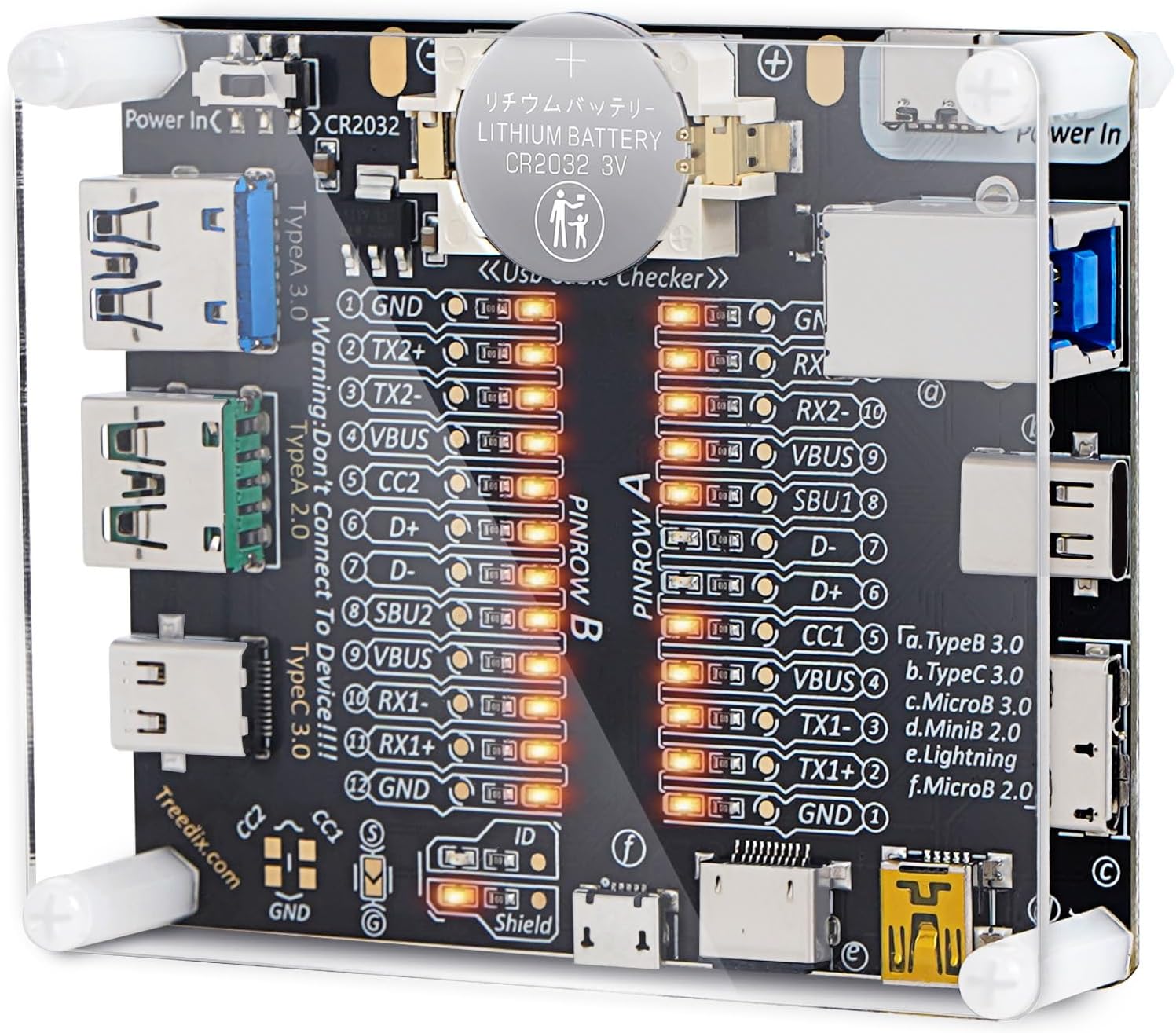
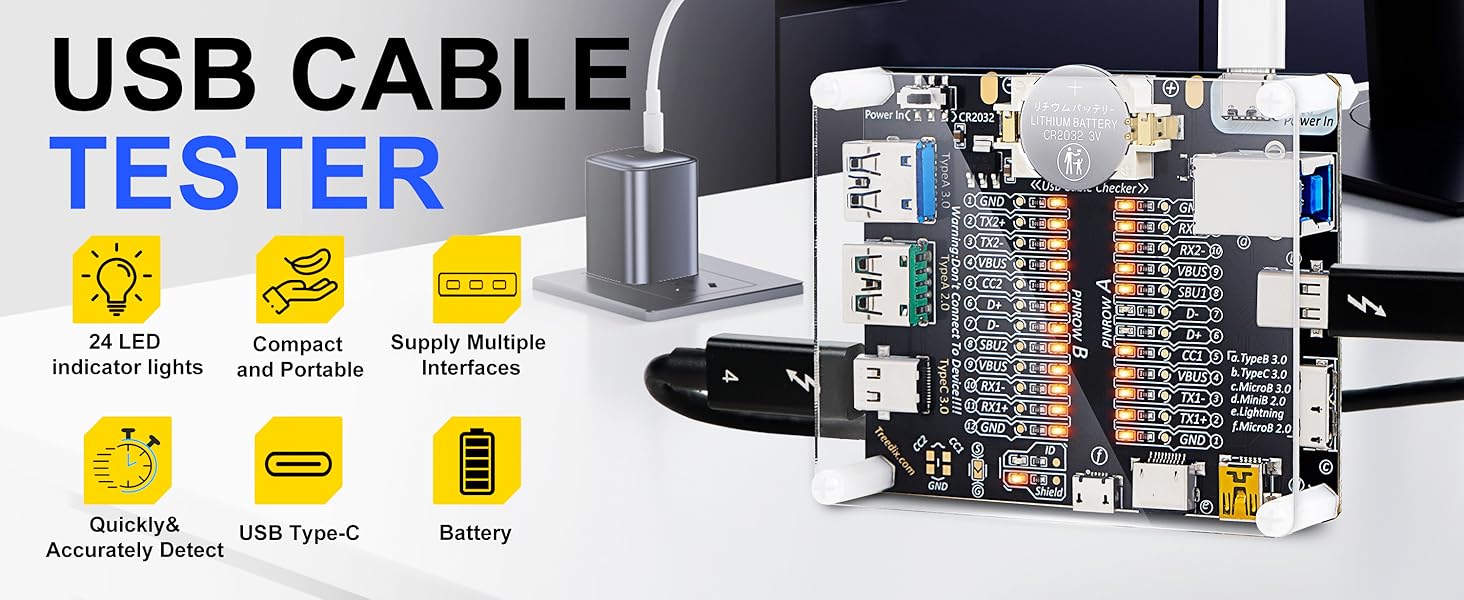
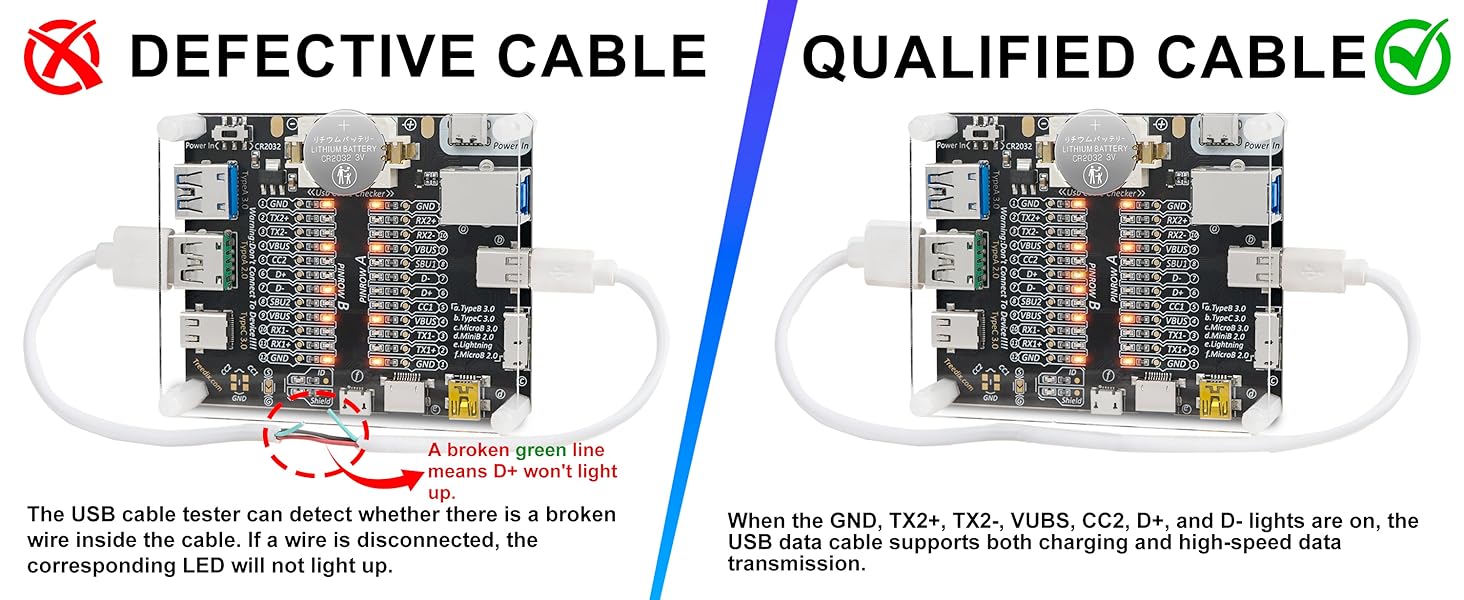
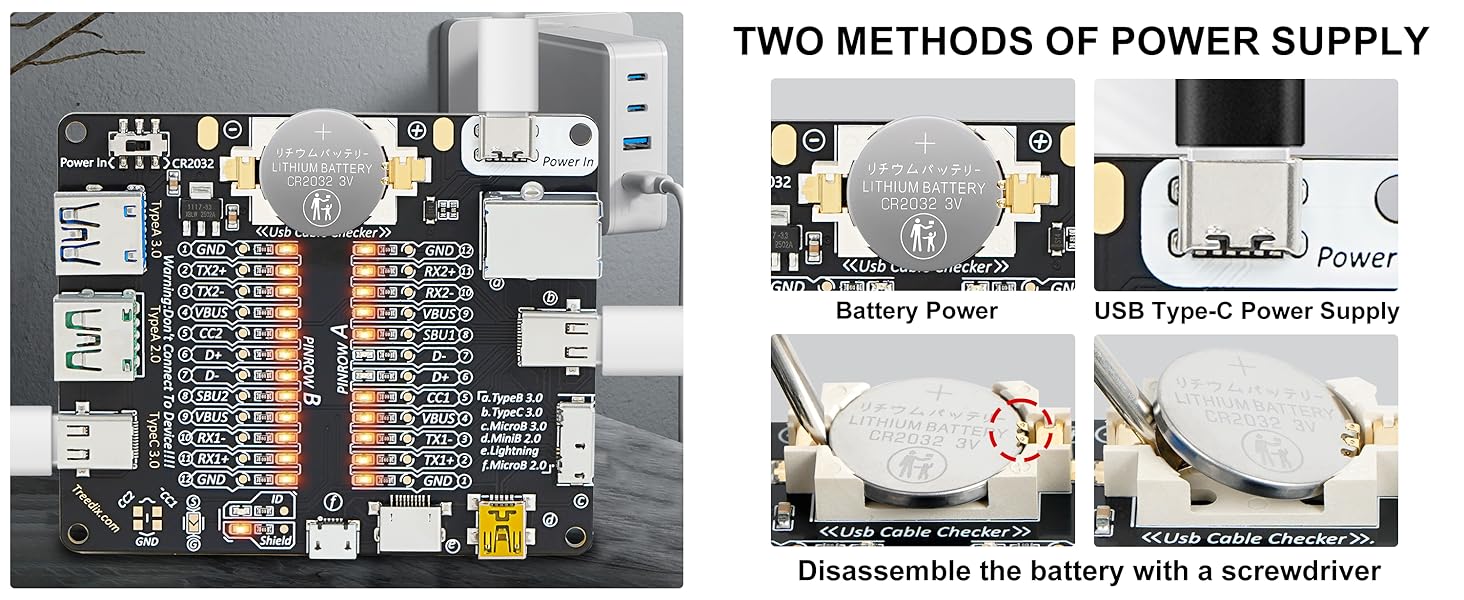
The Treedix USB Cable Tester Board is a professional-grade diagnostic tool designed to test a wide range of USB cables including Type-C (3.0/3.1/3.2), Type-A, Micro-B, Mini-B, and Lightning. Featuring 24 LED indicators for detailed pin-level analysis, it identifies cable faults such as shorts, open circuits, and charge-only lines. Powered by either a CR2032 battery or USB-C 5V, its compact form factor is protected by a sleek acrylic case, making it the perfect portable solution for tech-savvy professionals to ensure cable integrity and avoid performance issues or scams.


| ASIN | B0CF95VL2Y |
| Best Sellers Rank | #11,176 in Industrial & Scientific ( See Top 100 in Industrial & Scientific ) #19 in Network & Cable Testers |
| Brand | Treedix |
| Brand Name | Treedix |
| Color | Transparent |
| Compatible Devices | USB devices with TypeB 3.0, TypeB 2.0, TypeC 3.0, MicroB 3.0, MicroB 2.0, MiniB 2.0, and Lightning connectors |
| Customer Reviews | 4.6 out of 5 stars 1,061 Reviews |
| Item Weight | 9.07 g |
| Manufacturer | Treedix |
| Min. Operating Voltage | 3 Volts |
| Minimum Operating Voltage | 3 Volts |
| Model | USB Cable Tester with Acrylic Case |
| Part Number | TRX5-0575 |
| Power Source | Battery Powered |
| Specification Met | Ul 61010-1, Ce Marked |
| Style | USB Cable Checker with Acrylic Case |
| Style Name | USB Cable Checker with Acrylic Case |
| UPC | 644197770089 |
| Unit Count | 1.0 Count |
M**O
One Beefy Little Guy! (Showcase of Device and Manual For Pins Included) :)
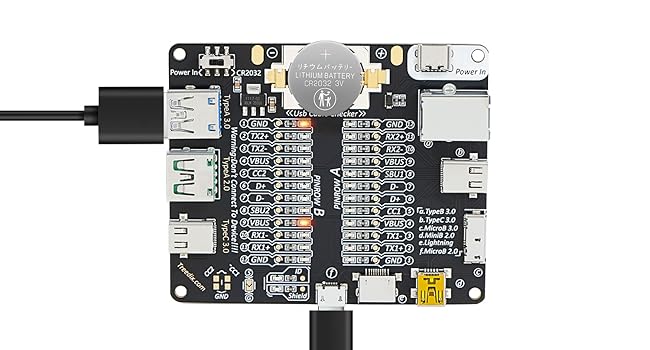
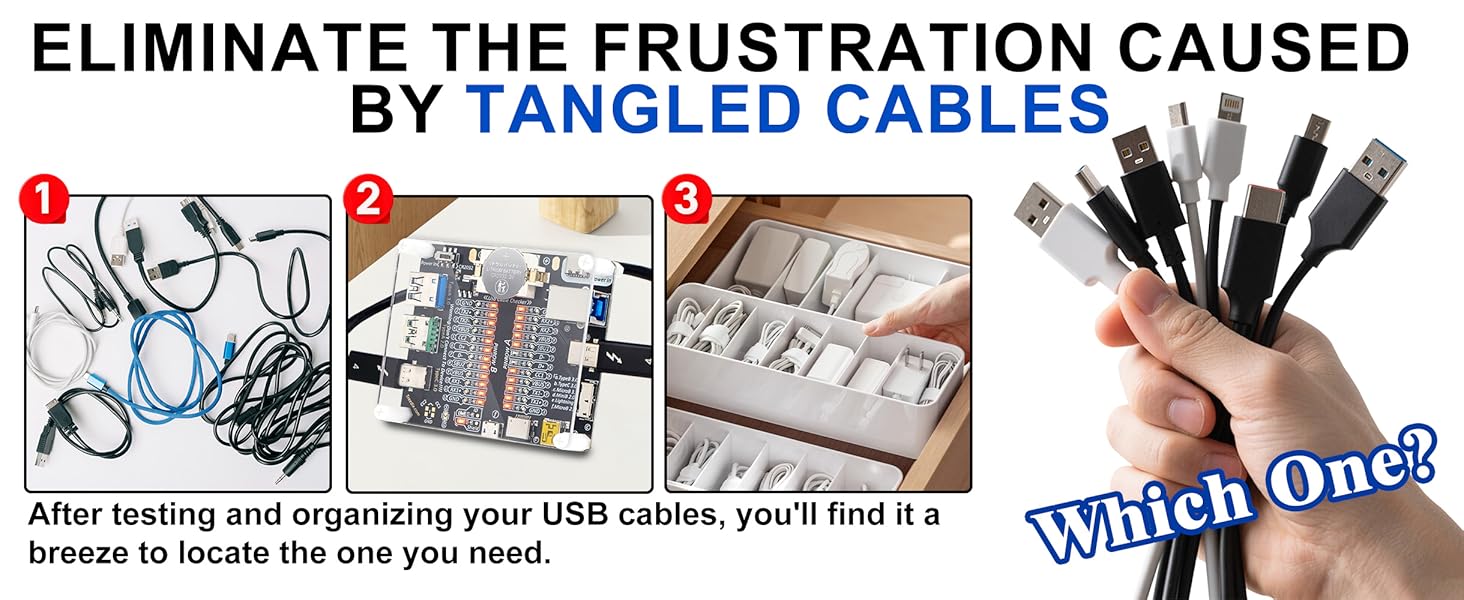
Important Warning: DO NOT use this tester to connect to live devices. Doing so could potentially damage both your devices and the tester itself. It is designed solely for testing cables as intended. --------------------------- ★ Section 1 - The Review ★ • This is by far the best design I've encountered for a cheap USB cable tester. It features a straightforward circuit powered by a CR2032 battery or via a Vin pin (cable not included). Each pin of the cable connects to a corresponding light that illuminates when a cable completes the circuit. I really appreciate the broad range of compatible ports, including USB Type-A 2.0 and 3.0, Thunderbolt 3/USB Type-C 3.0 on both sides, Lightning, Micro-B 2.0 and 3.0, and Mini-B 2.0. These standards are fully backward compatible, and the inclusion of both versions ensures that this tester is 100% reliable. • The board has two sides: "Side A" and "Side B," accommodating the reversible nature of Type-C cables. For other types such as Lightning, Micro-B, Mini-B, typically only one side will light up. Generally, you should focus on the side with the most lights illuminated; the other side can usually be disregarded, except for Lightning cables. • One area for improvement.. It would be the documentation of expected pinouts and explanations of the different common combinations. However, this can easily be resolved with a quick Google search. I’ll share my understanding and research below. --------------------------- ★ Section 2 - Here’s a breakdown of what each of those pins means ★ GND (Ground): This is the reference point for electrical signals in the circuit. It serves as the common return path for electric current. • TX+/- (Transmit): These pins are used for data transmission. "TX+" is the positive data line, and "TX-" is the negative data line. They work together to send data signals. • RX+/- (Receive): Similar to TX, these pins are used for receiving data. "RX+" is the positive line for incoming data, and "RX-" is the negative line. They allow the device to receive signals from another device. • VBUS: This pin carries the main power supply voltage. It typically provides +5V to power devices or charge them. • D+ and D-: These are the data lines used in USB connections. "D+" is the positive data line, and "D-" is the negative data line. They enable data transfer between devices. • CC1 and CC2 (Configuration Channel): These pins are used in USB Type-C connections to determine the orientation of the connector and negotiate power delivery. They help devices communicate their capabilities to each other. • SBU1 and SBU2 (Sideband Use): These pins can be used for additional features, such as audio or alternate modes, depending on the type of device connected. They provide extra functionality in certain situations. • ID (Identification): This pin is used to determine the type of device connected. In certain configurations, it helps differentiate between host and peripheral roles. For example, in some USB OTG (On-The-Go) setups, the ID pin can signal whether the device should act as a host or a peripheral. • Shield: This pin is used for grounding the shield of the cable, which helps reduce electromagnetic interference (EMI). It helps protect and improve the signal integrity by grounding any external noise that may affect data transmission. --------------------------- ★ Section 3 - A valuable diagnostic tool for several reasons ★ • Signal Integrity Testing: It helps verify the quality of data transmission through the USB cable, ensuring that signals are not degraded. This is crucial for high-speed data transfer applications. • Pin Configuration Verification: The board can confirm that all the necessary pins in the USB cable are properly connected and functioning. This is important for ensuring compatibility with devices. • Identifying Faults and Damage: By testing various cables, you can quickly identify any faulty ones. This is helpful if you suspect that a cable is defective or if a company is providing subpar products. • Compatibility Checks: It can help determine if a cable is compatible with specific devices, preventing the use of cables that might cause performance issues or failures. • Preventing Scams: If you're considering purchasing cables from a vendor, using the test board can help you confirm that the cables meet advertised specifications. Then you would know to return the product for a full refund, and purchase a different cable from another vendor. This can protect you from scams where companies sell low-quality or counterfeit products. • The Frustration Caused by USB Cables: Want to organize or discard cables, but don't know which ones are functional? You can use the USB Cable Tester Board to easily help you identify the right cables to keep.
A**R
Handy little USB cable checker
Easy to use--put a battery in, plug in a cable and go. It does take a little getting used to reading the status LEDs. The manual is bare-bones but provides the essential info. A simple but effective continuity checker to sort my drawer full of USB cables. I was surprised at how many of my old cables were charging only (no data connections). AFAIK, this tester does not read e-marker chip (required on hi-power charging/very hi-speed data, e.g. thunderbolt, USB 3 gen 2), but it does everything else I need. Thank you treedix for this simple and effective tool at an affordable price. I would definitely buy again.
C**N
Mostly pros but a few cons
Pros: Make no mistake, this is a well-made, inexpensive, and useful gizmo for checking USB cables since manufacturers don't seem to be willing to clearly identify how much of the USB spec a given cable covers in its wiring (i.e., is it charge only, data and charge, for video and audio, etc). I actually endorse the plexiglass cover you get for an extra $2. It's easy to put on or leave off, with threaded stand-offs that lift the circuit board's bottom off of a table surface. The components are surface mounted except for the USB connectors, so there's little to be gained by adding more to the case (although you could, since the underside stand-offs are threaded for a screw insert to allow mounting an underside cover should you wish to do so (I wouldn't bother) I should note that the plexiglass is protected by a brown paper contact sheet you peel off to get the beautiful clear plexiglass you expect. Amusingly a small bladed screwdriver is included that doesn't fit the Phillips head nylon mounting screws. Cons: The instruction manual is minimal, failing to explain how to interpret the results for a typical cable or even how to hook it up (while for me it's pretty obvious, it might not be so for others). It's also an annoyance that the box isn't big enough to hold the gizmo with the plexiglass cover installed. My real quibble is the use of a JST PH2 power supply connector should you want to bypass the battery (or if it is dead). There is (unexplained) a switch to channel power from the battery or from the power supply input (Vin). A JST PH2 plug is a type not found in most if any plug adapter kit; i.e., you would have to acquire a plug and wire it up to a power supply since it's unlikely you already have that kind of plug on hand. At least Vin is not voltage specific (3V < Vin <12V) so you could just use one of those old 5V cell phone chargers you have lying around to convert to a JST PH2 plug (doing whatever is necessary to identify +/-). I really like the thing for weeding out bad cables and separating by type (which I diligently label using an old label maker I have on hand). The cons are annoyances rather than deal breakers. I recommend the gizmo.
C**3
Outstanding USB and Lightning Cable Tester
I decided to purchase this Treedix simplified USB cable tester rather than a considerably more expensive different brand tester with an LCD readout. The difference is dedicated LEDs versus LCD readout. The board left side has USB connectors for Type A 3.0, Type B 2.0, and Type C 3.0. The board right side has USB connectors for Type B 3.0, Type C 3.0, Type Micro B 3.0. The board bottom side has USB connectors for Mini B 2.0, Micro B 2.0, and an Apple lightning connector. The circuit board backside has useful pad printed wiring diagrams for the connectors. The board comes with a CR2032 battery with provision to supply alternate 3V to12V input power via a JST PH 2.0 jack. A switch allows selection of input power. Unfortunately, a JST plug with leads is not supplied. I tested numerous unknowns to known high quality USB and lightning cables. Some cables I thought were USB 3.0 were actually USB 2.0. So far, none of my tested cables were found defective. The included Quick Start Guide was adequate, but a detailed instruction manual is downloadable from the internet. It is easy to install the plexiglass cover with included plastic hardware and a screwdriver. In summary, this is truly an inexpensive and versatile USB and lightning cable tester.
V**Y
Essential Bench Tool for Sorting Charging and Data Cables.
As someone who frequently manages a large inventory of electronics and charging accessories, the USB Cable Tester is a practical solution to a common problem. We all have a drawer full of "mystery" cables, and this board provides an immediate, visual way to distinguish between high-quality data cables and "charge-only" versions. Functional Versatility The board is impressively comprehensive for its size. It features input and output ports for almost every common USB standard: USB Type-A and Type-B USB Type-C Micro-USB Mini-USB (found on some older peripherals) By plugging a cable into the corresponding ports, the LED indicators tell you exactly which internal wires are functional. If only the VCC and GND lights illuminate, you know it’s a power-only cable. If the D+ and D- lights also light up, you’ve confirmed it can handle data transfers. Build Quality and Protection At the $15.99 price point, I was pleased to see the inclusion of a clear acrylic protective case. Durability: It gives the board a bit of heft and protection from dust and physical damage while still allowing you to see the silk-screened labels on the PCB clearly. Assembly: The case arrives as a kit with protective film on the pieces. Assembly is straightforward and takes only a few minutes with the included standoffs and screws. Ease of Use The operation is purely plug-and-play. There is no complicated software or screen to navigate. You simply provide power to the board via a dedicated Type-C or Micro-USB power port (not the cable being tested), and then plug in your test cable. The results are instant. It is a much faster workflow than plugging cables into a computer and checking the Device Manager to see if they are recognized. Pros: Dual power, battery, or USB-C Wide Compatibility: Supports Type-C, Micro, Mini, and Type-A/B. Clear Indicators: LEDs provide an instant pass/fail for power and data lines. Protective Case: The included acrylic shell is a significant value-add for bench safety. Excellent Value: At $15.99, it pays for itself by helping you identify and discard faulty or substandard cables. Cons: None Final Verdict: This is a must-have for anyone who tinkers with electronics or simply wants to organize their home cable collection. It is a reliable, well-built, and inexpensive diagnostic tool that does exactly what it's supposed to do. For the price, it is a highly recommended addition to any toolbox or tech desk.
L**C
Addressing some bad 1 star reviews
Disclaimer: I am just another buyer. I have no affiliation with Treedix. There are some legit 1 star reviews, I am addressing only the ones I consider to be the result of a fault on the user side, not on the hardware. 1. Not transparent "plastic" cover: This one even has pictures (thank you) so I can see the cover is exactly like the one I got. Those are indeed adhesive protectors, to protect the cover from scratches. Yes, it was not super easy to peel off, but they can indeed be peeled off (both sides come protected). 2. No replaceable battery: As soon as I read this one, I went and disassembled mine (as per instructions) and took the battery out, turned the device on and off, replaced the battery, and then tested the device with a cable to see everything was OK. (It was.) I see no issues with the battery or the replacement process. I do want to express gratitude that this tester uses a CR-2032 battery, which is very commonplace and that the included manual shows what is the correct way of extracting the battery, which should be done using the provided screwdriver. (Which is flat, and not Philips, precisely for this reason.) 3. Incomplete manual: I wish people complaining about this would be more specific. I don't know what info is the manual supposedly missing. (You should not only read the manual, but what is printed on the tester itself, FYI.) 4. Power connector: First of all, this tester could just NOT have any other power source than the battery. I find it to be a very nice addition, but some people found this to be a reason to complain. It's a connector so standard, that searching (even here on Amazon) for a "2 pin connector" will yield results for the correct connector. The board even inform us that a power source of more than 3V and less than 12V is acceptable. I am absolutely very grateful for this provided option, even if it is unlikely I'll ever use it (unless CR2032 batteries suddenly become very hard to come by). Finally: This tester is AMAZING, highly recommended. For a good review, there's a very nice one (5 stars) with many pictures and a lot of information.
B**L
A Reputable Company! With a great little device.
A reputable company! The original order showed up with a manufacturing defect in the battery holder. The unit functioned properly with USB power. After confirming the problem (2 emails) I was quickly shipped a replacement, didn't even ask me to return the defective unit! The little gadget does exactly what it claims and checks out if cables are wired correctly. I tried it on several cables and found a few duds. The documentation is minimal but gives you the information you need it your read carefully. Watch out cable suppliers I won't be accepting any improperly wired cables in the future. I can't stress enough how pleased I am with the device and the service provide by this company! Note: there is some assembly required. You have to screw in the plastic feet & cover standoffs. You also need to peel off the paper covering on the plexiglass cover. Not to difficult, but for us oldies a little challenging with the small parts.
P**Y
Great. For the price? Can't beat it.
Looks like many of the negative reviews are old. This came right up and worked for me. So here goes: 1- Not easy but not hard either to peel off the protective backing from both sides of the clear top. 2-Assembly took fewer than 5 minutes. Might take you 10 if you're ham-handed. 3-Battery: easy enough to remove the battery with a pocket knife point on the left side (towards the USB A connectors), remove the insulating strip and snap the battery back in. Pry out from top-center-left. Should be simple to do the same when changing the battery. 4- Slide the power switch towards center to turn on. No lights at all until you connect a cable that's at least partially good. Mine worked right away. 5- Tests the shield too. 6- If you're buying this for continuity testing, you're home free. 7- Should perhaps have included a female pigtail for power supply but CR2032s are so cheap, why bother with an external supply anyway? Battery should last a good long while. Great price, does the job, identifies open and intermittent conductors (haven't found a shorted cable yet but it probably shows you those too). I've already tossed out a couple of bad cables and have a good idea of which are good. Can't ask more for under 20 bucks.
M**N
Sort out unknown usb cables
I bought the option with cover so some assembly required. Works as advertised. It’s helped me organise my usb cables.
M**O
Recomendable
De facil uso, permite rápidamente determinar si el cable funciona adecuadamente y que tipo de cable es
M**L
Excellent
USB cables come in all kinds of capacities. This lets you quickly know if a cable is for power only (apple Vision Pro for example) or whether it has data capabilities and so on It’s interesting to use
R**L
Excelente... si sabes algo de electrónica
Muy bueno, te hace un mapeo de todos los pines, sin embargo creo que la mayor utilidad es cuando sabes como interpretar las lucecitas.
W**C
Does the job but cheap manufacture. If you intend using it a lot it may break.
Has an on board connector for power - but nothing to mate to it and actually provide that power. Quite ridiculous. I have seen reviews saying the button cell battery cannot be removed - but actually it can and quite easily so. My main gripe is flux on the printed circuit board because it hasn't been washed off during manufacturing so if you see greasy spots on the circuit board and /or the soldered joints it is flux. To add to this the leads of the components don't pass through the holes far enough so can't be properly soldered to the board. You can buy a device off a well known Asian supplier for a fraction of the cost and sure it's quality isn't much worse but there is a big difference in price. With plenty use I can see one or more of the connectors coming off the Treedix board - probably taking some track with it and for all intents and purposes (except for the die hard DIY repairers) rendering it scrap. At least with the alternative suppliers in Asia they are a fraction of the cost and the loss is much easier to take.
Trustpilot
5 days ago
2 days ago