
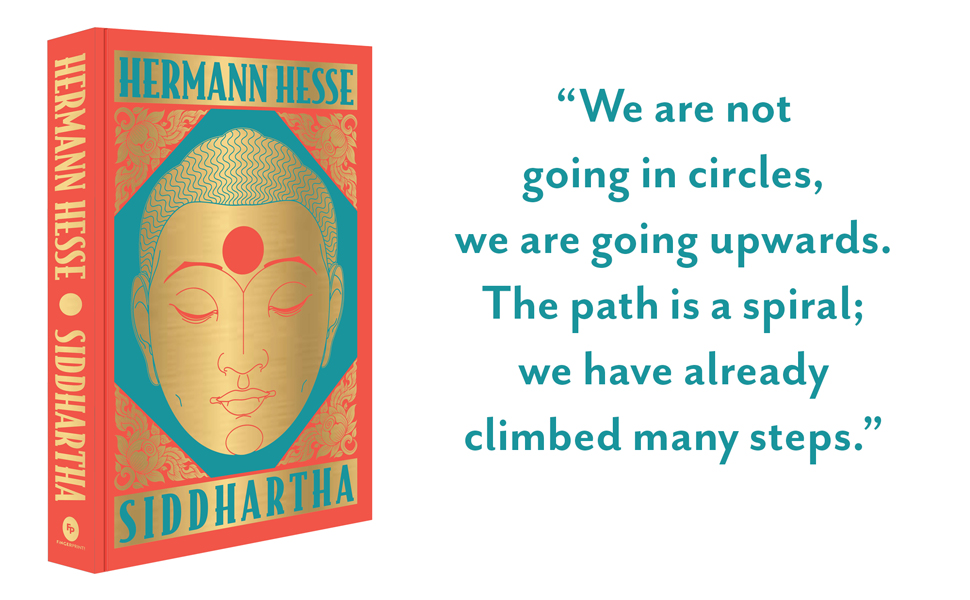
Siddhartha (Deluxe Hardbound Edition)
Product ID: 663063248
Desertcart purchases this item on your behalf and handles shipping, customs, and support to EGYPT.
Siddhartha by Hermann Hesse is a timeless work of philosophical fiction and spiritual literature that follows one man's search for enlightenment, inner peace, and self-understanding. Set in ancient India, the novel traces Siddhartha's decision to leave behind a life of comfort and convention in pursuit of deeper truth and a more authentic way of living. His journey leads him through asceticism, desire, worldly experience, meditation, and self-discovery , as he learns that wisdom cannot simply be taught or borrowed from others. Through moments of discipline, pleasure, loss, and reflection, Siddhartha gradually develops a deeper understanding of life, identity, and the nature of fulfillment. Written in lyrical and contemplative prose, Siddhartha explores Eastern philosophy, spiritual growth, self-realization, mindfulness, and the search for meaning . Hesse examines the balance between opposites—worldliness and renunciation, individuality and unity, striving and acceptance—creating a novel that invites readers to reflect on their own inner journey. Quietly powerful and deeply human, Siddhartha remains an enduring spiritual classic for readers drawn to philosophical novels, introspective fiction, meditation, personal growth, and timeless questions about purpose, peace, and enlightenment. Why should readers pick this book? A Timeless Spiritual Classic: Follow Siddhartha's profound journey toward self-knowledge, enlightenment, and inner peace. Philosophy Through Storytelling: Explore ideas of desire, discipline, detachment, mindfulness, identity, and spiritual awakening through an accessible literary narrative. For Reflective Readers: Ideal for readers interested in philosophical fiction, Eastern thought, spirituality, meditation, and personal transformation. Key Themes Self-Discovery & Enlightenment: Explore the search for truth through personal experience rather than borrowed wisdom. Desire, Detachment & Balance: Reflect on the tension between worldly experience, renunciation, discipline, and acceptance. Unity & Inner Peace: Discover how connection, awareness, and acceptance can lead toward a deeper understanding of life and the self. Review: Perfect for the Lost Westerner - My name is Firecat Hat. As a writer, I love to read great writer’s works. And this book is definitely one I enjoyed. ‘Siddhartha’ is a deeply eastern philosophical story written by a westerner with a keen perception, and almost uncanny awareness, of not only eastern thinking, but depth of life itself. Sometimes the insights he has really impress me. He is aware of abstract concepts of life that few people in our modern world ever talk about. ‘Siddhartha’ is a remarkably insightful book by a remarkably insightful writer. The lessons about life that this book has to offer are deep – lessons one would be very lucky to hear from some aged and helpful older person, good enough to share with us. The man is a guru. The tragedy of the story, I believe, centers around Govinda, around that character’s separation from Siddhartha. Whether the separation from him is actually necessary for the two of them to advance on their roads through life is, I think, a subject for interesting debate. But Hesse shows that they separate, and indeed that it is necessary for the blossoming of their characters. One can’t help but feel sorry for Govinda. And I noticed something in this book worth remarking. While Hesse is brilliant philosophically, he does not bleed the emotional parts of the story to their maximum effect. That is, he never gets the reader to ‘feel’ the story on an emotional level. (He never made me cry). But, I must say that this also makes us feel the story’s emotion even better. Sometimes by not emphasizing the emotional tones, the reader is made to feel them – underlying as they are – even stronger. Overall, this is a philosophy book almost unparalleled as such in the novel world. It shows us the journey of life, with masterful language that is very reader-friendly, cover to cover. It has the potential to be, in fact, life changing. And it stands with the classics, tall and deep. It stands like the Sequoia trees: tall for all to see, living on and on – timeless. And one last point worth remarking. The book’s main point is something profound, and that I agree with. Happiness can not be pointed out precisely to one by anyone else. ‘Each entered the forest adventurous at a point that he himself had chosen, where it was darkest, and there was no way or path.’ F I R E C A T H A T May 18, 2011 Review: A Delightful Story Indeed - A very delightful story that I highly recommend to anyone questioning their existence and or the direction that their path has taken them. It’s an easy read, especially for those that find it difficult to stay focused while reading.


| Best Sellers Rank | #36,577 in Books ( See Top 100 in Books ) #8 in Indian Literature #144 in Buddhism (Books) #170 in Classic Literature & Fiction |
| Customer Reviews | 4.6 out of 5 stars 18,238 Reviews |
F**T
Perfect for the Lost Westerner
My name is Firecat Hat. As a writer, I love to read great writer’s works. And this book is definitely one I enjoyed. ‘Siddhartha’ is a deeply eastern philosophical story written by a westerner with a keen perception, and almost uncanny awareness, of not only eastern thinking, but depth of life itself. Sometimes the insights he has really impress me. He is aware of abstract concepts of life that few people in our modern world ever talk about. ‘Siddhartha’ is a remarkably insightful book by a remarkably insightful writer. The lessons about life that this book has to offer are deep – lessons one would be very lucky to hear from some aged and helpful older person, good enough to share with us. The man is a guru. The tragedy of the story, I believe, centers around Govinda, around that character’s separation from Siddhartha. Whether the separation from him is actually necessary for the two of them to advance on their roads through life is, I think, a subject for interesting debate. But Hesse shows that they separate, and indeed that it is necessary for the blossoming of their characters. One can’t help but feel sorry for Govinda. And I noticed something in this book worth remarking. While Hesse is brilliant philosophically, he does not bleed the emotional parts of the story to their maximum effect. That is, he never gets the reader to ‘feel’ the story on an emotional level. (He never made me cry). But, I must say that this also makes us feel the story’s emotion even better. Sometimes by not emphasizing the emotional tones, the reader is made to feel them – underlying as they are – even stronger. Overall, this is a philosophy book almost unparalleled as such in the novel world. It shows us the journey of life, with masterful language that is very reader-friendly, cover to cover. It has the potential to be, in fact, life changing. And it stands with the classics, tall and deep. It stands like the Sequoia trees: tall for all to see, living on and on – timeless. And one last point worth remarking. The book’s main point is something profound, and that I agree with. Happiness can not be pointed out precisely to one by anyone else. ‘Each entered the forest adventurous at a point that he himself had chosen, where it was darkest, and there was no way or path.’ F I R E C A T H A T May 18, 2011
R**S
A Delightful Story Indeed
A very delightful story that I highly recommend to anyone questioning their existence and or the direction that their path has taken them. It’s an easy read, especially for those that find it difficult to stay focused while reading.
U**H
A beautifully written journey of self discovery
Poetically written with great colour and imagery with a central spiritual lesson embedded for us the reader to interpret individually. A tale that is relatable to us at any age as we strive and achieve and become disconnected only to be reminded of the oneness of life once again. This journey that we watch Siddhartha go on reminds us of what really matters and what life actually is. Recommended for adults and teenagers. (I'd say children but it's a little inappropriate at times!)
P**L
Perfect - except the Kindle edition is okay
Yes, the Kindle edition has some typos and translation issues, but these are the sorts of issues that are par for the course reading translated texts, you can certainly get the overall gist of the story. It's an acceptable edition. Siddhartha is beautifully written, and worth reading. It's essentially a collection of essays, each trying to explain and illustrate concepts of Buddhist thought. The first story stands alone, and is as close to perfectas literature gets. The short version of the story is that a young boy named Siddhartha is trying to learn to lead a more perfect life, and after many trials and tribulations he comes to meet a mystic by the name of Gautama. For anyone who doesn't know, Siddhartha Gautama is the full name of the Buddha. This story serves as a biography for how the young Siddhartha came to be the Buddha, while at the same time serving as a metaphor for how people of the time- or indeed you as the reader- can come to understand the Buddha and his teachings. From that description alone you should be able to see all the layers in this book, it's wonderful. The book does everything right. It's a good story on its own, but it's also written in the style of Buddhist literature. There is a lot of repetition, as were present in the Buddha's own words, without getting annoying. There is adventure, metaphor, allusion, and biography. It's food for thought. Anyone worried about this sounding overly religious or hokey need not worry- the stories here are just as powerful if you read them in a perfectly secular way where the Buddha was just a wise man and not any kind of deity. As someone who's advanced in Buddhist/Zen thought myself, the message of the opening chapter is absolutely perfect. This continues through the book. If you want a play-by-play for exactly what "Englightenment" is supposed to be, how to attain it and how to live with it, the first story is one of the best examples I've ever read. I'd almost go so far as to say that you can't read the first chapter without "getting it"- it's just too perfect of a description of what Enlightenment is- but human beings have an amazing ability to miss the point. So this book is great prose in and of itself, read as pure fiction it's lovely. As a biography of the Buddha and his travels, it's light on detail but rich in imagery. As a how-to manual for meditation and better living, it's similarly amazing. An all-around class act, I wish this text- in a better translation- would be mandatory reading for anyone who wants to consider themselves "learn-ed".
S**3
Incredibly Profound Book to read and reread!
I'm still in the process of reading this incredibly inspiring book. I've had books that I love and "can't put down" but this is not one of them. No, this is a book I MUST put down and THINK. I revisit the words & lessons Siddhartha learns along his path and they so easily apply to present day life, to my own life. On the surface I could describe the book merely as one man's journey to "enlightenment". But that seems so vague and undervaluing of what this book truly is. It is a reflection of self, of life and its ups and down, it's quirks. Each chapter, or even at times, each phrase has become a point of discussion between me and my husband. We are both introverted intuitives and love to pontificate on the depth of knowledge Hermann Hesse lends this Siddhartha character. So often we read and discuss psychology books or self-help books to really delve into the analysis of life and how to not just deal with but to accept suffering. This book stands alone in its unique understanding and concise verbiage of the path of wisdom that eludes so many of us. It is a true gem in the library of analytical knowledge and discovery of self. A book you could read annually and still never tire of the ever evolving messages and discoveries of self-actualization. The prose style does take some getting used to with lots of run on sentences and comma splices such such as this example: "Under black hair, which made to tower high on her head, he saw a very fair, very delicate, very smart face, a brightly red mouth, like a freshly cracked fig, eyebrows which were well tended and painted in a high arch, smart and watchful dark eyes, a clear, tall neck rising from a green and golden garment, resting fair hands, long and thin, with wide golden bracelets over the wrists." But overall an incredible read for anyone seeking higher thought. ____________Update____________ Upon finishing this book, I was so inspired and still wanting more, I looked up study guides and questions to help me delve deeper. Also learned that it has been made into a movie, twice. Looking forward to watching it & hoping it lives up to the ridiculous expectations I have now :)
R**K
We Are Born With the Buddha Mind
I really love this book so much. The only true way for me to review Siddhartha is to write about how this beautiful book leaves me feeling. Here's what I have gleaned. When we look deeply into something, we are no longer really looking, we are experiencing. It is the experiencing that is us, not us experiencing. We are simply bearers of light bearing the light of awareness. Looking through the veil, through the thin mist of mind, we gaze upon the unseen. In that moment of blissful gaze, there lies eternity. All appearances have their source in pure awareness. At the moment of our birth, we have no mind, no concept of self. Yet we are already complete, before thought or word. We are entirely without possession. Yet everything is in us. Being without the all, we contain the all, the whole universe in us. Just as the cup is the container for water, so life flows from us and is us. Life is, in all its entirety and splendor, occupying our emptiness, filling our cup, our holy grail, and evermore filling. When mind is formed through conditioning of other minds, everyone takes and everyone gives and such is life. It is a game, but the content on which we play this game does not enter our heart because we are already the openness upon which we pretend to be. Look right now, more deeply at the world...and there you will see everything but your face. There is space where your face is. We are looking out from a clear, boundless openness, and it is because of no-face that we pretend there is one, and we create a mask to wear, and we call this mask our being, being a person (and person of course, means persona, a mask). And so we are constantly seeking our true self wearing a mask, not knowing we are already what we are seeking! When we remove the mask, when we stop the game, we see clearly again. Light fills the void. We are the river of life. We see everything stays the same, yet constantly everything is changing and renewing. Everything is flowing...as an aspect of everything else; A tree, a bird, a stone, a cloud... all flowing...all life simply experiencing itself. Enlightenment is simply the art of being. The art of pure awareness. The art of love. There is no I. No face. Only openness, where everything and nothing are one. The cup and the water, though not together, they are one. And in this openness, we are open to all life. The boundless all. The clear state of being awake. The invisible source of being. Inside you and me, there is peace and refuge. The nameless. The faceless. The perfected. It is our home we never left. Robin Craig Clark peliguin.com
C**4
This wasn't my favorite book, but more importantly, be very careful which version to buy so you don't get a bad translation.
This is literature in the Mark Twain sense, a book I want to have read but don't want to read. First off, I want to mention that the translation I got was abysmal. When I first started reading I though it might be like the Spanish in For Whom the Bell Tolls, which is translated directly rather than idiomatically so you knew when they were speaking Spanish instead of English. Like "How are you called?" instead of "What's your name?" But as I read on it was obviously not that. This wasn't someone writing in German but trying to convey the feel of Maghadi Prakrit, or whatever language would have been spoken where the story took place. No, it was someone who has a horrible grasp of English translating the original text. Badly translating, and not being edited AT ALL. Seriously, there were even points where the translator's notes to the editor were left in, in German, with some words he cannot decide on the correct translation for. The left them in, in a different font and bracketed to make them obvious. The grammar was not just bad, but inconsistently so. The same sentence would be repeated in the same context and the verb tense would change. Commas would, randomly, be, placed so that they made no, sense. And the word choice was so bad that no subtlety of meaning was conveyed anywhere. In case Amazon smooshes this review in with reviews for all versions, mine was the paperback with the green cover and gold "Siddhartha" on top and Herman Hesse in green on a gold stripe along the bottom. If you insist on reading this book don't buy this version. As for the book itself, ignoring the fact that it was translated by someone for whom English was probably not their primary language, I thought it was awful. I always heard stories about how it changed people's lives, changed their view of the world, and the like, so I guess I had too grand of an expectation. I'm giving it three stars because, for some reason, lots of people seem to like it so I'm obviously out of the mainstream. But I threw my copy in the recycle bin rather than give it to a friend, I thought it was such a stupid story. The story is very linear. It is stilted, contrived storytelling at best. Without throwing in spoilers, you have to suspend belief to understand that characters and events all happen (even decades apart) at the exact time and exact place with the exact people you know. There would be absolutely no reason for many of these coincidences, and they're obviously just a plot device. The philosophy is similarly contrived. It's the story of the son of a priest who wanders around what I assume is Maghada (because that's where Buddha "attained enlightenment") trying on different lives until he finds his own enlightenment. He's an amazingly crappy, selfish, small minded, self centered, awful human being. He has no control over himself, even though he was supposed to have been an ascetic. He has no regard for anyone else, either. The story assumes that you have to be lustful if you engage in commerce, that you have to be evil if you are part of the material world, and that the only path to true spiritual enlightenment takes a lifetime void of any practical applications. Even after setting up all these straw men, it is still not compelling in how it tries to knock them down. I'm sorry to say it, but you can't have a billion beggars and expect everyone to get fed. The people looked down upon, called children (though confusingly so as it's bad in one context but childlike in the context of the Buddha is a good thing -- I think that was the horrible translation) and worse pejoratives, are the only reason those shaven headed beggars had rice in their bowls and an ex whore's pleasure garden to sleep in. Those "children" are viewed as lesser animals because the hero of the story couldn't love himself, couldn't stop gambling, abandoned his pregnant whore girlfriend and future son, and decided to sit beside a river and row a boat for a couple of freaking decades to think. Somehow this special dude, this guy who listened to the water for 20 years before he finally thought of something came to the same conclusion that every damned stoner burnout in the parking lot of a Dead show worked out the first time the dropped a tab and listened to American Beauty at the age of 19. God is everywhere, Everything is connected, blah blah... I suppose if you're 15, or you really haven't read anything too deep, and you don't know anyone from anywhere other than your tiny town, this is mind bending. If you read Jonathon Swift and though he just wrote a book about a dude who got to see giants and tiny people, Siddhartha is just about your speed. If you honestly think he wanted the Irish to eat their babies, then Siddhartha will totally wrinkle your brain. If you understand allegory, farce, or metaphor, skip this one and move on to something written for adults.
J**R
Great classic tale of life and the pursuit of enlightenment
Hermann Hesse’s Siddhartha is an absolutely amazing and engrossing tale of one man’s journey to find that all-elusive idea of enlightenment. The book’s title may suggest that it is simply a story that would have value only for people of the Buddhist persuasion, but this simply is not true. The work is well written and thought out, and it does a terrific job of showing us as human beings that often times what we are looking for is with us all along. Hesse’s book follows a young man named Siddhartha on his journey to find the true meaning of life and peace. The young man leaves his family of Brahman priests believing that they have spiritually achieved all that they ever will, and embarks with his friend Govinda down the path of a contemplative and restrictive existence. The young man soon realizes that these religious men (Samanas) also are lacking, to Siddhartha, what the path to true enlightenment really is. He continues on his journey coming by entering the company of the real Buddha—Gatama, but soon comes into contradictions with the Buddha’s teaching of removing oneself from the world. This leaves the man frustrated and lost, and eschews him down another path that is quite opposite of the one he originally intended to take. Siddhartha has now become rather restless with his pursuit of happiness, so he soon discards it for one of sexuality, greed and total reliance on the flesh. He falls in love with Kamala—a beautiful courtesan woman—and embraces the life of a merchant that furthers his greed and lustful desires. Siddhartha and Kamala conceive a son soon after their affair, but after a dream leaves Siddhartha puzzled, he becomes bored and sickened by his lust and greed, and decides to move on to find his enlightened path. With total despair encompassing his heart and soul, Siddhartha comes to a river where he soon hears a unique sound that will change his life forever. This sound signals the true beginning of his new and fulfilled life--the beginning of earthly suffering, human rejection and inner peace, and, finally, ultimate wisdom and enlightenment. The book is a harrowing tale of man’s lust for greed, power, sex and material gain; however, its ultimate purpose is to show that often times what we are looking for is in the simplest places imaginable. Hesse’s work craftily explains (through Buddhist and Hindu philosophies) that life is an all-encompassing journey that will eventually show all mankind what it is looking for. We suffer and struggle mightily through banal everyday tasks, but perhaps this daily grind of being in a symbiotic relationship with other life is what inner peace really is.
Y**E
Cheap printing
I haven't read the novel itself yet, but the quality of the edition is poor. It looks and feels like a photo-stat copy of an original Bantam, not an authentic printing. Cover image and text just slightly out of focus and low resolution, cheap plastic covering peeling, and interior pages and printing is cheap. But it is cheap... it just depends what you are looking for
R**A
Must read
The book is perfect for people interested in philosophy. Also anyone on a road of self-discovery and looking of answers to the questions of life and love and inner peace should read. The narrative is slowly paced and very colorful.
S**H
A tale of universal truths
I read this book and saw the movie many years ago as a teenager. It had a profound impact on me then. Now, as I enter my golden years, I picked it up again to see whether it had the same pull as before. The pull was greater this time. Hesse, perhaps out of respect, and wanting to create fictional protagonists out of religious leaders, creates the fictional character of Siddhartha, one who has the same name as the Buddha. He lives during the time of the Buddha. Siddhartha’s life follows a similar path of the Buddha: born into privilege, rejecting comfort and taking up the ascetic life at a young age, discovering its limitations and taking the middle path to enlightenment, and ending his days as a great teacher and spiritual leader. In fact, the fictional Siddhartha meets the older Buddha and tells him that living by others’ teachings, something he had done as a Brahman and later as a Samana, is insubstantial; Siddhartha wants to experience enlightenment, just as the Buddha has done. The Buddha smiles, as if to say, “The road ahead is long and tortuous.” Siddhartha, therefore, leaves the life of an ascetic Samana where his only skills are of waiting, fasting and thinking, to lead the sensual life. He takes up with the courtesan Kamala, becomes a successful businessman, and accumulates wealth. He gives into lust, and gambling, but finds both to be masks that hide his continued dissatisfaction. “I was afraid of myself, I was fleeing from myself! I searched Atman (soul), I searched Brahman, I was willing to dissect my self and peel off all its layers, to find the core of all peels in its unknown interior, the Atman, life, the divine part, the ultimate part. But I have lost myself in the process.” He finally leaves the worldly life too, heading for the river, a place where enlightenment will finally come, but only after learning the pain of love. The river is a metaphor for the circular nature of life and the confluence of all desires and sufferings: flowing, evaporating, condensing and flowing once more. Everything and everyone that goes upstream, finally returns downstream, and the water flows everywhere simultaneously, making the past and the future irrelevant, making only the present matter. There are some beautiful words of wisdom in this book, although Siddhartha claims that wisdom is intrinsic to the individual and cannot be transferred, as he had once complained to the Buddha. 1) Everyone can perform magic; everyone can reach his goals, if he is able to think, to wait, and to fast. 2) Writing is good, thinking is better. Intelligence is good, but patience is better. 3) “There was nothing that the wise one or thinker possessed that put him above the rest of them except for one single, small, tiny thing: the awareness and conscious thought of the unity of all life.” 4) “I therefore see whatever exists as good. Death is like life to me, sin is like holiness, wisdom is like foolishness; everything has to be just as it is, and everything requires only my consent, willingness, and loving agreement to become good to me and work for my benefit, unable to ever harm me.” 5) “When someone is searching, then it can easily happen that the only thing his eyes see is that for which he is searching. He is then unable to find anything or let any thought enter his mind because he always thinks of nothing but the object of his search. He is obsessed by a goal; searching means having a goal. But finding means: being free, open, and having no goal.” The story is told in the form of a parable, full of wisdom and philosophy, low on the other elements of novelistic importance. Hesse was supposed to have had a less than fulfilling visit to India before he wrote this novel. But I suppose the insights in this book did not only come from that visit but from a continuous preoccupation on the purpose of life and the search for meaning. I highly recommend this read.
R**E
Poetisches Meisterwerk
Absolut geniales und sehr poetisches Buch über den Gründer des Buddhismus Siddharta Gautama
T**N
Un libro da portarsi dietro da leggere e rileggere.
Spedizione: è stata perfetta. Nonostante l’edizione e’ in copertina flessibile da pochi soldi, il libro è arrivato nel giro di due giorni e in condizioni perfette. L’edizione è di formato piccolo, in modo da poterlo portare con se in viaggio. Il libro: chi sceglie questo libro è o un fan di Hesse o sta percorrendo una ricerca spirituale. E in entrambi i casi è un libro che vale la lettura. Anzi, più letture. Credo che la maggior parte dei lettori non riescano a cogliere le sfumature più profonde del pensiero orientale (ciò che Hesse è riuscito a fare in modo incredibile).
Trustpilot
1 month ago
2 weeks ago