We remain fully operational. Our teams are working around the clock to ensure your deliveries continue safely.

DOWNLOAD THE APP


Customer Services
Copyright © 2025 Desertcart Holdings Limited
DOWNLOAD THE APP


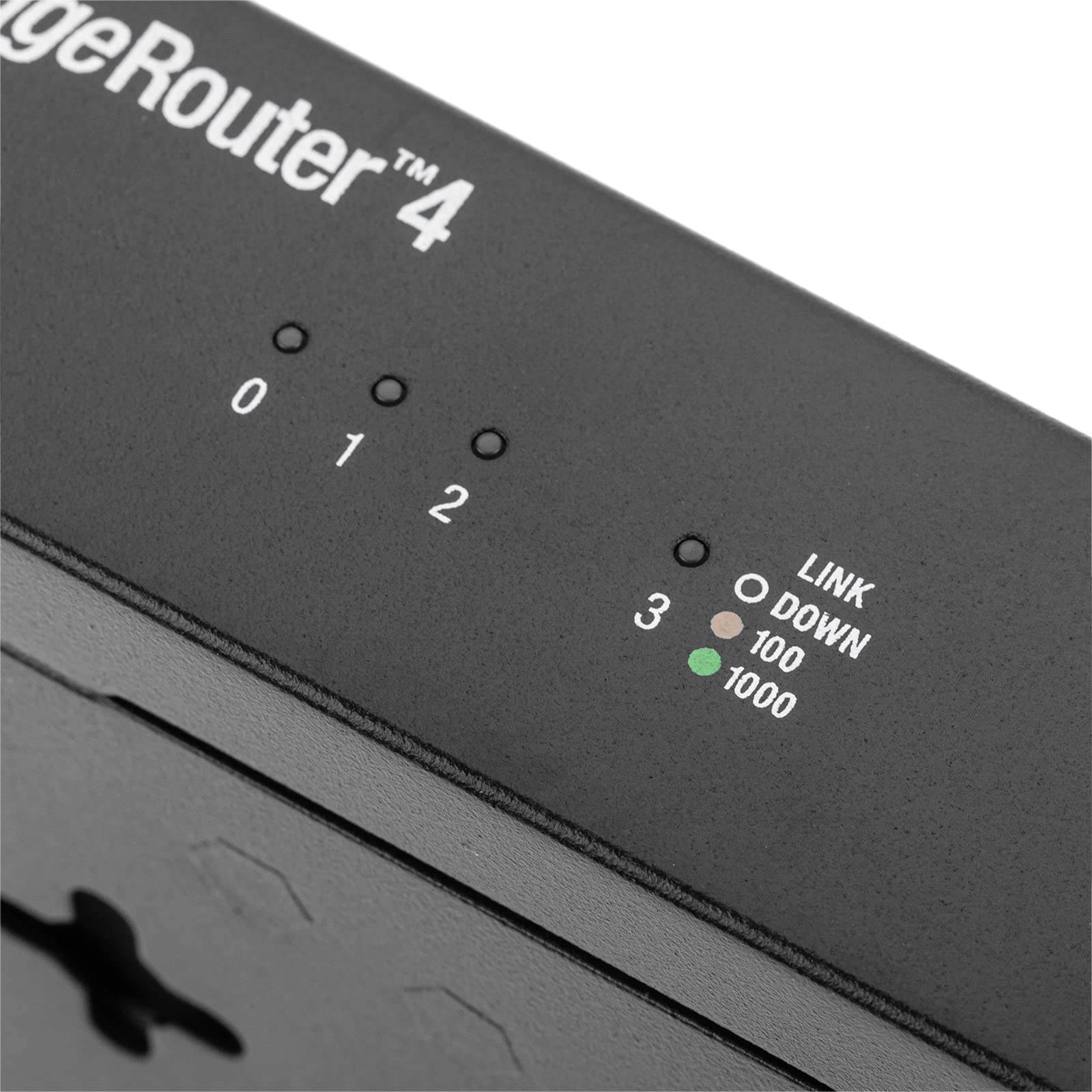


🚀 EdgeRouter 4: Power your network like a pro, no compromises.
The Ubiquiti EdgeRouter 4 is a high-performance, professional-grade router featuring 3 Gigabit RJ45 ports and 1 SFP fiber uplink port. It delivers up to 4 Gbps throughput and processes 3.4 million packets per second, making it ideal for demanding home or medium business networks. With advanced CLI and UNMS management, plus robust security protocols and VPN capabilities, it offers unparalleled control and reliability for tech-savvy users who want enterprise features without enterprise complexity.


| ASIN | B078PGCGN2 |
| Are Batteries Included | No |
| Best Sellers Rank | 258,047 in Computers & Accessories ( See Top 100 in Computers & Accessories ) 1,884 in Routers |
| Brand | Ubiquiti |
| Colour | Black |
| Computer Memory Type | DRAM |
| Customer Reviews | 4.6 4.6 out of 5 stars (906) |
| Date First Available | 25 Jan. 2018 |
| Form Factor | 1U |
| Guaranteed software updates until | unknown |
| Item Weight | 795 g |
| Item model number | ER-4 |
| Manufacturer | Ubiquiti Networks |
| Number of Ethernet Ports | 3 |
| Number of Serial Ports | 1 |
| Operating System | Windows |
| Power Source | Mécanique |
| Processor Count | 4 |
| Processor Speed | 1000 MHz |
| Product Dimensions | 22.9 x 13.65 x 3.11 cm; 795 g |
| RAM Size | 1024 MB |
| Series | EdgeRouter 4 |
| Voltage | 240 Volts |
| Wattage | 13 watts |
| Wireless Type | IrDA |
C**.
tl;dr full control router, no recommended for click-next users (if this is you, go to the UniFi line instead). Great value for a nice almost corporative grade router with enough power to truly handle 1 Gb bandwidth thru WAN-NAT-LAN while providing DHCP and DNS services. The Ubiquiti EdgeOS is based on the outdated Vyatta 6.3 router OS, but Ubiquiti has updated and regularly post security patches. This means this router could be configured and customized by using the unix CLI. Of course it has a web GUI, but the real power is on the CLI. If you feel comfortable on unix, you can even install extra packages and services. Now on COVID time with high VPN requirement demands, I have been able to deploy this router on a medium size business (60+ clients). The build-in VPN server can be authenticate using the intranet Windows Domain Server (Active Directory, NPS (RADIUS) , DNS, Certificate Authority). The workstations use the build-in Windows VPN client. Ubiquiti documentation is lacking on how to use the advance features. These can be better documented on the Vyatta documentation. Also YouTube has plenty amazing tutorial videos for beginners and how to start with the advanced features. Once you learn how to use this router you will be glad that you choose this over the easy click-next, but limited UniFi line.
T**K
The Ubiquiti EdgeRouter4 (ER4) falls somewhere in between a consumer grade SOHO router (NetGear, Linksys, etc.) and enterprise class (Cisco, Juniper). It supplies many of the features of enterprise grade hardware, such as a robust CLI, and is packaged in a durable, fanless metal box that is easily wall mounted. The SFP port is a nice plus when you need it. I purchased this product for two reasons: to better segment my home network and because it can handle Cox Gigablast's 1Gb downstream connectivity. I no longer have the time to build and maintain my own Linux or *BSD based router and this is the next best thing. The TL;DR version of below is: if you need 1 Gb symmetric (TX & RX) performance, the ER4 has you covered. If your upstream connectivity is limited to hundreds of Mb or less, you should consider the Unifi Security Gateway (USG) instead. The pros: great web GUI that doesn't hide technical complexity from the user; it does not force coddle you or obfuscate capability behind a boring interface. While wizards are available to walk you through common setup scenarios, they are optional, and you have the ability to make changes after the fact. Pretty, interactive, and live graphs on the dashboard and DPI for client IPs are nicely, albeit mostly cosmetic, features. Performance is great and you can setup almost everything from VLANs to firewalls to various services (VPN, DHCP) in the GUI. If you are a native Linux user and are already familiar with how most networking concepts (including iptables firewalls) are implemented, you will find setup intuitive and clean. If you are coming from other enterprise grade hardware companies, such as Cisco, you're going to have a slight learning curve while you translate concepts and technology implementations. The device also integrates with Ubiquiti's network management system, UNMS, a godsend if you are trying to manage multiple networks/sites/etc., less useful if you're just a home user. The cons: Apparently, Ubiquiti for some reason maintains two separate management systems, UNMS and Unifi, both with overlapping features, but nearly independent ecosystems. You cannot manage Edge devices in Unifi and vice versa. it escapes me why this makes sense, rather than have a "step up" market strategy where you hook small businesses into your equipment and offer them an upgrade path as they grow. Apparently, the benefit of the Edge series is you don't require it to be centrally managed (UNMS), while the Unifi hardware requires a unifi controller to do so. I can see the value in some situations of stand alone management interfaces, but why the central management system can't manage both types of devices makes no sense to me. So why the ER4? I couldn't find good documentation on performance for the various Edge class (UNMS) and USG (Unifi) hardware, although I heard many reports that the USG could not switch gigabit Ethernet at full duplex (meaning symmetric) on its WAN interface, while the ER4 could. This was a show stopper for me. The ER4 is fully capable of switching 1 Gb of symmetric traffic.
V**N
Excelente equipo y práctico de configurar
M**M
This is a 'newer' generation edgerouter, which better throughput / processing capacity (ie, if you turn on full packet inspection features, you can still get good throughput performance). Overall it has the same excellent build quality of other edgerouter gear. Has of course the same core ER platform / so is familiar if you are used to that. Clearly the ER platform is not a 'novice friendly' setup. But it is simple enough to setup if you just use the 'built in wizard' config tool and actually follow the directions for doing a basic setup. After that it does require some self-education if you want to turn on and configure more features. But to some extent this just comes from - the reality that properly using more advanced features implies you actually know what they are and understand how they work at least a tiny bit, which is - inherently more technical. Anyhow. Edgerouter gear is great, amazing feature set for price point, and this is another fine example of the ER product line. This is a nice step up from ER_X in terms of capacity but a fairly modest price increase, so that is just great IMHO.
M**Z
It is a mini server, not just a router WARNING! This review has been written over several weeks, it will be long and comprehensive as it might be. By no mean, I'm to be called a networking expert, although i know something or two around Linux and software development. My review is based on one year of extensive usage and i have not used all the features available in the router, so your experience might be different. 1- Target audience of this router ____________________________________ Ubiquity may say that this is a professional level routers line, after one year of owning and running this router, I can confirm that this router can be installed and configured by any person who ever dealt with any router before. The user web interface is as simple as it gets, add that to a wizard based configurations, it makes it even easier to fire and forget. 2- Why a wired router and not the all-in-one router? __________________________________________________________ basically, every wireless/all-in-one routers consist of: - router - switch - access point (usually bridged with the switch) and in regard to software, at minimum: - NAT (for routing traffic) - DHCP (for automatically assigning IP addresses to devices) - DNS (for translating domain names into IP addresses) - VLAN (packet tagging) - access point software (to configure your SSID, encryption, passphrase, etc.) Now, we must understand that one device to do all that perfectly is nearly impossible. Not to mention updating hardware is impossible, for example, to support WIFI6. Separating these roles and responsibilities will ensure upgrade-ability and stability exactly like HI-FI equipments, separates is always the best way to go. 3- a brief on my internet connection(s) ________________________________________ I have two internet connection: - VDSL maxing @ 30Mbps up and 5Mbps down - 4G maxing @ 50Mbps up and 20Mbps down my VDSL connection is not stable at all (that is the reason I have a 4G connection). Knowing little about networking, I had an all-on-one router that I would physically go and change its WAN connection to either VDSL or 4G :) that started my search for dual LAN router and thus, I knew about Ubiquity, in particular, the EdgeRouter X. For my situation, the EdgeRouter X was enough for where i wanted to load balance two internet connection, yet, has a decent switching chip that is capable of Gigabit routing when hardware offloading is activated and it runs the same firmware as its big brothers. The only thing EdgeRouter X falls short is hardware capacity it is nearly impossible to run additional programs/software due to this limitation, if all you want is routing, load-balancing, and simple switch, you are good to go with EdgeRouter X. 4- Why the EdgeRouter 4(or 6P): ________________________________ in comparison to ERX, ER4 specifications clearly says that it is not just a router but a full single board computer. With 1 GHz 4 core CPU, 1 Gbyte Ram, and 4Gbyte of storage, the ER4 is able to crunch billions of packets with ease. Unlike ERX, the ER4 (or ER6P) doesn't have a switching chip, although you can still bridge ethernet ports, but it will be done by the CPU not a dedicated chip, so it should be avoided. Worth mentioning that the ER4 has an SFP port as well and doesn't have/provide any Power-Over-Ethernet capabilities. So, the ER4 is a dedicated router only machine that its functionalities can be extended due to very good hardware specifications. Coupled with ES8-150W POE switch, both can give a very robust and pleasant experience. Stability of the hardware and software is phenomenal, i don't remember ever restarting the router, only restarts due to software updates or power outages. 5- Initial setup and software installation ___________________________________________ using the wizards, you should be able to get going, i used load-balancing wizard which was really easy to get the router going and all i can say is WOW! i don't have to physically switch the WAN link. but this is just scratching the surface, the software is good enough for day to day activities, backups, restore, monitor devices usages using DPI (Deep Packet Inspection, which is not and will not be %100 accurate). because the software is based on older version of Debian Linux, the sky is the limit, you can install software from Debian repo, or, like i did, install python pip and then install python packages to fit your need. also, i externalized the DHCP and DNS services off the router to a server running on the LAN to offload the router and let it only focus on the one thing it should be focusing on, routing and load balancing. the grayscale interface reflects the seriousness this line of routers represents, however, it can control 20% of the router configurations, the other 80% can be configured using the command line interface (logging in via SSH or Telnet). 6- Network Automation ______________________ being obsessed with IOT and Automation, i always wanted to control the router remotely, for example, to allow or deny devices using a mobile app. as said in point 5, i installed pip on the router, then installed python flask package which allowed my to create my own python HTTP server to control the router behavior using MQTT and Node-Red. also, i was able to receive mobile notifications once the VDSL or the 4G line goes down or up, also collecting usage statistics to graph it on Grafana. by the end of the day i would know how much internet was consumed (per ISP) and which devices consumed the most. the statistics are stored in a database for later usage. 7- Things that i love ______________________ - excellent hardware specification - reasonably priced - great routing capabilities - advanced load balancing and monitoring options - function extensibility via Debian software repo - robust and stable no matter how many users 8- Things that i would like to be improved ___________________________________________ - Dedicated screen for monitoring the Load balancing feature (for now it can be only tracked via CLI) - although it lacks dedicated switching chip, it would be nice to have port mirroring feature which can ease usage monitoring, currently i have a Netgear 5 port smart switch dedicated only for WAN to LAN port mirroring. - more frequent updates 9- Conclusion ______________ no matter you are experienced network engineer or a (wo)man that just wants things to work, you can't go wrong with ER4. Highly recommended!
Trustpilot
3 days ago
2 weeks ago