⚡ Control with Confidence: Power, Precision, and Protection in One Module
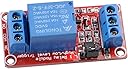
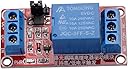
The 4 pcs DC 5V 1 Channel Relay Module Board Shield by CHENBO offers reliable high/low level triggering with genuine quality relays capable of switching up to 10A at AC 250V or DC 30V. Featuring SMD optocoupler isolation for stable performance and fault tolerance, it includes user-friendly screw terminals and LED indicators, making it ideal for Arduino projects and professional automation setups.
| ASIN | B079FJSYGY |
| Best Sellers Rank | #347,035 in Industrial & Scientific ( See Top 100 in Industrial & Scientific ) #714 in Electromechanical Relays |
| Brand | CHENBO |
| Brand Name | CHENBO |
| Coil Voltage | 5 volts_of_direct_current |
| Connector Type | Screw |
| Contact Current Rating | 10 A |
| Contact Material | Tungsten |
| Contact Type | Normally Open |
| Current Rating | 10 A |
| Customer Reviews | 4.6 out of 5 stars 259 Reviews |
| Manufacturer | CHENBO |
| Maximum Switching Current | 10 A |
| Maximum Switching Voltage | 250 volts |
| Minimum Switching Voltage | 5 volts_of_direct_current |
| Model | WJ-00010 |
| Mounting Type | hole mount |
| Operation Mode | Automatic |
| Part Number | WJ-00010 |
| Unit Count | 4 Count |
| Wattage | 25 Milliwatts |
A**K
works good but each channel is separate
need to add a jumper wire if you want to have both channels controlled by 1 input, but they work well and a bargain for the price - terminals are hard if you don't know to place wire to one side as the screw is in the middle.
C**Y
Low cost low voltage relay.
I installed two of these on my tractor for controlling a larger high current solenoid switch. I had to add a DC-Buck voltage regulator upstream of it, due to burning out the first one, since somewhat wild 12-14.5V was just too much for it (it worked fine for about a day, then died.) The second one has been performing flawlessly for a couple months now. 😀
A**G
Works with Raspberry Pi
I'm using this with two Raspberry Pi boards (one a 3B+, the other a 2B) connecting both the 5V to power the solenoid board and using the PI 3.3V GPIO to turn on/off. One of the 4 units was defective out of the box but the others are working. For the money, they are a good choice. Note that there is a severe limit on the current available for GPIO switching from the Pi, so the single-channel model would be the only viable choice. I am able to use this to power a 3D printer on/off by switching the AC power using the OctoPrint PSU control add-in, which simply raises a configurable GPIO pin.
M**L
Great value and simple to use with a little research
These are actually quite simple to use after a little digging. The datasheet is terrible but the manufacturer has placed these relays on a breakout board that allows you to use a HIGH or LOW signal to activate the relay. I'm using mine for a class project involving a temperature controller that turns on a fan or heating element depending on the temp. They are rated for up to 250V AC and use an infrared optocoupler to separate the digital control circuit (low voltage) from the analog output (higher voltage). Very happy with my purchase as many Amazon electronic components are very inconsistent in quality and reliability coming when they come from foreign manufacturers. Would recommend.
M**.
Can work with as low as 5V.
My use is to power up a USB power supply using a USB port on computer as trigger. I have some lighting that I want to always come on when the computer is powered on or comes out of standby. The PCI-E USB card I'm using powers down in standby so I'm running a cable from that to trigger this relay which will close the AC circuit on a USB power supply. I could've potentially powered them from the USB card on the computer but I'd rather subcontract this power demand to a lesser device. Using my inline USB voltage and current meter, (so-so quality, readings always seem appropriate and correlate with the load put on it but I haven't checked it against a VOM), standby current was too low to read and with relay engaged it showed 80mA. Resolution on this USB meter is only 2 decimal places so something under 10mA for unclamped state. I could've just used a 5V relay for this task but I haven't seen any with 1/4" spade terminals and it's convenient having a board to solder the 120V wires to. For the price I went ahead and got a 5 pack for future projects. I was able to use only USB power by connecting red(+ from USB cable) to DC+ and IN terminals, and black (- from USB cable) to DC- terminal. This initial use is just for "bling" but I can imagine many applications where having switch control conditional to a computer being on or off would be handy.
M**N
nice little relays, great price
I use these on the outputs of Raspberry Pi for automation tasks. I like that they have LEDs to show power supplied, and also if the relay is picked. They're compact, come with screw down terminal blocks for both input and output, and have mounting holes. Can't think of a way to improve them.
F**Y
Simple and effective
I’m using this as a relay for a power supply to a Raspberry Pi used as a media center. The tv usb doesn’t supply enough power for the device, but now it turns on and off with the tv but powered through an external 5V supply capable of the required current. Ideal. I only wish it had usb interfaces instead of bare wires...
M**A
Work like they should.
Using these with the Octorelay plugin for Ocroprint to turn my printer and lights on and off. Working great!
J**N
Ils ne consomment très peux de courant.
Ils font partie d'un système de domotique
Trustpilot
1 month ago
2 days ago